WORLD

Shakuru
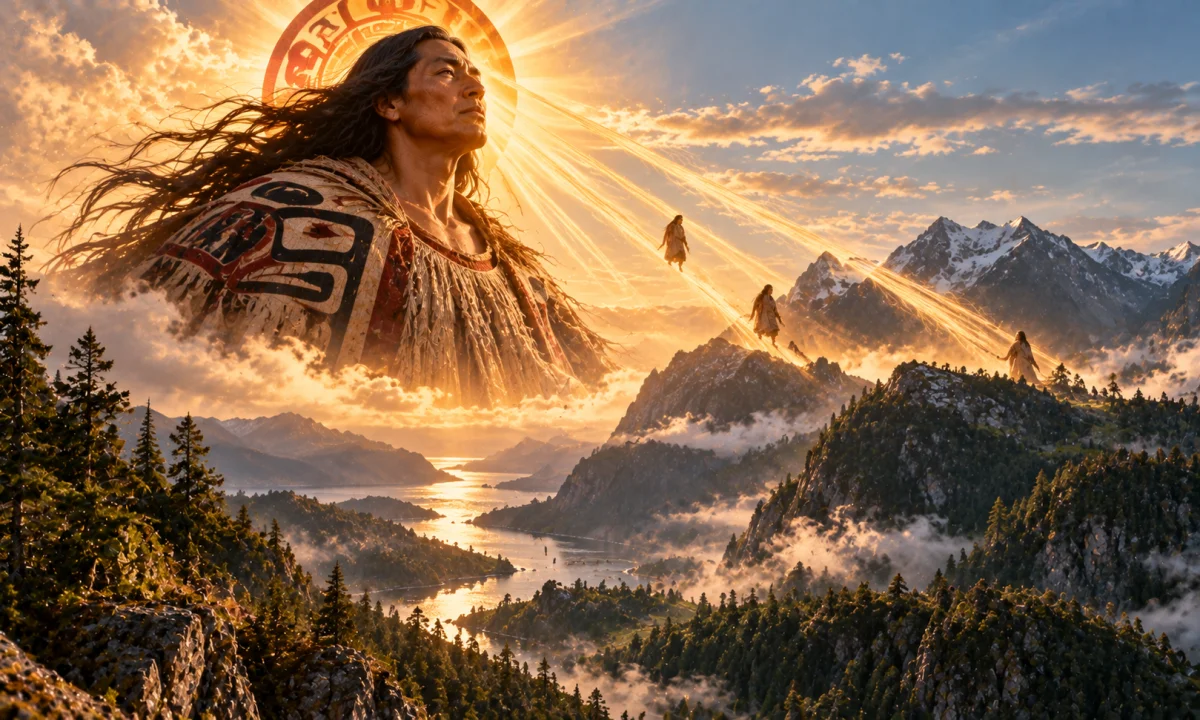
Shakuru is a name associated in some English-language accounts with the Sun in the religious traditions of the Pawnee, an Indigenous people of the central Great Plains of North America. The identification is not completely uniform: spellings, translations and descriptions vary between sources, and “Shakuru” should not automatically be treated as a universally recognized Pawnee god with one fixed mythology. In the traditions where the name is used, Shakuru belongs to a wider sacred order of celestial powers that includes the Sun, Moon, stars, the Earth and Tirawa, the supreme creative power.
Cultural setting
The Pawnee traditionally lived along the Platte, Republican and other rivers of the Great Plains, in what is now Nebraska and parts of Kansas. Their society consisted of several related bands, including the Skidi, South Band, Chaui and Kitkahahki. Religious knowledge was preserved through ritual, priestly instruction, sacred bundles, songs and narratives rather than through a single written scripture.
Pawnee religious life connected the movements of heavenly bodies with the creation and continuing order of the world. The sky was not merely a distant realm. It was a place of living powers whose relationships were reflected in seasonal changes, agricultural activity, social ceremonies and the proper conduct of human beings. Celestial observation therefore had religious as well as practical importance.
English descriptions of Pawnee religion were recorded by outsiders, especially during the nineteenth and early twentieth centuries. These records are valuable, but they do not always preserve Indigenous terms consistently. An interpreter might translate a divine name as “Sun,” while another might retain a Pawnee word; a name could also be written according to different systems of pronunciation. For that reason, the exact status of Shakuru in every account cannot be assumed.
Name and identity
Shakuru is generally presented as a Pawnee name for, or a personal designation of, the Sun. Some summaries call Shakuru a sun god, while others treat the figure more simply as the sacred Sun itself. The difference matters. Many Indigenous traditions do not divide the world into the same categories as modern English discussions of “gods,” “spirits” and “natural objects.” A heavenly body may be a visible being, a powerful person, a divine presence and a source of life at the same time.
The name is sometimes written with alternative spellings in general mythology collections. Such variations may result from differences in transcription, dialect, historical orthography or the use of English approximations. The available descriptions also differ in how closely they connect Shakuru with other Pawnee cosmic figures. It is safest to describe Shakuru as a Sun-associated power in Pawnee tradition, while recognizing that the figure’s precise genealogy and narrative role are not identical in every source.
Shakuru should not be treated as a generic “Native American sun god.” Native American religions are highly diverse, and the presence of a solar being in one tradition does not establish a common figure across North America. Names from unrelated languages and cultures are sometimes grouped together in popular mythology books, even when the original communities did not regard them as connected.
Place within Pawnee cosmology
Pawnee cosmology describes a universe ordered through relationships among powerful beings. At the highest level is Tirawa, often translated as the supreme power, the father of creation or the power above. The English word “god” is frequently used for convenience, but it can conceal the breadth of Tirawa’s significance. Tirawa is associated with creation, life, law and the ordering of the cosmos rather than with a narrow human-like role.
Other sacred powers express particular aspects of the cosmic order. The Sun and Moon occupy prominent places among these powers, as do the Morning Star, Evening Star and other heavenly bodies. The Earth is also a central sacred presence. In many accounts, these beings are related through marriages, births or acts of creation, but the details depend on the particular narrative and Pawnee community from which the account was obtained.
Shakuru’s importance consequently lies not only in daylight. The Sun represents a continuing source of warmth, growth and visibility. Its regular rising and setting help establish time and direction, while its heat sustains the natural world. A solar power can therefore be understood as part of the larger system through which life is renewed and the world remains in balance.
Attributes and religious significance
Descriptions of Shakuru do not provide a single standardized physical portrait. The figure is usually understood through the Sun’s observable actions rather than through a detailed human-like appearance. In an interpretive sense, Shakuru may be associated with radiance, heat, movement across the sky and the return of light after darkness. These are not necessarily separate magical powers listed in a traditional catalogue; they are ways of explaining the sacred significance of the Sun.
The Sun’s daily course creates a dependable rhythm. Its light makes the world visible, while its warmth supports plants, animals and people. For agricultural communities, the solar cycle is inseparable from the timing of planting, growth and harvest. The Sun is therefore connected with fertility and continuity, although it would be misleading to reduce Shakuru to a simple fertility deity in the style of some classical European categories.
Solar symbolism can also involve knowledge and order. Light reveals what is present, distinguishes day from night and marks the passage of time. In a religious worldview where correct ritual action helps preserve harmony, the regularity of the Sun’s movement may represent the reliability of the cosmic order established by higher powers.
These interpretations should be kept distinct from claims about a formal Pawnee doctrine. Some are careful scholarly readings of the Sun’s place in cosmology, while others come from broad comparative mythology. The surviving descriptions do not justify assigning every common solar symbol—such as a radiant crown, a chariot or a weapon—to Shakuru. Those images belong to other mythological traditions or to modern artistic invention unless a specific Pawnee tradition establishes them.
Shakuru and other celestial beings
The Pawnee sky world includes several important celestial figures, and their names are sometimes confused in secondary writing. The Morning Star and Evening Star are especially prominent in Skidi Pawnee religious tradition. Their relationship is associated with creation and with the ordering of the world. The Morning Star has often been described as a male power, while the Evening Star is commonly presented as female, although English descriptions can simplify complex Indigenous concepts.
The Sun and Moon also appear in accounts of Pawnee cosmology. They should not be casually substituted for the Morning Star and Evening Star. A source that names Shakuru as the Sun is referring to a different celestial figure from the Morning Star, even when all are discussed within the same creation system.
Some retellings give the Sun and Moon family relationships with other heavenly powers. Such relationships are not consistent across all accounts, and the English versions may reflect the terminology or interpretation of the recorder. A relationship mentioned in one narrative should not automatically be presented as a universal Pawnee belief.
Connection with Pawnee ceremonies
Pawnee ceremonies were tied to the maintenance of relations between human communities, the land and the powers of the universe. Priests preserved sacred bundles containing objects, materials and ritual knowledge connected with particular powers. Ceremonial practice could include songs, offerings, prayers, dances and highly regulated procedures.
The Skidi Pawnee were especially known in historical records for a ceremony connected with the Morning Star. This rite was described by nineteenth-century observers and involved the sacrifice of a captive girl. The practice was ended in the nineteenth century, and it must be discussed as a historical religious practice, not as a living custom of contemporary Pawnee people. The ceremony concerned the Morning Star and the cosmic order associated with that power; it should not be casually relabeled a ritual of Shakuru merely because both figures belong to the sky.
Other Pawnee ceremonies, including the Hako, involved prayers and ritual actions concerning life, kinship, fertility, peace and well-being. English sources do not always identify every celestial power invoked in a ceremony with the same name or in the same way. It is therefore preferable to speak of Shakuru’s place in Pawnee cosmology rather than claim that every major Pawnee ceremony was dedicated to Shakuru.
Stories and narrative variation
Shakuru does not have a single widely standardized cycle of adventures comparable to the stories of Heracles or Coyote in some popular collections. The Sun is more often part of a sacred structure of relationships than the protagonist of a long sequence of independent episodes. Narratives may explain how celestial powers came into being, how they established the world’s order or how they relate to human life.
This difference is important when reading summaries written for general audiences. A modern encyclopedia may turn a sacred power into a character with a fixed personality, a list of powers and a neatly arranged family tree. Pawnee traditions, however, were transmitted in specific ceremonial and cultural contexts. A narrative recorded from one informant, band or period may not represent every Pawnee understanding.
There is also a difference between a story’s literal wording and its ritual meaning. A narrative involving the Sun might explain a relationship among cosmic beings, while the associated ceremony expresses obligations toward the world. Treating the story only as entertainment can obscure the religious importance of the material and the authority of the people who preserved it.
Interpretation and cultural significance
Shakuru can be understood as part of a Pawnee vision in which the universe is alive, ordered and relational. The Sun is not an isolated object placed in the sky for human observation. It participates in a wider network of powers that makes life possible and gives rhythm to the world.
This perspective also challenges the tendency to interpret Indigenous religions as incomplete versions of familiar European mythology. The Pawnee did not need a solar god to resemble Apollo, Helios or Ra. Their understanding of the Sun emerged from Pawnee language, ritual institutions, ecological experience and relationships among their own sacred powers.
At the same time, caution is necessary when translating Indigenous names. A term rendered as “Sun” may identify a being, a power, a sacred object or a complex concept that has no exact English equivalent. The English name Shakuru is therefore useful for discussion, but it should not be assumed to capture every meaning carried by the original Pawnee expression.
Distinguishing Shakuru from similar figures
- Shakuru and the Morning Star: In accounts that identify Shakuru with the Sun, the two are different celestial powers. The Morning Star is associated with the planet Venus as it appears before sunrise, whereas the Sun is the central source of daylight.
- Shakuru and the Moon: The Moon is a separate heavenly power in Pawnee cosmology. The two may appear in related stories, but Shakuru should not be treated as another name for the Moon.
- Shakuru and Tirawa: Tirawa is generally described as the supreme creative or ordering power. Shakuru, where the name is used for the Sun, is a more specific celestial power within that larger sacred order.
- Shakuru and solar beings from other cultures: Figures such as the Inca Inti, Egyptian Ra, Greek Helios and Japanese Amaterasu belong to different religious traditions. Similar solar associations do not make them versions of Shakuru.
- Shakuru and fictional “Native American” characters: Games, fantasy novels and illustrated mythology books sometimes combine names or assign invented costumes and powers to Indigenous figures. Such portrayals should not be mistaken for Pawnee tradition.
Survival of the tradition
Pawnee religious traditions suffered severe disruption through disease, warfare, forced removal, land loss, missionary pressure and government policies directed at Indigenous cultural life. Historical records about Shakuru and other Pawnee powers were often written during this period of upheaval, which makes their preservation important but also requires careful reading.
The Pawnee Nation remains a living community, and Pawnee people are not relics of a vanished mythology. Contemporary cultural knowledge may include teachings, practices and interpretations that are not fully represented in older non-Pawnee records. Some religious matters are also not intended for unrestricted publication. Respectful discussion should therefore avoid presenting museum records or nineteenth-century ethnographic accounts as the final authority on all aspects of Pawnee belief.
Shakuru is best approached as a name connected with the sacred Sun in Pawnee tradition, set within a complex Indigenous cosmology rather than a universal North American mythology. The variations in spelling and interpretation are part of the historical record, and acknowledging those limits is more accurate than supplying a fictional biography or an overconfident list of attributes.