WORLD
WORLD
Omacatl
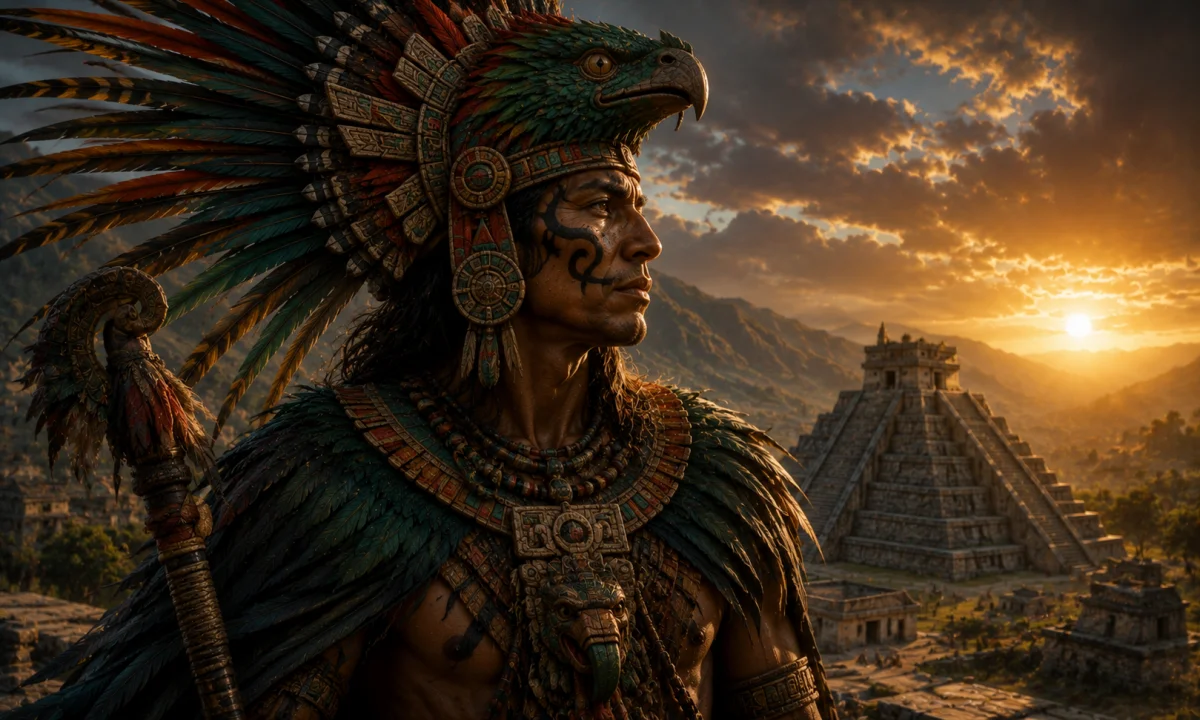
Omacatl is a deity associated in Aztec, or Mexica, religious tradition with feasting, banquets and festive abundance. His name is usually written Omacatl or Omácatl in modern publications. Unlike major Mexica gods such as Huitzilopochtli, Tlaloc or Quetzalcoatl, Omacatl is known mainly through descriptions of ritual practice and household devotion rather than through a large cycle of surviving myths.
Omacatl belonged to the religious world of central Mexico before and during the Spanish conquest. The evidence for him comes chiefly from early colonial Nahuatl and Spanish accounts, especially material associated with Bernardino de Sahagún and Indigenous informants in the Florentine Codex. These records preserve valuable information about Mexica beliefs, ceremonies and sacred images, but they were produced in a colonial and Christian setting. Descriptions may reflect both Indigenous explanations and the categories or questions introduced by European missionaries. As a result, Omacatl’s identity should not be treated as though it were defined by a single complete ancient doctrine.
Name and identity
The name Omacatl is commonly connected with the Nahuatl expression ome acatl, meaning “two reed.” Ome means “two,” while acatl can mean “reed” or “cane.” The form of the divine name is contracted, and the precise relationship between the ordinary calendrical expression and the deity’s name is not entirely clear. “Two Reed” was also a calendrical designation in Mesoamerican timekeeping, so the name may carry calendrical or symbolic associations rather than functioning only as a literal description.
Interpretations of Omacatl’s classification vary. He is regularly identified as a god of feasts and banquets, particularly those organized by wealthy or high-status people. Some modern accounts call him a god of pleasure, merriment or revelry. Those descriptions are broadly understandable, but “pleasure” can make him sound like a purely secular god of entertainment. In Mexica society, a banquet was also a social, political and religious event involving hospitality, status, obligations and the circulation of wealth. Omacatl’s sphere therefore included much more than amusement.
Omacatl is also sometimes described as an aspect, form or manifestation of Tezcatlipoca, the powerful and complex deity associated with night, rulership, destiny, conflict, sorcery and the instability of human fortune. This connection appears in modern discussions of the deity and may reflect the way Mexica religious thought grouped related manifestations of divine power. Nevertheless, surviving colonial descriptions do not present a universally agreed systematic explanation of Omacatl as simply “another name” for Tezcatlipoca. It is safer to say that the two figures were sometimes interpreted as related, while Omacatl retained a distinct association with feasting.
Feasts in Mexica religious and social life
To understand Omacatl, it is important to understand the place of feasting in central Mexican society. A banquet could mark a religious observance, a life-cycle event, a military success, a marriage, the completion of a building project or the display of an individual’s wealth. Rulers, nobles, merchants and other prosperous people could use feasts to create alliances and demonstrate generosity. Food and drink were not merely consumed; they established relationships between hosts and guests.
Such generosity also carried expectations. A person who held an important feast displayed the resources to feed many people, but the event could create obligations that had to be repaid through future hospitality, gifts or political support. Mexica accounts often present social life as a balance of honour, debt and reputation. Omacatl’s presence in this setting suggests a divine dimension to the risks and rewards of public abundance.
Feasts could include music, dancing, flowers, prepared foods, alcoholic drinks such as pulque, incense and offerings. Their exact form would vary according to the occasion and the status of the participants. It would be misleading to imagine one standardized “Omacatl festival” that looked the same everywhere. The surviving sources describe practices connected with his image and with private or household banquets, but they do not provide enough information to reconstruct every ceremony in detail.
Appearance and sacred images
Colonial descriptions associate Omacatl with a distinctive figure that could be kept in a household and brought out during a feast. Modern summaries often describe him as a heavy or corpulent man, sometimes with black-and-white facial painting and ceremonial clothing. These features fit his connection with abundance and festivity, but the evidence should be handled carefully. Illustrations and written descriptions from the colonial period do not always agree, and the surviving information is not sufficient to establish one uniform canonical appearance.
The emphasis on a large-bodied figure has often led modern readers to see Omacatl as a personification of plenty. That interpretation is plausible, especially given his connection with lavish meals and wealthy hosts, but the image should not be reduced to a simple symbol of gluttony. In the religious context of the Mexica, abundance was valuable and prestigious, yet it could also become dangerous when it was ostentatious, wasteful or improperly managed.
Accounts associated with Omacatl describe people caring for his image, clothing it and treating it as an active sacred presence. A household that possessed such an image did not merely own a decorative statue. The image could be honoured, fed symbolically and included in the preparation of a banquet. This reflects a broader Mesoamerican religious practice in which sacred images served as material points of contact with divine powers. The image was not necessarily thought of as an ordinary portrait of a god; it could act as a vessel, representation or embodied focus of the deity’s presence.
Ritual behaviour and the dangers of neglect
Omacatl was not only invoked when a feast was going well. He could also be treated as a power whose favour had to be maintained. Descriptions of his cult indicate that hosts might honour his image before or during a banquet. The care given to the image expressed respect for the deity and helped place the feast within a sacred framework.
In traditions recorded by early colonial observers, Omacatl could punish people who failed to honour him properly. Stories connected with his image describe household disorder, damaged objects or other misfortunes when he was neglected or treated without due respect. The details vary in retellings, and the surviving accounts should not be expanded into a fully developed mythology that the sources do not actually preserve. Their central point, however, is clear: Omacatl was not a harmless mascot of parties. He was a divine power whose generosity could be accompanied by demands.
This pattern is common in religious traditions. A god associated with prosperity may also govern the conditions under which prosperity is granted. Feasting created an impression of effortless abundance, but the ritual treatment of Omacatl emphasized that abundance was precarious. A host had to observe obligations, maintain reputation and recognize the sacred dimension of material plenty.
Omacatl and wealth, status and social order
Omacatl’s close association with rich people and banquet-givers is significant. In Mexica society, elite feasting was one of the visible ways in which social rank was performed. A successful host showed that he had access to food, labour, servants, valuable goods and networks of dependents or allies. Generosity could elevate a person’s honour, but a failed or poorly managed feast could damage it.
Omacatl therefore occupied a place at the intersection of religion and social competition. He represented the joy of abundance, but also the pressure attached to public generosity. His cult can be read as acknowledging that prosperity was never entirely under human control. Crops, trade, political security, household labour and the goodwill of guests all affected whether a banquet succeeded.
Some modern interpretations connect Omacatl with luck or the unpredictable turning of fortune, especially because of his proposed relationship with Tezcatlipoca. This is a reasonable interpretive possibility, but it should not replace the more securely attested evidence for his role in feasting. The sources identify his banquet associations more clearly than they define a general theology of luck.
Stories and relationships
Omacatl does not possess a widely preserved creation story, heroic narrative or genealogy comparable to those associated with Quetzalcoatl, Huitzilopochtli or the heroic twins of Maya tradition. The surviving material is fragmentary and largely descriptive. It tells us about his name, image, function and ritual treatment rather than presenting a sequence of dramatic adventures.
His most important “stories” are therefore the short accounts surrounding his image and his worship. These accounts portray him as a deity who attended banquets, received honour from hosts and could retaliate against neglect. They are less like an epic mythology than explanations of why a household or feast required ritual care.
The relationship with Tezcatlipoca deserves particular caution. Tezcatlipoca was associated with several names, forms and manifestations, and Nahua religious categories did not always divide divine beings in the same way as modern reference books do. A deity could have a distinct name and ritual identity while also being understood as related to a larger divine power. Calling Omacatl a “manifestation of Tezcatlipoca” may therefore be useful as a summary of one interpretive tradition, but it should not imply that all Mexica communities understood the relationship identically.
Distinguishing Omacatl from similar figures
Omacatl should not be confused with every Mesoamerican deity associated with food, agriculture or celebration. His main documented sphere is the banquet and the social use of abundance, not the growth of maize itself. This distinguishes him from agricultural and rain deities such as Centeotl and Tlaloc, whose principal responsibilities belong to crops, rain and fertility.
He is also not simply the Mexica equivalent of a European god of wine or a generic “god of partying.” Although alcoholic drinks and merrymaking could be part of a feast, the evidence does not make Omacatl a straightforward deity of intoxication. The worship of pulque involved other divine associations, especially those surrounding the Centzon Totochtin, the “Four Hundred Rabbits.” Those figures should not be merged with Omacatl merely because both may appear in discussions of drinking and celebration.
Nor should Omacatl be identified with Xochipilli without qualification. Xochipilli was associated with flowers, music, dance, games, beauty and forms of pleasure, and the two figures may seem similar in a broad modern classification. Their documented religious profiles are different. Omacatl’s distinctive concern is the feast as an act of hospitality, status and sacred obligation.
Sources and historical limits
Knowledge of Omacatl depends heavily on records produced after the Spanish invasion. The Florentine Codex, compiled in the sixteenth century in Nahuatl and Spanish, is especially important because it preserves information gathered from Indigenous speakers about gods, ceremonies and everyday life. Other early colonial works and visual manuscripts may provide related context, but they do not always offer identical descriptions.
These sources are indispensable, yet they are not neutral transcripts of a pre-conquest religion. They were created during a period of epidemic disease, political transformation, Christian evangelization and the destruction or suppression of many Indigenous institutions. Missionaries frequently organized Nahua religious concepts according to European ideas about “gods,” “idols” and “devils.” Indigenous collaborators and informants, meanwhile, preserved knowledge within a changing world. The surviving record should consequently be read as evidence of Mexica religious traditions as recorded in the early colonial period, not as a perfect window onto every earlier belief.
The limited evidence also explains why descriptions of Omacatl differ in modern works. Some writers present him as an independent deity; others emphasize his connection with Tezcatlipoca. Some focus on feasting, while others expand his role to pleasure, wealth or fortune. The secure core is narrower: Omacatl was a sacred figure associated with banquets, festive abundance and the ritual responsibilities of those who hosted them.
Cultural significance
Omacatl offers an important reminder that religious life is not confined to temples or dramatic myths. A household feast could be a religious event, and ordinary social practices could carry obligations toward divine powers. His presence in accounts of elite hospitality shows how food, status, wealth and worship were connected in Mexica culture.
His character also reveals an ambivalence at the heart of abundance. A successful feast communicated generosity and honour, but it could expose the host to envy, debt, failure and divine displeasure. Omacatl embodied the celebratory side of plenty while retaining the dangerous unpredictability found in many Nahua sacred powers. He was connected with joy, but joy did not erase responsibility.
Modern popular culture has given much greater attention to famous Aztec deities than to Omacatl, and he rarely appears as a major figure in widely known films, novels or games. When he does appear in online lists or fictional settings, his role is sometimes simplified into that of a generic party or pleasure god, or he is presented as completely identical with Tezcatlipoca. Those treatments are modern interpretations rather than settled statements of Mexica tradition. The historical figure is better understood through the specific religious setting of the banquet: a place where hospitality, wealth, honour and divine obligation met.