WORLD
WORLD
Montezuma
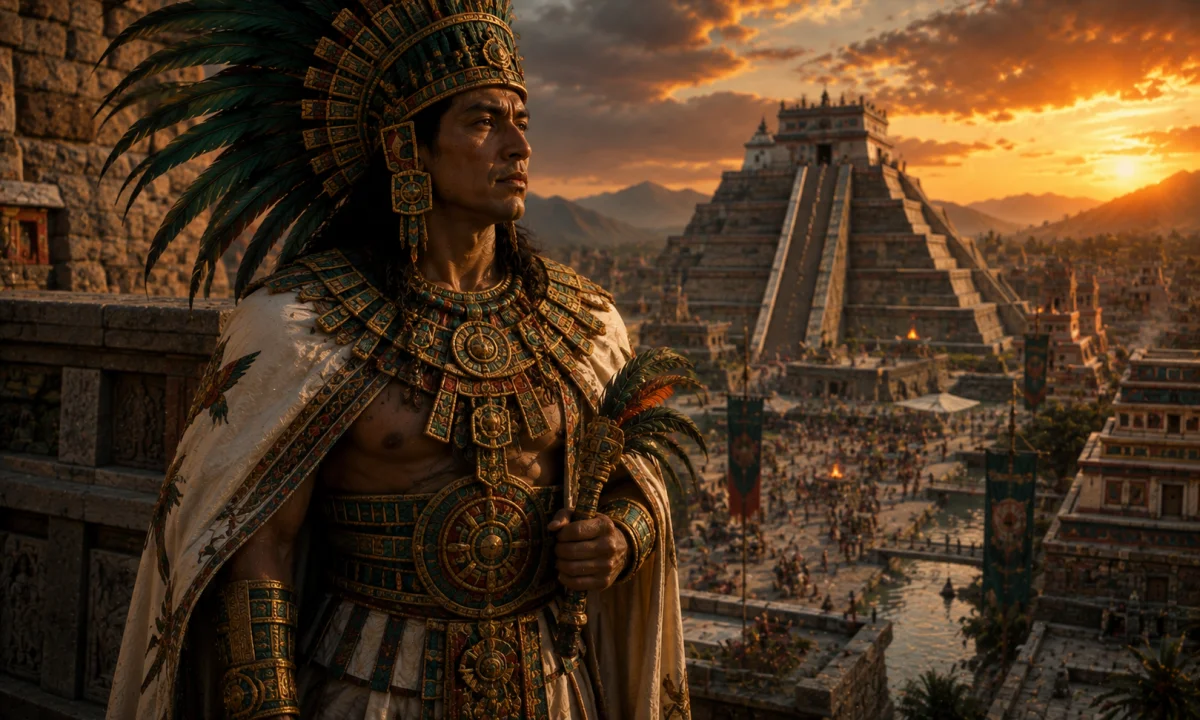
Montezuma is the name commonly used in English for Moctezuma II, the Mexica ruler who governed the Aztec Empire when Hernán Cortés and the Spanish entered central Mexico in 1519. He was a historical sovereign rather than a god, spirit, or legendary creature. His association with Aztec mythology arises from the religious authority of the Mexica ruler, the sacred traditions surrounding imperial power, and later stories that transformed the events of the Spanish conquest into a dramatic legend.
Name and identity
“Montezuma” is a Spanish rendering of the Nahuatl name usually written Motecuhzoma, Moctezuma, or Motēuczōma. The exact pronunciation and meaning are not completely straightforward because colonial writers represented Nahuatl sounds inconsistently. The name is often interpreted in connection with lordly anger, authority, or a ruler who shows anger, although translations differ.
The figure most often meant by “Montezuma” is Motecuhzoma Xocoyotzin, known as Moctezuma II. The word Xocoyotzin is commonly understood as “the younger” or “the junior,” distinguishing him from an earlier ruler with the same principal name. He became tlatoani of Tenochtitlan around 1502 and ruled until his death during the Spanish invasion in 1520.
Another ruler, Motecuhzoma Ilhuicamina, governed earlier, from approximately 1440 to 1469. He is often called Montezuma I in English. Montezuma I and Montezuma II were different historical figures, and their achievements, stories, and religious associations should not be combined. Some broad descriptions of “Montezuma” become misleading because they draw details from both rulers.
The Mexica religious and political setting
The Mexica were the Nahuatl-speaking people who established Tenochtitlan on an island in Lake Texcoco. They formed the dominant power in a wider political system often called the Aztec Empire, although “Aztec” is a later umbrella term that includes several related peoples. The empire was not a centralized nation-state in the modern sense. It relied on military power, tribute, alliances, local rulers, and the prestige of the Triple Alliance formed by Tenochtitlan, Texcoco, and Tlacopan.
The tlatoani, literally a “speaker” or “one who speaks,” was both a political ruler and a central participant in religious life. He presided over ceremonies, patronized temples, received tribute, led or authorized warfare, and represented the community before the gods. This sacred status did not make him a god in the same way as Huitzilopochtli, Tlaloc, Tezcatlipoca, or Quetzalcoatl. Instead, his authority depended on maintaining relationships among human communities, deities, ancestors, and the forces that sustained the world.
Mexica religion understood the cosmos as dynamic and vulnerable. The sun, rain, fertility, warfare, rulership, and the continuation of human life were connected through ritual exchange. Offerings, prayer, festival observances, bloodletting, and human sacrifice formed part of this religious system, although practices varied by context and the surviving descriptions were shaped by the interests and judgments of colonial observers. Montezuma’s position placed him at the center of these institutions.
Origins and historical sources
Knowledge of Montezuma comes from a mixture of sources produced during and after the Spanish conquest. These include Spanish narratives, indigenous accounts written in Nahuatl or Spanish, pictorial manuscripts, annals, legal testimonies, and later histories compiled by Indigenous authors and colonial scholars. No single source gives a complete or neutral account.
Spanish conquerors had political reasons to portray events in ways that justified invasion, tribute, and the seizure of authority. They also interpreted unfamiliar institutions through Christian and European assumptions. Indigenous accounts preserve perspectives that are indispensable for understanding the conquest, but they too were produced after the catastrophe and sometimes reflect the changed political circumstances of colonial rule.
Descriptions of Montezuma’s childhood and education are therefore difficult to verify in detail. Later narratives present him as highly trained in religious knowledge, ritual discipline, military affairs, and courtly conduct. He may have served as a priest or religious official before becoming ruler, as was appropriate for an elite member of the royal lineage, but the surviving accounts do not allow every biographical detail to be confirmed.
Montezuma II as ruler
Before his accession, Montezuma II belonged to the ruling dynasty of Tenochtitlan and was associated with the city’s military and religious elite. As tlatoani, he inherited a powerful empire but also a system that required constant management. Subject communities paid tribute and supplied labor or military support, while rival states remained capable of resisting Mexica influence.
Traditional accounts describe Montezuma II as an exacting and ceremonially conscious ruler. His court was organized according to strict hierarchies, and access to his person was controlled through formal etiquette. These accounts emphasize his sumptuous palace, the display of precious materials, the use of attendants, and the distinction between the ruler and ordinary people. Some details may have been amplified by Spanish observers who wished to portray the Mexica court as both magnificent and strange.
Montezuma’s government continued military expansion and the extraction of tribute. The empire’s wealth included food, textiles, feathers, precious stones, weapons, and other goods from many regions. Imperial power also depended on the authority of local nobles and on the threat or reality of warfare. The Mexica state was not simply a religious institution, but religion gave political actions a cosmic and moral framework.
Under Montezuma II, tensions existed with neighboring powers, including Tlaxcala and other communities that resisted Mexica domination. These rivalries later affected the conquest because Cortés was able to recruit Indigenous allies who opposed Tenochtitlan. The fall of the empire cannot be explained by Montezuma’s personal decisions alone. Disease, warfare, Indigenous alliances, Spanish military technology, internal divisions, and the political ambitions of many communities all played major roles.
Appearance and ceremonial representation
There is no reliable portrait of Montezuma II in the modern sense. Indigenous manuscripts may depict rulers through conventional signs rather than individualized facial likenesses, while European images often combine observation with symbolic or imagined details. Some later images show him wearing elaborate featherwork, gold ornaments, royal garments, or a distinctive headdress. These representations communicate rank and wealth more securely than they establish his exact appearance.
Descriptions of the ruler’s clothing and courtly behavior reflect the importance of display in Mexica political culture. Textiles, feathers, ornaments, incense, architecture, and ritual movement all expressed relationships of rank. The ruler’s body and surroundings were part of a larger ceremonial language. Such imagery should not be treated as evidence that Montezuma possessed supernatural powers or a fixed costume comparable to that of a mythological character.
Montezuma and the gods
Montezuma was closely connected with the worship of major Mexica deities, especially through the temples, festivals, and priestly institutions under his authority. The Great Temple of Tenochtitlan, or Huey Teocalli, was dedicated principally to Huitzilopochtli and Tlaloc. The ruler participated in or supervised ceremonies associated with these and other deities.
In mythological terms, the important point is not that Montezuma was himself divine, but that rulership operated within a sacred order. The tlatoani could act as a ritual mediator and a representative of the community. His successes or failures could be interpreted as signs of the condition of the relationship between society and the gods. This helps explain why later accounts sometimes give Montezuma an almost superhuman dignity, while others portray him as a ruler overwhelmed by events.
Montezuma should also not be treated as an incarnation of Quetzalcoatl. Quetzalcoatl was a major deity with different manifestations and a long religious history in Mesoamerica. The famous claim that the Mexica believed Cortés to be the returning Quetzalcoatl, and that Montezuma welcomed him for this reason, is disputed. The story is not securely supported as a simple explanation of the encounter and may reflect later attempts to interpret the conquest through prophecy and European religious expectations.
The Spanish arrival and the meeting with Cortés
In 1519, Cortés landed on the Gulf Coast with a Spanish expedition. He advanced toward the basin of Mexico while forming alliances with Indigenous groups opposed to Mexica rule. Montezuma received information about the newcomers and their movements, but the surviving accounts disagree about his intentions, fears, and decisions.
On 8 November 1519, Montezuma and Cortés met near the causeways leading into Tenochtitlan. The meeting became one of the most famous encounters in the history of the Americas. Spanish narratives present Montezuma as ceremonially greeting Cortés and then, in some accounts, treating him as an honored guest. Other traditions stress coercion, strategic caution, or the rapid deterioration of the relationship.
Cortés soon took Montezuma into custody. The Spanish attempted to rule through him, using his authority to demand obedience and supplies from the city and its subject territories. This arrangement exposed the limits of the ruler’s power. A captive ruler could not easily command genuine loyalty, and Mexica leaders and residents increasingly opposed the Spanish presence.
While Cortés left Tenochtitlan to confront a rival Spanish force, Pedro de Alvarado ordered an attack during a festival at the Great Temple. The assault intensified the uprising against the Spaniards. Cortés returned to a city in revolt, and the Spanish and their allies were forced to withdraw during the event later known as La Noche Triste, or the “Sad Night.”
Death and competing accounts
Montezuma died in 1520, but the circumstances remain disputed. Spanish accounts state that he addressed the people from a position near the palace and was struck by stones or other missiles thrown by his own subjects. These accounts often suggest that he was killed because the population had turned against him.
Indigenous accounts recorded after the conquest give different versions, including the possibility that the Spanish killed him while retreating or while holding him captive. The evidence is complicated by propaganda, translation problems, the confusion of an active uprising, and the later political need to assign responsibility. It is therefore unsafe to present one version as certain.
After Montezuma’s death, the Mexica resistance continued under other rulers, including Cuitlahuac and Cuauhtemoc. Tenochtitlan fell to the Spanish and their Indigenous allies in August 1521 after a long siege. Montezuma’s death did not mark the immediate end of Mexica resistance or the instant collapse of all Indigenous political life.
Prophecy, omens, and the making of a legend
Later accounts describe a series of omens before the Spanish arrival: a comet or strange light, a temple fire, unusual natural events, and reports of people seeing supernatural figures. These stories belong to the post-conquest tradition of interpreting the disaster, but their date, form, and original significance are uncertain. They should not automatically be treated as direct records of what Montezuma or the wider population believed before 1519.
The image of a ruler paralyzed by prophecy became especially influential in European and later popular writing. It presents the conquest as the fulfillment of an inevitable destiny, but this interpretation can obscure the political and military realities of the event. The Spanish did not conquer the Mexica Empire through a single act of mistaken identity. They depended heavily on Indigenous alliances, exploited existing conflicts, and benefited from epidemic disease and the disruption of imperial authority.
The idea that Montezuma believed Cortés to be Quetzalcoatl is similarly uncertain. Some accounts may have been shaped by translation, retrospective explanation, or efforts to make the conquest intelligible within Christian historical expectations. Scholars continue to examine how Nahuatl concepts, Spanish vocabulary, and colonial storytelling interacted in these narratives.
Montezuma I and other possible confusions
Montezuma I, or Motecuhzoma Ilhuicamina, ruled roughly six decades before Montezuma II. He was an important builder of Mexica power and is associated with the expansion of Tenochtitlan, the development of imperial institutions, and major ritual projects. Stories about the growth of the empire or the establishment of ceremonies may refer to him rather than to the ruler encountered by Cortés.
Montezuma is also sometimes confused with Quetzalcoatl, the feathered-serpent deity; Topiltzin Quetzalcoatl, a legendary or semi-historical ruler associated with Tollan in later traditions; and Huitzilopochtli, the Mexica patron deity. These figures belong to different categories. Montezuma was a human ruler who held sacred political office, while the others are divine or mythic figures whose stories extend across broader Mesoamerican traditions.
Cultural significance
Montezuma’s importance lies in the tension between historical evidence and later memory. For Mexica society, he was the holder of a powerful office within a religious and political system. For Spanish conquerors, he became evidence of the wealth and organization of the kingdom they sought to control. For Indigenous chroniclers, he could represent the final phase of an older order, although their accounts vary in tone and purpose.
Modern historians generally avoid reducing the conquest to Montezuma’s personality. He faced a rapidly changing crisis involving foreign invaders, Indigenous enemies of Tenochtitlan, military violence, religious uncertainty, and the capture of the ruler himself. Descriptions of him as either a foolish leader who surrendered an empire or a wholly passive victim oversimplify the available evidence.
The name also carries the legacy of colonial language. “Montezuma” became the standard English form, while “Moctezuma” and “Motecuhzoma” are closer to forms used in Nahuatl and modern scholarship. Choosing one spelling does not by itself settle questions about pronunciation, translation, or the historical interpretation of the ruler.
Later reception and popular culture
From the colonial period onward, Montezuma appeared in histories, dramas, paintings, operas, novels, films, and educational narratives about the conquest. European and later American works often portrayed him as an exotic emperor surrounded by immense wealth, or as a tragic monarch whose kingdom was destroyed by prophecy. These images frequently reflect the concerns of the societies producing them more than the surviving evidence about Mexica life.
Modern fiction may present Montezuma as a fantasy emperor, a mystical seer, or a symbol of lost civilizations. Such portrayals can be engaging, but they are adaptations rather than traditional Aztec mythology. The historical Montezuma belonged to a living Mesoamerican civilization with complex institutions, languages, rivalries, and religious practices—not to a timeless fantasy world detached from history.
His name is also used in expressions such as “Montezuma’s revenge,” a popular term for gastrointestinal illness experienced by travelers to Mexico. The phrase is a modern stereotype, not an Aztec belief, ritual, curse, or mythological punishment. It has no meaningful connection with Montezuma II’s religious role or with Mexica explanations of illness.