WORLD
WORLD
Nanautzin
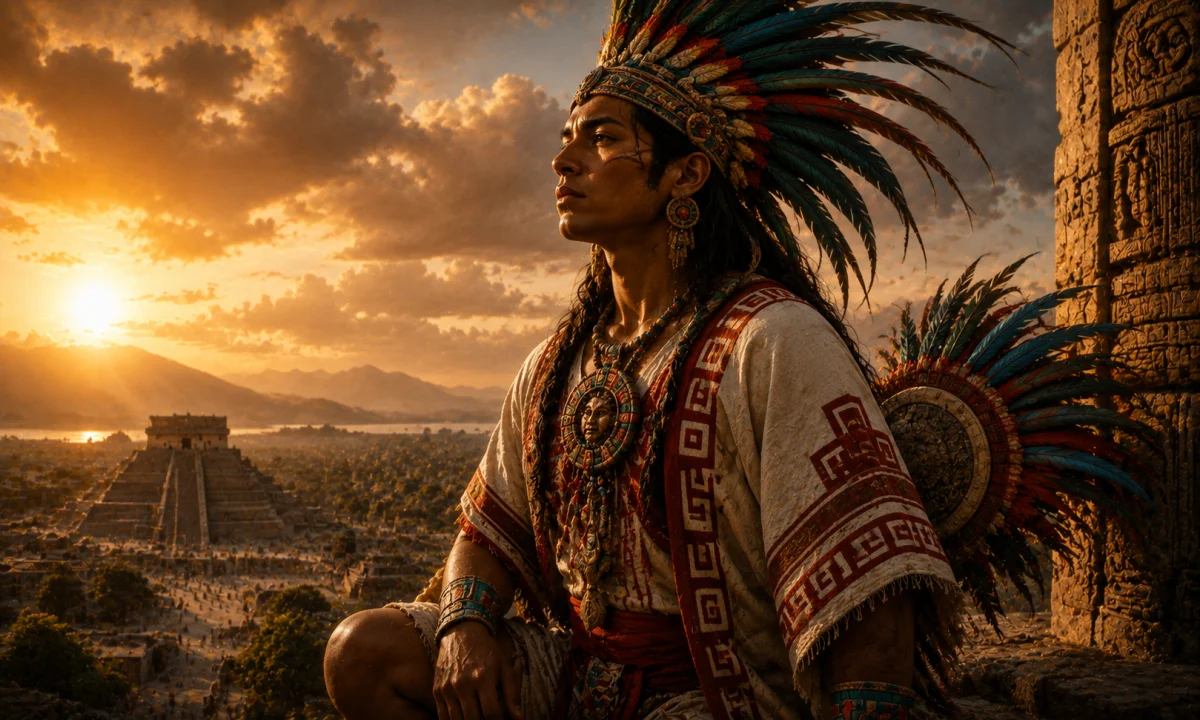
Nanautzin—more commonly written Nanahuatzin in modern renderings of Nahuatl—is a deity of central Mexican tradition best known for becoming the Sun in the creation story of the Fifth Sun. He appears as a poor, humble, and physically afflicted god who willingly throws himself into a sacred fire at Teotihuacan. His act of self-sacrifice allows the present cosmic age to begin, although the story also presents him as a figure whose courage contrasts with the hesitation of a wealthier god, Tecuciztecatl.
Origins and cultural setting
Nanahuatzin belongs to the religious world of the Nahua peoples of central Mexico, including the Mexica, often called the Aztecs. The best-known account of his transformation occurs in the myth of the creation of the Fifth Sun, the current cosmic era in much Nahua thought. According to this tradition, the gods gathered at Teotihuacan to decide which of them would sacrifice himself and become the Sun.
The story survives in several early colonial sources that recorded Indigenous traditions after the Spanish conquest. Important versions appear in the Florentine Codex, a large Nahuatl-Spanish encyclopedic work associated with Bernardino de Sahagún, and in other sixteenth-century compilations such as the Historia de los mexicanos por sus pinturas and the text commonly known as the Leyenda de los Soles. These sources do not provide a single uniform account. Details of the gods, the sequence of events, and the explanation of cosmic movement vary between versions.
Because these accounts were written down after the conquest, they should not be treated as a perfectly preserved transcript of a pre-Hispanic oral tradition. They reflect Indigenous knowledge, colonial recording practices, translation choices, and the particular interests of the people who transmitted or compiled them. Even so, the different versions consistently associate Nanahuatzin with humility, bodily affliction, fire, sacrifice, and the creation of the Sun.
Name and identity
Nanahuatzin is the spelling most often used in English-language discussions, while Nanautzin is another common form. Nahuatl spelling was not standardized in the way modern languages often are, and colonial manuscripts represent Indigenous words in different ways. The final element -tzin is generally understood as an honorific or respectful suffix. The name is often connected with nanahuatl, a term associated with sores, pustules, or a disease marked by eruptions on the skin.
This connection explains why translations and descriptions sometimes call Nanahuatzin “the afflicted one,” “the one covered in sores,” or “the pustulous one.” Such translations are interpretive rather than exact equivalents of a modern medical diagnosis. The sources do not establish that he suffered from one identifiable disease in the modern clinical sense. His appearance and condition have a symbolic function within the narrative: poverty, weakness, and physical imperfection are set against the wealth and pride of Tecuciztecatl.
Nanahuatzin is a distinct mythological figure, not simply another name for every Nahua being associated with disease or transformation. His name may resemble terms connected with illness, and confusion can also arise with nanahual or nahualli, words associated in different contexts with a sorcerer, ritual specialist, or person capable of taking an animal form. These are not interchangeable identities. Nanahuatzin is specifically the sacrificial deity of the Fifth Sun narrative.
The creation of the Fifth Sun
Before the present Sun appeared, the gods assembled at Teotihuacan. The central question was who would leap into the fire and become the new luminary. Tecuciztecatl, a rich and distinguished god, volunteered or was appointed for the role. Nanahuatzin was also chosen.
The two gods prepared themselves through ritual acts. In the account preserved in the Florentine Codex, their offerings reflect their contrasting circumstances. Tecuciztecatl offers valuable materials such as precious feathers, ornaments, and other things associated with wealth. Nanahuatzin offers humble objects, including reeds, paper, and his own blood. The contrast does not make Nanahuatzin ritually insignificant. Instead, it emphasizes the sincerity of his devotion and the value of sacrifice that is measured by commitment rather than by material richness.
When the time comes to enter the fire, Tecuciztecatl approaches but repeatedly draws back. Nanahuatzin, by contrast, does not retreat. He throws himself into the flames and is consumed. Ashamed or inspired by this act, Tecuciztecatl follows him into the fire.
Nanahuatzin then rises in the east as the Sun. Tecuciztecatl also emerges as a celestial body, but the gods decide that he shines too brightly or that the two luminaries should not have equal brilliance. In one widely known version, one of the gods throws a rabbit at Tecuciztecatl’s face, marking and diminishing his radiance. He becomes the Moon. The rabbit motif is important in later Indigenous interpretations of the Moon’s visible markings, although the exact details differ among traditions.
The appearance of the Sun and Moon does not immediately bring motion to the world. They remain in place, and the gods must address the problem of movement. In the best-known version, the wind god Ehecatl blows upon them, setting the Sun on its course. The other gods then sacrifice themselves so that the cosmic order can continue. Thus, Nanahuatzin’s act is the first decisive sacrifice, but the movement and continuation of the world depend on further divine sacrifice.
Nanahuatzin and the meaning of sacrifice
Nanahuatzin’s most important attribute is not a weapon, animal companion, or physical emblem, but his willingness to give himself completely. The myth presents sacrifice as the foundation of cosmic order. The Sun does not simply appear by divine command; it must be created through bodily offering, fire, and death.
His poverty and illness have a deliberate narrative importance. Tecuciztecatl has prestige, resources, and elaborate offerings, yet his hesitation prevents him from being the first to enter the fire. Nanahuatzin has little to display, but he acts decisively. The story therefore challenges a simple association between social rank and sacred worth. Humility and courage become the qualities that determine who truly fulfills the cosmic role.
The image should not be reduced to a modern moral tale in which poverty is automatically virtuous or illness is merely a sign of inner goodness. Within Nahua religious thought, bodily conditions, ritual offerings, social status, and cosmic obligations could carry several meanings at once. Nanahuatzin’s afflicted body marks him as unusual and vulnerable, but it also places him in a liminal position suited to transformation. He crosses from weakness into solar power through fire.
The story also reflects a larger Mesoamerican understanding of the Sun as a force that requires continual support. The world is not permanently secure after creation. It depends on movement, offering, and reciprocal obligations between human beings, the gods, and the forces of nature. Later Mexica ritual practice, including forms of blood offering and sacrificial ceremony, developed within this broader religious framework, although the myth of Nanahuatzin should not be treated as a simple explanation for every ritual practice.
Teotihuacan and the sacred landscape
The setting of the transformation is Teotihuacan, the monumental city whose ruins lie northeast of modern Mexico City. Teotihuacan flourished many centuries before the rise of the Mexica capital, Tenochtitlan, and its original inhabitants did not speak from a surviving written record that allows their own religious system to be reconstructed with certainty.
By the time Nahua peoples preserved the Fifth Sun story, Teotihuacan had already become an ancient and prestigious sacred place. Its name is usually translated as “the place where one becomes a god” or “the place of divinity,” though translations vary according to how the Nahuatl expression is analyzed. The myth’s setting gives the creation of the Sun a connection with a monumental landscape that later peoples regarded as exceptionally sacred.
The placement of the event at Teotihuacan does not prove that Nanahuatzin was worshipped there during the city’s original period. It reflects the importance of the site in later Nahua religious geography and historical memory. The association also shows how ancient ruins could be incorporated into later traditions as places where gods, ancestors, and cosmic events were believed to have acted.
Sources, versions, and uncertainties
No single pre-conquest book provides a complete, uncontested biography of Nanahuatzin. The surviving evidence comes from colonial-era manuscripts, Indigenous pictorial traditions, and later scholarly interpretation. Some accounts name the gods involved differently, describe the sacrifices in different ways, or arrange the events in another order.
In certain versions, the creation of the Fifth Sun is connected with an earlier destruction of worlds or “suns.” Nahua traditions often describe previous cosmic eras that ended through disasters such as jaguars, wind, fire, or floods. The number and sequence of these eras are not identical in all sources. The familiar modern phrase “the Fifth Sun” is therefore useful, but it can conceal important variation between texts and traditions.
The identification of every pre-Hispanic image of Nanahuatzin is also uncertain. Colonial manuscripts sometimes provide explanatory glosses, but pictorial signs do not always function as straightforward portraits. A figure shown near fire, the Sun, a skin condition, or a sacrificial scene cannot automatically be labeled Nanahuatzin without contextual evidence. Some modern publications have treated related images as definite depictions when the identification remains debated.
Relationship with Tecuciztecatl
Tecuciztecatl is Nanahuatzin’s principal counterpart in the Fifth Sun story. His name is commonly associated with shells or a person connected with the Moon, though translations vary. In the myth, he represents wealth, display, and social distinction. Nanahuatzin represents humility and decisive self-offering. Their opposition is not a battle between good and evil. Both enter the fire, and both become celestial bodies, but they do so in different ways and with different results.
The resulting Sun and Moon form a complementary pair. The Sun receives the greater brilliance and becomes the dominant source of daylight, while Tecuciztecatl’s light is reduced. The story of the rabbit thrown into the Moon’s face provides a mythic explanation for the Moon’s markings and lesser radiance. In some retellings, the rabbit is thrown by a particular god; in others, the detail is less central or appears differently.
Nanahuatzin should not be identified with the later, highly prominent solar deity Huitzilopochtli. Huitzilopochtli was the patron god of the Mexica and was strongly associated with war, the Sun, and the Mexica state, but he is a separate figure with a different mythology. Nanahuatzin becomes the Sun in one creation narrative; that role does not make him identical with every solar god in Nahua religion.
Religious and cultural significance
Nanahuatzin’s story illustrates several central themes in Nahua religious thought: the instability of the cosmos, the transformative power of fire, the importance of reciprocal offering, and the relationship between death and renewal. His transformation is not an effortless elevation from an ordinary state. He must enter the fire, disappear, and return in another form.
The narrative also preserves a criticism of outward status. Tecuciztecatl’s splendid offerings are not enough to guarantee success. Nanahuatzin’s modest offerings are meaningful because they represent what he can genuinely give. The story thereby links ritual value to sincerity, endurance, and personal commitment rather than simply to expensive materials.
At the same time, the creation of the Sun requires more than individual bravery. After Nanahuatzin and Tecuciztecatl become celestial bodies, further divine action is needed to set the heavens in motion. This makes the myth a story not only about one hero’s courage but also about collective obligation. Cosmic stability emerges from a chain of sacrifices and responsibilities.
Later reception
Nanahuatzin remains one of the most recognizable figures from Nahua creation mythology. His story appears in museum interpretation, historical writing, educational material, visual art, novels, games, and other modern works dealing with Mesoamerican mythology. These adaptations often emphasize the contrast between the humble afflicted god and the wealthy hesitant rival.
Modern retellings may simplify the story by presenting Nanahuatzin as a “leper,” naming him as the universal Aztec Sun god, or treating every detail of one colonial account as equally certain. Those descriptions go beyond what the surviving evidence securely establishes. In traditional context, Nanahuatzin is best understood as the deity whose self-sacrifice produces the Sun of the present cosmic age, within a group of related but varying Nahua accounts about the origin and movement of the world.