WORLD
WORLD
Nyami Abe
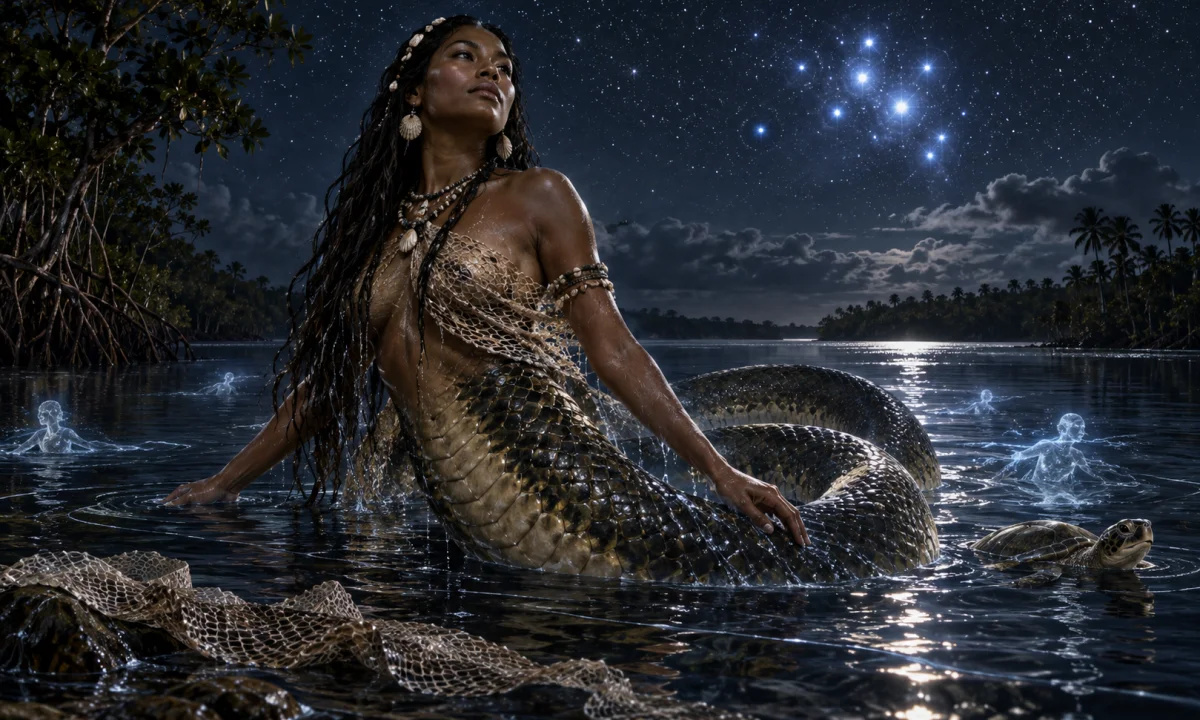
Nyami Abe is a name associated with a supposed South American water being, usually presented in modern English-language accounts as a large serpent or aquatic monster. Its identity is uncertain, however. Unlike well-attested figures from Indigenous oral traditions and regional folklore, Nyami Abe has no clearly established corpus of traditional stories, no securely identified community of origin, and no consistently recorded description. The name therefore requires careful treatment rather than a confident assignment to a particular South American mythology.
Origins and cultural setting
South America contains an immense range of Indigenous religious traditions, local legends and colonial-era folklore. Stories about rivers, lakes and wetlands are especially widespread because waterways are central to food, travel, settlement and spiritual life. Many communities describe powerful beings that inhabit or control aquatic environments. Some are guardians, some are dangerous predators, and others are spirits whose behaviour reflects moral or ritual rules.
Nyami Abe is sometimes placed within this broad category of South American aquatic beings. The difficulty is that the name does not appear to belong to a well-documented mythological tradition in the same way as figures such as the Amazonian Yacumama or the Brazilian Boiúna. Modern descriptions commonly repeat a short identification—usually that Nyami Abe is a giant water serpent—but provide little information about the language, people or region from which the name supposedly comes.
That absence matters. Indigenous myths are not interchangeable simply because they share themes such as a huge snake, a dangerous river or a supernatural lake. Similar motifs can arise independently in distant societies, while a single figure may have different names and meanings among neighbouring communities. Without reliable information about the original language and cultural setting, it is not possible to assign Nyami Abe confidently to a specific people.
The name and its uncertain identity
The spelling Nyami Abe is not stable across popular reference material. It may represent a transcription, a misunderstanding, a shortened form, or a name copied from an earlier modern compilation. The available descriptions also vary. Some treat Nyami Abe as a water serpent; others present it more generally as a river monster or giant snake. These differences may reflect ordinary variation in oral tradition, but they may also result from repetition between unsourced websites.
The name should not automatically be interpreted through a familiar word from another language. In particular, Nyami resembles the name of Nyami Nyami, a river deity in the traditions of Tonga-speaking peoples connected with the Zambezi River in southern Africa. Nyami Nyami belongs to an African cultural and religious context, not a South American one. A similar spelling does not establish a relationship between the two beings.
There is also no sound basis for treating “Abe” as a universal South American term for a serpent, spirit or god. South America contains hundreds of languages, and a word’s meaning depends on its language, dialect and context. When the original language is unknown, translating or analysing a name can easily create a false sense of certainty.
Appearance and attributes
In modern summaries, Nyami Abe is generally described as a large aquatic serpent. The creature is imagined as living in a river, lake or other body of water and as being capable of threatening people who approach its territory. Descriptions may portray it as enormous, hidden beneath the surface, or mistaken for an ordinary animal until it reveals its supernatural size.
These details should be regarded as a general modern profile rather than a securely recorded traditional description. There is no consistently preserved account establishing the creature’s colour, number of heads, horns, scales, eyes, length or other physical features. Nor is there reliable evidence for a fixed set of powers such as creating storms, swallowing boats, causing floods or controlling fish.
The image of a giant serpent nevertheless has a strong symbolic fit within many river-based traditions. A large snake can represent the danger of deep water, the hidden forces of the landscape or the unpredictable power of nature. Its ability to move between land and water can also make it a boundary figure, associated with places where ordinary human knowledge becomes unreliable.
It is important not to turn these broad symbolic possibilities into claims about Nyami Abe’s original meaning. They are interpretive comparisons drawn from recurring patterns in world mythology. A particular community could understand a water serpent as a protector, ancestor, deity, monster or warning spirit, and those meanings cannot be determined from the creature’s name alone.
Stories and traditional roles
No widely attested cycle of myths about Nyami Abe is available. There is no securely documented creation story, heroic encounter, ritual tradition or genealogical relationship involving the being. Accounts that describe the creature usually provide a brief catalogue entry rather than a narrative transmitted in a named community’s oral tradition.
Because of this, claims that Nyami Abe attacks boats, lives in a particular famous river, protects a specific people or explains a particular natural event should be treated cautiously unless they can be tied to a clearly identified tradition. Such details may have been added by later retellings or confused with stories about other aquatic beings.
In traditional South American storytelling more generally, supernatural water beings often perform several different roles:
- Guardians of dangerous places: a being may mark a deep pool, rapid, cave or lake as a place requiring respect.
- Explanations for accidents: drownings, disappearances and unexpected currents can be connected with a powerful inhabitant of the water.
- Regulators of human behaviour: stories may warn against travelling at certain times, taking more fish than necessary or entering protected locations.
- Agents of transformation: some aquatic beings change their shape, lure people away from settlements or connect the human world with a spirit realm.
- Symbols of environmental power: the creature embodies the fact that rivers and forests are not merely scenery but active forces in human life.
These are common functions of water mythology, not proven attributes of Nyami Abe. They provide cultural context for why a giant serpent might appear in a South American legend, while leaving open the question of whether the name itself preserves an independent traditional figure.
Comparison with South American water serpents
Nyami Abe is easily confused with several better-known South American serpent figures. The most important distinction is that resemblance in form does not demonstrate shared identity or origin.
Yacumama
Yacumama is a giant serpent associated in modern accounts with the waterways of the Peruvian and wider Amazonian region. The name is commonly explained through Quechua as “mother of the water,” although terminology and interpretation can vary. Yacumama is often described as inhabiting rivers, lagoons or deep pools and as embodying the power and danger of the Amazonian environment.
Yacumama has a more identifiable connection with Amazonian storytelling than Nyami Abe does in the surviving English-language record. A description of Nyami Abe as a giant river serpent should not be silently rewritten as a description of Yacumama.
Boiúna
Boiúna, also called Cobra-Grande or “Great Snake,” belongs primarily to Brazilian Amazonian folklore. Stories describe an enormous snake that can appear in rivers, produce unusual lights or transform its appearance. Details differ by region and retelling, and the figure has been influenced by both Indigenous traditions and Portuguese-speaking popular culture.
Boiúna is sometimes compared with other Amazonian serpents because of its size and aquatic setting. It should not, however, be treated as another name for Nyami Abe without evidence of a specific linguistic or regional connection.
Sachamama and related figures
Sachamama is another giant serpent associated with parts of Amazonian and Andean-Amazonian folklore. It is often portrayed as a land-dwelling or forest-associated snake whose immense body can be difficult to distinguish from the landscape. In some accounts it is contrasted with aquatic serpents, while in others the boundaries between forest and water beings are less precise.
These comparisons demonstrate why classification is difficult. “Giant serpent” is a descriptive category, not proof of a single pan-South American monster. Similar beings may have different names, moral functions and relationships with local communities.
Religious and cultural interpretation
It would be misleading to call Nyami Abe a universally recognised South American god or demon. The available material does not establish a formal cult, priesthood, sacred festival or religious doctrine connected with the name. Nor is there adequate evidence to say that the being was worshipped, feared in a prescribed way or addressed through offerings.
If Nyami Abe reflects an actual local tradition, its original meaning may have been more specific than the modern label suggests. A water serpent could be part of a clan history, a story about a particular spring, a warning associated with fishing, or a teaching about relations between people and animals. In many Indigenous traditions, the category “mythological creature” is imposed by later outsiders and does not correspond neatly to local ideas of spirit, person, animal or ancestor.
Modern readers should therefore avoid assuming that the figure was simply a monster invented to frighten children. Serpent and water beings can express a sophisticated understanding of landscape, ethics and community responsibility. At the same time, that respectful possibility should not be used to manufacture a detailed belief system where the evidence is missing.
Surviving evidence and modern classification
The main evidence for Nyami Abe appears to be its circulation in modern English-language lists and brief descriptions of mythical creatures. Such compilations can preserve names that are difficult to trace, but they often omit the information needed to evaluate them: the original spelling, the language, the storyteller, the date of collection and the location where the tradition was recorded.
A name repeated across reference sites can consequently appear more established than it really is. Copying may create an illusion of independent confirmation, even when every description ultimately derives from one uncredited entry. The lack of a clear traditional source does not prove that Nyami Abe is fictional, but it does mean that its status remains unresolved.
The safest classification is therefore an uncertain or poorly documented South American aquatic being in modern popular reference culture. It may preserve a distorted record of a local legend, represent a mistranscribed Indigenous name, or have been created or embellished by a later compiler. Until a more traceable tradition is identified, specific claims about its people of origin, habitat, powers and stories should remain provisional.
Nyami Abe and modern popular culture
Nyami Abe has little established presence in major literary, cinematic or game traditions. Its modern visibility comes mainly from online mythology directories, encyclopedic lists and content about legendary animals. In these settings, it is often presented alongside famous cryptids and mythological serpents from many different cultures, which can obscure the difference between a documented traditional figure and an uncertain catalogue entry.
Contemporary writers and artists may use Nyami Abe as the name of a colossal river serpent in fantasy fiction, role-playing games or creature collections. Such adaptations are legitimate creative works, but they should be identified as modern inventions or reinterpretations rather than treated as evidence for ancient beliefs. A fictional portrayal may give the being horns, magical powers, a detailed personality or a precise homeland that cannot be confirmed from the older record.
The most responsible way to discuss Nyami Abe is to preserve that distinction: the name is associated with a South American serpent-like water being in modern accounts, while its original cultural identity and traditional history remain uncertain. It should not be merged with Nyami Nyami, Yacumama, Boiúna, Sachamama or any other similarly described figure without reliable evidence of a connection.