WORLD
WORLD
Marerewana
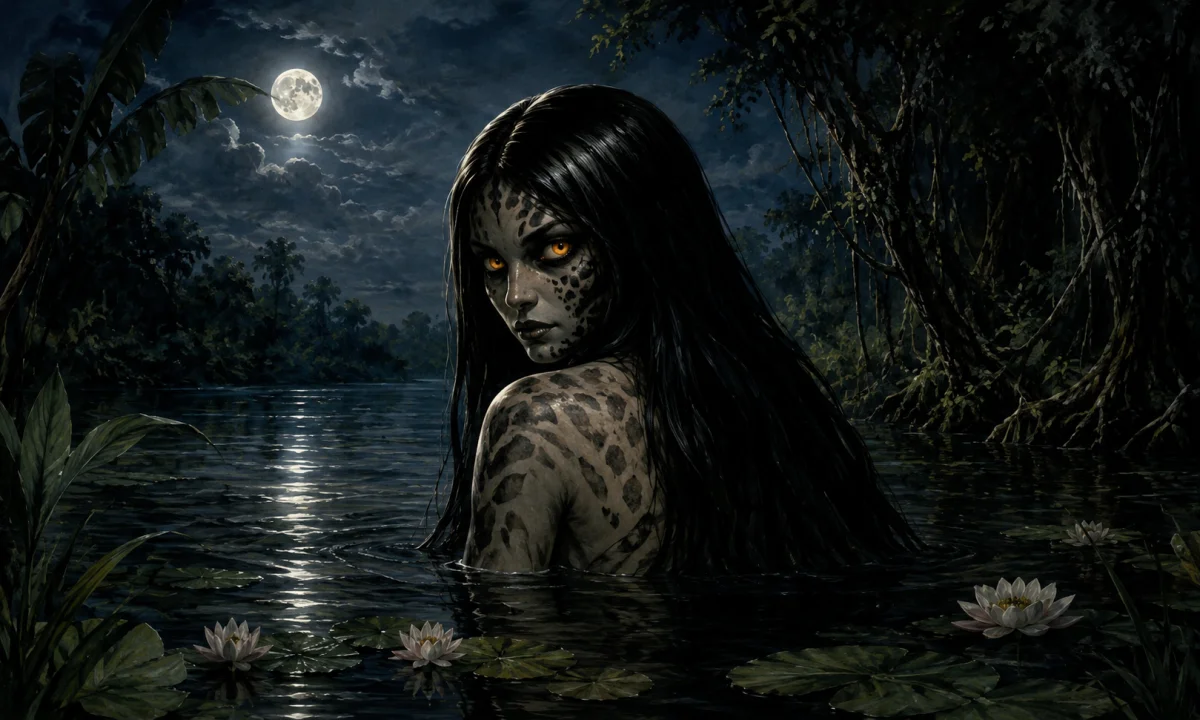
Marerewana is a name associated in some modern mythological and folklore compilations with South American indigenous tradition. Its identity, however, is unusually uncertain. Unlike well-documented figures such as the Guaraní Pombero or the Mapuche Caleuche, Marerewana does not have a clearly established, widely accessible body of traditional narratives, and the exact people, language and region connected with the name are not consistently identified.
That uncertainty matters. South America contains hundreds of distinct Indigenous cultures and languages, each with its own religious ideas, oral histories and naming systems. A name copied from one catalogue to another can lose its original pronunciation, acquire a new spelling or be detached from the community that used it. In the case of Marerewana, the available references do not provide a secure basis for assigning a single appearance, function or mythology to the figure.
The problem of identifying Marerewana
Marerewana is not a standard, universally recognised name in the major bodies of published material on South American mythology. The name appears primarily in secondary lists, encyclopaedic-style websites and collections of legendary beings, where it may be classified as a spirit, deity, monster or supernatural creature. These classifications are not necessarily evidence of distinct traditional categories. They may reflect the vocabulary of the compiler rather than the terminology of the culture from which the name supposedly comes.
No single authoritative account establishes all of the following at once: the Indigenous community associated with Marerewana, the language in which the name originated, the correct pronunciation, the gender of the figure, the stories in which it appears and the religious practices connected with it. As a result, confident descriptions of Marerewana as one specific kind of being should be treated cautiously.
The uncertainty may have several causes. Oral traditions were often recorded by outsiders, sometimes through interpreters and sometimes in languages that had no standard written form. A recorder could represent unfamiliar sounds in several different ways. Later writers might then treat a variant spelling as a separate name. In addition, many traditional narratives were never written down, while others were published only in specialised ethnographic works that are not widely available.
Cultural and religious setting
It is misleading to approach an obscure South American name as though it belonged to a single continental mythology. There is no one “South American mythology” comparable to a unified pantheon. The continent is home to numerous religious traditions, including those of the Guaraní, Tupi-speaking peoples, Arawakan- and Cariban-speaking peoples, the Mapuche, the Quechua and Aymara, and many smaller nations with their own cosmologies.
Within these traditions, the boundary between a god, ancestor, animal person, landscape power and dangerous spirit may not correspond to European categories. A being may be described as a person in one story, an animal in another, and a force associated with a particular river, forest or season in a third. Names can also be restricted, sacred or meaningful only within a specific ritual and linguistic context.
For that reason, the label mythological creature may be inadequate for Marerewana. If the name does belong to a traditional Indigenous narrative, it may refer to a being whose importance lies not in a fixed physical appearance but in its relationship with people, territory, animals, weather, illness or social rules. Calling such a figure a “monster” can impose a modern fantasy category on a tradition with a different understanding of the supernatural.
Name, spelling and origin
The spelling Marerewana should not automatically be assumed to be original. Indigenous languages of South America have frequently been written according to the orthographic habits of missionaries, colonial officials, travellers and later folklorists. A single word may therefore appear with changes in vowels, consonants, stress marks or word boundaries.
There is no securely established etymology for the name in the form commonly circulated. It should not be broken into apparently meaningful parts merely because those parts resemble words in Spanish, Portuguese or another Indigenous language. Similar-looking names can arise in unrelated languages, and a spelling that appears meaningful to an English reader may have no such meaning in its original setting.
Nor should Marerewana be confidently assigned to the Guaraní, Tupi, Arawak, Cariban or Andean traditions without a specific linguistic or ethnographic basis. Broad labels such as “Amazonian,” “Brazilian” or “South American” are not sufficient to establish cultural origin. The name may have been miscopied, translated, or separated from information that originally identified its community.
Attributes and appearance
Descriptions of Marerewana found in unspecialised sources are not consistent enough to establish a canonical appearance. There is no dependable consensus that the figure has a particular body, animal form, supernatural power or domain. Claims that assign it a fixed shape or a detailed set of abilities should therefore be presented as uncertain modern descriptions, not as settled elements of an ancient tradition.
This lack of a standard appearance is significant. In many popular treatments, a short entry is expanded into an illustrated profile: a name is given a body, a habitat, a temperament and a set of powers even when the original record contains none of these details. Such embellishment can make an obscure figure appear better documented than it is.
A cautious account should distinguish between three different things:
- information traceable to a named Indigenous tradition or recorded narrative;
- interpretations made by folklorists, translators or later compilers; and
- creative details added in modern encyclopaedias, games, videos or fantasy writing.
At present, the first category is not sufficiently clear for Marerewana to support a reliable character profile. It is safer to describe the name as a poorly documented or disputed entry than to invent a definitive set of attributes.
Stories and relationships
No widely recognised cycle of stories about Marerewana can be securely identified. There is no established collection of episodes that defines its family relationships, enemies, companions, place of origin or role in a creation narrative. Nor is there a well-attested ritual tradition that can confidently be linked to the name.
This does not prove that no Indigenous story has ever used the name. Oral traditions are often local, and the survival of a tradition cannot be measured solely by its presence in English-language reference works. A name may be known within a community while remaining absent from general publications. Conversely, an isolated name in a modern list may preserve a genuine but fragmentary record, or it may be the result of an error.
The difference between these possibilities cannot be resolved by repeating the name. Verification would require identifying the original language, the community concerned, the recorder or publication, and the narrative or cultural context in which the word occurs. Without that information, assigning relationships or recounting dramatic adventures would go beyond the evidence.
Interpretation and cultural significance
The most responsible interpretation of Marerewana is therefore methodological rather than symbolic: the name demonstrates the difficulty of turning diverse oral traditions into fixed lists of “mythical beings.” Such lists often remove a name from its cultural setting and present it as if every culture had a catalogue of creatures equivalent to a modern fantasy bestiary.
Indigenous religious traditions generally connect supernatural beings with lived relationships. A river spirit may be relevant because of fishing practices, travel, dangerous places, obligations to the land or the conduct expected of human beings. A forest being may express rules about hunting, hospitality or respect for non-human persons. The meaning of a name cannot be separated from those relationships simply by assigning the being a shape and a power.
There is also an ethical issue. When a poorly documented name is turned into an exotic monster, the result can obscure the people whose language and knowledge gave rise to it. Treating every obscure Indigenous term as public fantasy material may erase distinctions between sacred tradition, local folklore and modern invention. It can also encourage the false impression that Indigenous cultures are sources of interchangeable supernatural creatures rather than living communities with their own intellectual and religious authority.
Distinguishing Marerewana from similar figures
Marerewana should not be merged with better-known South American beings merely because they are all described in broad popular sources as monsters or spirits. The Guaraní Pombero, for example, belongs to a different and comparatively well-recorded tradition. The Mapuche figures known as ngen are connected with a particular system of relationships between spirits and places, while Andean beings such as the Amaru belong to different cultural and historical contexts. None of these figures can be used to fill gaps in the evidence about Marerewana.
Likewise, similarities in a name do not establish an identity. A word resembling Marerewana in another language may refer to a person, place, animal, ritual expression or unrelated supernatural being. Transliteration can make unrelated words look alike, while small changes in spelling can hide a genuine connection. Claims of equivalence require linguistic and cultural evidence, not visual resemblance alone.
Marerewana in modern reference culture
The name’s presence in contemporary mythology databases and online lists should be understood as part of modern reception rather than automatic proof of ancient status. Digital reference culture often reproduces short entries without preserving their original context. Once an uncertain identification has been copied several times, repetition can create an appearance of authority.
Modern fantasy writers, illustrators and game designers may use Marerewana as an evocative name for a supernatural character. Such uses can be legitimate creative works, but they should be labelled as adaptations or inventions. A fictional portrayal does not establish the traditional appearance, powers or cultural meaning of the name.
Until a specific Indigenous source and context can be established, Marerewana is best treated as a disputed or insufficiently documented name associated with South American folklore compilations. A careful description preserves that uncertainty instead of presenting an attractive but unsupported legend as historical tradition. If fuller evidence becomes available, the figure should be discussed in relation to the particular community, language and narrative that document it, rather than under the vague heading of South American mythology alone.