WORLD
WORLD
Nuckelavee
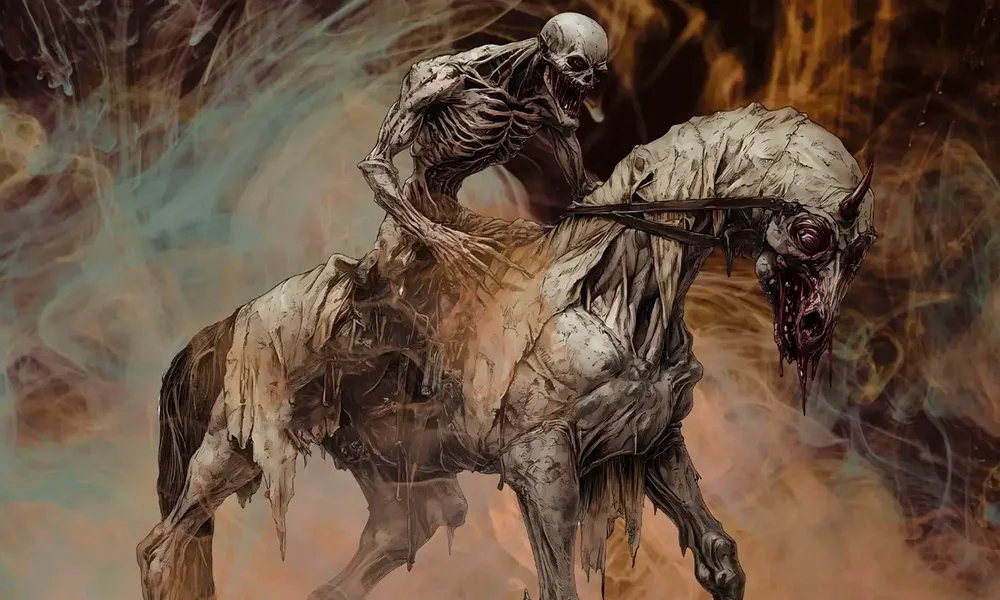
The Nuckelavee is one of the most frightening beings in the folklore of Orkney, the island group north of mainland Scotland. It is usually described as a skinless, horse-like monster with a human torso joined to its back, although details vary between retellings. Orcadian tradition presents it as a malevolent creature of the sea, associated with disease, crop failure, drought and other forms of environmental harm. Unlike many legendary animals, the Nuckelavee is not simply a wild beast: it is a supernatural threat whose presence reflects the dangers of island life, the power of the sea and the vulnerability of farming communities.
Orcadian origins and cultural setting
The Nuckelavee belongs specifically to the folklore of Orkney. The islands have a cultural history shaped by both Scottish and Norse influence, and their traditional stories contain beings connected with the sea, weather, farming, cliffs and dangerous coastal places. Long before modern roads, medical services and scientific explanations of disease, Orcadian communities depended heavily on fragile harvests and livestock. A creature blamed for blight, illness or the failure of crops could therefore embody several real fears at once.
Much of what is known about the Nuckelavee comes from late written records of oral tradition rather than from an ancient manuscript. The Orcadian writer Walter Traill Dennison recorded stories about the being in the nineteenth century, drawing on local tradition from the islands. His account is especially influential in shaping the description now commonly repeated. Earlier oral versions may have differed, and the surviving written record should not be treated as a complete or unchanged account of ancient belief.
Orkney's folklore was transmitted through storytelling, local memory and community knowledge. Names, appearances and incidents could change from one island or speaker to another. As a result, there is no single canonical Nuckelavee story comparable to a fixed literary myth. Modern descriptions often combine details from Dennison's account with later retellings, illustrations and general ideas about Scottish monsters.
The name and its uncertain meaning
The spelling Nuckelavee is the most familiar in English, but variations occur, including Nuckelavee and forms influenced by Orcadian pronunciation. The name is often explained as being related to a term meaning “devil of the sea,” though the exact etymology is not certain. Some discussions connect it with the Scandinavian nykr or related words for water spirits and supernatural water horses. That possible relationship reflects Orkney's Norse linguistic and cultural history, but it does not prove that the Nuckelavee is simply a Norse creature preserved unchanged in the islands.
The name is also sometimes compared with the words behind nuggle, a term used in parts of northern Scotland and the Northern Isles for a water horse or kelpie-like being. Such comparisons are plausible because the Nuckelavee has an equine form and a maritime association. Nevertheless, the name's history remains debated, and similarities in vocabulary do not establish that every water-horse tradition refers to the same being.
Appearance
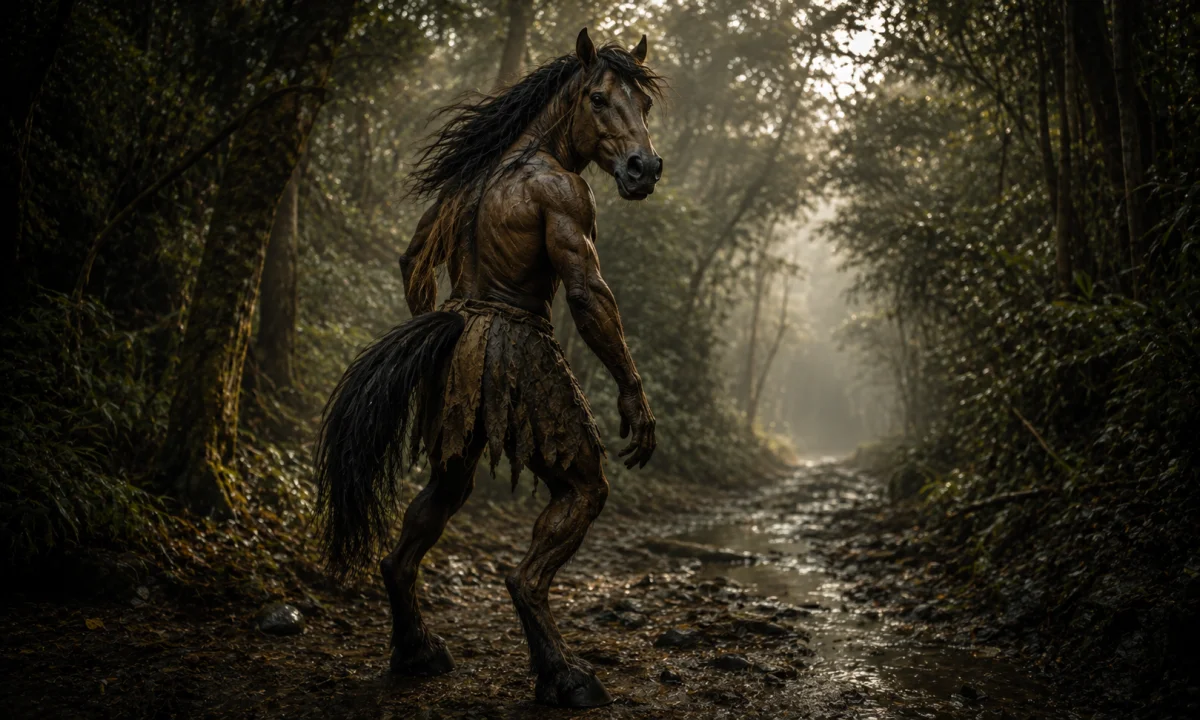
The Nuckelavee is commonly portrayed as a horrifying fusion of a horse and a human. Its lower body resembles a powerful horse, while a human-like torso rises from the animal's back. In the best-known descriptions, the human and horse are not separate rider and mount. They are joined together into one unnatural body, making the creature appear physically distorted rather than merely accompanied by a rider.
Its appearance is traditionally described as skinless. Raw muscle, exposed flesh and dark blood are said to be visible beneath the surface of its body. The creature's horse head is enormous, with a wide mouth and a poisonous or terrifying breath. Some accounts give it a single large eye, while others emphasize its distorted human head, long arms or monstrous proportions. Details are not consistent across all retellings, and many highly graphic visual features belong to later popular presentations of the legend.
The skinless body is particularly important to the monster's effect. It removes the protective boundary normally associated with living creatures and turns the body itself into an image of suffering and corruption. The Nuckelavee is not merely ugly; it appears unnatural, exposed and diseased. Its form suggests a violation of the ordinary boundaries between human, animal and spirit.
Powers and harmful influence
Traditional accounts associate the Nuckelavee with destructive effects on the natural world. It is blamed for crop failure, the drying of fields, livestock disease and outbreaks of illness among people. Its breath is sometimes said to carry pestilence or poisonous influence. These claims place the creature among folklore beings that personify calamity rather than relying only on physical violence.
In an island economy, a bad harvest or epidemic could threaten an entire community. A supernatural explanation gave such events a recognizable agency: misfortune was not random but the work of a hostile presence. The Nuckelavee therefore occupies a role similar to other legendary beings blamed for sickness, storms or the death of animals, while retaining a distinctly Orcadian form.
The monster is also associated with the sea and the coastline. It may emerge from the water or travel along the shore and open land. Its connection with the sea reflects both the practical importance of maritime life and the danger of the surrounding waters. The sea provided food and transport, but it could also isolate communities, destroy boats and expose islanders to sudden weather. The Nuckelavee embodies that double character: the sea is necessary, powerful and potentially hostile.
Protection and the importance of fresh water
One of the most repeated features of the tradition is the Nuckelavee's inability to cross running fresh water. A person pursued by the creature can escape by reaching a stream or another body of fresh water. This boundary gives the legend a practical dramatic device and establishes a clear division between the monster's maritime realm and the human landscape.
The detail should not be treated as a universal rule in every version. Folklore often changes when stories are retold, and some modern accounts present the fresh-water barrier more rigidly than the older material allows. Even so, it remains the most recognizable protective feature of the Nuckelavee legend. It may also reflect a wider pattern in European folklore, where supernatural beings are limited by particular boundaries, materials or natural elements.
In some retellings, the Nuckelavee is especially active during the winter months or at times when the land is vulnerable. The exact seasonal pattern is not uniform, and claims that assign it a fixed calendar or a detailed set of rituals should be regarded cautiously unless they can be traced to a particular local account. The basic tradition does not require an elaborate system of ceremonies or a standardized method for defeating the creature.
Stories and associated figures
The most widely circulated Nuckelavee stories are encounter tales. A person meets the creature while travelling near the shore, crossing exposed ground or returning home after dark. The monster pursues the traveller, who must reach fresh water or another place of safety. These narratives often focus on terror and escape rather than on a complex chain of events.
A related figure in Orcadian tradition is the Mither o' the Sea, a powerful sea being associated with the creation or control of marine creatures in some accounts. Later summaries sometimes describe her as the Nuckelavee's mother, but the relationship is not presented consistently in all versions. The Mither o' the Sea is not simply another name for the Nuckelavee, and the two should not be merged. Their relationship belongs to particular strands of Orcadian storytelling rather than to a universally fixed genealogy.
The Nuckelavee is sometimes said to fear the Mither o' the Sea or to be subject to her authority. Such details help place the monster within a broader imagined population of sea beings, but they should be distinguished from the better-established description of the Nuckelavee as a harmful horse-like spirit. The surviving tradition does not provide a complete mythology with an agreed family tree, hierarchy or set of divine functions.
Religious and folkloric context
The Nuckelavee is generally classified as a folkloric monster or evil spirit rather than as a god. It does not have a formal cult, sacred scripture or widely documented religious practice. Its story belongs to the sphere of local belief, supernatural storytelling and explanations of misfortune. That does not make it culturally insignificant. Folklore can express religious and moral ideas without producing a formal system of worship.
Descriptions of the Nuckelavee sometimes use Christian language, especially the word “devil.” In local tradition, however, a label such as “devil” may function as a translation or description of a dangerous supernatural being rather than evidence that the creature is identical with Satan in Christian theology. The Nuckelavee has no standard place in Christian doctrine. Its association with evil reflects the way Christian vocabulary was often applied to older or non-doctrinal beings in later descriptions of European folklore.
The monster's symbolism can be understood at several levels. It represents the sea as a source of danger, the fear of contagious disease, the fragility of agriculture and the uncertainty of life on remote islands. Its unnatural body also expresses anxiety about the violation of familiar categories: human and animal, land and sea, life and decay. These are scholarly interpretations of the tradition, not explicit explanations supplied by every storyteller.
Distinction from kelpies and other water horses
The Nuckelavee is often compared with the kelpie, the Scottish water horse that commonly appears as a shapeshifting spirit able to lure riders into water. The comparison is understandable because both beings may have an equine form and a dangerous relationship with water. They are not, however, the same creature.
Kelpies are usually associated with inland waters such as lochs and rivers, and many stories emphasize deception, transformation and the danger of mounting the apparent horse. The Nuckelavee is more specifically an Orcadian sea monster whose horse form is fused with a human body and whose destructive powers include disease and environmental devastation. Some local vocabulary and historical influence may overlap, but the traditions should remain distinct.
The Nuckelavee is also not simply an each-uisge, the Gaelic water horse often linked with lochs and the sea. Nor is it identical to every Scandinavian water spirit or to the medieval and early modern concept of a sea devil. Comparative folklore can identify recurring themes, but resemblance does not erase differences in language, region, narrative role and cultural setting.
Historical record and interpretation
Because the Nuckelavee was primarily preserved through oral tradition, evidence about its age is limited. Orkney's Norse heritage provides a possible background for water-horse imagery and certain words, while later Scottish and Christian influences may have shaped descriptions of the creature as a devil. Yet there is no secure evidence showing that the modern image existed in exactly the same form during the Viking Age or in pre-Christian Orkney.
The nineteenth-century recording of the legend is important but also selective. A collector hears stories from particular informants, writes them in a particular style and may organize local material according to literary expectations. Graphic details repeated today may have been emphasized by later writers, artists and popular reference works. The written record is therefore evidence for the history of the legend's transmission, not a transparent record of an unchanged prehistoric belief.
Scholars and folklorists may interpret the Nuckelavee through environmental, social or psychological themes, but no single interpretation explains every version. It can be read as a personification of epidemic disease, a warning about dangerous coastal travel, a survival of water-spirit traditions or a narrative expression of island vulnerability. These possibilities can coexist without turning the creature into a confirmed historical memory of a particular event.
Later reception and popular culture
In modern culture, the Nuckelavee appears in books about monsters, fantasy fiction, role-playing games, video games, podcasts, illustrations and online retellings. These adaptations often heighten its skeletal or demonic appearance, give it additional magical abilities or place it in a broader catalogue of Celtic creatures. Such changes can make the being more familiar internationally, but they are creative developments rather than established elements of Orcadian folklore.
Modern writers also sometimes use “Celtic mythology” as a broad label for beings from very different regions and traditions. The Nuckelavee is more precisely an Orcadian folkloric figure, connected with the Northern Isles and their complex Norse-Scottish cultural history. Calling it simply a Celtic monster can obscure that local identity and suggest a unity that the historical traditions do not support.
The enduring power of the Nuckelavee lies in the combination of a memorable body and a distinctly local set of fears. It is a horse of the sea, a diseased and exposed human-animal form, and a force blamed for the ruin of land and livestock. Its legend remains most meaningful when understood not as a generic fantasy monster, but as an expression of Orcadian folklore shaped by island geography, oral storytelling and the uncertain boundary between natural disaster and supernatural agency.