WORLD
WORLD
Tarasque
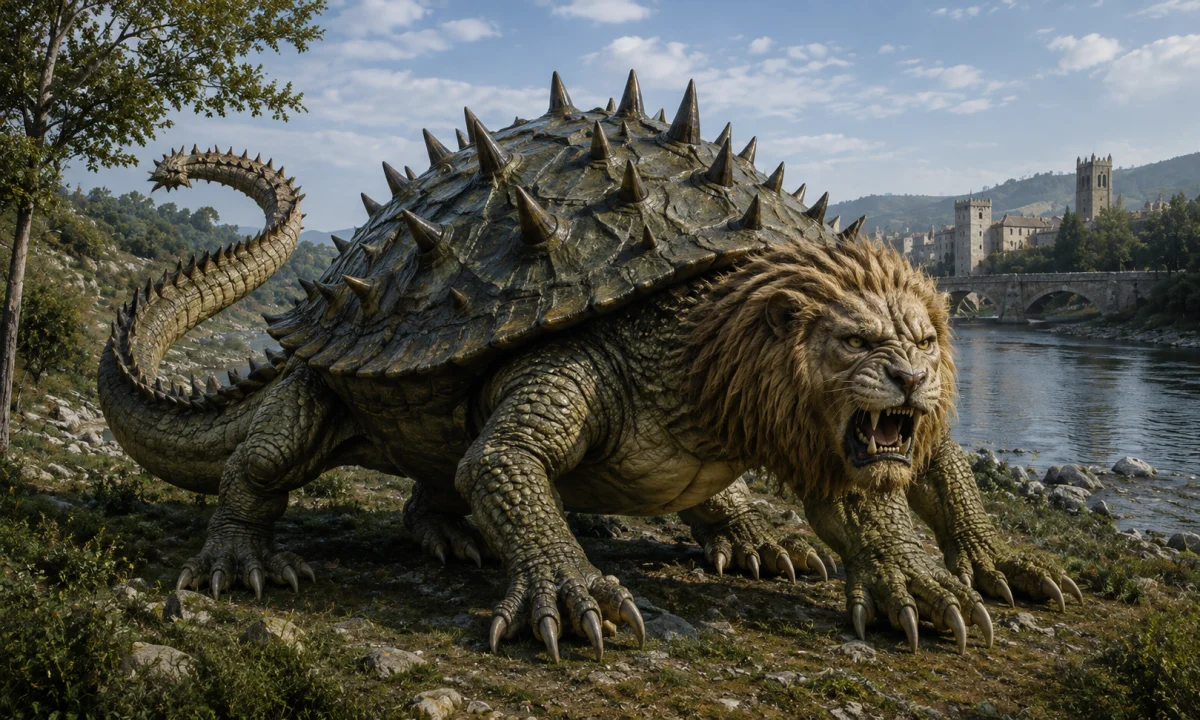
The Tarasque is a legendary monster associated with Provence in southern France, especially the town of Tarascon on the Rhône. In Christian legend, it was a dangerous beast that lived near the settlement of Nerluc until Saint Martha overcame it through prayer and religious authority. The story belongs to the medieval hagiographic tradition surrounding Martha, rather than to the mythology of ancient Gaul as far as surviving evidence shows. Over time, the Tarasque became both a local emblem and the central figure of a major festival tradition.
Origins and cultural setting
The Tarasque is best understood within the religious and cultural world of medieval Provence. The region preserved many local traditions about saints, martyrs, holy places and miraculous encounters with dangerous animals. Such stories often connected a Christian saint with the conversion of a landscape: a wilderness was made safe, a pagan place was reinterpreted, or a threatening creature was defeated by the power of the Christian faith.
The Tarasque legend is linked particularly with Tarascon, a town on the Rhône. Medieval tradition says that the settlement was once called Nerluc and that a monster lived in the surrounding area. The creature attacked travellers and inhabitants, making the countryside unsafe. Saint Martha, who is associated in the New Testament with Bethany, was said to have encountered the beast during her missionary activity in Provence.
The Provençal mission of Martha is not part of the New Testament. It belongs to later Christian tradition, which made Martha, her sister Mary, her brother Lazarus and other figures from the Gospels into evangelists in southern Gaul. According to these traditions, they travelled west after persecution in the Holy Land and took part in the Christianisation of Provence. Historians do not treat this missionary journey as securely established historical fact. It is a medieval sacred tradition that helped connect important Provençal places with the earliest generations of Christianity.
The fullest medieval version of the Tarasque story appears in accounts of the life of Saint Martha, especially in the Golden Legend, a widely circulated collection of saints’ lives compiled by Jacobus de Voragine in the thirteenth century. The tale also circulated through local Provençal traditions and later retellings. Details differ between versions, and no single ancient description fixes the monster’s appearance or behaviour for all time.
The name and identity of the Tarasque
The name Tarasque is closely associated with Tarascon, but the precise origin of the name is uncertain. Medieval forms of the place-name and the monster’s name vary, and proposed explanations have connected them with local linguistic traditions, older place-names and legendary names from the region. These proposals remain interpretations rather than firmly demonstrated etymologies.
There is no reliable evidence that the Tarasque was a clearly defined monster in pre-Christian Gallic religion. Modern descriptions sometimes present it as an ancient Celtic or Gaulish dragon, but that claim goes beyond what the surviving medieval evidence can securely establish. A location may have older pre-Christian history without proving that the particular creature described in Christian legend was inherited unchanged from an ancient religion.
The Tarasque is therefore a medieval Provençal legendary monster with possible connections to older local ideas about dangerous animals, dragons or sacred landscapes, but its documented identity is primarily shaped by Christian storytelling. It should not automatically be classified as a deity, demon or ancient pagan spirit. In the main legend, it is a monstrous animal that becomes part of a saint’s miracle.
Appearance and physical features
Descriptions of the Tarasque are deliberately composite. It is not simply a European dragon with a standard set of wings, scales and flames. Medieval and later accounts combine features from several dangerous or powerful animals, producing a creature that is difficult to place within the ordinary natural world.
Common descriptions give the Tarasque a large body, a hard shell or armour, a fierce head and a long tail. It may be represented with the body of a reptile or turtle, the head of a lion, and a tail resembling that of a serpent or other threatening animal. Some accounts describe six legs. Other versions emphasise claws, sharp teeth, horns or a thick, protective hide. The exact arrangement differs according to the text, image or local retelling.
The Golden Legend describes the creature in hybrid terms and compares parts of it with several formidable animals. Its account is not a zoological description but a literary catalogue of features associated with danger and strength. Later artists and festival makers have taken considerable freedom, so medieval written descriptions, carved or painted images and modern parade figures do not always resemble one another.
In the most familiar modern representations from Tarascon, the Tarasque often has a bulky, low-slung body, a shell-like back, a lion-like face, several legs and a long tail. Bright colours and an open, sometimes smiling mouth are common in festival figures. These features reflect the needs of a large processional effigy as much as any fixed rule of traditional mythology.
The encounter with Saint Martha
The central episode tells how Saint Martha confronted the monster. In the usual form of the story, the Tarasque lived in a wooded or marshy area near the Rhône and preyed upon people who attempted to pass through its territory. It was regarded as so dangerous that armed men had been unable to defeat it.
Martha approached the creature without relying on weapons. Through prayer, the sign of the cross, holy water, or the authority of her faith, she rendered it harmless. Some versions say that she tamed the Tarasque by speaking to it or by fixing it with her gaze. Others stress that her holiness overcame the beast’s violence. She then led it toward the inhabitants of Nerluc, who attacked and killed it once they saw that it had been subdued.
These details vary, and the story does not always present Martha’s action in exactly the same way. In some retellings, the people kill the monster out of fear after Martha has made it docile. In others, the miracle is treated as a complete victory by the saint, with the death of the Tarasque following as the final liberation of the community.
The town’s name is traditionally explained through this event. Nerluc is said to have been renamed Tarascon in memory of the monster. This is a legendary place-name explanation rather than proof of the historical origin of the town’s name. Such explanations are common in medieval storytelling: a remarkable event is used to explain why a landscape, city or shrine bears a particular name.
Meaning in the legend of Saint Martha
The Tarasque episode gives Martha a role that differs from the domestic and hospitable image often associated with her Gospel story. In the New Testament, Martha is known as a follower of Jesus and the sister of Mary and Lazarus. In medieval Christian interpretation, she could also represent practical service, faith and the active defence of the Christian community. The Tarasque legend expands those themes into a dramatic confrontation with chaos.
The monster’s defeat can be read as a story of faith overcoming brute force. Warriors cannot solve the problem, while Martha succeeds through sanctity and command. The tale also follows a familiar Christian pattern in which a saint makes a threatening place safe and brings a community under religious protection.
At the same time, the Tarasque is not merely an abstract symbol of evil in every version. The story presents it as a physical creature that belongs to a particular river landscape and local community. Its defeat is tied to travel, settlement and the safety of ordinary people. This combination of universal religious meaning and local geography helped the legend remain important in Tarascon.
The monster can also be interpreted as a cultural image of uncontrolled nature. The Rhône and its surrounding wetlands, forests and waterways were powerful elements in the life of Provence. A hybrid animal emerging from such a landscape embodies the dangers imagined at the boundaries between settled land and wilderness. These interpretations are scholarly or symbolic readings; medieval storytellers did not necessarily explain the Tarasque in a single, consistent way.
Images, processions and the Tarasque festival
The Tarasque became one of the most distinctive figures in the ceremonial culture of Tarascon. A large model or framework representing the monster is carried or moved through the streets during celebrations. Participants may accompany it with music, costumes and performances, turning the old saint’s legend into a public festival.
The processional creature is not treated simply as a museum reconstruction of an original medieval animal. Festival traditions change as communities adapt them to new materials, civic events and ideas about local identity. The Tarasque may appear frightening, comic, unruly or celebratory, depending on the occasion and the style of the performance.
In local festivities, the monster’s presence allows inhabitants to stage the legend as a shared civic drama. The streets become the landscape of the old story, while the moving effigy makes an otherwise invisible creature visible to the community. Saint Martha and the Tarasque may therefore be represented together, preserving the relationship between the monster and the saint rather than treating the beast as an isolated fantasy character.
The festivals and practices associated with the Tarasque were inscribed on UNESCO’s Representative List of the Intangible Cultural Heritage of Humanity in 2008. This recognition concerns living cultural practices and their transmission, not a declaration that the monster existed as a historical animal or that every detail of the medieval legend is factual.
Variants and changing representations
There is no universally standard Tarasque. Written accounts may disagree about its body, number of legs, habitat and method of defeat. Artistic depictions also reflect the period in which they were produced. One image may make the creature dragon-like, another may give it a turtle shell, and a festival figure may combine features that are only loosely connected with medieval descriptions.
The relationship between the Tarasque and Saint Martha is more stable than the creature’s anatomy. Martha’s role as the saint who tames or defeats the monster is the defining feature of the tradition. Even here, however, the emotional tone can change. The Tarasque may be shown as a savage predator, a subdued animal, a tragic victim or a playful civic mascot.
Some retellings emphasise the monster’s death, while others give greater attention to Martha’s power to tame it. This distinction matters. A story of killing presents the Tarasque as an irredeemable threat; a story of taming presents it as a force that can be brought under control. Both patterns occur in the wider folklore of saintly encounters with dragons and dangerous animals.
Distinction from related monsters
The Tarasque is often grouped with dragons because it is a large reptilian or hybrid creature defeated by a saint. It is not, however, identical to the dragon of Saint George. Saint George’s dragon belongs to a different legend, with its own narrative, geography and religious tradition. Nor should the Tarasque be confused with the dragon-like creatures associated with other French saints, such as the legendary beast defeated or controlled by Saint Radegund or Saint Romanus in separate local traditions.
It also differs from the Guivre and related French folkloric serpents. A guivre is generally a serpent or dragon-like being in French medieval and later tradition, whereas the Tarasque is a particular local monster connected with Tarascon and Saint Martha. Similar reptilian features do not make the figures interchangeable.
Modern fantasy frequently uses the spelling Tarrasque, with an extra “r,” for a gigantic fictional monster. The best-known example is the Tarrasque of the Dungeons & Dragons role-playing game, which has become an influential creature in popular fantasy. That monster draws on the name and broad image of the Tarasque but is not the same being as the Provençal legend. Its powers, size, behaviour and place in a fictional game system belong to modern popular culture.
Tarasque in cultural memory
The enduring importance of the Tarasque comes from the meeting of several traditions: a local place-name legend, medieval Christian hagiography, imagery of hybrid animals and a living civic festival. Its identity is not preserved in one ancient mythological text but through layers of storytelling, religious practice, visual art and public performance.
For Tarascon, the monster is more than a defeated enemy from a saint’s life. It is a marker of local belonging and a figure through which the community represents its own history. The Tarasque’s continued appearance in public celebrations also shows how legendary beings can survive without remaining fixed. Its form changes, but the connection between the monster, Saint Martha and the town remains the central thread of the tradition.