WORLD
WORLD
Nine Worlds
The Nine Worlds are the interconnected realms of Norse cosmology, traditionally understood as being held together or structured around the world tree Yggdrasill. They belong to the religious and mythological traditions of medieval Scandinavia, although the surviving sources do not provide one complete, universally agreed list of all nine worlds. The number nine is important in Norse tradition, but the identities, boundaries and arrangement of the worlds remain partly uncertain.
Origins and cultural setting
Norse ideas about the cosmos developed within the religious cultures of Scandinavia before and during the Viking Age. These traditions were transmitted orally for generations, and much of the surviving written evidence was recorded in Iceland after the conversion to Christianity. As a result, the sources preserve valuable information about pre-Christian beliefs, but they do not constitute a single systematic account of Norse religion.
The most important evidence comes from two groups of medieval writings. The Poetic Edda preserves mythological poems whose origins are generally considered older than their manuscripts, while Snorri Sturluson’s Prose Edda, written in the thirteenth century, explains many myths for an audience interested in poetry and traditional lore. Snorri was a Christian writer looking back on an earlier religious tradition, and his organization of the myths may reflect his own interpretation as well as inherited material.
The idea of nine worlds appears in the poem Völuspá, in which a seeress describes seeing or knowing “nine worlds” associated with the great tree. The poem does not provide a clear numbered catalogue. Snorri also refers to nine worlds, but his account does not remove every ambiguity. Consequently, modern lists of the Nine Worlds are reconstructions rather than an uncontested ancient diagram.
Yggdrasill and the structure of the cosmos
The worlds are commonly imagined in relation to Yggdrasill, the immense ash tree that connects different levels and regions of existence. Its branches extend over the cosmos, while its roots reach into distant and significant places. The gods meet near the tree, and many beings live on or around it.
Yggdrasill is not simply a decorative tree placed in the centre of a finished universe. It is a living structure whose condition reflects the vulnerability of the cosmos. A serpent or dragon named Níðhöggr gnaws at one of its roots, while other creatures inhabit its branches and trunk. A squirrel, Ratatoskr, carries insults between Níðhöggr below and an eagle above. These details emphasize tension, communication and the constant exchange of forces throughout the mythic universe.
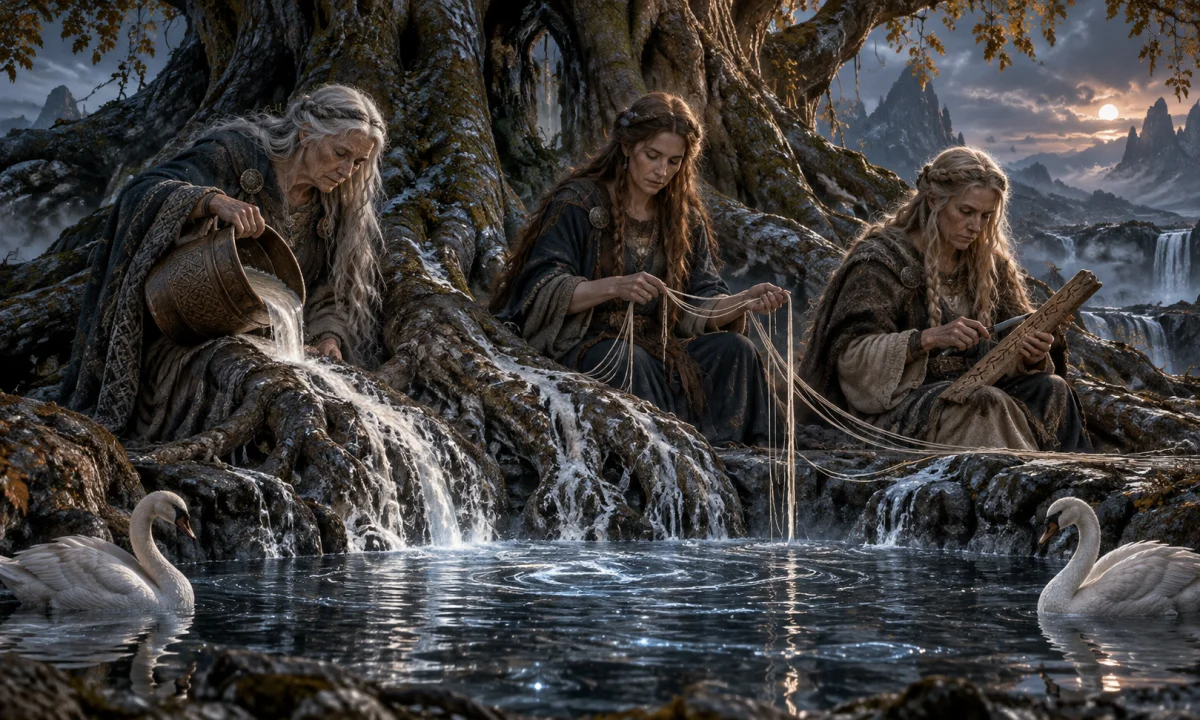
Several wells or springs are connected with the roots of Yggdrasill. The Well of Urðr is associated with the Norns, the beings who shape or determine the destinies of gods and humans. Mímir’s well contains wisdom, and Odin sacrifices an eye to drink from it. Hvergelmir is a primordial spring linked with rivers and with the serpent Níðhöggr. The sources do not always describe these places in exactly the same way, but they show that Norse cosmology was organized around relationships between realms, waters, trees and beings rather than around a simple map.
What are the Nine Worlds?
Lists of the Nine Worlds usually include the following names. The Old Norse spellings vary according to grammatical form and modern editorial practice, and some of the names are more securely attested than others.
- Ásgarðr, the stronghold or world of the Æsir gods.
- Miðgarðr, the inhabited world of human beings.
- Jötunheimar or Jötunheimr, the lands associated with the jötnar, often called giants in English.
- Vanaheimr, the home of the Vanir gods.
- Álfheimr, associated with the álfar, or elves.
- Svartálfaheimr, a realm associated in Snorri’s account with svartálfar, or “dark elves.”
- Niflheimr, a cold, mist-filled region of primordial character.
- Múspell or Múspellheimr, the fiery realm connected with the fire giant Surtr.
- Hel, the realm of the dead ruled by the goddess Hel.
This list is widely used today, but it should not be treated as a direct quotation from a single ancient source. Some traditions and modern reference works replace Svartálfaheimr with Niðavellir, the “Dark Fields” or “Dark Dwellings,” often connected with dwarfs. Others treat Niflheim and Hel as overlapping regions, or place Útgarðr among the worlds. The evidence does not establish one definitive arrangement.
The divine worlds
Ásgarðr
Ásgarðr is the fortified home of the Æsir, the group of gods that includes Odin, Frigg, Thor, Baldr, Tyr and Heimdallr. It is often imagined as a celestial realm, but Norse myths do not present it simply as a heaven separated from all other places. The gods travel between worlds, and Ásgarðr is connected to Miðgarðr by the rainbow bridge Bifröst, guarded by Heimdallr.
Ásgarðr contains halls and estates belonging to different gods. Odin’s hall, Valhöll or Valhalla, receives some warriors who die in battle, while Freyja receives others in her hall Fólkvangr. Valhalla is therefore not identical with Ásgarðr as a whole. It is one place within the gods’ realm, and it is also not the destination of every dead person.
Vanaheimr
Vanaheimr is associated with the Vanir, a group of gods linked in the surviving myths with fertility, prosperity, seafaring, wisdom and magic. Important Vanir include Njörðr, Freyr and Freyja, although the relationships among the divine groups are complicated by different versions of the myths.
The Æsir–Vanir war describes a conflict followed by an exchange of hostages and a reconciliation. Njörðr and his children Freyr and Freyja become closely associated with the Æsir. Vanaheimr is named in Snorri’s work, but the surviving sources give little detailed description of its landscape or organization.
Álfheimr
Álfheimr is the home of the álfar, generally translated as elves. In the poem Grímnismál, Álfheimr is said to have been given to Freyr as a tooth-gift, traditionally understood as a gift made when a child’s first tooth appears. This links Freyr with the realm, although the sources do not offer a detailed account of the elves who inhabit it.
Old Norse álfar should not automatically be equated with the small, winged fairies of later European literature or with modern fantasy elves. The evidence suggests that elves were a distinct category of supernatural beings, possibly connected with fertility, ancestors or powers of the landscape, but their exact nature is uncertain.
The human world and the lands beyond it
Miðgarðr
Miðgarðr means “middle enclosure” or “middle yard.” It is the world of human beings, protected from dangerous outside forces by a boundary or fortification. In the creation myth, the gods make the first human pair, Ask and Embla, from materials found in the landscape and establish human life within Miðgarðr.
The name expresses both location and protection. Humanity occupies a middle position between divine powers and threatening wilderness. Miðgarðr is not necessarily a planet in the modern sense. It is the human region within a larger mythological environment, and its relationship with surrounding realms is more important than its physical shape.
Jötunheimar
Jötunheimar is the land of the jötnar, beings often translated as giants. The term “giant” can be misleading because the jötnar are not defined only by enormous size. They include powerful, ancient beings associated with natural forces, wilderness, mountains, the sea and forces that challenge the gods.
Jötunheimar is often portrayed as a remote and dangerous region beyond the ordered human world. Thor frequently travels there, sometimes to fight jötnar and sometimes to encounter beings whose power exceeds his expectations. The jötnar are not simply evil enemies: several gods have jötunn ancestry, and the gods form marriages and other relationships with them. The opposition between Ásgarðr and Jötunheimar is therefore real but not absolute.
In some stories, Útgarðr is a stronghold within the lands beyond the human enclosure. It is especially famous from the tale of Thor’s visit to the hall of Útgarða-Loki, where the visitors are deceived by magical illusions and fail tests that are later revealed to have been extraordinarily difficult. Útgarðr is sometimes listed as one of the Nine Worlds, but this identification is not secure. It may instead be a particular outer stronghold or a literary place-name associated with the jötnar.
Cold, fire and the realms of the dead
Niflheimr
Niflheimr is connected with mist, cold and darkness. In Snorri’s account, it existed in the primordial age alongside Múspell, before the ordered world had been formed. When the cold of Niflheim met the heat of Múspell, the resulting interaction helped produce the first being, the giant Ymir, and the primeval cow Auðhumla.
Niflheimr is sometimes described as the location of Hel, or as a region containing the realm of the dead. The sources do not always distinguish these places consistently. It is safest to treat Niflheimr as a primordial cold realm and Hel as a specific destination or domain associated with the dead, while recognizing that later retellings often combine them.
Múspellheimr
Múspell, often rendered as Muspelheim in English, is associated with fire and destructive heat. Its inhabitants include the fire beings known as the Múspell-sons, and it is ruled or led by Surtr, a powerful fiery figure who carries a blazing sword.
At Ragnarök, Surtr advances against the gods and sets the world alight. Fire from Múspell is therefore not merely an element but a cosmic force capable of ending the existing order. The final conflagration does not make Múspell identical with all forms of evil; rather, it represents one of the primordial powers that stands outside the stable arrangement of gods and humans.
Hel
Hel is both the name of a realm and the name of its ruler. The goddess Hel is a daughter of Loki and the giantess Angrboða, and she is described as having a body partly associated with the living and partly with death. Odin sends her to govern those who die from sickness or old age, while many who die in battle are assigned elsewhere.
Hel is not equivalent to the Christian concept of hell. In Norse tradition, it is primarily a destination for many of the dead, not necessarily a place of eternal punishment. The condition of its inhabitants can be bleak, and the journey to Hel may be difficult, but the sources do not present every dead person there as wicked or condemned. Baldr’s death is one of the best-known stories involving Hel: he remains in her realm after dying, and the gods’ attempt to secure his release fails when a single being refuses to weep for him.
Dwarfs, dark elves and uncertain classifications
Some popular lists include Svartálfaheimr as one of the Nine Worlds. The name appears in Snorri’s Prose Edda, where it is associated with svartálfar, “dark elves.” In the story of the god Baldr, the gods travel to the realm of the dwarfs, who create the binding that restrains the wolf Fenrir. Elsewhere, Snorri’s terminology can make the categories of dwarfs and dark elves difficult to separate.
Niðavellir is another name frequently included in modern lists. Its meaning is uncertain, and it is mentioned in Völuspá in a passage that connects it with halls or beings beneath the earth. The poem’s wording and interpretation are debated. It is therefore not safe to claim that Niðavellir and Svartálfaheimr are definitely the same place, or that either belongs to a universally accepted nine-part scheme.
Movement between the worlds
Travel between realms is common in Norse mythology. The gods cross Bifröst, ride through the sky, journey by ship or enter strange lands by physical roads. Odin travels widely in disguise, Thor repeatedly visits the territories of jötnar, and Hermóðr rides to Hel in an attempt to recover Baldr.
These journeys often reveal that the boundaries between worlds are permeable but dangerous. A visitor may be challenged by misleading appearances, magical transformations or rules that are not immediately visible. The stories do not portray the worlds as isolated planets with fixed borders. They are overlapping domains connected by roads, bridges, roots, waters, ancestry and supernatural power.
Ragnarök and the fate of the worlds
At Ragnarök, the existing cosmic order breaks down. The gods face their enemies, including the wolf Fenrir, the Midgard Serpent Jörmungandr, the forces of the jötnar and Surtr’s fire. The sun and moon are threatened, the earth suffers devastation, and the boundaries that have kept the worlds in order no longer hold.
Several gods die, including Odin, Thor, Freyr and Heimdallr. Yet the mythology does not end solely with destruction. The earth rises or becomes renewed, some gods survive, and a new human pair, Líf and Lífþrasir, continues human life. Baldr and Höðr are also said to return. The surviving texts give different details, and they do not provide a single fully explained theology of cosmic renewal.
Meaning and interpretation
The Nine Worlds can be understood as a mythological expression of relationships: between order and wilderness, fire and ice, gods and humans, life and death, and the visible world and hidden powers. Their arrangement reflects a worldview in which nature, society and destiny are interconnected.
The number nine has a special place in Norse tradition. Odin hangs on Yggdrasill for nine nights during his ordeal to gain knowledge of the runes, and the god Heimdallr is sometimes associated with nine mothers. These examples do not prove that every group of nine has the same meaning, but they suggest that the number could signify completeness, mystery or a full cycle.
Because the evidence is fragmentary, interpretations should remain cautious. The Nine Worlds were not described in the surviving sources as a standardized chart with universally agreed borders. The familiar modern diagram is a useful way to organize the mythology, but it combines information from poems, Snorri’s prose and later scholarly reconstruction.
The Nine Worlds in modern culture
Modern fantasy, games, novels and films frequently present the Nine Worlds as a precise system of separate realms. The Marvel universe, for example, uses several Norse names while adapting them into a superhero setting with its own geography, characters and history. Other works turn the worlds into locations that can be visited like planets or game levels.
These adaptations have helped make names such as Asgard, Midgard, Jotunheim and Hel widely familiar, but their maps and relationships should not be confused with the surviving Norse tradition. In the older mythology, the worlds are fluid, partly overlapping and imperfectly documented. Their significance lies less in a fixed cosmic diagram than in the stories and tensions linking gods, humans, giants, the dead and the forces that shape the fate of the universe.