WORLD

Nehalennia
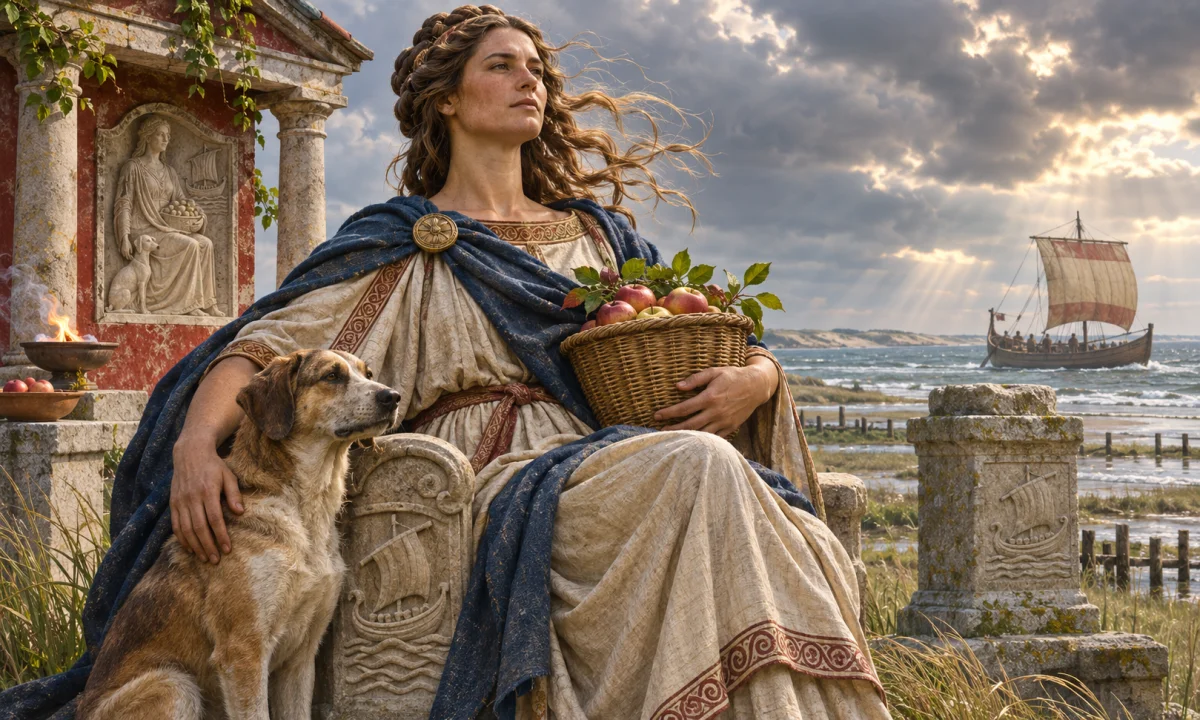
Nehalennia is a goddess known from Roman-period inscriptions and votive altars discovered mainly in the coastal Netherlands. Although she is sometimes listed under Norse mythology, the surviving evidence does not place her securely within the mythology of Scandinavia. She is better understood as a local or regional deity of the North Sea coast, worshipped in a cultural environment where indigenous religious traditions existed alongside Roman institutions and artistic styles.
Origins and cultural setting
Nehalennia was worshipped during the Roman period, probably in the second and third centuries CE. Her principal cult area lay in the southwestern Netherlands, especially around the island and coastal region of Zeeland. In antiquity, the coastline differed greatly from the modern landscape. Settlements, islands, tidal channels and waterways connected the southern North Sea with the Rhine and the wider Roman world.
The people who honoured Nehalennia lived in a frontier region of the Roman Empire. Local communities retained their own languages, customs and religious practices, while adopting Roman forms of public worship, stone carving and inscription. Nehalennia’s altars are a particularly clear example of this cultural mixture: the goddess appears to have had a local name and a distinctive regional identity, but many dedications were written in Latin and followed familiar Roman votive conventions.
Her cult was probably associated with the coastal settlement often identified as Ganuenta. Archaeological remains in the area near modern Colijnsplaat have been connected with a temple or sanctuary dedicated to Nehalennia. The ancient settlement was eventually damaged or submerged as the coastline changed. The exact extent and history of the sanctuary remain matters for archaeological interpretation.
Sources and surviving evidence
Almost everything known about Nehalennia comes from archaeology rather than from a surviving body of myths. More than a hundred stone altars and altar fragments bearing her name have been found, including discoveries made in the waters of the Oosterschelde during the twentieth century. Earlier finds had already drawn attention to the goddess, but the underwater discoveries greatly expanded knowledge of her cult.
The altars are generally votive monuments. Worshippers dedicated them after making a promise or asking for assistance, and inscriptions commonly record that a person fulfilled a vow to the goddess. Some dedicants identify themselves as merchants or traders. Several inscriptions indicate connections with places across the North Sea and in other parts of the Roman Empire, suggesting that her sanctuary served people involved in maritime travel and commerce.
Many altars carry reliefs of the goddess. These images are valuable because they show how worshippers represented her, but they do not provide a complete mythology. An image may express a deity’s power or function without illustrating a particular story. No ancient narrative describing Nehalennia’s birth, family, adventures or conflict with other gods has survived.
Name and classification
The usual spelling is Nehalennia, although inscriptions and modern discussions may show variant forms such as Nehalenia. The meaning and linguistic origin of the name are uncertain. Scholars have proposed connections with Germanic or other local languages, but no interpretation has achieved universal acceptance. The name itself does not prove that she belonged to the Norse pantheon.
Nehalennia is sometimes described as a Germanic goddess, a Celtic goddess, or a local North Sea deity. These labels reflect different attempts to classify a figure whose cultural setting was mixed and whose name is not securely explained. “Local or regional goddess of the Roman Netherlands” is generally a safer description than assigning her confidently to a single later ethnic or mythological system.
There is also no strong evidence that Nehalennia was simply another name for a better-known goddess. Roman authors and worshippers often compared local deities with Roman gods, but the surviving inscriptions do not establish a straightforward identification with Venus, Fortuna, Isis, or any other major deity. Her cult had its own local character.
Appearance and attributes
Reliefs on Nehalennian altars commonly show a seated female figure in a long garment and cloak. Her posture is dignified and formal, resembling the presentation of many protective or civic deities in Roman provincial art. She may sit on a throne or bench, and the sculptural style varies according to the skill, materials and workshop of the person who commissioned the altar.
A dog is one of her most recognizable attributes. It is often shown beside her or at her feet. The dog may symbolize loyalty, guardianship or protection, although the evidence does not allow one precise interpretation. Dogs had varied religious meanings in the ancient world: they could serve as guardians, companions, hunters or creatures connected with healing and the boundary between life and death. Nehalennia’s dog should therefore not automatically be assigned a single universal meaning.
She is also frequently associated with a basket, dish or container filled with fruit or produce. This attribute may suggest abundance, prosperity and the successful outcome of trade. It could also express fertility or the blessings of the land. Because many of her worshippers appear to have been merchants, the image may have carried a practical meaning: safe travel and profitable business were closely connected.
Some reliefs include maritime imagery, such as a ship’s prow or other objects associated with seafaring. The precise identification of individual carved details can be difficult because many altars are damaged or weathered. Even so, the repeated appearance of nautical motifs supports the view that Nehalennia was invoked by people travelling across the North Sea or along connected waterways.
Her representations combine several themes rather than presenting her only as a sea goddess. She appears protective, prosperous and connected with movement between coastal communities. The dog, produce and maritime elements together suggest a deity who could guard travellers while also supporting the economic and domestic well-being that depended on successful journeys.
Role in travel and trade
Nehalennia’s strongest documented association is with merchants and maritime traffic. The North Sea was dangerous, and commercial voyages depended on favourable weather, navigational skill and the security of ports and waterways. A trader could dedicate an altar after reaching safety, completing a voyage or obtaining a successful business result.
Her worshippers were not necessarily all local residents. The inscriptions include personal names and place references that point to a broad network of contacts. Some dedicants came from communities elsewhere in the Roman world, particularly from regions connected by trade routes. Their presence indicates that the sanctuary was not merely a village shrine; it had significance for people whose lives and livelihoods were tied to long-distance travel.
It is important, however, not to turn this evidence into a fully developed mythology of Nehalennia controlling the sea. The inscriptions demonstrate devotion and petition, but they do not preserve prayers in enough detail to explain all the powers worshippers attributed to her. “Protector of travellers and traders” is a reasonable description of the cult evidence, while claims that she ruled every aspect of the ocean or commanded a specific divine fleet go beyond what the sources establish.
Stories, relationships and mythology
No traditional cycle of stories about Nehalennia is known. There are no surviving ancient accounts of her relationships with Odin, Thor, Freyja, Frigg or other figures of Norse mythology. Nor is there evidence of a canonical local epic comparable to the myths preserved in the medieval Icelandic Eddas.
This absence is significant. Many ancient deities are known through inscriptions, offerings and images rather than narratives. A goddess could have been important to worshippers without having a written mythology that survives. Nehalennia’s religious importance must therefore be reconstructed from archaeological context, repeated imagery and the wording of dedications.
The surviving evidence also does not establish a divine consort, parentage or group of companions. Attempts to create a family tree for Nehalennia usually depend on speculation or on comparisons with unrelated deities. Such comparisons may be useful for exploring possible themes, but they should not be presented as documented tradition.
Religious significance
Nehalennia illustrates how religion operated in the coastal provinces of the Roman Empire. Her worship was neither simply “Roman” nor easily separable from the broader religious world of northern Europe. Local religious identity could be expressed through a regional goddess, while Roman-style altars and Latin inscriptions gave that devotion a public and durable form.
The cult also reveals the social importance of merchants. Traders were not only economic actors; they faced physical danger and uncertainty. Religious dedication provided a way to acknowledge divine assistance, express gratitude and establish a visible relationship with a protective power. An altar could record personal success while also contributing to the reputation of a sanctuary visited by other travellers.
Her imagery suggests that protection and prosperity were linked. A safe voyage could bring food, wealth and social stability, while a failed voyage might threaten an entire household or commercial partnership. The goddess’s basket of produce and association with ships therefore need not represent separate areas of authority. Together they may express the desired result of travel: arrival, exchange and abundance.
Nehalennia and Norse mythology
Nehalennia is often placed in a Norse mythology category because of her northern European setting and her possible connection with Germanic-speaking communities. That classification is historically imprecise if it implies membership in the Norse pantheon known from medieval Scandinavian sources.
Norse mythology, as it is usually studied, is documented primarily through medieval Icelandic and Scandinavian texts, along with runic inscriptions and other archaeological evidence. Nehalennia’s evidence is older and geographically farther south. Her known cult belonged to the Roman-period North Sea region, and no surviving text connects her with the gods of the Eddas.
She may have shared broad cultural themes with later Germanic traditions, including reverence for protective female powers, prosperity and travel. Such thematic similarities do not demonstrate identity. Nehalennia should not be treated as an alternative name for Freyja, Frigg or a Norse sea deity. The responsible classification is that she was a distinct regional goddess whose worship existed in a northern European environment before the medieval Norse mythological record was written down.
Distinction from similar figures
Nehalennia is sometimes confused with Nerthus, a Germanic mother or earth goddess mentioned by the Roman historian Tacitus. Nerthus is associated with a sacred wagon and a ritual procession, but the evidence for her cult is separate from the inscriptions and altars of Nehalennia. The two figures should not be merged simply because both are female deities from northern Europe.
She is also sometimes compared with Nehalennia-like figures in later speculative reconstructions of Dutch or Germanic paganism. These reconstructions may be culturally interesting, but they are not equivalent to ancient evidence. Modern writers can create interpretations that connect her with sea travel, fertility or a wider pantheon, yet those connections remain modern or hypothetical unless supported by archaeological material.
Likewise, a resemblance between Nehalennia’s dog and dogs associated with other ancient goddesses does not prove that the deities were the same. Shared symbols were common across the ancient world, and the meaning of an animal could change from one cult to another.
Rediscovery and modern reception
Knowledge of Nehalennia was largely lost after the ancient sanctuary disappeared beneath or near the changing coastal landscape. Her name returned to scholarly and public attention through the discovery of inscribed stones, especially the finds recovered from the Oosterschelde. Museums in the Netherlands preserve and display many of the altars, allowing visitors to examine the combination of local religious identity, Roman inscriptional practice and maritime symbolism.
A reconstructed sanctuary near Colijnsplaat reflects modern archaeological efforts to interpret the ancient cult site. Such reconstruction is an educational representation, not an unchanged survival of the original temple or ritual system. The ancient sanctuary itself must be understood through fragmented remains, inscriptions and comparisons with other Roman-period religious sites.
In contemporary pagan and mythological writing, Nehalennia is sometimes invoked as a sea guardian, protector of sailors, goddess of abundance or ancestral Dutch deity. These roles are compatible with some features of the archaeological record, especially the maritime dedications and images of fruit or produce. However, modern devotional practice and popular descriptions often go beyond what the ancient evidence can confirm. The historical Nehalennia remains a distinctive regional goddess known primarily through the stones her worshippers left behind.