WORLD
WORLD
Ratatoskr
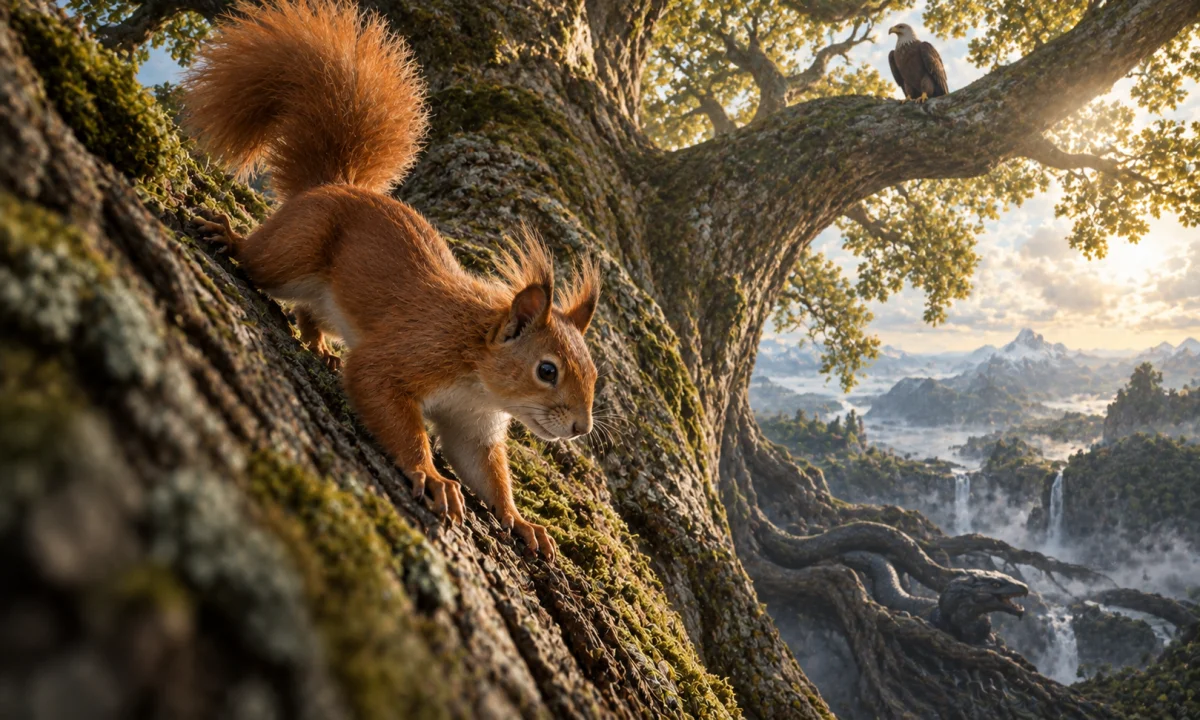
Ratatoskr is a squirrel-like creature in Norse mythology, known for running up and down the world tree Yggdrasil. According to the surviving medieval poems and prose, Ratatoskr carries hostile messages between the great eagle associated with the tree’s crown and the dragon or serpent Níðhöggr, who gnaws at its roots. The figure is brief in the old sources, but the image of a restless messenger travelling between the heights and depths of the cosmos has made Ratatoskr one of the most recognisable minor beings in Norse myth.
Ratatoskr in Norse mythology
Ratatoskr belongs to the mythological world surrounding Yggdrasil, the enormous tree that connects different regions of the Norse cosmos. Yggdrasil is described as suffering various kinds of damage: animals feed upon it, a serpent or dragon gnaws at one of its roots, and other creatures occupy its branches and surrounding spaces. Ratatoskr moves through this living structure, linking beings that otherwise remain far apart.
The surviving evidence for Ratatoskr comes chiefly from two medieval Icelandic works: the poem Grímnismál, preserved in the Poetic Edda, and Snorri Sturluson’s Prose Edda. These works were written down in the thirteenth century, although much of the poetry and mythological material they preserve is generally considered older. The precise age and original form of individual myths are uncertain, and the sources do not provide a long narrative devoted to Ratatoskr.
In Grímnismál, Ratatoskr is named as a creature that runs up and down the ash tree. The poem says that the squirrel carries messages or words between the eagle above and Níðhöggr below. Snorri’s Gylfaginning, part of the Prose Edda, expands this description by saying that Ratatoskr carries hostile or malicious speech between them. The prose account presents the creature as helping to sustain enmity between the two beings.
The name Ratatoskr
The Old Norse name is usually written Ratatoskr, with spelling variations such as Ratatöskr reflecting different editorial and manuscript conventions. Its meaning is not completely certain. It has often been interpreted as something like “drill-tooth” or “bore-tooth,” perhaps combining an element related to boring or travelling with a word associated with a tusk or tooth. Other explanations have been proposed, and the name’s etymology remains debated.
The first part of the name should not automatically be understood as the modern English word “rat.” Nor should the name be treated as a simple statement that Ratatoskr is a rat. In the Norse sources, the creature is identified as a squirrel in the prose tradition, and modern translations commonly call it a squirrel. The uncertain etymology does not change that classification in the surviving mythological account.
Appearance and nature
Ratatoskr is not given a detailed physical description. The source material does not specify its colour, size, voice, sex, age or individual personality. Its most important characteristic is its movement: it travels constantly between the upper branches and the roots of Yggdrasil.
The squirrel form is significant in practical rather than symbolic terms. Squirrels are agile tree-dwelling animals, so a squirrel is well suited to an immense tree that spans the different levels of the cosmos. Ratatoskr’s ability to move vertically allows the creature to connect the eagle at the top with Níðhöggr at the bottom. The image is vivid, but the texts do not explain that the squirrel was chosen according to a specific religious doctrine about squirrels.
Ratatoskr is sometimes described in modern retellings as a trickster. This description can be useful if it refers to the creature’s role in provoking or transmitting quarrels, but it should not be treated as a complete traditional classification. The old sources do not give Ratatoskr the broad range of powers, disguises or adventures commonly associated with major trickster figures such as Loki. Ratatoskr is better understood as a messenger and instigator within the structure of Yggdrasil.
Ratatoskr and the eagle
The eagle at the top of Yggdrasil is not given a personal name in the relevant passages. It is described as a great eagle, and in Snorri’s account a hawk called Veðrfölnir sits between the eagle’s eyes. Veðrfölnir and the eagle are therefore separate figures in the prose description. They should not be merged with Ratatoskr or assumed to be different names for the same animal.
The eagle’s presence at the top of the tree creates the upper end of Ratatoskr’s route. The source does not explain why the eagle and Níðhöggr are enemies, nor does it record a direct confrontation between them. Their hostility is presented as part of the larger, tense life of Yggdrasil. Ratatoskr’s messages keep that hostility active, or at least make it visible.
Ratatoskr and Níðhöggr
Níðhöggr is a dragon-like or serpent-like being associated with the roots of Yggdrasil. The name is commonly translated in ways connected with malice, disgrace or a powerful attack, although exact interpretations vary. Níðhöggr is also associated with the dead in other passages of the Poetic Edda, but the being’s various roles should not be reduced to one simple description.
In the account of Yggdrasil, Níðhöggr gnaws at one of the tree’s roots. Ratatoskr travels between this creature and the eagle, carrying their words. Snorri characterises the messages as slanderous or quarrelsome, making Ratatoskr an intermediary who does not simply pass along neutral information. The creature’s role is closer to that of a provocateur or bearer of insults than to a trusted herald.
The sources do not say that Ratatoskr invents the insults, nor do they describe a particular argument. It is therefore safest to say that Ratatoskr transmits or carries hostile speech, rather than claiming that the squirrel deliberately creates the conflict in a fully developed story. Later retellings often give the animal a more elaborate personality than the medieval evidence supports.
Yggdrasil and the cosmic setting
Yggdrasil is not merely a tree in an ordinary landscape. It is a cosmic structure connected with the worlds, divine assemblies, wells and various animals. The mythological image combines nourishment, danger, decay and continuity. The tree supports life while also being attacked by the creatures that inhabit it.
Several animals are associated with Yggdrasil. A stag or stags feed among its branches, while serpentine or dragon-like creatures affect its roots. The eagle occupies its upper region, and Ratatoskr moves between these levels. This population of animals gives the tree the character of a living ecosystem rather than a static pillar.
Ratatoskr’s role makes the tree a place of communication as well as physical connection. The squirrel carries speech through a vertical cosmic space, linking distant opponents. The myth therefore presents Yggdrasil as a structure through which conflict travels. The tree is not an idealised symbol of perfect harmony; it is exposed to rivalry, feeding, gnawing and continual strain.
What the sources actually say
The most important difference between the two principal accounts is their level of detail. The stanza in Grímnismál is concise. It names Ratatoskr and describes the creature running up and down the ash tree while carrying words between the eagle and Níðhöggr. It does not explain the squirrel’s motives or give an independent adventure.
Snorri’s Gylfaginning presents a more explicit interpretation of the relationship. It states that Ratatoskr runs up and down the ash and carries the eagle’s words to Níðhöggr and Níðhöggr’s words to the eagle. The messages are described as malicious, suggesting that the creature contributes to their antagonism.
Because both accounts are short, many popular claims about Ratatoskr go beyond the evidence. The old sources do not establish that Ratatoskr is immortal in a personal sense, that the squirrel possesses magical weapons, that it serves Odin, or that it participates in Ragnarök as a named combatant. Nor do they give Ratatoskr a spouse, family, origin myth or special connection with humans.
Symbolism and interpretation
Scholars and readers have interpreted Ratatoskr in several ways, but these interpretations should be distinguished from statements directly made by the sources. The creature can be read as an image of gossip, rumour or the movement of hostile speech. It carries words between two powerful beings and thereby represents how conflict can be maintained through communication.
Ratatoskr can also be understood as part of a broader Norse interest in verbal hostility. Insults, accusations, boasts and formal exchanges are important in several mythological and heroic texts. In this context, the squirrel’s activity is not simply comic. It shows that speech can connect distant places while also deepening antagonism.
Another interpretation sees Ratatoskr as a figure of ceaseless movement. The creature is always travelling through Yggdrasil, never settled at the top or bottom. This reading fits the image of a cosmic tree inhabited by forces that continually affect one another, although the sources do not explicitly state that Ratatoskr symbolises motion or change.
It is also possible to view Ratatoskr as a small-scale figure in a mythic system dominated by gods, giants, dragons and cosmic events. The squirrel has no obvious heroic status and does not defeat an enemy. Its importance comes from position and function. A comparatively minor creature can influence the relationship between beings located at opposite ends of the world tree.
Ratatoskr and Ragnarök
Ratatoskr is not assigned a clearly stated role in the surviving accounts of Ragnarök, the catastrophic sequence involving the destruction and renewal of the world. The creature is associated with Yggdrasil, and Yggdrasil is involved in the wider cosmic crisis, but the sources do not say that Ratatoskr fights, dies, escapes or delivers a specific message during Ragnarök.
Some modern versions place Ratatoskr among the creatures active during the final battle or connect the squirrel directly with the tree’s survival. Such additions may work within a particular adaptation, but they are not details securely supplied by the medieval mythological texts.
Distinguishing Ratatoskr from similar figures
- Ratatoskr and Níðhöggr: Ratatoskr is the squirrel that travels through Yggdrasil; Níðhöggr is the dragon-like or serpent-like being associated with the tree’s roots. They are enemies or antagonists in the exchange of hostile words, not alternative forms of one figure.
- Ratatoskr and the eagle: The eagle occupies the upper part of Yggdrasil, while Ratatoskr carries words to and from it. The eagle is not another name for the squirrel.
- Ratatoskr and Veðrfölnir: Veðrfölnir is the hawk said to sit between the eagle’s eyes in Snorri’s account. It is a separate bird and is not Ratatoskr in another shape.
- Ratatoskr and Loki: Loki is a major god-like figure with extensive myths concerning transformation, deception and conflict. Ratatoskr may be called a messenger or instigator, but the sources do not identify the squirrel as Loki or as one of Loki’s forms.
- Ratatoskr and ordinary squirrels: The myth gives Ratatoskr a place within the supernatural environment of Yggdrasil. Although the creature is called a squirrel, it is not simply a record of a particular natural animal observed in an Icelandic forest.
Later reception and popular culture
Ratatoskr has become more prominent in modern fantasy than its brief appearance in the medieval sources might suggest. Writers, artists and game designers often expand the creature into a speaking character with a distinctive personality. It may appear as humorous, sarcastic, mischievous or helpful, depending on the work.
Modern adaptations frequently turn the old messenger into a guide or quest-giver. Some portray Ratatoskr as a friendly guardian of Yggdrasil, while others preserve the traditional association with provocation and argument. These portrayals are creative developments rather than evidence that the medieval sources described the squirrel in detail.
The character has appeared in contemporary video games, comics, novels and other fantasy media, including works that use Norse mythology as a setting or inspiration. In these contexts, Ratatoskr may receive dialogue, powers, relationships and storylines absent from the old poems and prose. The enduring appeal of the figure lies in the contrast between its small animal form and its position within a cosmic network connecting the eagle, the tree and Níðhöggr.