WORLD

Nidhogg
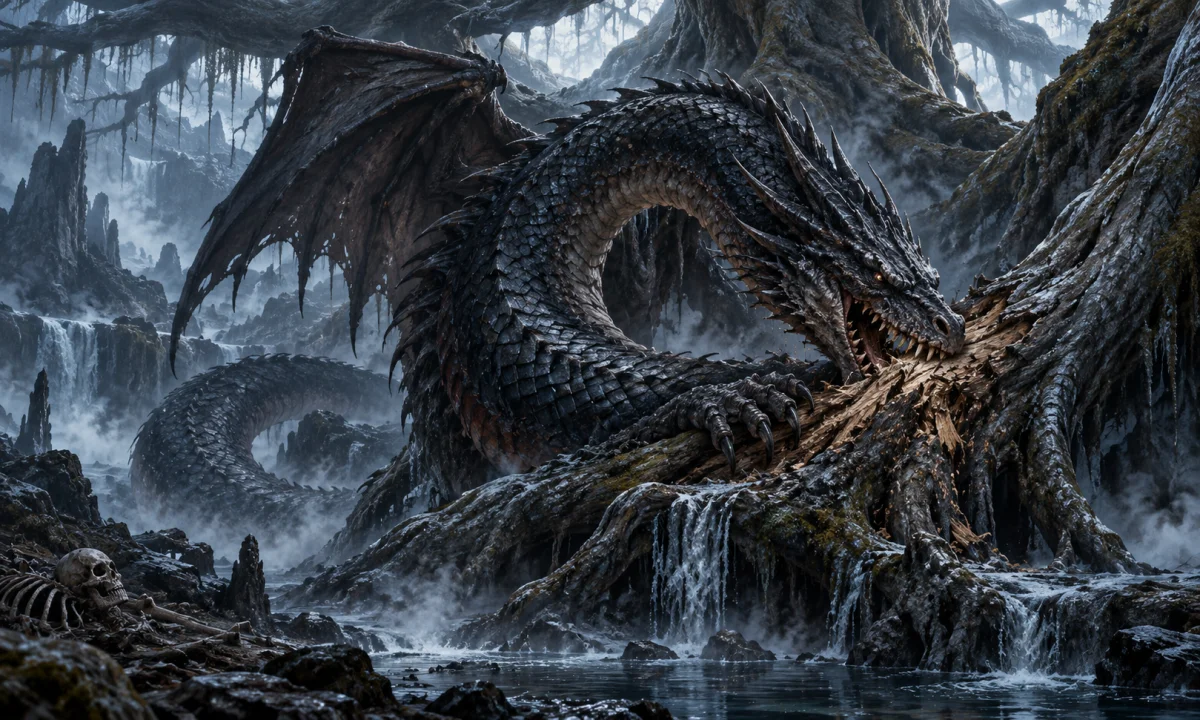
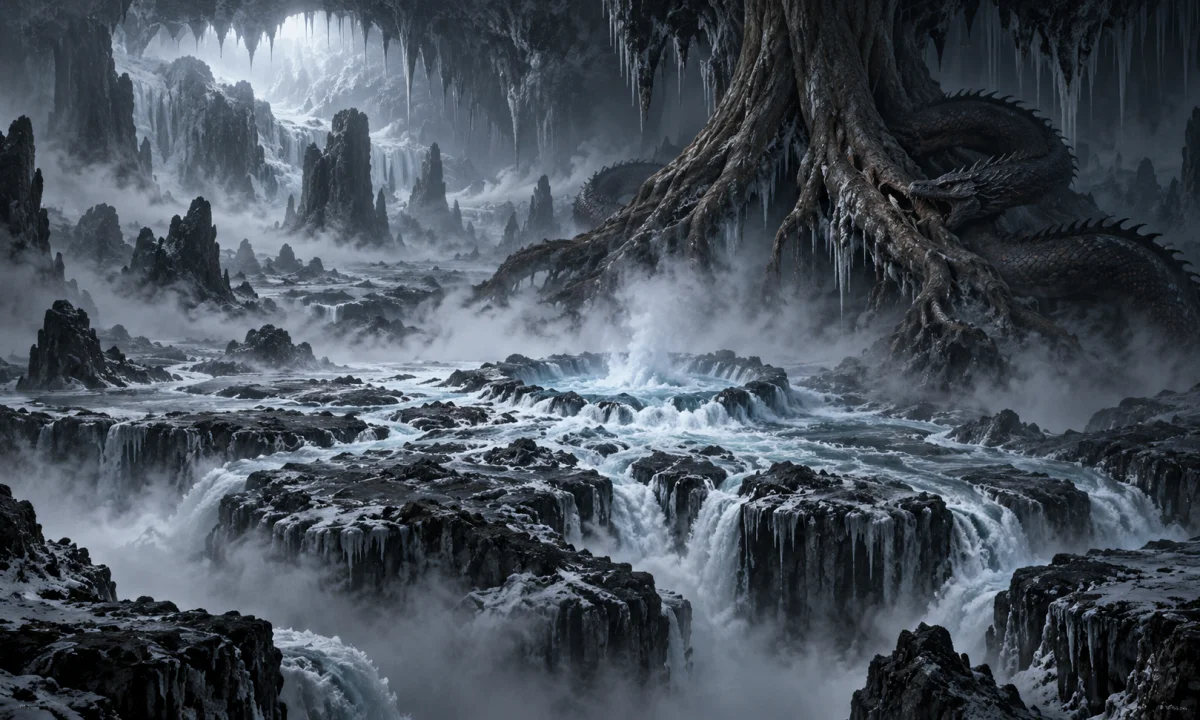
Nidhogg—Old Norse Níðhöggr—is a powerful serpent or dragon in Norse mythology. He lives beneath Yggdrasil, the great ash tree that connects the worlds, where he gnaws at one of its roots. Nidhogg is also associated with the corpses of the dead, especially those who have broken serious moral or social laws. In surviving Norse poems and prose, he represents destruction working beneath the visible structure of the cosmos, although his exact nature and role vary between passages.
Origins and cultural setting
Nidhogg belongs to the mythological world preserved in medieval Icelandic literature, particularly the poems now collected as the Poetic Edda and the prose work known as Snorri Sturluson’s Prose Edda. These texts were written down in Christian Iceland during the thirteenth century, but they preserve material from an older Scandinavian religious and poetic tradition. The age and original form of each individual myth are not always known. Some poems may contain very old elements, while others may have been reshaped through generations of oral performance.
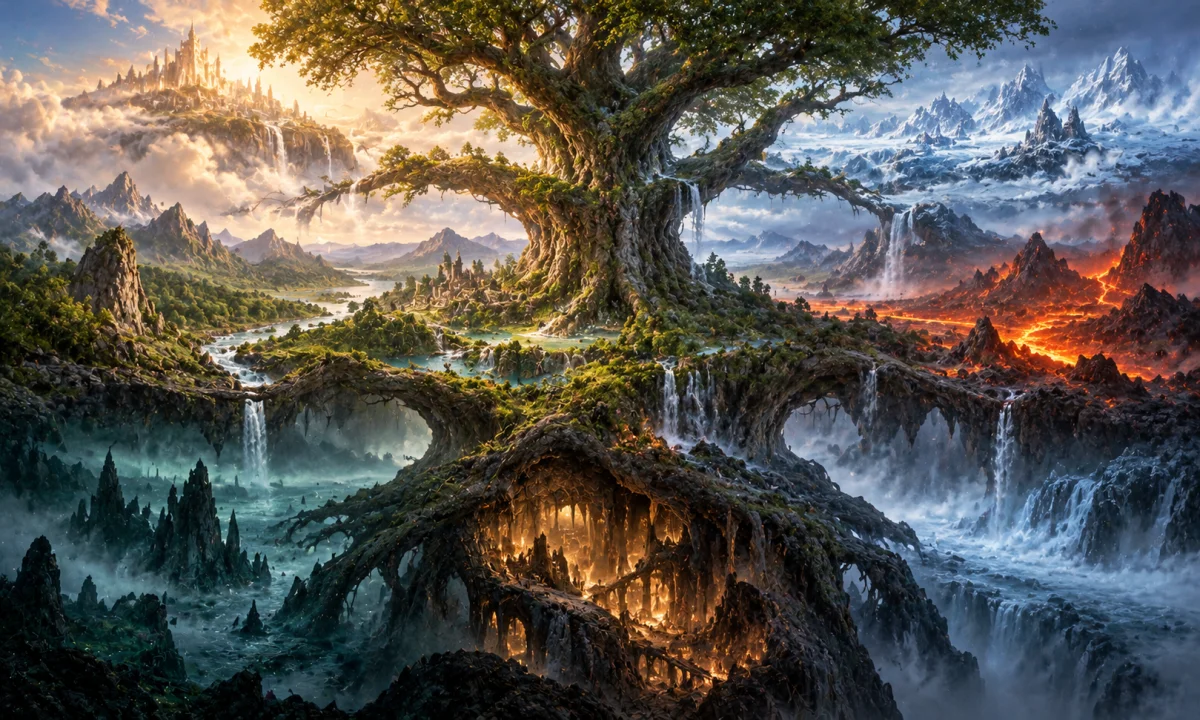
In pre-Christian Norse religion, the universe was imagined not as a single orderly realm but as a network of connected worlds inhabited by gods, giants, humans, the dead and many other beings. Yggdrasil stood at the centre of this cosmic structure. Its branches reached into the heavens, while its roots extended into regions associated with the gods, the giants and the underworld. The tree was not simply a symbol of life. It was also vulnerable, constantly threatened by animals, decay and hostile forces.
Nidhogg is one of the beings that damages Yggdrasil from below. This makes him part of a wider picture in which the cosmic tree requires continual care yet can never be made permanently secure. The gods and other creatures interact with Yggdrasil, but no surviving myth presents the tree as entirely free from injury. Its condition reflects the unstable and cyclical character of the Norse cosmos.
Name and identity
The name is commonly written Níðhöggr in normalized Old Norse, while Nidhogg is the usual English form. Spellings such as Nidhǫggr and Níðǫggr may also appear in discussions of Old Norse manuscripts and editions. The name’s meaning is not completely certain.
The first element, níð, can refer to disgrace, insult, hostility or a dishonourable act. The second element is related to the verb höggva, “to strike” or “to hew.” For this reason, the name is often translated in ways such as “Malice Striker,” “Striker of Disgrace” or “the One Who Strikes with Malice.” Other interpretations connect the name more loosely with the creature’s violence against corpses. English translations therefore differ, and no single rendering should be treated as definitive.
Nidhogg is generally identified as a serpent or dragon. Old Norse poetry does not always classify mythical creatures according to the precise categories used in modern fantasy. The terms for serpent, worm, dragon and monstrous reptile can overlap, and the surviving sources do not provide a detailed natural history of Nidhogg. Describing him as a dragon is acceptable in many contexts, but “serpent” may be closer to the imagery of the poems, especially where he is shown beneath the world tree.
Appearance and attributes
The surviving sources give only a limited physical description. Nidhogg is imagined as a huge, dangerous reptilian being capable of gnawing through the roots of Yggdrasil. He is associated with venomous or destructive creatures, but the texts do not establish a complete list of his powers. Later illustrations and modern fantasy often give him wings, horns, armour-like scales or a distinctly dragon-shaped body. Those features are artistic developments rather than details consistently supplied by medieval Norse sources.
His most important attribute is his position beneath the tree. He is not primarily introduced as a wandering monster or as a treasure guardian. His dwelling is connected with the deep and threatening regions below the ordinary world. In the mythology of Yggdrasil, what lies beneath the tree is not merely empty darkness. It includes wells, roots, the realm of the dead and creatures that participate in the slow weakening of the cosmic order.
Nidhogg’s feeding on corpses gives him a second major characteristic. This association links him with death, punishment and the dishonoured dead. It does not mean that every dead person in Norse belief was imagined as food for Nidhogg. Norse traditions describe several different destinations and conditions after death, and the surviving poems do not offer a single, systematic map of the afterlife.
Nidhogg and Yggdrasil
The clearest account of Nidhogg’s role appears in descriptions of Yggdrasil. In the poem Grímnismál, the great ash is said to suffer greatly: deer feed on its branches, its trunk decays or is harmed, and Nidhogg gnaws at it from beneath. The poem presents the tree as a living structure under continuous pressure rather than as an invulnerable pillar.
Snorri’s Prose Edda, especially the account of the world in Gylfaginning, expands this imagery. Nidhogg lies beneath the ash and gnaws one of its roots. A number of snakes are also said to dwell there, and the squirrel Ratatoskr travels up and down the tree carrying hostile messages between Nidhogg below and an eagle perched in the branches above. The eagle is not given the same importance as Nidhogg, and its personal identity is uncertain; a hawk named Vedrfolnir is described as sitting between the eagle’s eyes.
The quarrel between the eagle and Nidhogg, mediated or aggravated by Ratatoskr, illustrates the tension running through Yggdrasil. Forces at the top and bottom of the tree are connected but antagonistic. The squirrel’s role is sometimes presented as that of a messenger and sometimes as a malicious instigator, depending on translation and interpretation. The story does not say that Nidhogg alone threatens the tree. Instead, he is one part of a network of creatures whose actions express the tree’s vulnerability.
It is important not to interpret Nidhogg as simply “the enemy of Yggdrasil.” The tree continues to stand despite his gnawing, and the poems do not describe a heroic quest to kill him and restore cosmic harmony. His destructive activity appears to be built into the condition of the world. Yggdrasil lives, suffers damage and is sustained through a continuing process rather than existing in perfect permanence.
Nidhogg and the dead
In Völuspá, the seeress describes a grim hall in a region associated with the dead. The hall is traditionally called Náströnd, a name often interpreted as “Corpse Shore.” Serpents fill it, and those who have committed serious offences endure punishment there. Nidhogg appears in connection with the corpses of the dead, described in translations as sucking or feeding on them.
This passage is one reason Nidhogg is frequently associated with the underworld. Yet the poem does not make him identical with the ruler of the dead. Nidhogg is not Hel, the female being who governs a realm of the dead, and he is not simply another name for that realm. His role is that of a predatory or tormenting creature within an otherwise complex landscape of death and punishment.
The exact offences punished at Náströnd are also debated in translation and interpretation. The poem explicitly mentions oath-breakers and murderers, along with people guilty of other grave violations. Some versions or translations emphasize social and moral crimes, while the language of the original can be difficult to interpret with complete certainty. Nidhogg’s presence reinforces the atmosphere of dishonour, pollution and violent retribution, but it should not be turned into a detailed doctrine of Norse punishment that the sources themselves do not provide.
Nidhogg at the end of the world
Nidhogg appears near the end of Völuspá, after the poem’s account of cosmic destruction and renewal. The final image is difficult and has been translated in several ways. Nidhogg is described as coming or flying from below, with corpses associated with him. Some translations say that he carries the dead in his wings; others handle the grammar differently and give a less definite image.
This ending has encouraged the idea that Nidhogg survives Ragnarök and remains a threat in the renewed world. That interpretation is possible, but the poem does not offer a fully explained sequel. It does not clearly state whether Nidhogg is permanently victorious, whether he merely appears during a final vision, or how his activity relates to the rebirth of the earth. The final image is intentionally unsettling: even after the old order has been destroyed and a new world has emerged, death and destructive forces have not simply disappeared.
Nidhogg should not be confused with the major combatants of Ragnarök. He does not take the place of Jörmungandr, the Midgard Serpent, whose struggle with Thor is one of the central battles of the final conflict. Nor is Nidhogg described as a god who fights in the armies of the giants. His connection with the end of the world is more atmospheric and symbolic than martial.
Symbolism and interpretation
Nidhogg can be understood on several levels, although no single interpretation is confirmed by the surviving tradition. His attack on Yggdrasil suggests that destruction is present within the cosmos itself. The world is not threatened only by an outside invader; it is also worn down from below by forces already embedded in its structure.
His association with corpses gives this image a moral dimension. Nidhogg’s victims in Náströnd are not merely dead people but, in the poem’s presentation, figures connected with serious wrongdoing. The creature therefore participates in an image of shame and punishment. The possible connection between his name and níð—dishonour or malicious abuse—supports this interpretation, though the precise etymology remains uncertain.
At the same time, Nidhogg should not be reduced to a simple embodiment of evil in the later Christian or modern fantasy sense. Norse mythology contains many dangerous beings, and moral categories do not always map neatly onto the idea of an absolute cosmic devil. Nidhogg is hostile, destructive and associated with the dead, but the texts do not portray him as the single source of all wickedness or as the opposite of one particular god.
His position below Yggdrasil may also reflect a broader mythological contrast between heights and depths. The eagle above and Nidhogg below are connected through Ratatoskr’s movement along the trunk. The arrangement creates a vertical drama in which the world tree joins opposing regions without resolving their conflict. It is less a diagram of good versus evil than a picture of a universe held together by tension.
Distinguishing Nidhogg from similar figures
- Jörmungandr: The Midgard Serpent encircles the human world and is the enemy of Thor. Jörmungandr rises from the sea at Ragnarök and dies after Thor strikes him, though Thor then succumbs to the serpent’s venom. Nidhogg instead dwells beneath Yggdrasil and is linked with its roots and with the dead.
- Fáfnir: Fáfnir is originally a dwarf or man who becomes a dragon through greed and curses associated with treasure. He is slain by the hero Sigurd. Nidhogg is a mythic creature of the cosmic tree and is not the same being.
- Hel: Hel is a daughter of Loki and the ruler of a realm of the dead. Nidhogg is a serpent or dragon associated with that realm’s darker imagery, but he is not its ruler.
- Ratatoskr: Ratatoskr is the squirrel that runs along Yggdrasil. He carries words between the eagle above and Nidhogg below, but he is not a smaller form or servant-name of Nidhogg.
- Other root-serpents: Grímnismál names several snakes beneath Yggdrasil besides Nidhogg. Their names and roles are not always easy to interpret, and they should not automatically be treated as alternate names for him.
Surviving tradition and uncertainty
The medieval evidence for Nidhogg is brief compared with the large body of modern writing about him. The poetic references are compressed and highly allusive, while Snorri’s prose account organizes the mythological material into a more systematic narrative. Snorri is an important witness to Norse myth, but he was writing centuries after the conversion of Iceland and may have arranged older traditions according to his own literary and scholarly purposes.
As a result, several popular details cannot be securely attributed to the ancient tradition. The sources do not clearly establish Nidhogg’s parentage, a spouse, a personal history, a fixed size or a complete set of magical abilities. They also do not present a straightforward account of his defeat. Claims that he is the child of a particular god or giant, that he rules all dragons, or that he possesses a special hoard generally come from modern invention, loose reinterpretation or confusion with other legendary beings.
Later reception
Nidhogg has become especially visible in modern fantasy, games, novels, comics and visual art. These adaptations often portray him as an enormous winged dragon, a final boss, an ancient godlike enemy or a guardian of forbidden knowledge. Such uses draw on his striking names and imagery, but they frequently combine him with characteristics belonging to Jörmungandr, Fáfnir or dragons from later European folklore.
In traditional Norse material, Nidhogg’s power comes less from a catalogue of supernatural attacks than from his place in the structure of the mythic world. He gnaws beneath Yggdrasil, is connected with the dishonoured dead and appears in the ominous final movement of Völuspá. His presence expresses a distinctive Norse vision of cosmic life: even the world tree that binds the realms together is living under the pressure of decay, conflict and death.