WORLD

Niflheim
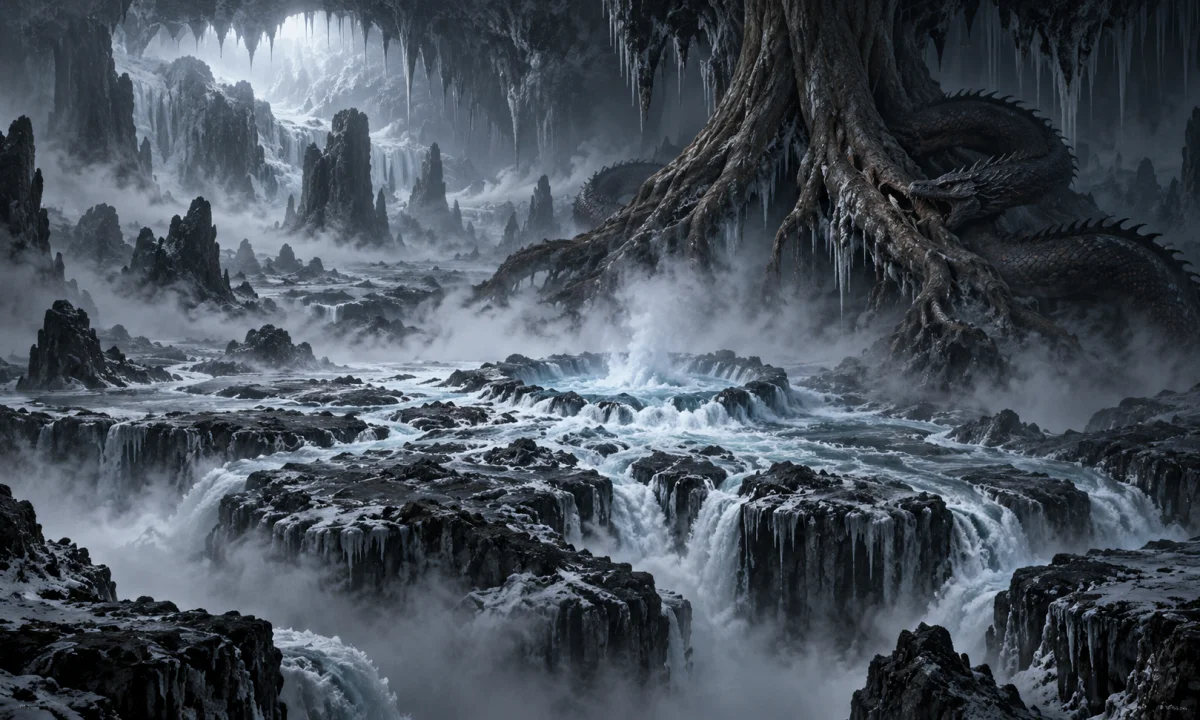
Niflheim is a place associated with cold, mist, darkness and primordial forces in Norse mythological tradition. Its name is Old Norse Niflheimr, usually understood as “world of mist” or “home of mist.” The surviving descriptions come chiefly from the medieval Icelandic writer Snorri Sturluson, who presents Niflheim as a primordial region in the northern part of the cosmos and as a place connected with the realm of the dead. The word is also closely related to Niflhel, but the two names are not always used in exactly the same way.
Origins and surviving sources
Information about Niflheim comes from a limited and complicated body of evidence. Norse religious traditions were transmitted orally for generations before being written down, mainly in Iceland during the thirteenth century. The most detailed account of Niflheim appears in Gylfaginning, the opening section of Snorri Sturluson’s Prose Edda. Snorri was a Christian author writing centuries after the conversion of Iceland, and his work combines traditional mythic material with his own explanations, organization and literary framing.
The Poetic Edda preserves older poems that contain related ideas, although it does not provide a single, systematic description of Niflheim. The poem Vafþrúðnismál describes the primordial rivers called Élivágar and asks about the origin of the giant Ymir. Other poems refer to Niflhel, Hel and the destinations of the dead. These references suggest a cluster of traditions involving mist, cold and an underworld, but they do not establish that every source imagined one fully consistent realm called Niflheim.
For that reason, Niflheim should not be treated as a clearly mapped “planet” or kingdom in the modern fantasy sense. Its character varies according to the source. Snorri gives it a prominent place in a cosmic geography, while the poems often use related names and images more briefly and poetically. Some details commonly associated with Niflheim may therefore reflect Snorri’s synthesis rather than a universally shared feature of pre-Christian Norse religion.
The meaning of the name
The first element, nifl-, is associated with mist, fog or obscurity. The second element, heimr, means “world,” “land” or “home.” Niflheimr can consequently be translated as “Mist-World,” “Mist-Land” or “Home of Mist.” No single English translation captures every possible nuance, but “world of mist” is the most common.
The name conveys more than a visual atmosphere. In Norse mythic language, cold, darkness and frozen water belong to the earliest conditions from which the ordered world emerges. Niflheim is therefore associated with cosmic otherness: it lies outside the familiar human world and represents forces that are ancient, hostile or not yet shaped into ordinary life.
Niflheim in Snorri’s creation account
In Gylfaginning, Niflheim is one of two primordial regions separated by the empty gulf called Ginnungagap. Niflheim lies toward the north and is characterized by intense cold, frost and mist. Opposite it is Múspell or Muspelheim, a realm of heat and fire associated with the fire giants and the destructive forces of Ragnarök.
When the frost from Niflheim meets the heat and sparks from Muspelheim across Ginnungagap, the first living beings arise. The earliest of these is the primeval giant Ymir, also called Aurgelmir in some traditions. A cow named Auðhumla emerges as well. She feeds Ymir with her milk, while she herself licks salty frost-covered stones. From those stones the first god, Búri, is revealed. Búri becomes the ancestor of Odin, Vili and Vé, who later kill Ymir and construct the inhabited cosmos from his body.
In this account, Niflheim is not simply a place where dead people go. It is one of the elemental conditions of creation. Its freezing vapour and waters provide one half of the opposition that produces the first generation of beings. The world is formed not from a peaceful act of creation but from the meeting of conflicting powers: frost and flame, north and south, stillness and heat.
Hvergelmir and the Élivágar
Snorri places the spring Hvergelmir in Niflheim. The name is often interpreted as “roaring kettle” or “bubbling cauldron.” Hvergelmir is presented as an ancient source from which numerous rivers flow. These rivers include the Élivágar, a name commonly translated as “ice waves” or “stormy waves,” although the exact meaning is debated.
According to Gylfaginning, the Élivágar flowed far from their source and carried poisonous matter. As the liquid hardened into frost, the frozen substance spread through Ginnungagap. Where this frost encountered the sparks and heat of Muspelheim, the first life appeared. Snorri thus makes Hvergelmir and the Élivágar part of a chain linking Niflheim to the origin of Ymir.
The poem Vafþrúðnismál also mentions the Élivágar in connection with Ymir’s origin, but its wording does not provide all the geographical details found in Snorri’s account. This is one reason scholars distinguish between the older poetic evidence and Snorri’s more elaborate cosmological framework.
Cold, mist and primordial danger
Niflheim’s most consistent qualities are not its architecture or inhabitants but its environmental character. It is imagined through images of:
- freezing cold and rime;
- dense mist and obscurity;
- dark or subterranean spaces;
- poisonous or turbulent waters;
- distance from the ordered world of humans and gods.
These features make Niflheim a useful contrast to the fertile and inhabited regions of the Norse cosmos. It is not a paradise, and it is not merely an ordinary winter landscape. Its cold is primordial and dangerous, linked to the formation of the earliest beings and to spaces beyond the boundaries of human society.
At the same time, Niflheim is not simply equivalent to evil. Norse mythology does not generally divide the cosmos into a straightforward moral opposition between a good heaven and an evil hell. The forces of cold, darkness and death can be threatening without representing moral wickedness. They are part of the world’s structure, just as fire, fertility, order and heroic power are.
Niflheim and the realm of the dead
Niflheim is frequently described in modern summaries as the Norse land of the dead. This description has some basis in medieval sources but is too simple if applied without qualification. In Snorri’s account, the realm ruled by the goddess Hel is connected with Niflheim. People who die from sickness or old age are said to go to Hel, while those who die in battle may be selected for other destinations, such as Odin’s Valhalla or Freyja’s Fólkvangr.
Snorri also describes Hel’s domain as lying downward and associates it with Niflheim. In some passages, however, he distinguishes the names and appears to use Niflheim, Hel and Niflhel in overlapping but not identical ways. The exact relationship between these terms is uncertain because the poetic sources do not present a single, detailed map of the afterlife.
Hel is both the name of a goddess and the name of the realm over which she rules. She is the daughter of Loki and the giantess Angrboða, and the sister of the wolf Fenrir and the serpent Jörmungandr. Odin casts her into the underworld, where she receives those who die in ways not assigned to the battle dead. Her appearance is described as partly living and partly corpse-like, a bodily image that reflects her authority over the boundary between life and death.
Niflheim should therefore not be identified automatically with Hel herself. Hel is a distinct figure, while Niflheim is primarily a place-name or cosmic region. The two are connected in Snorri’s account, but merging them removes an important distinction in the mythology.
Niflhel and related names
Niflhel is a related but separate term. It combines nifl, “mist” or “darkness,” with Hel. It may mean “misty Hel” or refer to a deeper or especially dark region of the underworld. In some poetic passages, Niflhel appears to be a destination or lower area associated with the dead, while Snorri’s presentation places it in a broader system involving Hel and Niflheim.
The evidence does not support a universally agreed distinction in which Niflheim always means one fixed realm and Niflhel always means another. Medieval authors and later interpreters may have organized these names differently. Care is also needed with the word Helheim, a popular modern expression meaning “realm of Hel.” It is understandable as a descriptive term, but it is not necessarily the standard name used across the oldest sources.
Other underworld locations should not be treated as synonyms for Niflheim. Náströnd, or “Corpse Shore,” is a particularly grim place described in Völuspá, where oath-breakers and murderers suffer after death. The poem depicts a hall or shore with serpents and venom, but it does not simply call the place Niflheim. Snorri incorporates Náströnd into his account of the afterlife, yet the relationship between these traditions remains a matter of interpretation.
Connections with Yggdrasil
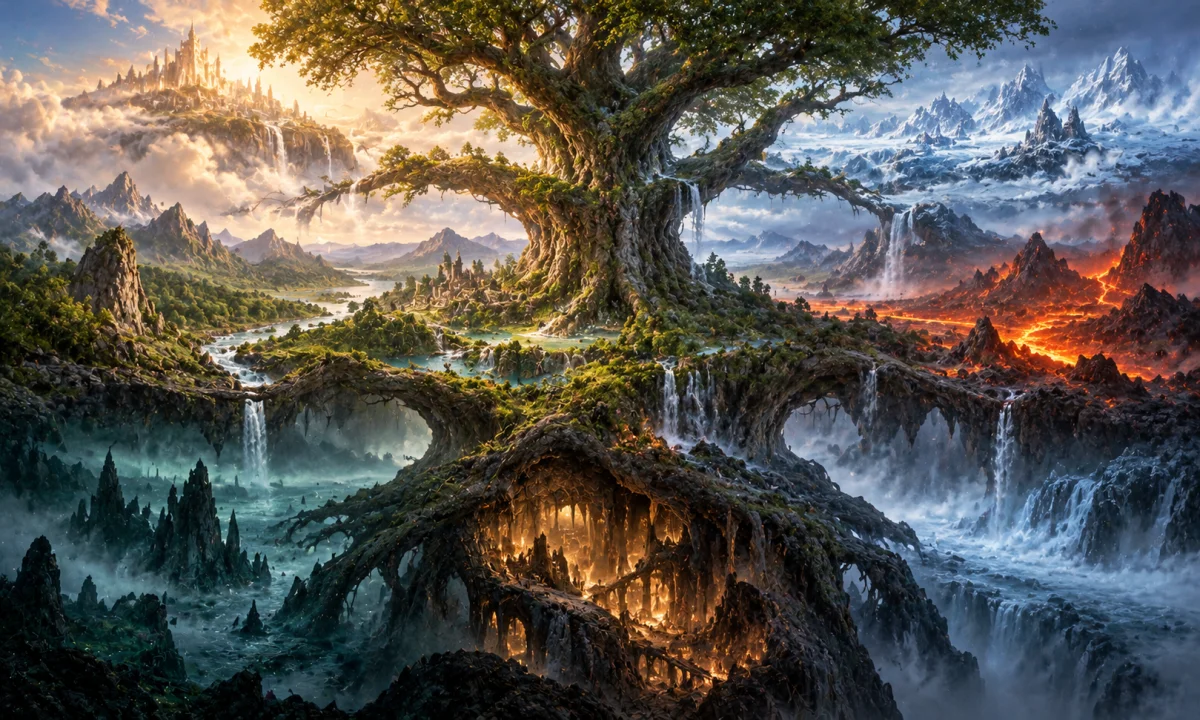
Snorri describes the cosmic tree Yggdrasill as extending through the worlds. One of its roots reaches toward Hvergelmir, another toward the well of Mímir, and another toward the well associated with the goddesses known as the Norns. Because Hvergelmir is located in Niflheim, the region is connected with the roots and lower reaches of the cosmic tree.
Yggdrasill’s roots are not simply underground in the ordinary physical sense. They extend into different dimensions of the mythic cosmos, linking the world of gods, giants, humans and the dead. Hvergelmir’s location beneath or near one root reinforces Niflheim’s role as a place of origin and depth. The spring is also associated with serpents and with the dragon Níðhöggr, who gnaws at the roots of Yggdrasill. These details belong to the wider imagery of the cosmic tree and should not be taken to mean that every version of Niflheim contains the same inhabitants or landmarks.
Role in Ragnarök
Niflheim is not the principal battlefield of Ragnarök. The final conflict is more directly associated with the breaking of cosmic boundaries, the attack of the giants and monsters, and the destruction and renewal of the world. Muspelheim’s fire and the fire giant Surtr play a major role in the apocalyptic imagery.
Even so, Niflheim belongs to the larger network of forces surrounding death, decay and the limits of cosmic order. The dragon Níðhöggr, the underworld and the roots of Yggdrasill participate in the mythic picture of a cosmos that is never completely stable. After the destruction, the world is renewed, but the old forces connected with death and the depths are not simply erased from the mythic imagination.
Cultural and religious significance
Niflheim reflects several important patterns in Norse cosmology. First, it expresses the idea that the world emerges from a meeting of opposites rather than from a single, orderly act. Frost and fire are both dangerous, but together they generate the conditions from which the gods, giants and later worlds arise.
Second, Niflheim represents the power of the landscape. Ice, fog, darkness, rivers and subterranean depths were not merely decorative features in Norse storytelling. They could symbolize forces beyond human control, especially in northern environments where winter and exposure posed real dangers. The mythic world gives these experiences a cosmic scale.
Third, Niflheim helps show that Norse ideas about death were plural rather than uniform. The dead might be connected with Hel, Valhalla, Fólkvangr, burial mounds or other destinations depending on how they died and which tradition is being followed. There was no single, fully standardized Norse doctrine of the afterlife preserved in the surviving sources.
Niflheim in modern culture
Niflheim remains popular in fantasy literature, games, films and television. Modern works often portray it as a frozen underworld, a hostile realm of monsters or a distinct level in a neatly organized multiverse. Such portrayals draw on genuine traditional elements—mist, frost, the dead, Hvergelmir and the connection with Hel—but usually combine them with material from other Norse myths or with entirely new settings.
In particular, modern fiction may present Niflheim as the exact opposite of Muspelheim, a pair of fully developed elemental worlds. This is a useful dramatic structure, but the surviving medieval evidence is more uneven. Snorri clearly sets Niflheim’s cold against Muspelheim’s heat in his creation account, while the poetic sources do not supply a complete atlas of two rival realms. Modern depictions are therefore adaptations rather than straightforward reproductions of a single ancient description.
Niflheim is best understood as a mythic region of mist, frost and deep cosmic antiquity, linked both to the beginnings of creation and to the shadowed regions of the dead. Its precise boundaries and relationship to Hel and Niflhel vary across the evidence, making those distinctions an important part of the subject rather than a problem to be concealed.