WORLD
WORLD
Mens
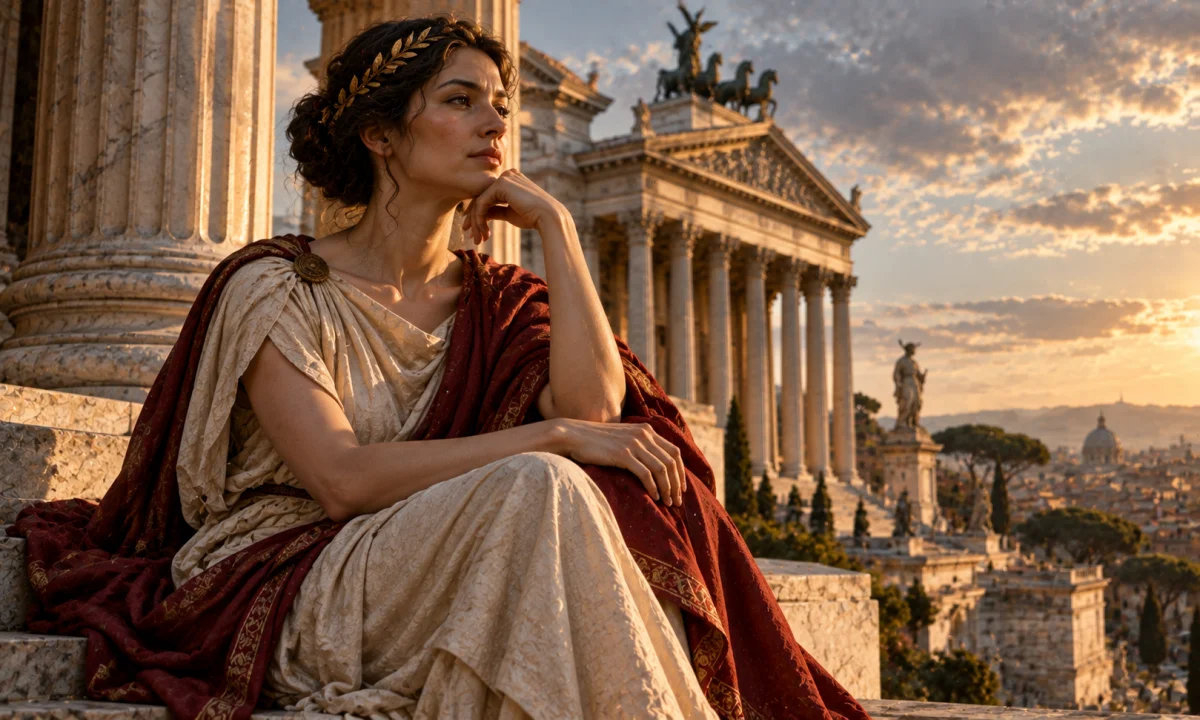
Mens was a Roman divine personification of the mind, understanding, intelligence and sound judgment. Although the Latin word mens is an ordinary noun meaning “mind” or “intellect,” Roman religious practice could treat such abstract qualities as divine powers. Mens therefore belonged to the broad group of Roman deities associated with moral qualities, civic virtues and desirable states of mind rather than to the older mythic family of gods with extensive genealogies and narratives.
Identity and meaning
In Roman usage, mens could refer to thought, consciousness, intention, disposition or mental judgement. Its meaning was wider than the modern English word “intellect.” A person’s mens could be rational and disciplined, but it could also be disturbed, confused or morally misguided. When understood as a deity, Mens represented the mind as a power capable of guiding human conduct and public decision-making.
Mens is generally treated as a goddess, partly because the Latin noun is grammatically feminine and partly because Roman personifications were commonly imagined in feminine form. Literary and religious evidence does not provide a detailed mythology for her. She is not presented as a daughter, spouse or rival of the major Olympian gods in the way that many better-known Roman deities are. Her significance comes primarily from her function and cult rather than from stories about her adventures.
The expression Mens Bona, meaning “Good Mind” or “Sound Mind,” is also associated with Roman religious language. In some contexts, Mens Bona may represent a more specific aspect of the deity: a mind that is sane, morally upright, rational and well ordered. The evidence does not always allow a firm distinction between Mens by herself and the fuller expression Mens Bona. They should not automatically be treated as two entirely separate goddesses.
Historical and religious setting
The public cult of Mens is especially connected with Rome’s crisis during the Second Punic War. In 217 BCE, Rome suffered a major defeat against Hannibal’s army at the Battle of Lake Trasimene. The defeat created military, political and religious anxiety. Roman authorities responded with vows, sacrifices and the establishment or renewal of cults intended to secure divine support for the community.
During this period, a temple was vowed to Mens and later dedicated at Rome. Ancient accounts place the temple on or near the Capitoline Hill, one of the city’s most important religious centres. The exact details of its foundation and dedication are not equally clear in every surviving account, but its association with the crisis of the Second Punic War is well established in the ancient tradition.
The choice of Mens was meaningful in a time when Rome needed more than military strength. Sound judgement, courage under pressure and the ability to make disciplined decisions were essential qualities for the state. A public cult of Mens could therefore express a prayer for collective steadiness as well as individual intelligence. The deity did not simply represent cleverness; she embodied the mental balance and practical wisdom thought necessary for the survival of the Roman community.
Roman religion frequently gave divine form to qualities that a community wished to possess. Fides represented trust and good faith, Concordia represented harmony, Virtus represented courage and excellence, and Victoria represented victory. Mens belonged to this religious world of personified powers. Her presence among such figures shows that the Romans regarded mental clarity as a force with civic and religious importance.
Sources and surviving evidence
Information about Mens comes mainly from Roman historical and literary references rather than from a large body of myths or surviving descriptions. The historian Livy connects the foundation of her temple with the religious measures taken during the Second Punic War. The poet Ovid also mentions Mens in the Fasti, his poem on Roman festivals and the religious calendar.
These sources show that Mens had a recognised place in Roman public religion, but they do not provide a complete account of her cult. There is no surviving epic centred on her, no established cycle of divine exploits and no detailed description of a distinctive appearance. Archaeological evidence for her temple and worship is also limited compared with the evidence for major deities such as Jupiter, Juno, Venus or Minerva.
References to Mens in Roman religious and philosophical writing should be read with care. Roman authors could use the word mens in ordinary philosophical or psychological discussion without necessarily referring to a goddess. A passage about the human mind is not automatically evidence for the cult of Mens. Conversely, a reference to Mens as a divine power may use language that overlaps with philosophical ideas about reason, consciousness and self-control.
Attributes and role
Mens has no securely attested set of physical attributes comparable to Minerva’s helmet, Mercury’s winged sandals or Fortuna’s wheel. Ancient sources do not establish a single canonical appearance for her. If she was represented in art, such representations have not survived in a form that allows a confident reconstruction of her standard iconography.
Her symbolic attributes were primarily mental and ethical:
- Understanding: the ability to grasp situations and recognise their significance.
- Judgement: the capacity to choose wisely, especially in difficult circumstances.
- Self-command: control over fear, anger, confusion and impulsive behaviour.
- Soundness of mind: mental balance and freedom from destructive disorder.
- Civic deliberation: the clear thinking required by magistrates, commanders and the Roman people.
These qualities help explain why Mens could be important in a public rather than merely personal context. Roman religion did not sharply divide private psychology from the health of the state. The mental condition of leaders and citizens could affect military decisions, social order and the performance of religious duties. A community that possessed a sound collective mind would be better able to respond to danger.
Mens should not be understood as a goddess who simply grants intelligence in the manner of a magical gift. The surviving evidence does not describe spells, tests or mythic episodes in which she bestows wisdom upon a particular hero. Her role is better understood as the divine presence of rational and properly directed thought.
Mens and the Roman concept of mind
Roman ideas about the mind were not identical to modern psychology. Mens could refer to intellectual activity, but also to intention, character and inward orientation. A person’s mind was connected with the way that person approached the world and acted within it. A disorder of the mind could therefore have moral and social consequences as well as medical or emotional ones.
Later Roman philosophical writers, particularly those influenced by Greek philosophy, discussed the mind in terms of reason, knowledge and the control of passions. Such discussions are not identical to the older public cult of Mens, but they share an interest in the value of rational order. The philosophical use of mens helped preserve the importance of the term, even when the goddess herself received less prominent attention than the major state gods.
The relationship between Mens and Minerva is sometimes misunderstood. Minerva was associated with wisdom, strategic intelligence, crafts and skilled knowledge, and her cult had a much broader mythological and civic profile. Mens, by contrast, personified the mind itself and especially its soundness and judgement. The two could be conceptually related, but the available evidence does not make Mens a title, servant or aspect of Minerva.
Mens is also not the same as Juno Moneta, despite the fact that both can be connected with advice or warning in later interpretation. Juno Moneta was a form of Juno whose name was associated with warning and, eventually, with the Roman mint. Mens had a more direct connection with mental ability and sound judgement. Nor should she be confused with Prudentia, the personification of prudence, although prudence is one of the qualities that her worship could encourage.
Mens, madness and the opposite of sound judgement
Because mens could mean the mind in a broad sense, it could be discussed in relation to both sanity and mental disturbance. The religious expression Mens Bona emphasised the positive condition of a mind that was healthy, rational and morally reliable. This does not mean that Roman worshippers imagined a separate, fully developed goddess of every possible mental state. Rather, the language of “good mind” marked the difference between ordered thought and confusion or destructive passion.
Roman writers often contrasted reason with furor, a word that could indicate frenzy, madness, violent inspiration or uncontrolled passion depending on context. Mens represented the stabilising power that could oppose such disorder. This opposition was not always a simple division between good and evil: Roman literature could portray divine frenzy as both dangerous and creatively powerful. Nevertheless, in civic and ethical contexts, a sound mind was generally considered essential to responsible action.
Worship and public significance
The establishment of Mens’s temple during wartime suggests that her worship had a public and collective dimension. The Romans were not merely asking for private cleverness. They were acknowledging that military survival depended on planning, discipline and the ability to respond intelligently to disaster. The cult could therefore be interpreted as a religious expression of strategic and moral resilience.
Her temple also reflects a Roman tendency to respond to national emergencies by giving formal recognition to divine powers that addressed the crisis. A new or newly prominent cult could define what the community believed it needed. In the case of Mens, the desired quality was not only victory but the clear thinking that might make victory possible.
Little is known about the exact ceremonies performed in her honour. There is no secure evidence for a distinctive festival cycle, priesthood or set of offerings that can be described in detail. References to a festival day in the Roman calendar indicate that Mens had a place in the religious year, but the surviving information is too limited to reconstruct the full ritual programme.
Later reception and the Latin legacy
Mens did not become a major character in later European mythology. Her name, however, survived through Latin vocabulary. English words such as mental and mentality, as well as terms in other Romance and European languages, ultimately reflect the Latin word mens. This linguistic survival does not mean that the goddess continued to be worshipped under those modern terms. It reflects the long influence of Latin as a language of philosophy, law, education and medicine.
Modern references to Mens are uncommon and usually occur in discussions of Roman religion, ancient personification or the history of ideas. She has not acquired a substantial independent presence in contemporary popular culture. When she does appear in modern retellings, she is often interpreted broadly as a goddess of reason, intelligence or mental health. Such portrayals can be useful imaginative adaptations, but they go beyond the limited attributes securely preserved by ancient evidence.
Mens is therefore best understood as a Roman divine personification whose importance lies in the religious value assigned to a sound and capable mind. Her cult connected inward judgement with public responsibility, particularly at a moment when Rome faced military catastrophe. Although she lacks the extensive mythology of more famous Roman gods, she reveals how Roman religion could make an abstract quality into a power worthy of a temple, a festival and a place within the protection of the state.