WORLD

Maenads
Maenads were female followers of Dionysus, the Greek god of wine, ecstatic experience, theatre and altered states of consciousness. In myth and art, they appear as women seized by divine enthusiasm, often leaving ordinary society to dance, sing and perform rites in the mountains. Their name comes from the Greek mainomai, “to rave,” “to be mad” or “to be inspired,” reflecting the ancient image of Dionysian possession. They are also called Bacchae, a name derived from Bakkhos, an epithet of Dionysus.
Maenads belong to Greek religious tradition, but they are not a single, clearly defined race of supernatural beings. The word may describe mythical women in stories, female worshippers represented in art, or participants in Dionysian religious practices. Ancient writers and modern scholars do not always use related terms in exactly the same way. In particular, the mythical maenad, the historical worshipper and the divine companions of Dionysus can overlap without being identical.
Origins and cultural setting
Dionysian religion was associated with wine, fertility, music, performance, transformation and the loosening of ordinary social restraints. Dionysus could be a joyful and generous god, but also a disturbing force who punished those who denied his divinity or attempted to suppress his worship. His festivals included processions, dances, choral performances and ritual activity involving both men and women.
Greek communities celebrated Dionysus in many different ways. Some festivals were civic and highly organised, while others involved women travelling beyond the city into hills or mountain landscapes. These settings were symbolically important. The mountain, forest and night stood outside the ordered spaces of the household, law and city. In myth, they provided a setting in which normal boundaries between human and divine, civilised and wild, and individual and group could become unstable.
Evidence for Dionysian worship comes from literary works, inscriptions, vase paintings and other archaeological remains. These sources do not create one uniform picture. A vase may show women carrying ritual objects, while a tragedy may intensify the same figures into terrifying agents of divine punishment. Literary depictions therefore should not automatically be treated as direct descriptions of what historical worshippers did.
Name and identity
The most common Greek term, mainades, means something like “raving women” or “frenzied women.” It describes a state of religious enthusiasm rather than a separate species. Their alternative name, Bacchae, links them more directly to Dionysus as Bacchus. In Roman contexts, Bacchae and related Latin forms became especially common, although the underlying tradition remained Greek in origin.
Other names appear in particular local or literary contexts. The Thyiads, or Thyads, were women associated especially with Dionysian worship at Delphi. Ancient traditions describe them gathering on Mount Parnassus and taking part in nocturnal rites. The exact relationship between Thyiads and maenads varies by source: sometimes they are treated as a particular group of Dionysian women, while elsewhere “maenad” functions as a broader poetic label.
Maenads may also be presented as divine or semi-divine companions of Dionysus. In visual art, however, the term can refer to female figures engaged in Dionysian activity without implying that they were all supernatural beings. It is therefore more accurate to understand “maenad” as a flexible religious and artistic category than as the name of one fixed mythological race.
Appearance and ritual attributes
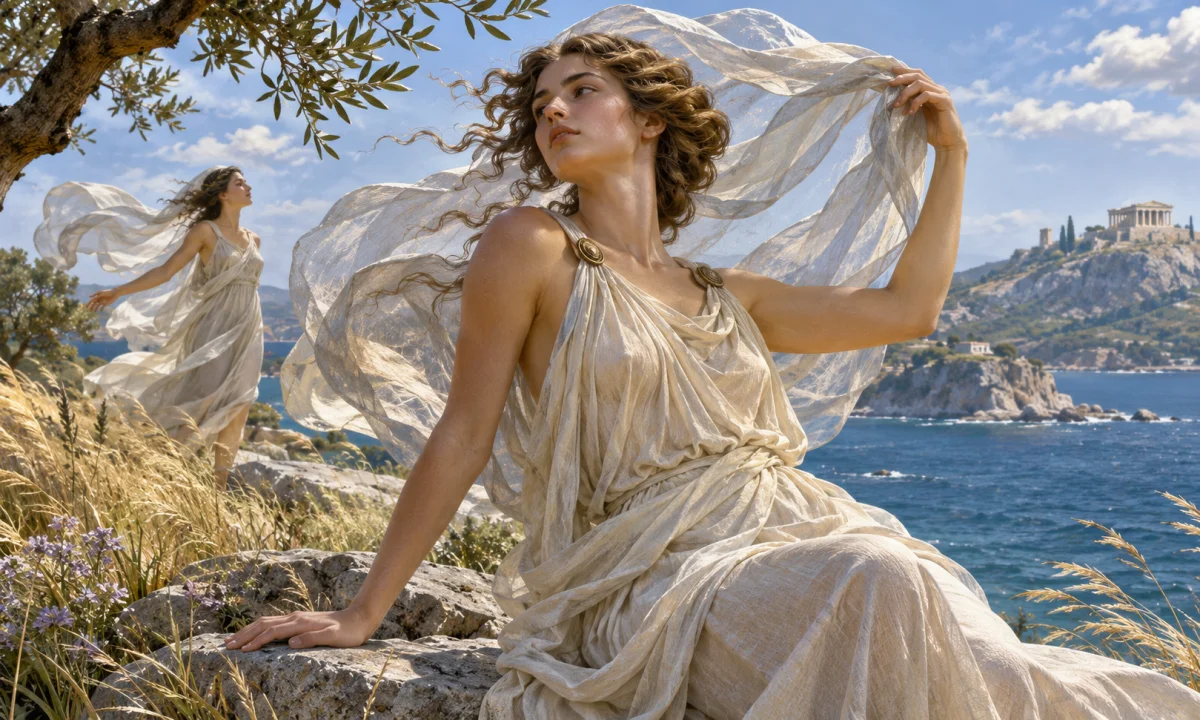
Maenads are commonly shown wearing loose garments, animal skins and wreaths of ivy. The fawnskin, or nebris, connected them with wild animals and the untamed landscape. Some images show them carrying a thyrsus, a staff wrapped in ivy or vine leaves and often topped with a pine cone. The thyrsus was one of the principal emblems of Dionysian worship.
Other attributes include branches, drums, tambourines and drinking vessels. Snakes sometimes appear in Dionysian imagery, and literary maenads may handle them or wear them as part of their ecstatic state. Their movements are typically energetic: they dance, whirl, raise their arms, shake their hair and participate in processions. They may be accompanied by satyrs, silens and the god himself, although these companions belong to different categories of Dionysian mythology.
Animal imagery is especially important. Maenads may be shown with fawns, panthers or other creatures associated with Dionysus. In myth, they can seem to move between human and animal worlds, nursing wild animals or tearing them apart. This imagery does not mean that every ancient Dionysian ritual involved such acts. It expresses the god’s power over nature and the temporary suspension of ordinary distinctions between human beings and the wild.
Ecstasy and the breaking of ordinary boundaries
The central feature of the maenad is ecstatic possession. Greek ideas of religious inspiration did not necessarily mean mental illness in a modern clinical sense. A god could enter or influence a person, producing extraordinary emotion, prophetic speech, physical endurance or behaviour beyond normal social expectations. Maenadic frenzy is one particular form of this religious transformation.
During their ecstatic activity, maenads are described as leaving domestic work and civic obligations behind. They may go into the mountains, dance through the night, cry out ritual words and take part in communal rites. Their temporary departure from the household is significant because Greek women were generally associated, at least in idealised social descriptions, with the domestic sphere. Maenadic stories explore what happens when women collectively move beyond that controlled environment under the authority of a god.
The contrast between freedom and danger is essential. Dionysian worship could offer joy, release and participation in divine power, but the same force could become frightening when resisted. Maenads are not simply symbols of carefree celebration. In myth they represent the possibility that suppressed religious power, social disorder or divine anger may return with overwhelming force.
The maenads in the Bacchae
The most influential literary portrayal of maenads appears in Euripides’ tragedy Bacchae, performed in the late fifth century BCE. The play tells how Dionysus comes to Thebes to establish recognition of his divinity. King Pentheus rejects the god and regards the new rites as a threat to public order. Dionysus causes the women of Thebes, including Pentheus’ mother Agave, to enter a state of ecstatic possession and leave the city for Mount Cithaeron.
Pentheus attempts to control the situation and refuses to accept Dionysus. The god then leads him, disguised and psychologically manipulated, toward the mountain so that he can observe the women’s rites. Pentheus is discovered by the maenads and torn apart in an act known as sparagmos, the ritual or mythic tearing apart of a living victim. Agave, unable to recognise her son while possessed, carries his head away believing it to be the head of a young lion.
The tragedy does not offer a simple celebration of female liberation or a straightforward condemnation of Dionysian religion. It presents Dionysus as both gracious and terrifying. Pentheus is rigid, contemptuous and unwilling to acknowledge a divine power, but the punishment inflicted on him and his family is also horrifying. The play leaves audiences confronting the destructive potential of both religious repression and divine vengeance.
The maenads in Bacchae are often described as peaceful while they perform ordinary Dionysian rites, yet they become violently destructive when provoked or when the god’s power is challenged. This contrast is central to the play. It also explains why later discussions of maenads sometimes focus almost entirely on madness and violence, even though Dionysian worship had many celebratory, communal and civic forms.
Sparagmos and omophagia
Two terms frequently associated with maenads are sparagmos and omophagia. Sparagmos means tearing apart, especially the violent dismemberment of an animal or person. Omophagia means eating raw flesh. Both appear in discussions of Dionysian myth and ritual, but their interpretation requires care.
Greek literature uses stories of maenads tearing apart animals or human victims to express extreme Dionysian power. Euripides’ Bacchae provides the best-known example. Some ancient evidence also associates Dionysian worship with the consumption of raw meat in ritual contexts. However, it is not safe to claim that all maenads practised cannibalism or that every Dionysian festival included a literal killing and eating of human beings. The evidence is uneven, and literary descriptions may be symbolic, dramatic or hostile portrayals rather than neutral records of religious practice.
The image of dismemberment can symbolise the destruction of ordinary identity and the overwhelming force of the god. It may also echo wider Greek ideas about sacrifice, animal transformation and the reversal of civilised behaviour. In each source, the immediate context matters more than a single universal interpretation.
Other myths involving maenads
Maenads appear in several myths in which Dionysian worship is rejected or attacked. In the Iliad, the Thracian king Lycurgus drives away the nurses or companions of Dionysus, provoking divine punishment. The passage is brief and does not provide the fully developed maenadic scene found in later literature, but it establishes the old mythological theme of a ruler opposing the god’s followers.
Another tradition connects maenads with the death of Orpheus. In some versions of the story, Orpheus is killed by women associated with Dionysus after he rejects or neglects the god, or after his grief and devotion to the dead Eurydice place him at odds with ordinary social and religious life. Other versions assign his death to different causes or describe the women less specifically. The Orpheus story is therefore variable, and “the maenads killed Orpheus” should be presented as one important version rather than a universal account.
Myths of Dionysus’ arrival in new lands also involve women becoming his followers. The god’s worship is represented as spreading through ecstatic transformation, often beginning with resistance from kings, husbands or civic authorities. These narratives repeatedly frame the maenads as a challenge to rulers who believe that political power can suppress divine worship.
Historical worshippers and the question of reality
Ancient Greek women did participate in Dionysian festivals, but the surviving evidence does not justify treating every literary maenad as a historical description. Women could hold religious roles, join processions and take part in local cults while remaining members of their communities. The details varied from city to city and from one festival to another.
The Thyiads of Delphi are among the clearest examples of named female Dionysian participants. Ancient accounts associate them with mountain rites on Parnassus, and later writers describe their movement between Athens and Delphi. These traditions indicate that organised female participation in Dionysian religion was culturally recognised. They do not prove that all such groups entered an uncontrolled frenzy or performed the violent acts found in tragedy.
Scholars have debated how closely the mythical maenad reflects actual ritual experience. Older interpretations sometimes treated maenadic stories as transparent records of women escaping social restrictions through collective religious madness. More cautious approaches emphasise that Greek authors, especially male authors writing for dramatic or literary purposes, shaped the image of the maenad to explore social anxiety, divine power and the limits of civilisation. Both ritual experience and literary construction may be relevant, but neither should be assumed without evidence.
Symbolism and interpretation
Maenads embody the tension between order and wildness. Greek culture valued the city, the household, law and self-control, yet Dionysus represented forces that those institutions could not fully contain: intoxication, sexuality, emotion, performance, seasonal renewal and contact with the divine. Maenadic imagery gives these forces a human form.
Their gender is also important. In myth, maenads can become physically powerful and socially independent in ways usually denied to respectable women. They leave the household, handle weapons or ritual staffs, hunt, kill and act collectively. This does not necessarily mean that Greek society viewed actual female religious activity as a political rebellion. Rather, the stories use temporary female power to examine the fragility of masculine authority and the dangers of suppressing religious emotion.
Maenads are not simply “female versions” of satyrs. Satyrs are male nature spirits associated with Dionysus, usually depicted with animal features and a strong emphasis on sexual appetite. Maenads are generally human women or female worshippers, even when myth gives them supernatural strength or divine possession. They also differ from the nymphs who accompany Dionysus in some traditions. Nymphs are nature spirits with their own identities and categories, whereas maenads are defined chiefly by their relationship to Dionysian worship and ecstasy.
Maenads in art and later culture
Maenads were popular subjects in Greek vase painting, particularly from the sixth and fifth centuries BCE onward. Artists show them dancing, carrying thyrsoi, playing instruments, pursuing animals or accompanying Dionysus. Some scenes are calm and ceremonial; others emphasise motion and ecstatic energy. Roman artists continued to use maenadic figures in sculpture, mosaics and decorative designs, often placing them among the god’s broader entourage.
Later European writers and artists often detached the maenad from her specific religious setting. She could become a general symbol of passion, sexual freedom, irrationality or dangerous femininity. Such interpretations may be creatively valuable, but they are modern readings rather than complete descriptions of ancient Dionysian religion.
Modern fiction, theatre and popular culture sometimes uses “maenad” for a woman associated with wild celebration, supernatural strength or violent frenzy. These adaptations commonly draw on the Bacchae, especially the image of women dancing in the mountains and tearing apart Pentheus. The ancient figure, however, was more than a stock image of madness: she belonged to a complex religious world in which joy, devotion, social reversal, divine inspiration and terror were all aspects of Dionysus’ power.