WORLD
WORLD
Kulimina
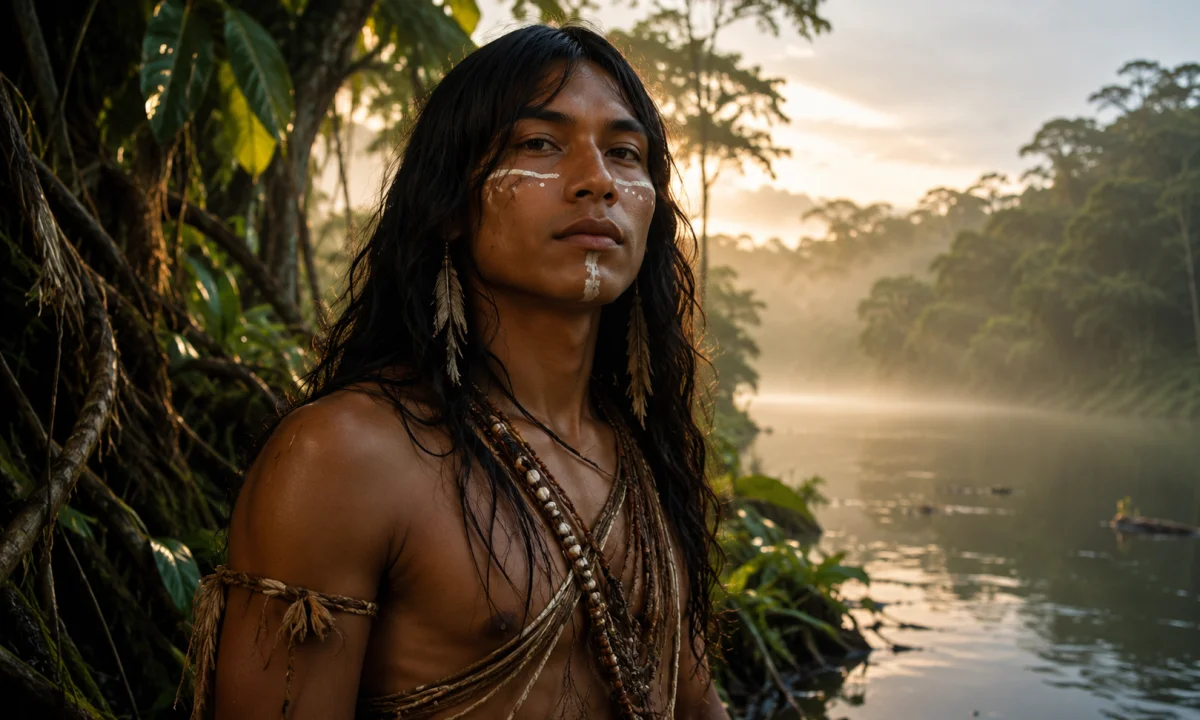
Kulimina is an obscure name associated in some modern reference lists with South American mythology, but its traditional identity is uncertain. There is no broadly accepted body of Indigenous stories, historical documentation or scholarly reference that establishes Kulimina as a clearly defined goddess, spirit, monster or culture hero. Descriptions attached to the name vary, and some may derive from repeated secondary listings rather than from an independently recorded tradition.
Origins and cultural setting
South America contains hundreds of Indigenous cultural traditions, each with its own languages, religious concepts and systems of storytelling. A name recorded in one colonial document, ethnographic collection or modern compilation cannot automatically be treated as part of a single continent-wide mythology. Quechua, Aymara, Mapuche, Guaraní, Tupi-speaking, Amazonian and Caribbean traditions, among many others, have different histories and categories for supernatural beings.
That context is important in the case of Kulimina. The name is sometimes presented without a clearly identified people, language or region. Without that information, it is not possible to determine whether Kulimina belongs to a particular Indigenous tradition, whether the spelling reflects an older transcription, or whether the name has been altered during copying between modern sources.
Many Indigenous traditions were transmitted primarily through oral performance. Their preservation depended on particular storytellers, communities, ritual settings and local languages. Historical records were often made by missionaries, explorers, government officials or later researchers who used unfamiliar spelling systems and translated culture-specific ideas into European categories such as “god,” “demon,” “fairy” or “monster.” A name can therefore be difficult to trace even when a related tradition is genuine.
At the same time, uncertainty should not be used as an excuse to fill gaps with attractive but unsupported details. A lack of accessible documentation does not prove that a figure never existed in oral tradition; it does mean that claims about Kulimina must be made cautiously.
The name and its identity
The spelling Kulimina is not sufficiently stable to establish a definite meaning. It may represent a transcription from an Indigenous language, a variant created by copying, or a name that has been detached from its original context. The available form does not, by itself, reveal whether the figure was benevolent, dangerous, ancestral, human, animal-like or divine.
Some catalogue-style sources assign Kulimina a simple category, such as “goddess” or “spirit.” Such labels should not be accepted automatically. Indigenous religious traditions often do not divide beings in precisely the same way as European mythological systems. A being described as a “spirit” in one translation might be an ancestor, owner of a place, guardian of an animal species, ritual power or person from an earlier age. Similarly, “goddess” may be a modern simplification of a female supernatural figure rather than a traditional title.
No secure etymology can be offered for the name. Similar sounds in unrelated languages are not proof of a relationship, and resemblance to words such as kuli, kulla or mina cannot establish a translation without linguistic evidence. Spellings that look similar may refer to completely different words, especially when names have passed through Spanish, Portuguese or older missionary orthographies.
Attributes and powers
There is no consistently documented description of Kulimina’s appearance. Claims that she had a particular animal form, lived in water or forests, controlled fertility, protected a community or punished wrongdoing should therefore be treated as unverified unless tied to a specific, identifiable tradition.
The same caution applies to alleged powers. A number of modern mythology databases provide short entries for obscure names and may assign them familiar functions: moon deity, nature spirit, underworld guardian, creator or bringer of illness. These classifications can arise because a compiler expects every name to fit a standard mythological category. They are not necessarily evidence of a traditional belief.
There is also no firmly established account of Kulimina’s gender or status. The ending of a name does not reliably indicate that a figure is female, and a modern translation may impose gender where the original language did not. If Kulimina is connected with a genuine local tradition, its role would need to be understood through the relevant community’s own categories rather than through a generic list of gods and monsters.
Stories and relationships
No widely recognized narrative cycle places Kulimina in a securely documented relationship with other South American figures. There is no dependable, commonly attested story that identifies a spouse, parent, enemy, child or companion. Stories sometimes attached to obscure names online may be composites assembled from motifs belonging to different traditions.
This kind of confusion is especially likely in discussions of South American mythology. A serpent associated with rivers in one Amazonian tradition may be combined with a water spirit from another region; a female forest being may be given the name of an unrelated deity; and a figure from a modern fantasy list may be presented beside well-attested beings such as the Guaraní Jasy Jatere or the Mapuche Shumpall as though all belonged to one shared system.
There is currently no sound basis for assigning such stories to Kulimina. A responsible account must distinguish between a narrative that can be traced to a named people and source tradition and a narrative that merely appears beside the name in a modern compilation.
Possible reasons for uncertainty
Transcription and translation
Indigenous names have often been written by outsiders using alphabets that do not represent all the sounds of the original language. A single name may consequently appear in several forms. Portuguese and Spanish records may also adapt the same word differently, while later English-language works may introduce additional changes.
Such variation is normal, but it must be demonstrated rather than guessed. A proposed connection between Kulimina and another name would require evidence from the relevant language, region and historical record. Phonetic similarity alone is not enough.
Loss of context
A name copied without its surrounding story can become misleading. The original word may have referred to a place, ritual object, ancestor, personal name or ordinary animal rather than to a supernatural being. A translator may also have used a broad term such as “spirit” for a concept with no exact equivalent in English.
When a name appears only in short lists, the loss of context becomes particularly serious. Lists frequently preserve labels while removing the information needed to identify their source. Later writers may then repeat the label and add new details, making an uncertain entry appear older and better established than it is.
Modern compilation
Modern websites, encyclopedic lists and popular books often bring together material from many regions. This can make South American mythology seem like a single unified catalogue, even though its traditions are geographically and culturally diverse. An obscure name can circulate through several publications without gaining independent confirmation.
Repeated appearance is therefore not the same as multiple evidence. Ten websites may ultimately reproduce one unattributed sentence. The absence of a named community, language, recorded story or historical context is a warning sign when evaluating material about Kulimina.
Cultural and religious interpretation
If Kulimina does preserve a fragment of an Indigenous tradition, its significance cannot be determined from the name alone. Traditional supernatural figures often express relationships among people, animals, landscapes, ancestors and unseen powers. Their meaning may be connected with particular rivers, mountains, forests, ceremonies, family histories or rules of conduct.
European categories can obscure these relationships. Calling a being a “mythological character” may suggest a fictional invention, while a community may understand the being as part of a living religious or ecological order. Conversely, calling every traditional figure a “god” may flatten distinctions between creator beings, ancestors, dangerous presences, animal masters and ritual specialists.
Respectful interpretation should therefore begin with the community and setting in which a tradition is recorded. It should also acknowledge that some knowledge may be restricted, sacred or not intended for general publication. An unknown or poorly documented name should not be treated as an invitation to invent a complete mythology around it.
Distinction from similar or unrelated figures
Kulimina should not be automatically identified with better-known South American beings whose names or supposed functions may appear similar. The Curupira, for example, is a forest being associated particularly with Brazilian Indigenous and regional folklore, while the Yacuruna belongs to traditions of the western Amazon and is linked in modern descriptions with aquatic or underwater worlds. The Pombero is a prominent figure in Guaraní-related folklore, and the Supay has a complex history involving Andean concepts and colonial Christian interpretation.
These figures have their own regional histories and should not be used to supply missing details about Kulimina. Similarity in themes such as forests, rivers, fertility or danger does not demonstrate that the beings are versions of one another. Nor does a similar spelling establish a linguistic connection.
The name should also not be confused with any personal name, place-name or word from an Indigenous language that happens to have a comparable form. Proper identification requires more than a resemblance visible in English transcription.
Kulimina in modern popular culture
Kulimina has no established presence in widely known film, television, literary fantasy or video-game traditions comparable to figures such as the Curupira or the Muisca El Dorado legend. When the name appears in modern popular culture, it is more likely to reflect an individual author’s use of an obscure mythological label than a broadly recognized adaptation.
Contemporary creators sometimes expand brief or uncertain entries into detailed characters, giving them visual designs, supernatural abilities and elaborate genealogies. Such works may be imaginative and worthwhile as fiction, but they should not be presented as evidence for an ancient South American tradition. A modern depiction of Kulimina would belong to popular culture unless it can be connected to a documented community tradition.
What can responsibly be said
Kulimina is best described as an uncertain and poorly documented name associated with South American mythology in some secondary material. Its precise cultural origin, meaning, classification, appearance and stories cannot be established confidently from the information that commonly circulates. There is no reliable basis for presenting a single authoritative profile.
Future clarification would require a traceable record: the name of the relevant Indigenous people or language, the region where it was collected, the original spelling or transcription, and the narrative or ritual context in which it occurred. Until such evidence is identified, keeping the uncertainty visible is more accurate than assigning Kulimina a fixed mythology that may belong to another figure—or may have been created by modern compilation.