WORLD
WORLD
El Dorado
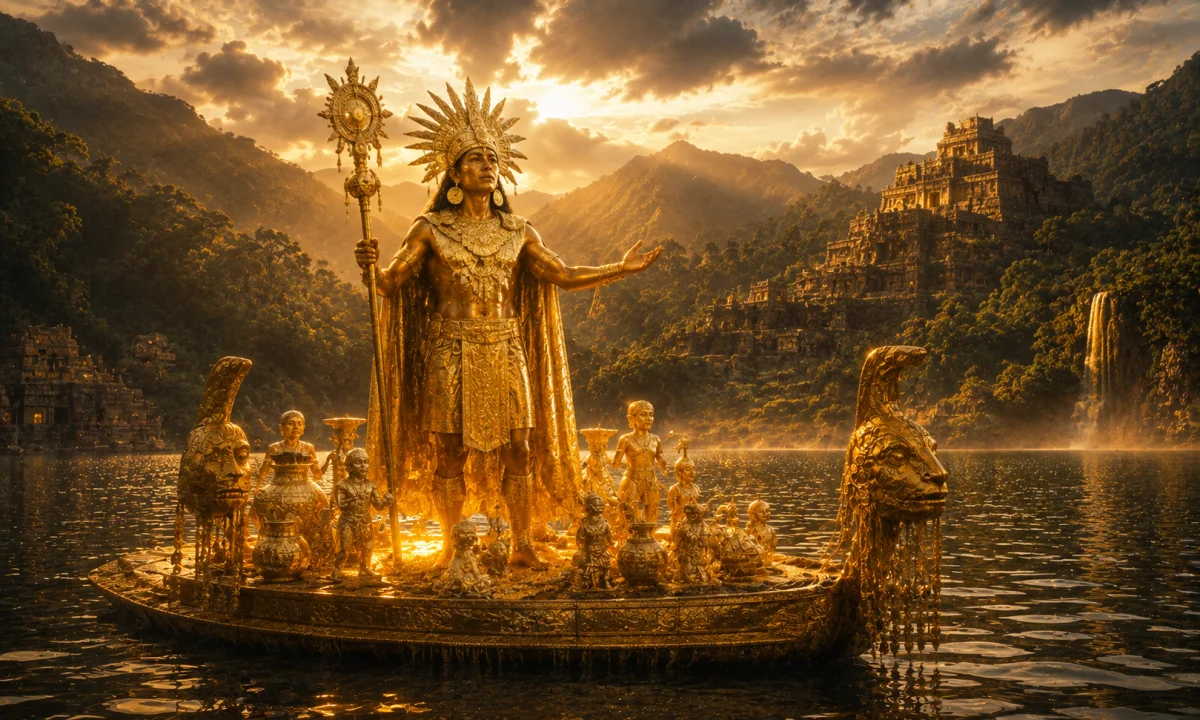
El Dorado is one of the most famous legends associated with South America, but it was not originally the name of a golden city. The earliest form of the story concerned a “gilded man” or ruler connected with the Muisca people of the Colombian Andes, particularly a ceremony associated with Lake Guatavita. Over time, Spanish reports transformed this ritual into rumours of a wealthy kingdom, a lost city and eventually an entire land of inexhaustible gold.
Origins in Muisca territory
The historical setting of the El Dorado tradition was the Altiplano Cundiboyacense, a high plateau in what is now central Colombia. Before the Spanish conquest, this region was inhabited by the Muisca, an Indigenous society organised into chiefdoms and political territories. Two prominent rulers mentioned in colonial descriptions were the zipa, associated with the southern part of the Muisca region, and the zaque, associated with the north.
The Muisca economy included farming, salt production, trade and skilled metalwork. Gold was important in ritual and political display, but it was not necessarily valued in the same way that European conquerors valued it. Gold objects could represent status, sacred power, relationships with supernatural forces and offerings to deities or other powerful beings. Much Muisca goldwork used tumbaga, an alloy of gold and copper, rather than pure gold.
European accounts describe a ceremony in which a newly installed ruler travelled by raft onto Lake Guatavita. According to the best-known version, the ruler’s body was covered with gold dust, and he entered the lake while attendants made offerings of gold objects and precious materials. The ceremony was understood by Spanish observers as an act of authority and religious significance. The ruler’s association with the lake may have expressed a relationship between political power, sacred landscape and divine or ancestral forces.
The exact form of the ceremony remains uncertain. The surviving descriptions were written by Europeans after the conquest, sometimes decades after the events they claimed to record. They differ in important details, and some may have combined eyewitness information, hearsay, political interpretation and imaginative elaboration. There is no surviving Muisca written account that allows the ceremony to be reconstructed with complete confidence.
The meaning of the name
El Dorado is Spanish for “the gilded one” or “the golden one.” It probably developed from the expression el hombre dorado, meaning “the gilded man,” or from a similar description of a ruler covered in gold dust. In English, the name is often treated as if it had always referred to a place. Historically, however, the earliest form referred to a person or ritual role rather than a city.
Spanish explorers and colonists gradually changed the meaning. A story about a ruler who used gold in a lake ceremony became a rumour about a wealthy land. That land was then imagined as a kingdom, a city and, in some accounts, a vast empire located somewhere beyond the known Spanish settlements. The change reflected both linguistic simplification and the ambitions of European explorers searching for treasure.
The name should therefore be used carefully. El Dorado was not originally a Muisca god, monster or named hero. It was a Spanish label applied to a reported Indigenous ruler or ceremony, later expanded into a colonial legend. The term also does not identify one fixed location. Different explorers placed the supposed golden realm in different parts of northern South America.
Lake Guatavita and the ritual tradition
Lake Guatavita lies northeast of present-day Bogotá in a mountainous region of Colombia. Its circular form and elevated setting made it a striking landscape, and it appears to have held religious importance for the Muisca. Colonial accounts connected the lake with offerings, sacred stories and the installation of a ruler.
The famous description presents the ruler standing or sitting on a raft, accompanied by attendants. He was said to have been coated in gold dust, while gold objects and other valuable offerings were cast into the water. After reaching the centre of the lake, he supposedly washed away the gold and returned to shore. This image became the central visual scene of the El Dorado legend.
Some accounts describe the ceremony as a rite connected with the succession of a new ruler. Others present it as a recurring offering or a general custom. The distinction matters because European writers did not always agree about whether they were describing one specific inauguration, a repeated ceremony or a story whose details had been enlarged through retelling.
Archaeological evidence confirms that Muisca communities made and deposited gold objects, including small figures commonly called tunjos. Some objects associated with the broader Muisca region depict human figures, animals or ritual scenes. The famous Muisca raft, a gold votive object showing a central figure surrounded by smaller attendants, is often linked to the El Dorado story. It supports the existence of sophisticated ritual metalwork and elite ceremony, but it does not by itself prove every detail in the Spanish accounts or establish that the object represents a literal scene at Lake Guatavita.
Attempts to recover treasure from Lake Guatavita began during the colonial period and continued in later centuries. Explorers and entrepreneurs tried to drain or partially drain the lake, but the difficult terrain, unstable mud and engineering limitations prevented a complete recovery. Gold objects have been found in and around the lake, yet the amounts recovered do not support the image of an unlimited treasure store. Finds may have resulted from offerings, accidental loss or later activity, and their precise connection with particular ceremonies is not always certain.
Colonial sources and the growth of the legend
The first Spanish conquerors entered Muisca territory in the 1530s. Reports of an extraordinarily wealthy ruler circulated among them as they encountered Indigenous communities and questioned local informants. Such information was filtered through translation, rival political interests and the expectations of men who were already searching for gold and precious stones.
Several colonial writers later recorded versions of the story. Gonzalo Fernández de Oviedo discussed reports of a ruler associated with gold and a lake. Juan Rodríguez Freyle included a detailed account in his seventeenth-century work El Carnero, while Pedro Simón also described Muisca traditions and the golden ruler. These texts are valuable evidence for the history of the legend, but they should not be read as direct transcripts of an unchanged Indigenous tradition.
Colonial chroniclers often relied on informants who had different political and cultural backgrounds. They also used familiar European concepts such as kings, kingdoms, temples and treasure. A Muisca ceremony involving sacred offerings could therefore be rewritten as evidence of a “king” possessing immense personal wealth. The religious meaning of the objects was easily overshadowed by their material value.
As the Spanish pushed beyond the Muisca region, the supposed source of wealth moved with the rumours. The legend was no longer tied only to Guatavita. It became a flexible explanation for the idea that another rich civilisation lay somewhere beyond the frontier. Reports from the Orinoco basin, the Amazon and the Guiana region were repeatedly interpreted in relation to El Dorado, even when they had no direct connection with the Muisca ceremony.
Searches for a golden kingdom
The search for El Dorado formed part of the larger Spanish conquest of northern and western South America. Expeditions travelled through difficult terrain in Colombia, Venezuela, Guyana and the Amazon basin. They encountered tropical forests, mountain ranges, rivers and Indigenous societies whose landscapes and political systems were poorly understood by Europeans.
Among the explorers associated with searches for El Dorado were Gonzalo Jiménez de Quesada, Sebastián de Belalcázar, Antonio de Berrio and Sir Walter Raleigh. Their aims and circumstances differed, and not all were searching for exactly the same place. Some sought the original Muisca source; others pursued rumours of a powerful inland kingdom or a city known by names such as Manoa.
Raleigh’s accounts helped popularise the association between El Dorado and Guiana. His descriptions presented the region as a promising destination for English expansion and wealth. Later European maps sometimes placed a great golden city near Lake Parime, a lake that appeared on maps for centuries but was never securely identified as a real geographical feature. In this phase, El Dorado became less a specific historical report than a moving destination shaped by exploration, cartography and imperial rivalry.
Repeated failures to find the golden city did not immediately destroy the legend. Instead, the imagined location shifted farther away. This pattern was common in colonial geography: when an expected kingdom could not be found, explorers interpreted the failure as evidence that it lay beyond the next mountain range or river system.
Religious and cultural significance
The Muisca context is essential because the original tradition was not simply a tale of greed. Lakes, mountains, caves and other natural features could serve as sacred places within Indigenous religious systems. Offerings to water or earth-related powers were part of broader relationships between communities, rulers and the supernatural world.
Muisca religious life included powerful figures such as Bochica, a culture hero or civilising figure in colonial accounts, and Chía and Súa, associated by Spanish writers with the Moon and Sun. These accounts vary and often interpret Muisca traditions through European categories. El Dorado should not be presented as a member of the same pantheon. It was a colonial description of a ruler and ritual, not the name of a universally recognised Muisca deity.
Gold objects also had meanings that extended beyond wealth. Small votive figures could represent people, animals, leaders or supernatural participants in ritual action. Their value lay partly in the relationship created by giving them to a sacred place. European treasure hunters often removed them from that context and treated them as evidence of a hidden financial reserve.
The transformation of a ceremony into a golden city illustrates a major cultural misunderstanding. A political and religious act was translated into a story about natural resources waiting to be seized. The legend consequently reveals as much about Spanish colonial desires as it does about Muisca traditions.
Important variants and related names
El Dorado has several overlapping but distinct forms:
- The gilded ruler: the earliest and most historically grounded form, based on reports of a Muisca leader associated with gold dust and a lake ceremony.
- The Lake Guatavita ceremony: the ritual tradition most closely connected with the Muisca region, although its precise details and frequency remain disputed.
- The golden kingdom: a later colonial idea that expanded the story from one ruler to an entire wealthy polity.
- Manoa: a name used in some later accounts for an imagined golden city or kingdom in the Guiana interior. It is related to the wider El Dorado tradition but is not simply another name for the Muisca ruler.
- Lake Parime: a legendary lake shown on early modern maps as the location of Manoa. Its appearance reflects European geographical speculation rather than confirmed evidence of a lost city.
These variants should not be collapsed into one single ancient narrative. The Muisca ritual tradition has a specific Colombian setting, while Manoa and Lake Parime belong mainly to later European exploration literature and cartography.
El Dorado in modern culture
In modern English, El Dorado is often used metaphorically for any place of exceptional wealth or opportunity. The name appears in novels, films, television programmes, games, adventure stories and commercial titles. Popular adaptations commonly portray El Dorado as a hidden city built entirely of gold, sometimes filled with temples, traps and supernatural guardians.
These versions are fictional elaborations rather than faithful representations of Muisca tradition. They often combine the Guatavita ceremony with unrelated Indigenous cultures, generic “lost civilisation” imagery and European adventure conventions. Some portray the search as harmless exploration, although the historical searches were connected with conquest, forced labour, territorial expansion and the extraction of Indigenous wealth.
The historical El Dorado is therefore best understood as a layered tradition. At its foundation lies a Muisca religious and political context in the Colombian Andes, preserved imperfectly through colonial reports. Around that foundation grew a Spanish legend of a golden ruler, then a roaming imperial fantasy about a city or kingdom that no expedition could locate. Its enduring power comes not from evidence of a literal city of gold, but from the interaction of sacred landscape, political authority, cultural misunderstanding and the relentless colonial pursuit of wealth.