WORLD
WORLD
Ka-ata-killa
Ka-ata-killa is a name associated in some modern accounts with an Inca or Quechua moon goddess. The identification is uncertain, however. Unlike Mama Killa—the better-attested lunar deity of the Inca religious system—Ka-ata-killa is not clearly documented as a separate figure in the principal Spanish colonial descriptions of Inca religion. The name may represent a rare spelling, a regional tradition, a modern reconstruction, or a confusion with Mama Killa. Any discussion of Ka-ata-killa therefore needs to distinguish securely recorded Inca beliefs from later summaries and speculative interpretations.
Historical and cultural setting
The Inca Empire, or Tawantinsuyu, ruled a large part of the Andes during the fifteenth and early sixteenth centuries. Its political centre was Cusco, but its religious world incorporated traditions from many earlier Andean societies and from communities brought under Inca rule. Religious practice was connected with mountains, springs, caves, ancestors, agricultural cycles and celestial bodies. The Sun, Moon and stars were not distant abstractions: they formed part of the sacred order that governed time, fertility and political legitimacy.
The Inca state placed particular importance on the Sun, known in Quechua as Inti. The Moon also had a major religious role. In Quechua, killa means “moon” and can also refer to a month or lunar period. The form Mama Killa, usually translated as “Mother Moon,” is the name most commonly associated with the Inca lunar deity in colonial accounts and later scholarship.
Knowledge of Inca religion comes from several different kinds of evidence. Spanish chroniclers recorded traditions after the conquest, often through interpreters and informants whose perspectives differed from one another. Some writers attempted to describe Indigenous beliefs accurately, while others rearranged them according to Christian assumptions or the political concerns of colonial society. Archaeological remains, Quechua vocabulary, colonial administrative documents and continuing Andean traditions provide additional evidence, but none supplies a complete, uncontested account of pre-conquest religion.
The name Ka-ata-killa
The spelling Ka-ata-killa is not a standard form used consistently across historical sources. It also appears with variations such as Ka-Ata-Killa or without hyphens. The final element, killa, is recognisably Quechua and points toward the Moon or a lunar association. The meaning and origin of the first part, however, are not securely established in the commonly cited descriptions of Inca religion.
Some modern mythology lists present Ka-ata-killa as an Inca moon goddess, sometimes giving her a family relationship with Inti or with Viracocha. Those claims are repeated in secondary material, but they should not be treated as firmly established pre-Columbian doctrine. There is no widely accepted body of early evidence showing that Ka-ata-killa was universally recognised throughout the Inca Empire as an independent goddess with a fixed genealogy and standard set of myths.
It is possible that the name reflects a local or poorly recorded Andean tradition. It is also possible that it arose through a transcription problem, an unusual rendering of a Quechua name, or the expansion of information about Mama Killa into a distinct entry. Because the evidence is limited, the safest classification is an uncertain or weakly attested lunar figure associated with Inca mythology, rather than a securely documented goddess separate from Mama Killa.
Relationship to Mama Killa
Mama Killa is the central point of comparison. In descriptions of Inca religion, she is commonly identified as the Moon and as a female divine power connected with the measurement of time. The lunar cycle helped regulate months, festivals and agricultural activities. The Moon’s phases were therefore religiously and practically significant.
Colonial accounts do not always agree on Mama Killa’s precise position in the divine order. Some portray her as the wife or consort of Inti, while others describe the Sun and Moon through family relationships that combine religious tradition with Inca ideas about royal ancestry. The Inca ruler was associated with the Sun, and the royal court used celestial relationships to express political and social hierarchy. Such accounts should not be read as though every Andean community held one identical family tree of the gods.
Ka-ata-killa is sometimes described as though she were simply another name for Mama Killa. That may be the most plausible explanation when the name is used for an Inca moon goddess without any distinctive mythology. Yet the equivalence cannot be proved in every case. Names for sacred beings could vary across regions, languages and periods, and the surviving record is too incomplete to determine whether every occurrence of Ka-ata-killa refers to Mama Killa, a local lunar power or a later literary construction.
Lunar symbolism in Inca religion
Regardless of the uncertainty surrounding the name, lunar worship was important in the Andean religious world. The Moon’s changing appearance provided a visible calendar and helped mark the passage of months. Religious festivals were timed according to celestial observations, and the state maintained specialists responsible for ritual calendars and the interpretation of signs in the sky.
The Moon was also associated with femininity, fertility and the rhythms of human life in later descriptions of Andean religion. These associations should be handled carefully: they do not form a single universal doctrine, and the categories used by European observers may have influenced how Indigenous beliefs were recorded. Still, the lunar cycle’s connection with agriculture, seasonal change and bodily reproduction made lunar symbolism especially important in an agricultural society.
Inca religious thought did not sharply separate nature from society in the modern Western sense. Celestial beings, mountains, ancestors and places could all participate in a sacred network of relationships. A moon deity could therefore have significance beyond the night sky, influencing ritual time, royal ideology and the wellbeing of communities.
Appearance and attributes
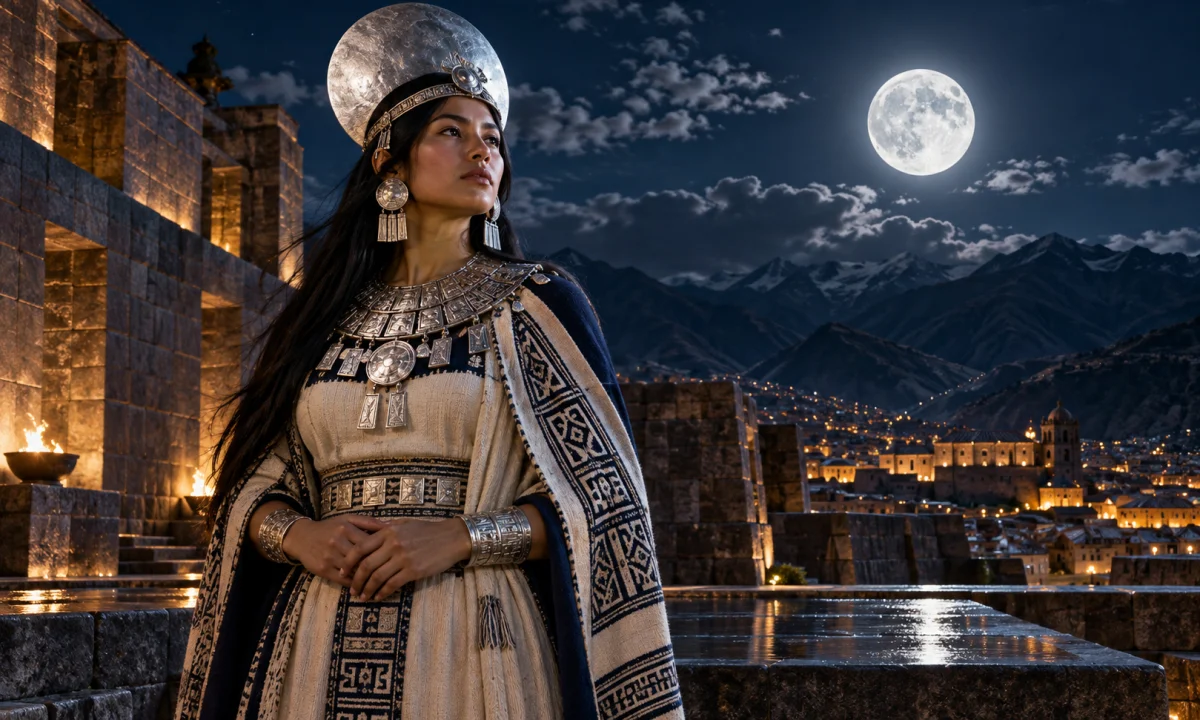
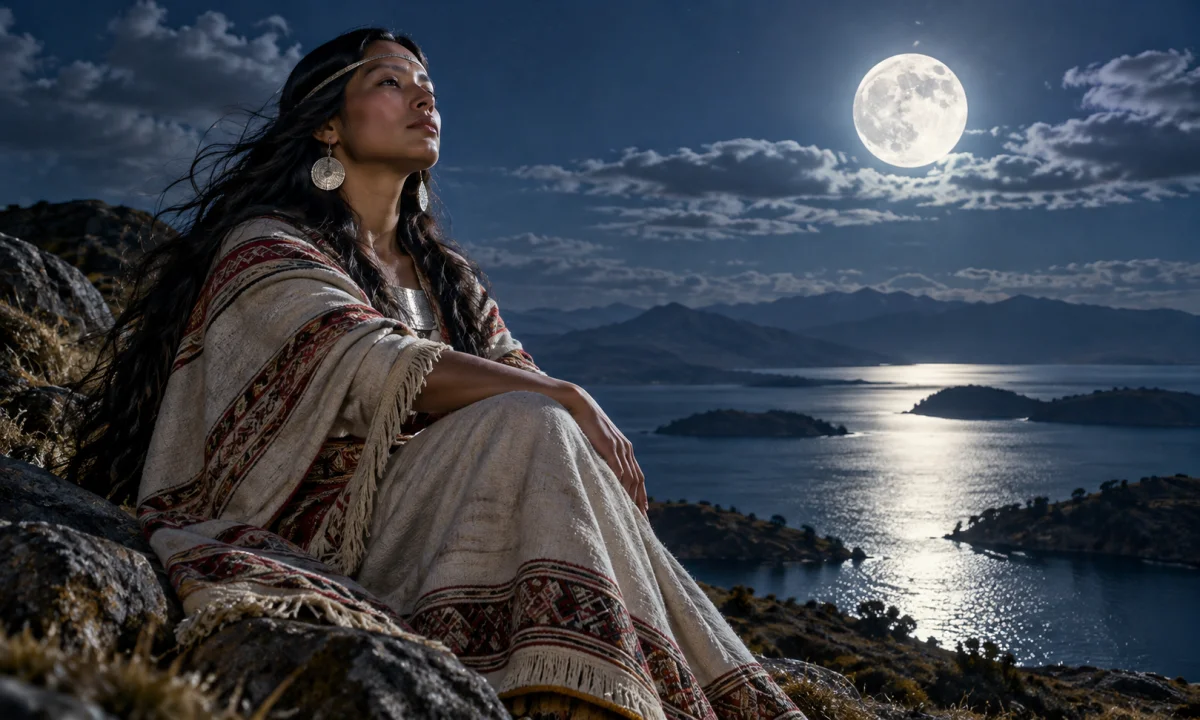
There is no securely documented traditional description of Ka-ata-killa’s appearance. Modern illustrations may portray her as a woman wearing a crescent, a silver headdress or elaborate Andean clothing, but these images are artistic inventions or general visualisations of a moon goddess rather than evidence for a historical iconographic tradition.
The same caution applies to claims about specific powers. Ka-ata-killa is often credited with governing the Moon, night, fertility, menstruation or calendars. Several of these themes are reasonable interpretations of lunar religion, but they are not all directly attested as attributes of a distinct deity named Ka-ata-killa. The safest statement is that the name is connected with lunar symbolism, while the fuller catalogue of powers belongs largely to later summaries or to general descriptions of Mama Killa.
Inca religious images and sacred objects were not necessarily portraits of gods in the familiar sense. Precious metals, textiles, stones and ritual vessels could represent or embody sacred forces. Colonial writers also described images whose original meaning remains debated. There is no universally accepted archaeological object that can be identified specifically as an image of Ka-ata-killa.
Stories and relationships
No major myth about Ka-ata-killa survives in a form that can be confidently identified as an ancient, independent narrative. Accounts that name her as the partner, sister or daughter of another deity should therefore be treated as uncertain. They may derive from broader stories about the Sun and Moon, from regional Andean traditions, or from later attempts to organise Inca gods into a family tree.
Traditional accounts of the Sun and Moon often express complementarity and opposition: day and night, brightness and darkness, masculine and feminine symbolism, or the alternating rhythms that structure time. Such contrasts do not necessarily imply a single canonical marriage story. Different communities could explain celestial relationships in different ways, and colonial authors sometimes harmonised traditions that had originally been distinct.
Viracocha presents a further difficulty. He is a major creator figure in several colonial accounts, but the details of his role and relationships vary substantially. Some modern lists make him the parent of numerous Inca deities, including lunar figures. That arrangement should not be assumed to represent a universally accepted Inca genealogy. The surviving traditions do not provide one complete family tree shared by all Andean peoples.
Religious significance and interpretation
If Ka-ata-killa preserves a local or alternative lunar name, its significance may lie in the diversity of Andean religious practice. The Inca Empire governed many peoples and incorporated older sacred traditions into its political system. A state cult centred on Cusco did not erase every regional deity. Instead, local sacred beings could be connected with Inca institutions, reinterpreted through imperial ideology or continue to be venerated outside the official centres.
The uncertainty also demonstrates the difficulty of reconstructing religions that left no Indigenous written scripture describing their gods in a single, systematic form. The Inca used visual, oral, ritual and administrative methods to preserve knowledge, while much of the surviving written evidence was produced after Spanish invasion. Names could be altered by interpreters, copied inconsistently by scribes or detached from the rituals that gave them meaning.
For that reason, a careful account should avoid presenting Ka-ata-killa as a well-defined goddess with a universally agreed mythology. It is more accurate to say that the name has become attached to an Inca lunar figure in modern reference material, while the strongest historical evidence concerns the broader role of the Moon and the better-attested deity Mama Killa.
Distinction from related figures
- Mama Killa: the principal Inca lunar deity named in many colonial and modern accounts. Ka-ata-killa may be an alternative or regional name, but this identification is not certain.
- Inti: the Inca Sun deity. Some accounts describe the Sun and Moon as partners or close relatives, but their exact relationship varies by source.
- Viracocha: a creator or high god in several Andean traditions. He should not automatically be treated as the father of Ka-ata-killa merely because modern lists place him in that role.
- Illapa: a storm and thunder deity associated in Inca accounts with rain, lightning and warfare. Illapa is not another name for a lunar goddess.
- Quilla or Killa: a Quechua lunar term and part of the name Mama Killa. The word itself does not prove the existence of a separate goddess called Ka-ata-killa.
Later reception
Ka-ata-killa has had a limited presence in modern popular culture compared with figures such as Inti, Pachamama and Mama Killa. The name appears mainly in online mythology directories, modern retellings and lists of deities. These sources may present a short biography, genealogy and set of powers without explaining how securely those details are documented.
Contemporary writers and artists may use Ka-ata-killa as a poetic name for the Andean Moon or as a way to explore Indigenous-inspired themes of night, fertility and celestial cycles. Such creative uses can have cultural value, but they should be distinguished from evidence for pre-Columbian worship. A modern depiction of a silver-clad moon goddess does not establish that the same image or character existed in the historical Inca world.
In historical terms, Ka-ata-killa is best approached as an uncertain lunar name within the wider field of Inca and Quechua religious tradition. The secure subject is the importance of the Moon in Andean sacred life; the precise identity of Ka-ata-killa, and whether she was distinct from Mama Killa, remains unresolved.