WORLD
WORLD
Jersey Devil
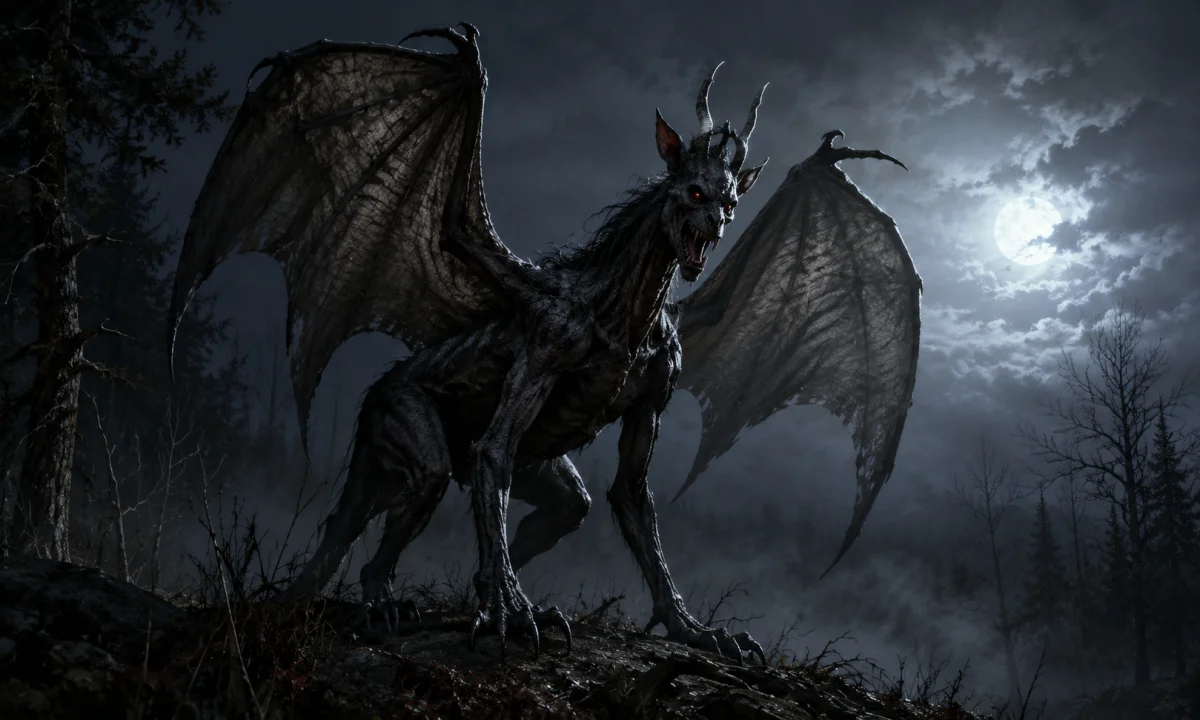
The Jersey Devil is a legendary creature associated with the Pine Barrens of southern New Jersey in the United States. In its most familiar form, it is described as a winged, hoofed being with a long horse-like head, clawed hands, horns, and a forked tail. The tradition belongs primarily to regional American folklore rather than to an ancient religion or a single old mythology. Its history combines colonial-era stories about the Leeds family, religious and social tensions, older European ideas about witches and monstrous births, and later reports of an animal-like visitor in the New Jersey forests.
Origins in the Pine Barrens
The Pine Barrens are a large, heavily wooded region of southern New Jersey. Historically, the area contained scattered settlements, bog iron industries, charcoal pits, farms, and extensive stretches of forest that could seem remote even though they lay relatively close to populated communities. Such landscapes often become settings for stories about dangerous animals, outcasts, spirits, and beings that inhabit the boundary between settled land and wilderness.
The best-known origin story concerns a woman usually called Mother Leeds. According to the common version, she lived in the Pine Barrens and became pregnant with her thirteenth child. During a difficult birth, she supposedly cursed the child, declaring that it would be the Devil. When the baby was born, it transformed into a monstrous creature, attacked those present, and escaped through a chimney or window before flying into the surrounding woods.
Many details of this story vary. Some versions say that Mother Leeds was a witch, while others present her as an ordinary woman who spoke in anger or desperation. The identity of the father, the number of children, the date of the birth, and the precise nature of the transformation also change from account to account. The often-repeated date of 1735 is part of the popular tradition, but it should not be treated as securely documented historical fact.
The story reflects several older motifs. A thirteenth child could be treated as ominous in societies that attached symbolic importance to numbers. A birth marked by a curse resembles European tales in which a child is transformed because of a parent’s words, a supernatural bargain, or suspected witchcraft. The creature’s escape from a house into the wilderness also fits a recurring folklore pattern: a frightening presence is born within the community but becomes a permanent danger outside it.
The Leeds family and colonial controversy
The name Leeds Devil appears in discussions of the creature’s possible historical background. The Leeds family lived in the region during the colonial period, and Daniel Leeds was a published almanac maker whose astrological and occult interests made him controversial among some Quakers. His writings included astrological material and emblematic imagery that opponents could portray as ungodly or diabolical.
Daniel Leeds became involved in a political and religious dispute with Benjamin Franklin. Franklin mocked Leeds in the Poor Richard almanacs, presenting him through satirical material as a foolish or demonic figure. This controversy is important because it shows that the word “devil” was already being used in connection with the Leeds name in colonial print culture. However, the surviving evidence does not establish a simple, continuous chain from Franklin’s satire to the fully developed Jersey Devil legend.
Some modern explanations claim that the creature began as a political insult directed at the Leeds family or at Daniel Leeds personally. That interpretation is plausible as part of the story’s development, but it remains an interpretation rather than a proven origin. The Mother Leeds birth legend, the Leeds family’s reputation, and later reports of a winged monster may have combined gradually. Folklore rarely develops from one identifiable event in the orderly way that a written fictional character does.
Another caution concerns the claim that the Leeds family’s thirteenth child was literally the Jersey Devil. Historical records may confirm that families in the region had large numbers of children, but they do not provide reliable evidence that a monstrous birth occurred. The alleged birth should therefore be described as a legend, not as a documented colonial incident.
Name and classification
“Jersey Devil” is the dominant modern name. “Leeds Devil” is an older or alternative designation that emphasizes the creature’s association with the Leeds family and colonial controversy. The terms are often used for the same legendary being, although individual writers may use “Leeds Devil” when discussing the historical background and “Jersey Devil” when discussing the broader folklore.
The creature is generally classified as a folkloric monster, a regional legendary being, or a cryptid in modern popular language. “Cryptid” is not a traditional category from the original stories. It is a modern term for an animal or animal-like creature whose existence is claimed but not accepted by mainstream zoology. Applying that label to the Jersey Devil highlights reports of sightings, tracks, and physical behavior, but it can obscure the older narrative elements involving curses, monstrous birth, and demonic symbolism.
Despite its name, the Jersey Devil is not a devil in the theological sense used by Christianity. It is not a figure with a stable role in Christian doctrine, scripture, or official religious tradition. The word “devil” functions here as a sign of menace and otherness. Some stories use Christian imagery because colonial communities understood supernatural danger through concepts such as sin, curses, witchcraft, and the Devil, but the creature itself belongs to folklore rather than formal demonology.
Appearance
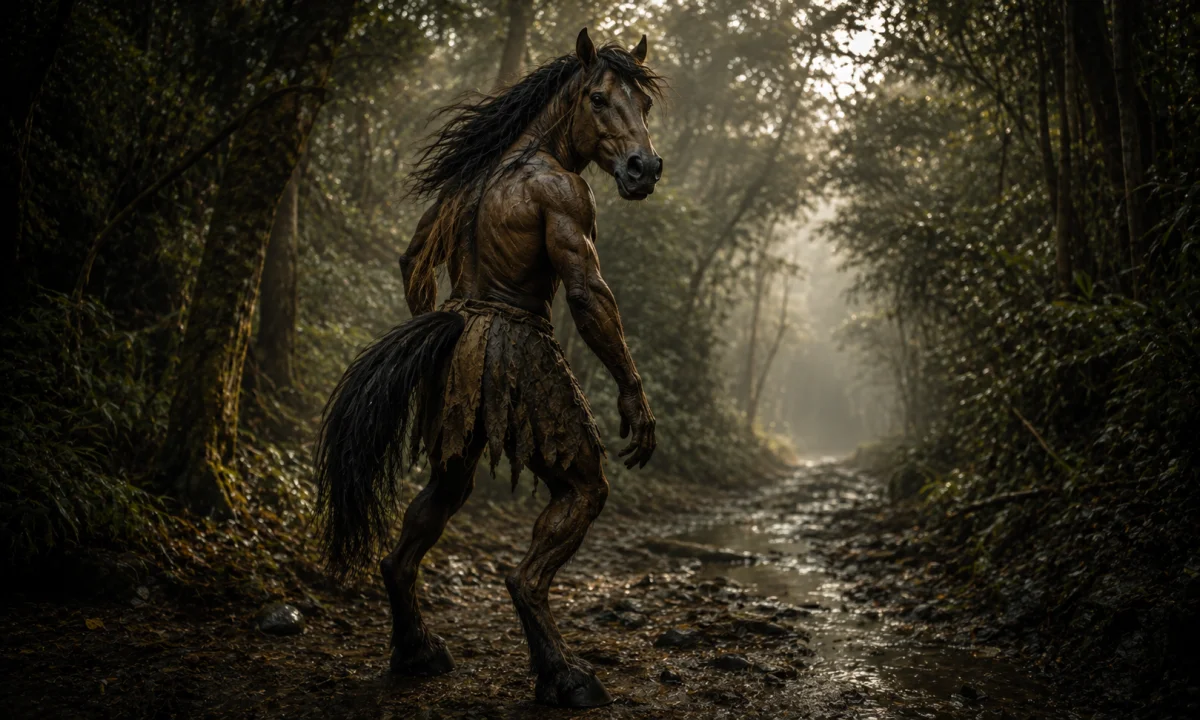
Descriptions of the Jersey Devil differ considerably, especially in early accounts. The creature may be portrayed as roughly humanoid, horse-like, reptilian, bird-like, or a mixture of several animals. Common features include:
- a horse-like or goat-like head;
- horns or antlers;
- large wings, sometimes described as bat-like;
- clawed hands or forelimbs;
- hooves or bird-like feet;
- a long tail, sometimes said to be forked;
- a dark, brown, black, or reddish body; and
- a loud, frightening cry.
The familiar illustrated image—a tall, thin creature with a horse’s head, bat wings, clawed hands, hooves, and a long tail—is largely a product of later standardization. Earlier stories do not always agree on these details. Some accounts describe an animal that resembles a kangaroo or large bird, while others report a creature with a dog-like or human-like form. The modern image brings together features from multiple traditions and is not evidence that every historical witness described the same body.
The hybrid appearance is meaningful within folklore. Combining traits from a horse, bird, reptile, goat, bat, and human produces a being that violates ordinary categories. It is neither fully animal nor fully human, neither grounded nor airborne. Horns, hooves, and wings can suggest European images of demons, while the long face and animal behavior connect the figure to frightening creatures of the forest. Its very instability of form helps explain why the legend can absorb different local descriptions.
Abilities and behavior
In popular accounts, the Jersey Devil can fly, move rapidly through the Pine Barrens, and produce a scream or shriek that causes alarm. It is sometimes said to leave unusual tracks in snow or mud, to frighten livestock, or to attack domestic animals. Some stories claim that it can pass through narrow spaces, disappear suddenly, or resist ordinary attempts to capture it.
These powers are not consistent across the tradition. Flight is central to the modern image, but not every early report necessarily describes a winged being. Likewise, claims that the creature kills livestock or causes physical harm belong mainly to particular stories and reported encounters rather than to a fixed body of traditional rules. There is no universally accepted account of what the Jersey Devil can or cannot do.
The creature’s behavior often shifts between that of a predatory animal and that of a supernatural omen. It may be described as wandering, screaming, and fleeing rather than deliberately seeking human victims. In other versions, its appearance is followed by illness, misfortune, dead animals, or communal panic. This ambiguity allows the legend to explain both a frightening encounter and an unexplained event without requiring a single consistent personality.
Stories of the 1909 encounters
The most important period in the modern history of the Jersey Devil legend came in January 1909, when newspapers reported a series of alleged sightings across southern New Jersey and nearby parts of Pennsylvania. Residents described unusual tracks, strange noises, and encounters with a winged or animal-like creature. The reports generated widespread fear, and some schools and workplaces reportedly closed or reduced activity during the excitement.
Newspapers played a major role in spreading and shaping the episode. Reports were repeated, embellished, and sometimes contradicted one another. Public anxiety encouraged further sightings, while sensational descriptions helped transform a local legend into a regional story. The 1909 episode therefore matters even if the alleged creature itself cannot be verified: it demonstrates how folklore, mass media, rumor, and collective expectation can reinforce one another.
Not every reported track or sighting had a supernatural explanation. Large birds, dogs, horses, and other animals can leave confusing marks, particularly when tracks are partly covered by snow or distorted by melting. Hoaxes and misidentifications are also possible. These possibilities do not explain every report individually, but they make it unnecessary to assume that all accounts came from one unknown species.
Later sightings continued to appear, especially in the Pine Barrens and in communities near the Delaware River. Some witnesses describe a creature matching the standardized winged form, while others report something less specific. The reports preserve the legend as living folklore, but they do not constitute accepted zoological evidence for a real monster.
Folklore, fear, and local identity
The Jersey Devil has served several cultural purposes in New Jersey. It gives a recognizable shape to the Pine Barrens, a region often imagined as mysterious because of its forests, bogs, abandoned industrial sites, and relative isolation. The creature is a symbolic inhabitant of a landscape that lies outside ordinary town life, even though the Pine Barrens are also a real environment with complex human and ecological histories.
The legend also reflects anxieties about family reputation, social exclusion, religious judgment, and the fear of abnormality. In the Mother Leeds story, a child becomes monstrous because of a curse associated with birth and family circumstances. In the Leeds interpretation, a controversial family is remembered through an accusation of diabolical identity. In the 1909 reports, modern communities confront the possibility that something unknown is moving through familiar roads and fields.
Descriptions of the creature should not be treated as proof that the people who told these stories were simply irrational. Folklore is a way of organizing uncertainty. A strange sound, unfamiliar tracks, an unusual animal, or a socially disapproved person may be interpreted through a community’s existing stories and religious vocabulary. At the same time, the tradition should not be presented as a verified supernatural event. Its cultural reality is well established; the physical existence of the monster is not.
Distinctions from similar figures
The Jersey Devil is sometimes confused with other winged or demonic creatures, but these associations should be kept separate.
- European devils and demons: The Jersey Devil borrows imagery associated with Christian devils, especially horns, hooves, and a threatening hybrid body. It is not, however, a standardized figure from Christian demonology.
- Witches: Mother Leeds is sometimes called a witch, but the Jersey Devil is not simply another name for a witch or a witch’s familiar. The witch element belongs to some versions of the origin story.
- Goat-like spirits: Resemblance to a goat or satyr does not make the Jersey Devil a satyr from Greek mythology. Satyrs have their own ancient cultural context and distinctive roles in Greek myth.
- Other American winged monsters: Reports of creatures such as the Mothman belong to different regional traditions and developed in different historical circumstances. Similar appearances do not prove a shared identity.
- Animal misidentifications: A large bird, deer, dog, or other animal may account for an individual sighting or track. Such explanations concern particular reports and do not erase the broader folklore tradition.
Modern reception
During the twentieth and twenty-first centuries, the Jersey Devil became a prominent symbol of New Jersey. It appears in books, documentaries, ghost tours, local festivals, artwork, merchandise, and fictional stories. The National Hockey League’s New Jersey Devils adopted the name in 1982, using the regional legend as a distinctive sports identity. The team’s name helped carry the creature far beyond the Pine Barrens, although its logo and public image are symbolic rather than claims about a literal monster.
Modern films, television programs, games, and online discussions often portray the Jersey Devil as a powerful predatory cryptid or an openly demonic antagonist. These adaptations may give it a fixed anatomy, supernatural powers, or a detailed biography that are absent from older accounts. Such portrayals belong to contemporary popular culture. They should not be confused with the variable colonial legends, newspaper reports, and local storytelling traditions from which the modern image developed.
The Jersey Devil remains compelling because it occupies several categories at once: family legend, regional monster, colonial tale, media phenomenon, and cultural emblem. Its history cannot be reduced with certainty to one birth, one family, or one unexplained animal. What can be said with confidence is that the story grew from the cultural world of New Jersey, acquired power through repeated retelling, and continues to give the Pine Barrens one of the most recognizable legendary creatures in American folklore.