WORLD
WORLD
Ipos
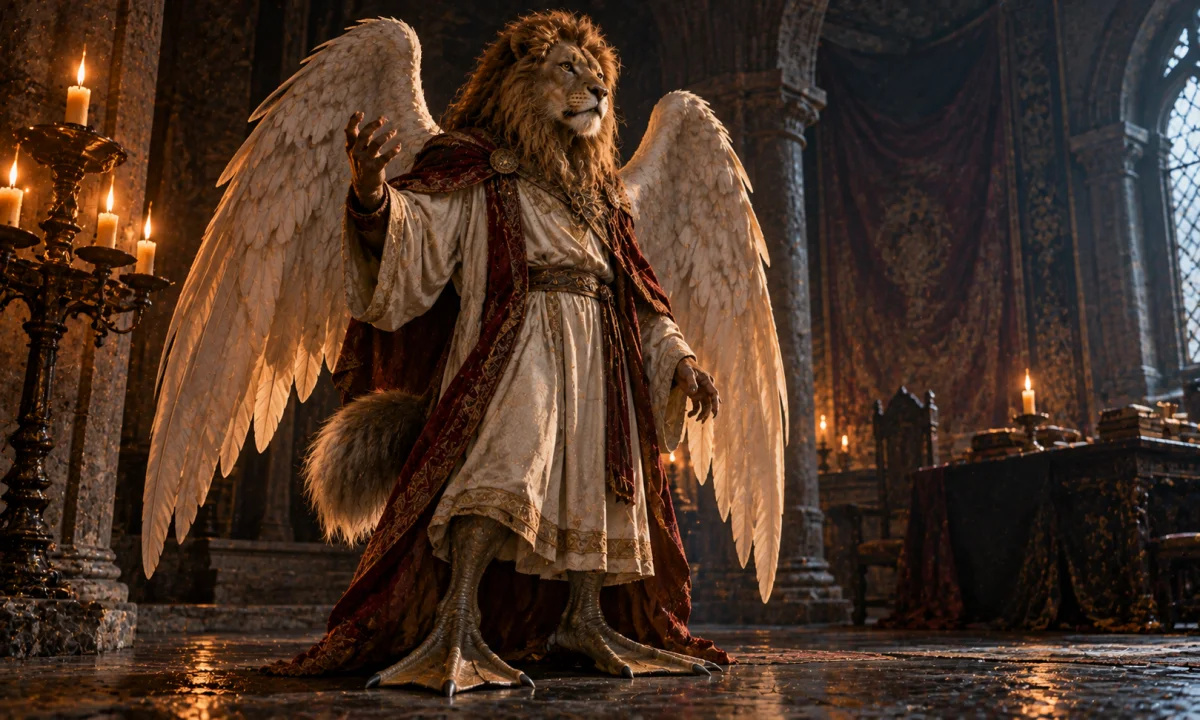
Ipos is a demon of early modern European ceremonial magic, best known from the Ars Goetia, the first section of the grimoire commonly called the Lesser Key of Solomon. He is described as a powerful spirit who reveals knowledge of the past and future and gives people wit, confidence, and boldness. His appearance is unusual: an angelic figure combined with features associated with a lion, a goose, and a hare. The name and details vary between related demonological texts, so Ipos should be understood as a figure of grimoire tradition rather than as a demon with a single, continuous identity in ancient religion or folklore.
Origins in early modern demonology
Ipos belongs to a literary and magical tradition that developed in Christian Europe between the sixteenth and seventeenth centuries. The demonological catalogues in which he appears were not records of an ancient pagan pantheon. They were products of learned occult culture, Christian ideas about demonic powers, and the growing circulation of magical manuscripts and printed books.
One important early appearance is under the name Ayperos or a closely related spelling in Johann Weyer’s Pseudomonarchia Daemonum. Weyer included this catalogue in his work De praestigiis daemonum, first published in 1563. The catalogue presents a series of spirits, their ranks, appearances, powers, and the number of infernal legions they command. Weyer’s treatment is part of a broader discussion of demons and magical deception, not an independent mythology originating with the beings themselves.
Ipos also appears in the Ars Goetia, a work transmitted in manuscripts associated with the larger Lemegeton, or Lesser Key of Solomon. The Lemegeton is generally regarded as a seventeenth-century compilation, although its contents draw on older magical and demonological materials. Its attribution to King Solomon is legendary and pseudepigraphic. There is no reliable historical evidence that Solomon wrote the book or personally commanded the spirits listed in it.
In these works, demons are arranged according to an infernal hierarchy influenced by European titles of rank. Their descriptions combine Christian demonology with material inherited from magical handbooks, occult catalogues, biblical interpretation, and the imaginative habits of early modern authors and copyists. Ipos is therefore best placed within the history of grimoire magic, rather than within the religious traditions of the ancient Near East, Greece, Rome, or pre-Christian northern Europe.
Name and classification
The spirit’s name is spelled in several ways. Ipos is the form most familiar from modern editions and discussions of the Ars Goetia. Related texts use forms such as Ipes, Ayporos, Ayperos, or Aiperos. The spelling is not stable across manuscripts and editions, and the original meaning of the name is uncertain. Proposed etymologies should therefore be treated cautiously. There is no widely accepted ancient language source that securely explains the name.
In the Ars Goetia, Ipos is listed as the twenty-second spirit. He is described as a great earl and also a prince. Some translations or editions use the title “count,” reflecting the relationship between the English word “earl” and continental noble titles. The variation does not necessarily indicate different beings; it reflects differences in translation and in the transmission of the demonological hierarchy.
The catalogue says that Ipos commands thirty-six legions of spirits. This number belongs to the conventional military structure of goetic catalogues, in which demons are assigned ranks and armies. It should not be read as historical evidence for an actual supernatural bureaucracy. The infernal court is a literary and ritual framework that gives order to a collection of named spirits.
Appearance
Ipos is described as appearing in the form of an angel, but with a striking combination of animal traits. The most familiar description gives him:
- the general form or appearance of an angel;
- a lion’s head;
- a goose’s foot; and
- a hare’s tail.
The wording and punctuation vary among editions, and artistic depictions are not standardized. Some illustrations present Ipos as a winged or human-like figure with a lion’s head and animal limbs. Others emphasize the grotesque mixture of parts. The source texts do not provide a detailed naturalistic portrait, so modern images necessarily make choices that are not fixed by the original descriptions.
The composite form is characteristic of many early modern demonological catalogues. Such figures often combine human, animal, angelic, and monstrous elements rather than belonging to a consistent biological species. The mixture may create an impression of strangeness, disguise, or inversion: Ipos resembles an angel while simultaneously violating the expected appearance of an angel. Yet the texts do not explain the symbolism of each body part, and it would be misleading to claim that the lion, goose, and hare possess a single established meaning in Ipos’s tradition.
Later interpreters sometimes assign symbolic qualities to the animals. The lion may be associated with strength or courage, the hare with speed or timidity, and the goose with vigilance, foolishness, or various folk associations. These readings can be useful as modern interpretation, but they are not explicitly stated in the principal goetic descriptions. The surviving texts focus more on Ipos’s powers and rank than on an allegorical explanation of his body.
Powers and functions
Ipos is primarily associated with knowledge, intelligence, and courage. The Ars Goetia describes him as knowing things that have happened and things that are yet to come. This gives him a role as a revealer of hidden or inaccessible information. His knowledge is not presented as a philosophical doctrine or a detailed system of prophecy. Instead, it is a concise claim about his ability to disclose past and future events.
He is also said to make people witty and bold. In the language of the period, “witty” can mean intelligent, mentally agile, ingenious, or capable in conversation, rather than merely amusing. “Bold” suggests courage, confidence, and readiness to act. Ipos’s powers therefore concern both the mind and the will: he can supposedly improve a person’s cleverness while strengthening their nerve.
These qualities place him among spirits invoked for practical advantage. A person seeking Ipos in the logic of a grimoire might be interested in foreknowledge, persuasive intelligence, courage in difficult circumstances, or the ability to respond quickly. The texts do not give Ipos a long narrative explaining why he possesses these abilities. Like many spirits in the Ars Goetia, he is defined by a compact catalogue entry rather than by a developed myth.
The power to reveal the past and future also places Ipos near the broad category of divinatory spirits. He should not, however, be confused with a deity of prophecy from a particular ancient religious tradition. The catalogue does not connect him to Apollo, the Greek seers, Roman divination, or any other established prophetic cult. His prophetic function is part of the Christian-European grimoire system.
Ipos in the Pseudomonarchia Daemonum
The description associated with Ayperos in the Pseudomonarchia Daemonum is closely related to the later Ipos entry. It presents the spirit as a high-ranking demon with an angelic form modified by animal characteristics. It also attributes knowledge of past and future events to him and says that he makes people clever and courageous. The number of legions is likewise given as thirty-six in the familiar tradition.
The relationship between the two entries illustrates how demonological material was copied, adapted, translated, and reorganized. Names could change through manuscript transmission, while descriptions remained recognizable. Titles could also shift because authors and translators interpreted ranks differently. For this reason, Ipos and Ayperos are usually treated as forms of the same goetic spirit, but the identification rests on textual comparison rather than on an ancient, universally preserved tradition.
The Pseudomonarchia Daemonum and the Ars Goetia are related, but they are not identical books. Their lists, ordering, names, wording, and details differ in places. A description found in one should not automatically be treated as if it appears in exactly the same form in the other. Discussions of Ipos are most accurate when they acknowledge the textual variation instead of presenting one modern edition as the only original account.
Place within the goetic hierarchy
The titles assigned to Ipos reflect the social and political vocabulary of early modern Europe. “Earl,” “prince,” and similar labels translate a world of aristocratic power into an infernal setting. These titles distinguish Ipos from spirits given lower or different ranks, such as kings, dukes, marquises, presidents, knights, or lesser nobles.
His status as both an earl and a prince is somewhat unusual, but such overlapping titles are not exceptional in the goetic catalogues. The hierarchy is not a consistent constitutional system. Different spirits may receive more than one title, and the titles can vary across sources. They function partly as markers of authority and partly as a way of organizing ritual material.
The mention of thirty-six legions reinforces his high rank. In the ritual logic of the Ars Goetia, each spirit is treated as a commander with a following. Ipos is therefore not simply an isolated monster or wandering ghost. He is represented as a powerful subordinate within an imagined infernal administration, summoned and constrained through the procedures of ceremonial magic.
Ritual context
The Ars Goetia presents spirits such as Ipos within a system involving divine names, protective circles, conjurations, seals, and formal commands. The practitioner is instructed to approach the spirit through a ritual structure intended to establish authority and protection. These instructions belong to the literature of ceremonial magic and should not be mistaken for evidence of a uniform practice followed by all historical Christians or occultists.
There is also no evidence that Ipos was the object of an ancient public cult. His name does not identify a known deity worshipped in temples or a demon preserved continuously in oral folklore from antiquity. His surviving identity is chiefly textual. What can be documented is his appearance in demonological and magical literature, not a long popular tradition independent of those books.
Historically, books of this kind circulated among a relatively small literate audience. Their influence later expanded through printing, occult revival movements, esoteric societies, reprints, translations, and popular reference works. The image of Ipos today is consequently shaped not only by early modern manuscripts but also by editorial choices and modern illustrations.
Interpretation and cultural significance
Ipos is an example of how early modern demonology transformed qualities that might otherwise be considered desirable into attributes of a demonic spirit. Intelligence, courage, and knowledge can be virtues, but in a Christian demonological framework they become powers supplied by a dangerous or rebellious supernatural being. This does not mean the texts condemn cleverness or courage in every context. Rather, they present access to extraordinary abilities through illicit magic as morally and spiritually perilous.
His body also reflects the period’s interest in categorizing and visualizing the monstrous. The angelic outline suggests a being of the spiritual world, while the lion’s head, goose’s foot, and hare’s tail mark him as abnormal. The combination is less like a creature from a coherent zoological mythology and more like a catalogue emblem designed to make the spirit memorable. Ipos’s form communicates otherness without requiring a complete narrative about his birth or history.
The contrast between angelic appearance and demonic classification is significant within Christian demonology. Demons were often imagined as spirits capable of deception, including the appearance of goodness or holiness. In Ipos’s case, the angelic form does not make him an angel in Christian theology. It is a mode of manifestation within a grimoire description, and the accompanying animal features make the image deliberately ambiguous.
Distinguishing Ipos from similar figures
Ipos is sometimes confused with figures whose names resemble his, especially Ayperos, Aiperos, or Ipes. In the context of the demonological catalogues, these forms generally refer to the same textual spirit or to closely related versions of the same entry. Spelling differences alone do not establish separate demons.
He should also be distinguished from Ipse or other short names that appear in unrelated magical, fictional, or modern occult materials. Similar spelling is not proof of a shared origin. The safest identification depends on the combination of the name, the rank, the animal features, the powers of revealing past and future events, and the command of thirty-six legions.
Ipos is not the same figure as a lion-headed deity from ancient Egypt, a were-animal from European folklore, or a generic “beast demon.” His lion’s head is one element of a specifically early modern composite description. Nor should he be identified with a named angel merely because the texts say that he can appear in angelic form. His classification in the goetic catalogues is demonic.
Later reception
Ipos has appeared in modern occult books, demonology databases, fantasy art, role-playing games, comics, games, and other popular media. These adaptations often expand his personality, redesign his appearance, or give him new relationships and abilities. Such additions belong to modern interpretation and fiction unless they can be traced to the older goetic descriptions.
Contemporary artists frequently emphasize the contrast between an angelic body and animal features, sometimes adding wings, armor, weapons, horns, or elaborate infernal clothing. These details are creative developments rather than stable features of the early sources. Likewise, modern stories may portray Ipos as a heroic, tragic, seductive, or villainous character, none of which is developed in the brief catalogue entries.
The traditional textual image remains comparatively concise: Ipos is a high-ranking demon of goetic literature, associated with the knowledge of past and future events, wit, boldness, an angelic form marked by animal parts, and command over thirty-six legions. His uncertain name and variant descriptions are reminders that the figure comes from a changing manuscript tradition rather than from a single canonical mythology.