WORLD
WORLD
Glasya-Labolas
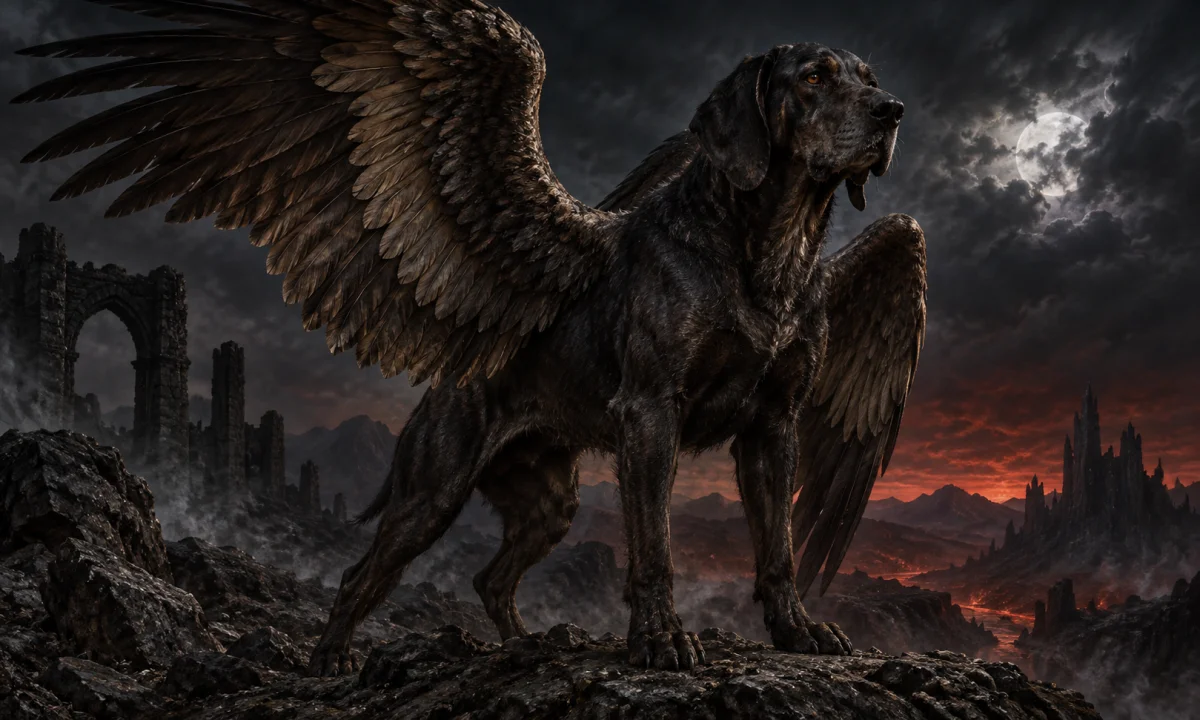
Glasya-Labolas is a demon described in early modern European demonological literature, especially the Lemegeton, or Lesser Key of Solomon. In that tradition, he is presented as a powerful spirit holding the ranks of President and Earl. His principal form is a dog with wings resembling those of a gryphon, and his powers combine learning, prophecy, concealment, affection and violent harm.
Origins in demonological literature
Glasya-Labolas belongs to the cataloguing tradition known as Goetic demonology. The best-known account appears in the Ars Goetia, the first part of the Lemegeton, a group of magical texts preserved in manuscripts from the seventeenth century and associated with the legendary figure of King Solomon. The work claims that Solomon compelled various spirits and recorded their names, ranks, appearances and abilities.
The Solomonic attribution is part of the text's religious and magical framework rather than a securely documented historical event. The Lemegeton is a later compilation drawing on older European traditions of angelology, demonology, astrology and ritual magic. Its lists are not evidence that the named spirits were worshipped as ancient gods, nor do they represent a single, uniform religious system.
A closely related entry appears in Johann Weyer’s Pseudomonarchia Daemonum, published in the sixteenth century as part of a larger work on alleged demonic magic. Weyer’s catalog predates the surviving Lemegeton manuscripts and shares many names, ranks and descriptions with the later Goetic material. The relationship between the two works is complex, but both helped establish the literary form in which Glasya-Labolas is known today.
These texts were written within a Christian intellectual environment that treated demons as malevolent or deceptive spirits. They were not neutral field records of popular folklore. Some authors intended to condemn magical practices, while later occultists reused the material as a ritual catalogue. Glasya-Labolas therefore belongs primarily to the history of learned demonology rather than to a clearly documented local folk tradition.
Name and variant spellings
The name is not stable across manuscripts and editions. Glasya-Labolas is the most familiar modern form, but related sources and printed versions use forms such as Cacrinolaas, Classyalabolas, Caassimolar and other variant spellings. Differences result from copying, transliteration, editorial intervention and the difficulty of interpreting names transmitted through handwritten texts.
Some editions present Cacrinolaas as an alternative name for Glasya-Labolas. In older demonological catalogues, however, spelling and identity do not always correspond neatly from one source to another. The variants should not automatically be treated as evidence of several separate demons. In the principal Goetic tradition, they refer to the same catalogued spirit.
No widely accepted etymology explains the name. It does not have a securely established meaning in Hebrew, Greek, Latin or another known ancient religious language. Attempts to derive it from particular words are speculative unless tied to a specific manuscript tradition. The unusual spelling is best understood as a product of the transmission history of grimoires rather than as proof of an ancient, independently attested origin.
Rank and classification
Glasya-Labolas is called both a President and an Earl. These titles belong to the hierarchy used by the Ars Goetia. They should not be interpreted as offices within an actual historical kingdom. Instead, they organize spirits according to a system of aristocratic and administrative ranks that resembles a distorted mirror of human institutions.
In this hierarchy, a President is a high-ranking spirit associated with authority, instruction or command. An Earl, or Count, is another noble rank within the same infernal structure. The combination gives Glasya-Labolas a comparatively elevated position in the catalog. The text also states that he governs thirty-six legions of spirits. The word “legion” reflects the military imagery common to Christian descriptions of demons and is not a count independently verified outside the grimoire tradition.
His classification is therefore literary and theological. It communicates the spirit’s supposed importance and danger within the ritual system rather than describing a political or social institution recognized by any historical community.
Appearance and symbolic features
The standard description gives Glasya-Labolas the form of a dog with wings like a gryphon. This combines the familiar dog with a powerful hybrid creature from classical and medieval visual culture. The dog can suggest loyalty, watchfulness or domestic familiarity, but in demonological writing an animal form can also mark a spirit as nonhuman, deceptive or threatening.
Gryphon-like wings add a different set of associations. Gryphons traditionally combine the body of a lion with the head and wings of an eagle, and they often symbolize strength, guardianship and elevated power. Glasya-Labolas is not a gryphon, however. The text compares his wings to those of a gryphon while retaining the body of a dog. Later illustrations sometimes emphasize the hybrid quality more strongly than the brief written description does.
The image is not supported by an extensive mythology of transformations or physical adventures. Unlike figures from epic or folkloric narratives, Glasya-Labolas has no substantial cycle of stories in which his form changes from one episode to another. The dog-and-wings image comes primarily from the descriptive format of the Goetic catalogues, which provide each spirit with a recognizable appearance for ritual visualization.
Abilities attributed to Glasya-Labolas
The powers associated with Glasya-Labolas are unusually broad. They combine intellectual instruction with violent action and forms of social or personal influence.
- Teaching: He is said to teach all arts and sciences immediately or with exceptional speed. This is one of the clearest reasons he is portrayed as more than a purely destructive demon. His knowledge is presented as comprehensive, although the text does not specify particular disciplines or methods of instruction.
- Bloodshed and manslaughter: He is described as an author or instigator of bloodshed and killing. This places him among the dangerous spirits of the catalog and gives his otherwise scholarly profile a distinctly violent dimension.
- Knowledge of time: He can reveal things past and things to come. The wording connects him with divination, hidden knowledge and the disclosure of information unavailable to ordinary human perception.
- Affection and influence: He is credited with gaining the love of friends and enemies. The ability is not described as a philosophy of love or a benevolent gift; within the context of the grimoire, it is a supernatural means of influencing relationships and sentiment.
- Invisibility: He can make a person invisible. The text does not explain whether this means literal physical invisibility, concealment from perception or a magical condition understood through ritual symbolism.
The juxtaposition of learning and violence is characteristic of grimoire demonology. A spirit may grant knowledge while also embodying the risks of seeking power through forbidden or morally dangerous means. Glasya-Labolas is not simply a patron of scholarship, nor is he only a monster of slaughter. His catalogued identity depends on the tension between these qualities.
Place within the Goetic system
The Ars Goetia arranges its spirits in a numbered sequence and supplies each with a seal, a rank, a visual form, powers and the number of legions under its command. Glasya-Labolas is commonly listed as the twenty-fifth spirit in modern editions of the Goetia. This number should not be confused with the thirty-six legions attributed to him.
The spirit’s entry is concise. It does not provide a biography, genealogy or detailed account of interactions with other demons. The catalog format is important: Glasya-Labolas is defined through attributes useful to a magical operator, rather than through a narrative explaining how he came to exist or why he possesses these powers.
Later editions of the Goetia often include an engraved seal associated with the spirit. Such seals are part of the ritual apparatus of early modern and modern occult books. Their designs vary between editions, and they should not be mistaken for ancient archaeological symbols or universally recognized emblems of Glasya-Labolas.
Religious and cultural significance
Within Christian demonological thinking, a demon was generally understood as a corrupting or rebellious spiritual being, not as a morally neutral source of knowledge. The promise of instant learning, prophecy or social influence could therefore be read as a temptation. Glasya-Labolas’s abilities illustrate a recurring concern in Christian discussions of magic: the desire for useful power may lead a person to seek assistance from beings considered spiritually dangerous.
At the same time, the Goetic catalogues are not straightforward expressions of official church doctrine. They belong to a marginal and often prohibited magical literature that borrowed religious names, biblical authority and hierarchical language. Clergy, scholars, magicians and printers could all participate in transmitting demonological material, but they did not necessarily share the same purposes. Some copied the names to criticize them, some used them in ritual practice, and some treated them as part of occult theory.
There is no reliable evidence that Glasya-Labolas was a pre-Christian deity later demonized by Christianity. Nor is there a well-attested ancient mythology surrounding him. The surviving evidence places him within the early modern tradition of learned demonological lists. Claims that he was originally a god, hero or spirit from a specific ancient culture require supporting evidence that the principal sources do not provide.
Distinguishing Glasya-Labolas from similar figures
Glasya-Labolas is sometimes confused with other animal-shaped or knowledge-giving spirits in occult writing, but the descriptions are distinct. Buer, for example, is associated in the Goetia with philosophy, moral instruction and the healing of illnesses, and is commonly represented with a wheel-like form. He is not another name for Glasya-Labolas.
Naberius is also linked with learning and eloquence and is often described in the form of a dog or a many-headed creature, depending on the source and edition. His traditional profile differs from Glasya-Labolas’s winged dog and his stated connection with bloodshed, invisibility and the love of friends and enemies.
Marchosias is another Goetic spirit associated with an animal-like appearance and wings, but his standard form is that of a wolf or ox with gryphon wings and a serpent’s tail. He is a separate figure with a different rank and description. The shared use of wings and hybrid animals reflects the visual vocabulary of demonological catalogues, not a shared identity.
Cacrinolaas is the most important apparent alternative name because it occurs in closely related descriptions. It should generally be treated as a variant identity for Glasya-Labolas within the relevant texts, while other spellings may reflect separate manuscript or editorial traditions. Exact equivalence cannot always be established for every unusual form appearing in later occult books.
Later occult and popular reception
From the nineteenth century onward, occult writers revisited the Goetia as a source of ritual symbolism, magical hierarchy and spirit imagery. In these settings, Glasya-Labolas may be interpreted as a spirit of hidden knowledge, dangerous instruction, influence over others or the concealment of identity. Such interpretations are later developments and should not be presented as the original meaning of the medieval or early modern material.
Modern fantasy literature, games, comics and other forms of popular culture sometimes use Glasya-Labolas as a demon, boss character or name for a supernatural antagonist. These adaptations may retain the winged-dog image or the themes of violence and knowledge, but they frequently add personalities, histories, alliances and powers absent from the Goetic sources. A fictional portrayal is therefore an adaptation of the grimoire figure, not independent evidence about the older tradition.
The historical Glasya-Labolas remains a compact but striking example of how early modern demonological texts organized supernatural danger. His identity is built from a hybrid animal form, aristocratic rank, command over thirty-six legions and a contradictory set of powers: he teaches, reveals, persuades and conceals, yet is also associated with bloodshed and killing. Those contrasts are central to the figure as preserved in the Goetic tradition.