WORLD
WORLD
Halphas
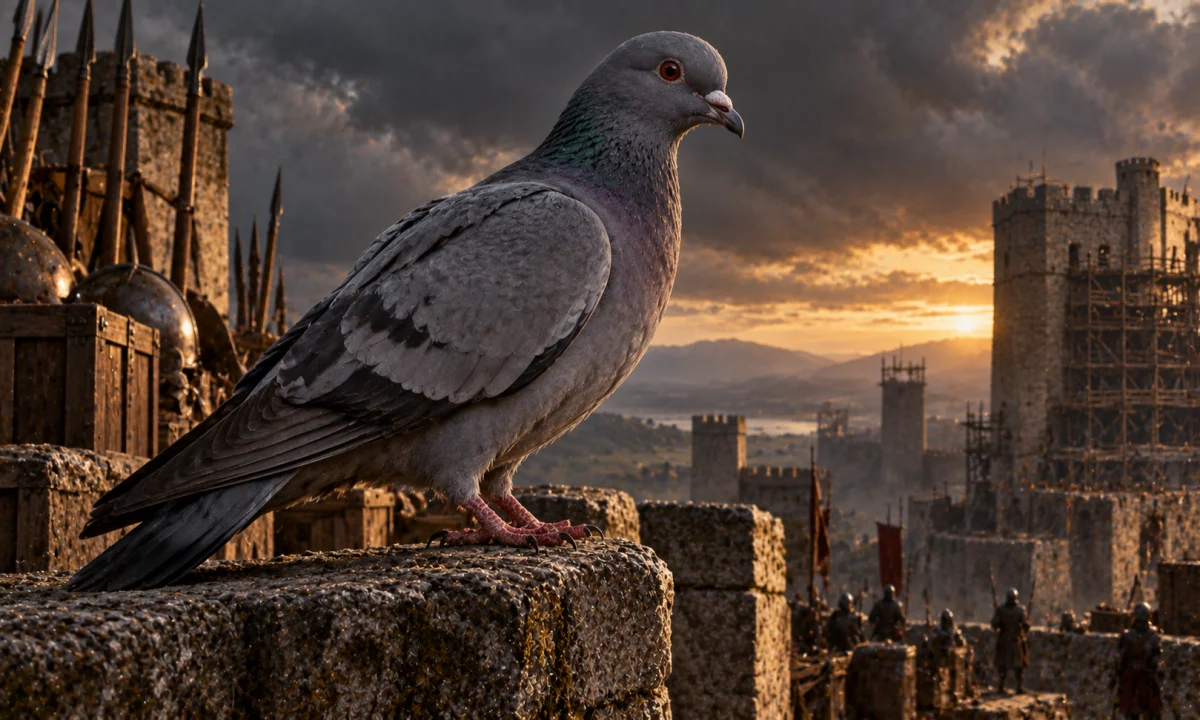
Halphas is a demon of early modern European grimoire tradition, best known from the Ars Goetia, the first section of the Lesser Key of Solomon. He is described as a great earl who appears as a stock dove, speaks with a hoarse voice, constructs towers, supplies them with weapons and ammunition, and sends men of war to designated places. The Ars Goetia assigns him command over twenty-six legions of spirits.
Halphas is not a figure from the Bible, classical mythology, or a known ancient pagan religion. His profile belongs to the system of ceremonial demonology that developed in European magical manuscripts and printed occult books during the late medieval and early modern periods. The names, ranks, appearances, and powers in these works form a catalogue of spirits rather than a collection of myths with extensive narratives.
Origins in grimoire tradition
The best-known account of Halphas occurs in the Ars Goetia, a work preserved in manuscripts of the Lemegeton, or Lesser Key of Solomon. The Lemegeton is generally regarded as a seventeenth-century compilation, although it incorporates material from earlier magical and demonological writings. Its catalogue contains seventy-two spirits, each given a name, rank, number of legions, description, and magical seal.
Halphas is listed as the thirty-eighth spirit in the usual ordering of the Ars Goetia. The text calls him a Great Earl, placing him within a hierarchy that borrows titles from European aristocracy and military society. This rank does not indicate a historical nobleman or a deity who was worshipped under that title. It is part of the administrative structure used by grimoire authors to organise the spirit world.
A related description appears in Johann Weyer’s Pseudomonarchia Daemonum, first published in 1577. In that work, the spirit is generally named Malthus rather than Halphas. Reginald Scot’s English presentation of Weyer’s material in The Discoverie of Witchcraft, published in 1584, helped circulate similar demonological descriptions in English. The relationship between these texts is part of a wider process of copying, translation, rearrangement, and adaptation that shaped early modern catalogues of demons.
Because the material was transmitted through manuscripts and translations, the spelling and wording are not completely uniform. Forms such as Halphas, Malthus, and Malthous may appear in different occult sources. The precise history of the name is uncertain, and there is no secure evidence that Halphas was an independently known spirit in antiquity before these grimoire traditions.
Name and identity
The most important identity question concerns the relationship between Halphas and Malthus. In the Ars Goetia, the entry is commonly headed “Halphas, or Malthus,” treating the names as alternatives for the same spirit. Earlier or related versions tend to preserve Malthus as the principal name, while later Goetic publications often give greater prominence to Halphas.
These variations should not be treated as proof of several distinct demons. They are more plausibly the result of textual transmission, copying, and changes in editorial preference. At the same time, the surviving evidence does not allow every spelling or variant to be traced with certainty to a single original form. Modern occult writers sometimes assign separate identities to variant names, but that distinction is not firmly established by the principal early sources.
Halphas also should not be confused with similarly named figures from unrelated religious or literary traditions. The name does not establish a connection with the biblical Moloch, the Greek god Hephaestus, or any other ancient power associated with war, fire, birds, or fortifications. Similarities created by sound or by modern speculation are not evidence of a historical relationship.
Appearance and attributes
The Ars Goetia describes Halphas as appearing in the form of a stock dove, a real European pigeon species rather than a supernatural bird invented specifically for the text. Some translations use less precise wording such as “dove” or “pigeon.” The stock dove is a small grey-blue bird that nests in cavities and can be associated, in ordinary natural history, with woodland and old buildings.
The text also says that Halphas speaks with a hoarse voice. This detail is unusual because the description combines a modest, familiar bird with a rough or unpleasant sound and a strongly military office. The source does not explain the symbolism of the bird, and no ancient myth survives to clarify why this particular form was chosen.
Beyond the dove form and hoarse voice, there is no elaborate physical description in the principal Goetic account. Halphas is not assigned horns, wings, a human body, armour, or a monstrous face in the basic text. Illustrations in later books may add visual features, but those artistic interpretations should not be mistaken for details found in the earliest relevant descriptions.
Functions and powers
Halphas’s principal office is military and architectural. He is said to build towers and to furnish them with ammunition and weapons. In the language of the period, “ammunition” refers broadly to military supplies or munitions. It should not automatically be understood as a reference to modern firearms, explosives, or industrial warfare.
The towers can be understood as fortifications, lookout structures, or strongholds. Halphas is not simply described as an architect or builder: his construction is connected directly with defence and armed conflict. The account further states that he sends men of war to places appointed by the magician or operator. The wording presents him as a logistical and strategic spirit, capable of preparing military positions and deploying forces.
His power therefore concerns the organisation of conflict rather than personal combat. The text does not present a famous battle involving Halphas, nor does it give him a particular enemy or patron. No individual warrior, king, angel, or demon is named as his permanent adversary. His role is functional, like those of many spirits in the Ars Goetia: a practitioner is told what the spirit is supposed to accomplish, rather than being given a developed biography.
Halphas is said to command twenty-six legions. In Goetic literature, a legion is a conventional measure of supernatural followers, not a force that can be verified historically. The number helps place each spirit within the catalogue and contributes to the military language of the entry. It should not be read as evidence for an ancient army or as a consistent census of demons across all demonological writings.
The military symbolism of Halphas
Halphas’s profile reflects the importance of fortification and military organisation in the historical world of early modern Europe. Castles, walled towns, artillery positions, and defensive towers were familiar features of political and military life. A demon who supplies strongholds and troops represents the practical infrastructure of war as much as the violence of battle itself.
The combination of a dove and military engineering creates a marked contrast. Doves are often associated in later Christian symbolism with peace or the Holy Spirit, although the stock dove in the Goetic text is not explicitly given either meaning. Halphas’s bird form may simply be an inherited or unexplained feature of the catalogue. Any interpretation linking him symbolically to peace, secrecy, surveillance, or the tension between peace and war remains speculative unless supported by a particular commentator or later tradition.
The contrast may also illustrate how demonological catalogues combine unrelated descriptive elements. A spirit can have an animal appearance, a noble title, a military office, and a fixed number of legions without those elements forming a coherent mythological story. The catalogues were designed to classify and describe spirits for ritual use, not necessarily to explain their origins or personalities.
Halphas in the broader system of the Ars Goetia
The Ars Goetia gives many spirits ranks borrowed from human institutions, including kings, dukes, princes, marquises, presidents, and earls. Their offices range from teaching languages and revealing hidden things to causing love, transporting objects, raising storms, and leading armies. Halphas belongs to the group whose alleged powers are especially concerned with political authority, warfare, and material organisation.
His title as an earl is significant within that artificial hierarchy. An earl is a high-ranking nobleman in the English and broader European social imagination, and the title communicates status without making Halphas the supreme ruler of the demons. The catalogue’s use of aristocratic titles reflects the social and political vocabulary available to its authors and readers.
As with other spirits in the Ars Goetia, Halphas is assigned a seal. The seal is presented as a ritual emblem associated with the spirit, and later practitioners have reproduced it in occult manuals. Its presence does not demonstrate that the symbol was used in ancient worship or that it predates the Goetic manuscript tradition. Designs can vary between manuscripts, engravings, and modern editions, so no single artistic form should automatically be treated as historically original.
Religious and historical context
Early modern Christian demonology often described demons as fallen or rebellious spirits operating under divine judgement, although individual grimoires do not always explain their theology consistently. The Ars Goetia combines Christian language about demons with magical techniques, astrological concepts, angelic names, ritual constraints, and bureaucratic rankings. It is therefore better understood as a product of learned occult culture than as a straightforward expression of official Christian doctrine.
Church authorities, theologians, magical practitioners, and sceptical writers did not necessarily agree about the status of grimoire spirits. Some regarded them as genuine demons, some as dangerous superstitions, and some as literary or magical constructions. Weyer, whose work is an important predecessor to the Goetic catalogue, criticised witch trials and the belief that accused people possessed the powers attributed to them, even while recording extensive demonological material.
There is no known ancient temple, cult, festival, or independent scriptural tradition devoted to Halphas. References to him arise from the manuscript and printed history of European demonology. Claims that he was worshipped by an ancient civilisation, or that his Goetic military function preserves a much older forgotten religion, go beyond the available evidence.
Stories and relationships
Halphas has no substantial cycle of myths comparable to the stories of demons such as Lucifer in later Christian literature, or to the legends of figures from ancient mythologies. The main sources provide an entry rather than a narrative. They do not describe his birth, fall, family, residence, personal enemies, or a particular encounter with King Solomon.
The association with Solomon comes from the larger framework of the Lesser Key of Solomon, in which the spirits are presented as entities controlled or catalogued through Solomonic magic. This literary framework should not be taken as evidence that Halphas appears in the biblical accounts of Solomon. The biblical books associated with Solomon do not provide the Goetic list of seventy-two spirits.
Likewise, the “men of war” assigned to Halphas are not named legendary soldiers or a distinct race of supernatural beings. They are part of the description of his supposed office. Later retellings may turn them into armies, undead troops, or fantastic warriors, but those additions belong to adaptation rather than to the core early account.
Later reception and modern usage
Halphas continues to appear in modern editions of the Ars Goetia, ceremonial magic, occult reference works, and online discussions of Goetic demons. Modern practitioners may treat the spirit as a ritual entity, a symbolic figure, or a name within a system of magical correspondences. These approaches reflect contemporary beliefs and practices rather than establishing new historical evidence about Halphas’s origin.
Popular culture sometimes adapts Goetic names for fantasy fiction, role-playing games, comics, music, and digital games. In such settings, Halphas may be redesigned as a warrior, a bird-like monster, a castle builder, or a commander of armies. These portrayals can draw on the traditional elements of the dove, towers, and military forces while freely changing the character’s appearance, motives, and powers. A fictional adaptation should therefore be distinguished from the brief and relatively formal description preserved in demonological sources.
The historically grounded image of Halphas remains comparatively narrow: a grimoire spirit under the alternate name Malthus, ranked as a great earl, appearing as a stock dove with a hoarse voice, associated with fortified towers, weapons, military personnel, and twenty-six legions. His interest lies less in a developed legend than in the way early modern demonology transformed familiar political and military structures into a supernatural hierarchy.