WORLD
WORLD
Haagenti
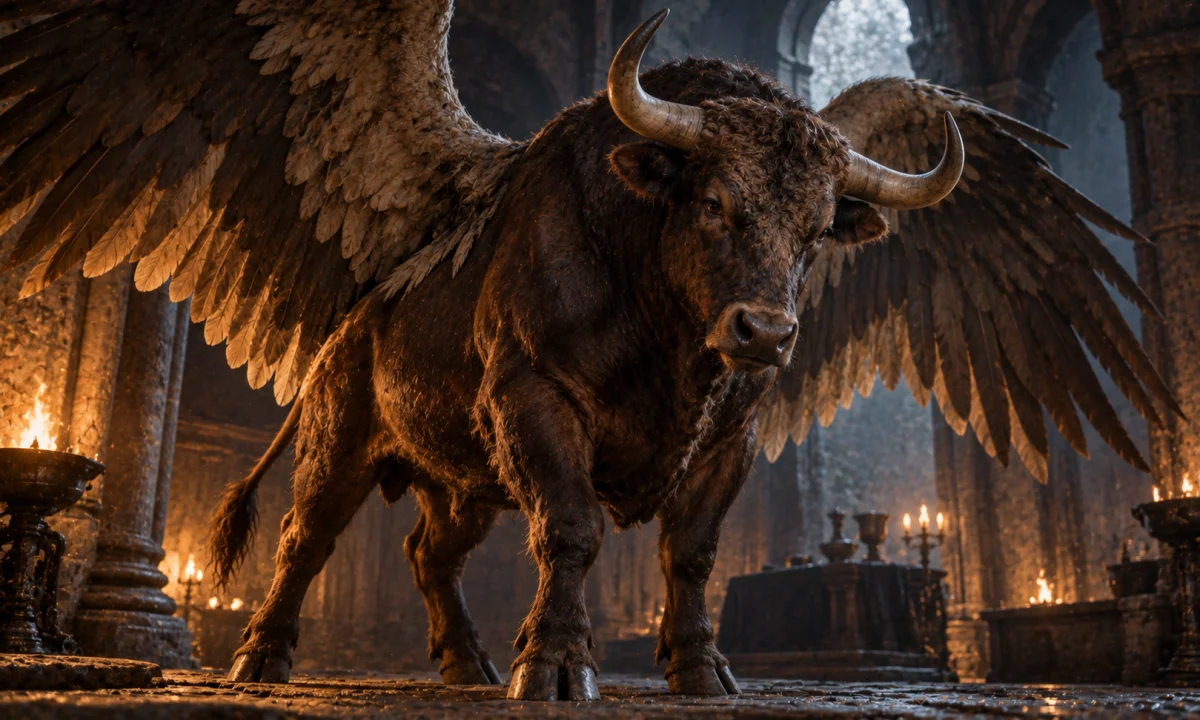
Haagenti is a demon described in the early modern grimoire tradition of Western ceremonial magic. In the Ars Goetia, the best-known section of the Lesser Key of Solomon, Haagenti is listed as the forty-eighth spirit. The text calls Haagenti a great president who commands thirty-three legions of spirits. Haagenti is said to appear first as a bull with griffin wings and then to take human form.
Origins in the grimoire tradition
Haagenti does not belong to a clearly documented ancient mythology as an independent god, monster or spirit. The surviving description comes from the European tradition of demonological and magical books that developed during the Renaissance and early modern periods. These works assembled names, ranks and ritual descriptions from several older sources, including Christian demonology, biblical language, late antique magical traditions and medieval lists of spirits.
The most familiar account appears in the Ars Goetia, the opening portion of the Lesser Key of Solomon. The Lesser Key survives in manuscript forms associated with the seventeenth century, although many of its materials are older. Its catalogue of spirits is related to earlier demonological compilations, especially lists circulated in Latin and later translated or adapted into other languages. The precise history of every name is not certain, and Haagenti's entry should be understood as part of this evolving textual tradition rather than as evidence for a single, continuous ancient cult.
Earlier demonological sources contain related names and descriptions, but the spelling is not entirely stable. Forms such as Haagenti, Hagenti and Haagent may occur in different editions, manuscripts or modern transcriptions. These variations make it difficult to establish a separate etymology with confidence. The name is generally treated as belonging to the catalogue of spirits that later magical writers organized into a hierarchy, rather than as a well-attested name from a pre-Christian religious tradition.
Name and classification
In the Ars Goetia, Haagenti holds the rank of president. This title is part of the work's infernal bureaucracy, in which spirits are assigned offices such as king, duke, prince, marquis, president and earl. These ranks resemble the titles of European courts and military administrations. They should not be confused with a standardized hierarchy shared by all forms of Christian demonology.
The number associated with Haagenti is the forty-eighth in the common ordering of the Ars Goetia. The catalogue also states that Haagenti governs thirty-three legions. A legion in this context is not a historical military unit or a reliably countable population. It is a conventional measure of supernatural followers used by the grimoire to give each spirit a particular scale of authority.
Numbering and details can vary between editions. The modern order usually follows printed and manuscript arrangements that were themselves subject to copying and editorial changes. As a result, the title, number and powers most commonly associated with Haagenti come from a particular grimoire tradition, not from a universally fixed body of demonological belief.
Appearance
Haagenti is described as appearing in the form of a bull with griffin wings. The spirit may then change into a human form. This combination brings together two different symbolic creatures. The bull suggests physical strength, virility, fertility or earthly power, while the griffin—a legendary creature traditionally combining features of an eagle and a lion—often represents majesty, vigilance and a connection between terrestrial and aerial realms.
The description does not provide a detailed physical portrait in the manner of later fantasy literature. It does not specify the bull's colour, the shape of the wings, the appearance of the human form or the spirit's clothing. Images that give Haagenti elaborate armour, horns, weapons or a distinctive face generally reflect modern artists' interpretations rather than details preserved in the early grimoire account.
The change from animal form to human form is significant within the catalogue's general style. Many spirits in ceremonial-magical texts are presented through a sequence of forms: an initial frightening or non-human manifestation, followed by a more intelligible form in which communication can occur. Such transformations emphasize the spirit's ability to cross boundaries between animal, human and supernatural states.
Powers and functions
Haagenti's principal power is the transformation of substances. The spirit is said to transmute metals into gold, a motif closely associated with alchemy and magical knowledge. In the language of the grimoire, this is presented as a supernatural operation rather than as a philosophical explanation of metallurgy. The entry does not give a recipe, process or technical method for producing gold.
Haagenti is also said to make people wise by teaching them various things. This role places the spirit among the many grimoire beings associated with hidden knowledge, instruction and intellectual transformation. The text does not define Haagenti as a teacher of one specific subject, such as astrology, medicine or languages. Its wording is broad, suggesting general acquisition of knowledge rather than a specialized scholarly discipline.
Another pair of transformations attributed to Haagenti concerns liquids: blood may be changed into water, and water into wine. These changes connect the spirit with the alteration of natural substances and with the symbolic importance of blood and wine in European religious culture. The use of wine is especially notable in a Christian cultural environment, where wine can carry sacramental and theological associations. The grimoire does not present Haagenti as a Christian sacred figure, however; it places these transformations within a demonic and magical framework.
Some modern summaries emphasize the power to turn a fool into a wise person. This reflects the spirit's traditional association with instruction and mental improvement, but wording differs between translations and editions. The broader point is that Haagenti changes a person's condition or understanding, just as it changes metal, blood and water.
Haagenti and transformation
Transformation is the central theme of Haagenti's profile. The spirit changes its own shape, alters physical substances and is associated with the movement from ignorance to knowledge. These features give the entry a coherence that goes beyond a simple list of magical tricks.
The change from a bull to a human being can be read as a movement from instinctive or material force toward reason and communication. The transformation of base metals into gold evokes the alchemical ideal of refinement: matter is purified and elevated into a more valuable form. The change from foolishness to wisdom similarly presents knowledge as a kind of inner transmutation.
Such interpretations are possibilities rather than fixed teachings of the original text. The Ars Goetia is primarily a catalogue of ritual spirits and their alleged powers, not a systematic treatise explaining the symbolism of every entry. Later occultists, artists and writers have therefore been free to develop meanings that are only implied, or not present at all, in the brief source description.
Place within Christian demonology
Haagenti belongs to a Christianized demonological environment, but the spirit is not a major figure in biblical literature, patristic theology or medieval popular religion. The Bible does not provide a narrative about Haagenti, and there is no widely documented historical cult devoted to this being. The name is instead preserved through magical catalogues that classified spirits as demons and presented methods for invoking or commanding them.
Grimoires often use the language of Christian ritual while dealing with beings considered illicit or dangerous by Christian authorities. A practitioner might be instructed to use divine names, prayers, seals, ritual clothing or consecrated tools while attempting to compel a spirit. This mixture reflects the intellectual world of ceremonial magic, in which Christian cosmology, Jewish angelology, astrology, alchemy and inherited folklore could appear together.
The classification of Haagenti as a demon therefore describes the spirit's place in this textual system. It does not demonstrate that Haagenti was an object of widespread popular belief, nor does it establish origins in a specific pre-Christian religion. Claims that connect the name directly to an ancient bull deity or to a particular Near Eastern god require evidence that the surviving grimoire tradition itself does not provide.
Relationships and associated beings
Haagenti is not given a family, consort, parentage or personal rivalry in the standard Ars Goetia entry. The spirit's relationship to other beings is administrative: Haagenti is said to rule legions of spirits. The catalogue does not explain who these subordinate spirits are or provide stories about their activities.
Haagenti's association with a bull can lead to comparisons with other bull-shaped beings, including the Minotaur of Greek mythology, the bull imagery surrounding ancient Near Eastern deities and the bull-headed demons of later artistic traditions. These comparisons are thematic rather than genealogical. The Minotaur is a specific figure in Greek myth, born from the story of Minos and confined in the Cretan Labyrinth. Haagenti has no documented connection to that narrative.
Nor should Haagenti be automatically identified with demons or spirits whose names resemble it. Similar spelling alone does not establish identity. Early modern demonological catalogues contain numerous unstable names, and copyists sometimes altered unfamiliar words. A figure called Hagenti in one transcription may represent a spelling variant of Haagenti, but a different being with a similar name should not be merged without textual evidence.
Historical and cultural significance
Haagenti illustrates how early modern magical texts organized supernatural knowledge through lists, offices and technical descriptions. Rather than presenting a long mythic story, the entry supplies a name, rank, number of legions, appearance and powers. This format turns a supernatural being into part of a structured system that a reader could, at least in theory, approach through ritual practice.
The spirit also reflects the importance of alchemical ideas in European occult culture. Gold-making was one of the most recognizable symbols of transformation, while the exchange of blood, water and wine suggests a broader interest in changing the essential qualities of substances. Haagenti's power to teach wisdom adds an intellectual dimension, linking material transmutation with the improvement of the mind.
Historically, the evidence shows the circulation of a written demonological description, not verified supernatural activity. The powers attributed to Haagenti belong to the claims and symbolism of the grimoire tradition. They should not be presented as established historical events or as experimentally confirmed abilities.
Modern reception
Haagenti has become more visible through modern occult publishing, fantasy art, role-playing games, video games and online lists of demons. These adaptations often expand the brief traditional description into a more elaborate character with a personality, motives, weapons, followers or a detailed visual design. Such additions may be imaginative reinterpretations rather than features of the Ars Goetia.
Contemporary artists frequently emphasize Haagenti's hybrid form by combining a bull's body with feathered wings and a human face or torso. Other depictions show a horned human figure, an alchemist or a winged beast. None of these designs has exclusive traditional authority. The consistent elements are the bull, the griffin-like wings, the ability to assume human form and the association with wisdom and transmutation.
In modern occult practice, Haagenti may be treated as a spirit of learning, transformation, alchemy or personal change. These uses belong to contemporary interpretation and should be distinguished from the short early modern catalogue entry. The historical Haagenti is primarily a named president in the Goetic hierarchy: a shape-changing bull-winged spirit associated with instruction and the alteration of matter.