WORLD
WORLD
Gusion

Gusion is a demon of European ceremonial magic, best known from the Ars Goetia, the first section of the Lesser Key of Solomon. He is listed as the eleventh spirit in that hierarchy and is described as a powerful duke who can reveal information about the past, present and future, explain the meaning of questions, reconcile friends and grant honour or social distinction. Gusion belongs to the literature of Christian-era demonology and ritual magic rather than to an ancient, independently documented religion or mythology.
Origins in ceremonial demonology
Gusion’s surviving identity comes primarily from early modern grimoires, especially manuscript and printed traditions associated with the Lesser Key of Solomon. These works present a structured catalogue of spirits that a ritual practitioner is expected to summon, constrain and question through divine names, prayers, protective circles and magical instruments. The system is commonly called Goetia, a term connected with spirit conjuration or the practice of ritual magic.
The Lesser Key of Solomon is not a single ancient book preserved unchanged from biblical times. It is a compilation that took shape through the circulation and reworking of magical material in the early modern period, drawing on older Christian, Jewish and classical sources as well as medieval traditions about demons, angels, planetary spirits and occult authorities. Its catalogue of spirits reflects the interests and assumptions of European learned magic rather than evidence for a historical cult devoted to Gusion.
Gusion also appears in related demonological catalogues under variant forms of his name. The Pseudomonarchia Daemonum, a sixteenth-century catalogue associated with Johann Weyer, contains a similar entry under a related spelling. The exact wording, ordering and descriptive details vary among manuscripts, translations and later editions. As a result, claims about Gusion should be tied to the grimoire tradition in which they occur, rather than treated as universally fixed features of a much older supernatural being.
Name and identity
The name is commonly written Gusion, but forms such as Gusoin, Gusoyn and similar spellings are also found. Early modern magical manuscripts were copied by hand, and names were often transmitted through languages, alphabets and scribal habits that did not preserve a single standard spelling. There is no broadly accepted etymology that securely explains the name.
Gusion’s identity is therefore largely defined by his entry in the goetic catalogue. He is not clearly identifiable with a demon from the Hebrew Bible, a god from ancient Mesopotamia, a figure from classical Greek mythology or a spirit from a documented pre-Christian cult. Later writers sometimes compare goetic names with older divine or demonic names, but resemblance alone does not establish continuity. In Gusion’s case, the historical evidence supports treating him as a figure of early modern demonological literature.
The title given to him is Great Duke or simply Duke, depending on the edition. In the hierarchy of the Ars Goetia, titles such as king, prince, marquis, duke and president organise the spirits into a feudal-like order. This language reflects the social and political vocabulary of European monarchy and aristocracy. It should not be mistaken for evidence that demons were worshipped according to an actual supernatural government with historically verifiable offices.
Position in the Goetic hierarchy
Gusion is traditionally said to command forty legions of spirits. A legion is a conventional unit in the catalogue, and the numbers assigned to individual spirits are part of the classification system. They are not supported by independent historical evidence about armies of demons. Similar numerical claims occur throughout the Ars Goetia, where they help give the hierarchy an ordered and bureaucratic appearance.
Within the ritual framework, Gusion is approached as a spirit with authority and specialised knowledge. The practitioner’s relationship to him is not portrayed as ordinary prayer to a benevolent deity. Instead, the spirit is summoned through a formal operation and compelled or petitioned under the authority of divine names. This distinction is important: the grimoire’s ritual language reflects a Christian magical worldview in which God stands above the spirits, while demons are potentially dangerous beings that must be controlled through ritual discipline.
Traditional powers and functions
The central abilities attributed to Gusion are forms of knowledge, interpretation and social mediation. His traditional functions include:
- Revealing matters connected with the past, present and future.
- Explaining the meaning of questions or problems presented to him.
- Reconciling friends or restoring an interrupted relationship.
- Granting honour, dignity or elevated social standing.
These powers place Gusion among the spirits associated with divination and practical human affairs. His description is less concerned with physical destruction, disease or battlefield violence than with uncertainty, social relationships and reputation. The promise to explain questions suggests an interpreter or adviser, while the ability to reconcile friends gives him a role as a supernatural mediator.
The references to honour and dignity are especially revealing of the social world in which the catalogue circulated. Status, patronage and public reputation were major concerns in societies structured by rank. A spirit who could bestow dignity offered an imagined magical route to advantages normally controlled by birth, wealth, office or powerful patrons. This does not mean that Gusion was associated with a specific historical office or social class; rather, his powers express the aspirations and anxieties that the grimoire’s readers may have recognised.
Appearance and textual uncertainty
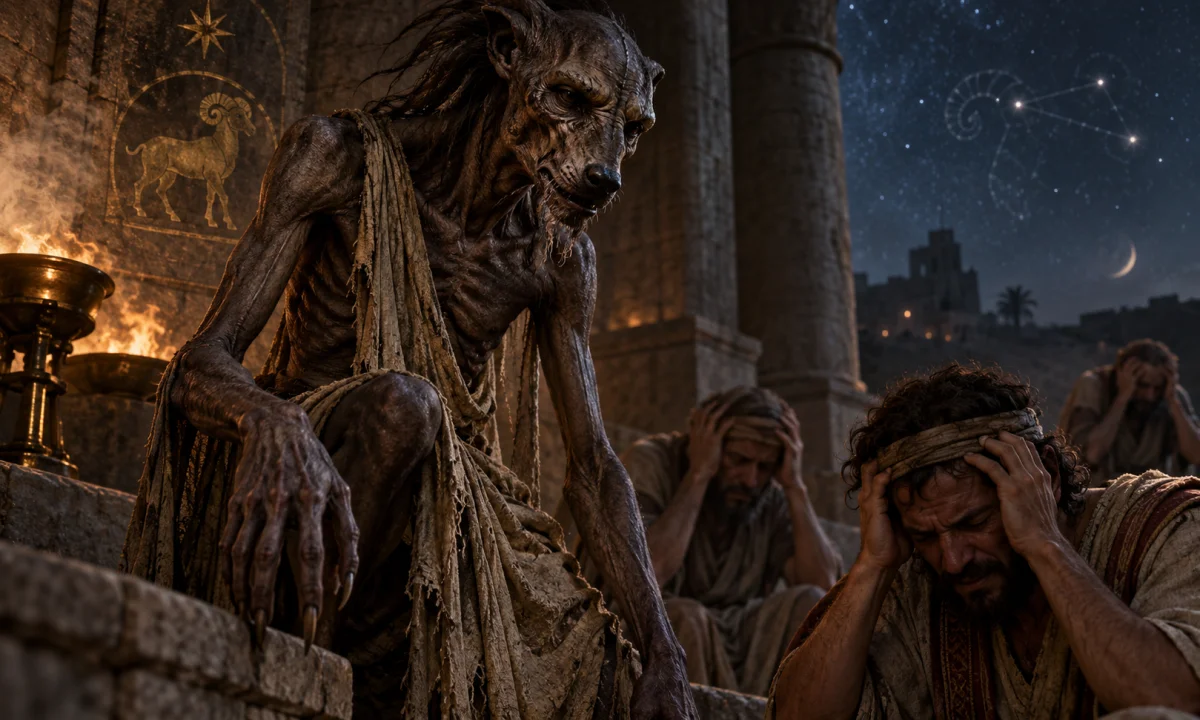
Descriptions of Gusion’s appearance are among the least stable parts of his tradition. Some versions of the Ars Goetia use an obscure term often printed as xenopilus or in a similar form. The word is difficult to interpret, and its meaning is not securely established. Other editions and modern accounts give a reading such as cynocephalus, a term meaning “dog-headed” or “dog-headed being.” These readings should not be treated as equally certain or as a single unquestioned description.
The textual problem may result from copying, translation or an unfamiliar word in the manuscript tradition. Because the underlying term is uncertain, there is no universally reliable ancient portrait of Gusion. Illustrations in modern occult books, websites and games often depict him as a dog-headed humanoid, a baboon-like creature or another animal-headed spirit, but these images are interpretations rather than a consistent historical iconography.
The possible connection with a cynocephalus can create further confusion. Dog-headed beings occur in several different cultural and literary contexts, including medieval legends, religious polemic, travel tales and later fantasy. A shared animal-headed motif does not prove that Gusion is the same figure as any of them. In particular, Gusion should not automatically be identified with the Egyptian god Anubis, the Christian saint Christopher in legends involving a dog-headed form, or generic “dog-headed demons.” Those figures have separate histories and meanings.
Stories and ritual role
Gusion does not possess a developed mythological cycle in the manner of figures such as Heracles, Odin or the Hindu deity Krishna. The goetic catalogues generally provide short entries rather than narratives describing a spirit’s birth, adventures, family or conflicts. Gusion’s traditional profile is consequently a set of ritual capabilities, titles and identifying signs rather than a sequence of stories.
In the Ars Goetia, each spirit is normally presented with a name, rank, number of legions, appearance and a description of powers. The catalogue also supplies ritual material associated with summoning, including seals or sigils attributed to individual spirits. Gusion’s seal belongs to that ceremonial system. Different editions and manuscript traditions may draw or reproduce sigils differently, so no single modern emblem should automatically be treated as the only authentic symbol.
The short entry makes Gusion useful within the logic of the grimoire because his abilities answer several common reasons for consulting a spirit. A practitioner might seek knowledge about an uncertain matter, ask for the interpretation of an ambiguous situation, attempt to repair a friendship or desire recognition. The catalogue does not provide a detailed moral philosophy explaining when these requests are justified. Its emphasis is operational: it identifies the spirit and states what the spirit is believed to accomplish.
Religious and cultural context
Goetic demonology developed in a cultural environment shaped by Christianity, biblical interpretation and medieval theories of spirits. Christian writers often described demons as fallen angels, deceptive powers or beings that tested human faith. Magical practitioners, however, adapted this religious vocabulary for ritual purposes. They arranged spirits into ranks, assigned them names and seals, and presented methods for commanding them.
This produced a tension between official religious condemnation of magic and the continued circulation of magical manuals. Clerical and learned authors could write about demons in order to condemn them, analyse them or claim authority over them, while occult practitioners used similar descriptions in ritual contexts. The presence of Gusion in a grimoire therefore does not demonstrate public worship. It demonstrates that a particular tradition of European magic classified him as a spirit who could be addressed in ceremonial operations.
The association with future knowledge also reflects a longstanding religious dispute over divination. In many Christian contexts, attempts to obtain hidden or future knowledge from spirits were considered dangerous because they could involve deception or place trust in powers other than God. Goetic texts nevertheless preserve detailed methods for such consultations. Gusion’s ability to disclose past, present and future belongs to this contested border between forbidden divination and ritual knowledge.
Interpretation of Gusion’s symbolism
Gusion can be interpreted as a figure representing the desire to make uncertainty manageable. His powers cover time, meaning, friendship and status: what has happened, what is happening, what may happen, what a problem signifies, whether relationships can be repaired and how one might gain recognition. These themes are not a formal ancient symbolism attached to his name, but they help explain the practical appeal of his catalogue entry.
His role as a reconciler is also notable. Many demonic figures in European literature are associated with temptation, conflict or punishment, whereas Gusion is described as capable of restoring harmony between people. This does not make him a benevolent deity in the theological sense. The goetic tradition still places him among spirits treated with caution and ritual control. It does, however, show that demonological catalogues could assign spirits socially constructive or desirable functions.
The promise of honour and dignity presents a more ambiguous form of power. Social advancement can be understood as a benefit, but it can also imply ambition, dependence on reputation or the pursuit of influence through supernatural means. As with other goetic spirits, the catalogue does not tell a full moral story about the consequences of obtaining such gifts. Later interpreters may read the power psychologically, symbolically or literally, but those readings should be distinguished from the brief claims of the original-style entries.
Distinguishing Gusion from similar figures
Gusion is sometimes confused with other named beings because demonological catalogues contain many spirits with overlapping titles and powers. He should not be merged with Gaap, another spirit in the Ars Goetia who is associated with teaching, philosophy, love and the movement of people or things. Nor should he be confused with Gremory, who is traditionally described as a duke with powers involving hidden treasure and knowledge of women’s love.
He is also distinct from Glasya-Labolas, a spirit associated in the goetic catalogue with knowledge, violence and the causing or healing of wounds. Similar claims about knowledge or influence do not make these spirits variants of one another. The catalogues assign separate names, ranks, seals and entries to them.
The spelling Gusoin or Gusoyn may refer to a related historical form of the same goetic name, but variant spellings should not be used to connect Gusion with every similarly named demon or folkloric being. In particular, there is no sound basis for equating him with figures whose names merely begin with “Gus-” or whose modern fictional designs resemble him.
Later reception and popular culture
Gusion has had a modest but persistent presence in modern occult writing, demonology reference works and internet discussions of the Ars Goetia. Modern practitioners may treat him as a literal spirit, an archetype, a symbolic intelligence or a name within a ritual system. These approaches belong to contemporary esoteric interpretation and should not be presented as identical to the historical manuscript tradition.
His name also appears occasionally in role-playing games, fantasy fiction, digital games and other forms of popular culture influenced by goetic demon lists. Such works may give him a new appearance, personality, backstory or set of powers. A dog-headed, animal-like or heavily armoured version of Gusion in a fictional setting is a creative adaptation, not evidence that the historical grimoires consistently described him that way.
The most historically secure image of Gusion remains a short catalogue entry: a duke among the spirits of the Ars Goetia, connected with hidden knowledge, interpretation, reconciliation and honour, with an appearance whose wording is uncertain across the textual tradition. Beyond those claims, detailed biographies, fixed physical portraits and ancient religious origins belong to later interpretation or invention rather than to well-supported evidence.