WORLD
WORLD
Huitaca
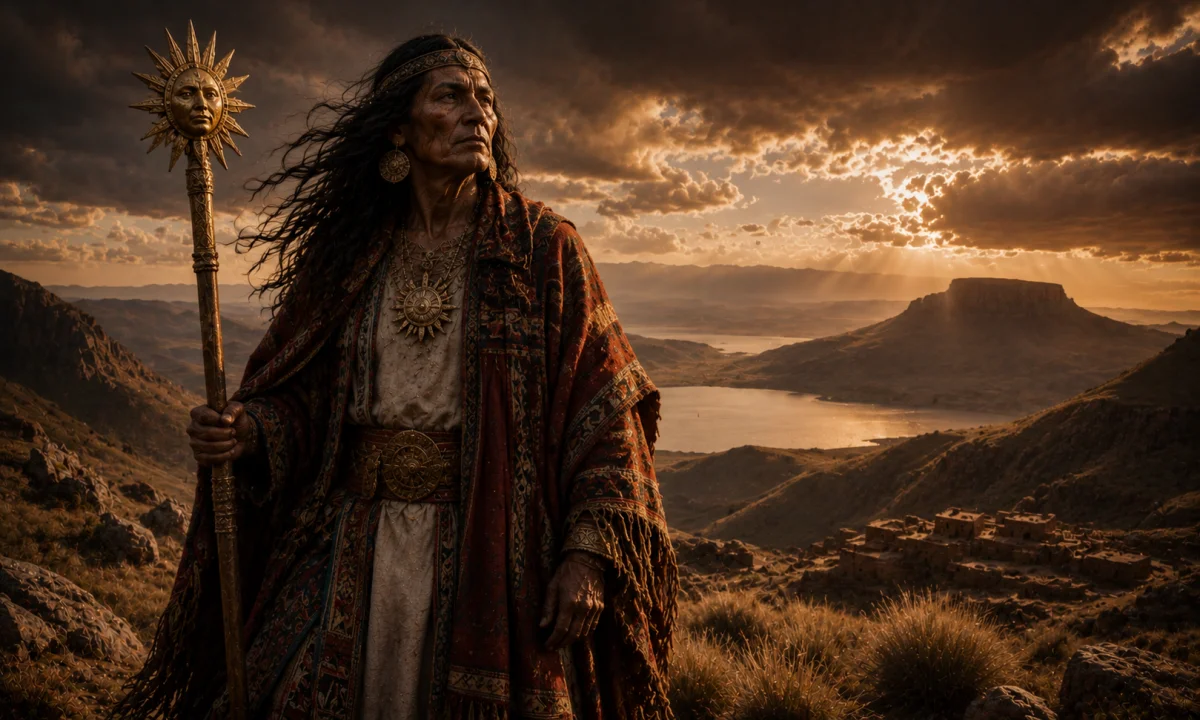
Huitaca is a female figure associated with the Muisca, or Muysca, people of the Andean highlands of present-day Colombia. Spanish colonial writers described her as a beautiful and rebellious supernatural woman connected with pleasure, sexual freedom, feasting, music, drunkenness and resistance to social restraint. In stories recorded after the Spanish conquest, she is often presented as an opponent of Bochica, a revered culture hero and lawgiver. Her identity, however, is not entirely fixed: surviving accounts differ in her origins, powers, punishment and relationship with other Muisca sacred figures.
The Muisca cultural setting
The Muisca lived chiefly on the high plateaus and valleys of the Eastern Cordillera, especially the Bogotá savanna and the regions now known as Cundinamarca and Boyacá. They formed a network of related communities and chiefdoms rather than a single centralized empire. Their religious life was connected to mountains, lakes, rivers, caves, cultivated land, celestial bodies and powerful ancestral or supernatural beings.
Much of what is known about Muisca religion comes from Spanish chroniclers writing in the sixteenth and seventeenth centuries. These writers recorded oral traditions, local practices and explanations supplied by Indigenous informants, but they interpreted them through Christian assumptions. A figure associated with sexuality, pleasure or opposition to an established moral order could therefore be described with words such as evil, licentious or devilish, even when the original Muisca understanding may have been more complex.
The surviving evidence does not provide a single authoritative Muisca mythology. Different communities preserved different versions of stories, and the colonial accounts sometimes contradict one another. Huitaca should therefore be understood as a figure known through varying traditions rather than as a character with one universally accepted biography.
Name and identity
The name is commonly written Huitaca, although colonial spellings and modern transcriptions vary. The original pronunciation and precise meaning of the name are not certain. Spanish writers often used names in forms adapted to Spanish spelling, and the Muisca language was not recorded in a way that allows every traditional name to be interpreted securely today.
Huitaca is frequently called a goddess in modern discussions. That label is convenient, but it can suggest a rigid pantheon resembling those of ancient Greece or Rome. Muisca religious traditions did include powerful sacred beings, but the surviving sources do not establish a standardized list of gods with clearly defined jurisdictions. Huitaca may be described more cautiously as a female supernatural or sacred figure associated with pleasure, transgression and opposition to social discipline.
Some accounts treat her as an actual goddess; others present her as a woman of extraordinary power or as a disruptive being who entered the human world. These differences may reflect both regional variation and the way colonial writers organized Indigenous beliefs into categories familiar to European readers.
Huitaca and Bochica
Huitaca's most important association is with Bochica. In Muisca traditions recorded by colonial authors, Bochica was a benevolent civilizing figure who taught people useful arts, promoted orderly conduct and intervened in times of catastrophe. He is also connected with the creation of the Tequendama Falls, where he opened a passage through the rock and allowed floodwaters covering the Bogotá savanna to escape.
Huitaca often appears as Bochica's opposite. Where Bochica represents discipline, social order, moderation and instruction, Huitaca is associated with pleasure, freedom from restraint and behavior that colonial observers considered excessive. This opposition should not automatically be read as a simple battle between good and evil. It may preserve a traditional contrast between competing principles: regulated communal life on one side and sensuality, autonomy, festivity or disruption on the other.
In some versions, Huitaca arrives after Bochica has taught the people. She persuades them to abandon his rules and encourages drinking, dancing, sexual freedom and other pleasures. Her influence causes social disorder, or at least is interpreted by the chronicler as disorder. Bochica then confronts her and transforms her into another form. The exact transformation varies from account to account.
Stories of transformation
One widespread modern presentation says that Bochica changed Huitaca into an owl. This version fits a broader pattern in which a powerful person or spirit is punished through bodily transformation. The owl may symbolize nighttime activity, secrecy, independence or a departure from ordinary human society. It is important, however, not to treat every symbolic interpretation as an established Muisca explanation. The colonial sources do not provide enough evidence to determine one definitive meaning for the transformed form.
Other accounts connect Huitaca with the moon rather than an owl. In these versions, she becomes a celestial body after opposing Bochica, while Bochica himself is associated with the sun or with a wandering teacher who eventually departs. Some modern retellings combine the lunar and owl forms, but that combination is not necessarily present in all traditional accounts.
The variation may result from different regional traditions, confused transmission, or later attempts to reconcile separate stories. It may also reflect the difficulty of translating Muisca ideas about celestial beings and transformations into European narrative categories. The safest description is that Huitaca is sometimes said to have been transformed by Bochica, with the resulting form reported variously as an owl, the moon or another supernatural manifestation.
Attributes and associations
Colonial descriptions generally emphasize Huitaca's beauty and seductive power. She is portrayed as capable of attracting people away from work, obedience and religious or social obligations. Her attractiveness is not merely physical: it represents the compelling force of pleasure and the desire to live outside prescribed limits.
Her principal associations include:
- Sexual freedom: Huitaca is often described as encouraging relationships or sexual behavior not controlled by conventional rules.
- Drunkenness and feasting: She is linked in colonial accounts with alcohol, celebration and the pursuit of bodily pleasure.
- Music and dancing: Her influence is connected with festive activity and forms of enjoyment that could be portrayed as excessive by Christian observers.
- Rebellion: She challenges the authority represented by Bochica and refuses to accept a strictly regulated way of life.
- Transformation: Her punishment or change of form is one of the most persistent features in later retellings.
- Night or celestial imagery: Versions identifying her with an owl or the moon associate her with darkness, the night sky and a world beyond ordinary human order.
These attributes should not be treated as a formal portfolio assigned to Huitaca in a documented Muisca theological system. They are themes that recur in colonial descriptions and later interpretations. In particular, the emphasis on sexual immorality may say as much about the chroniclers' moral vocabulary as it does about the original tradition.
Huitaca in the flood traditions
Huitaca is sometimes discussed alongside the Muisca flood story, but the relationships among the figures differ across retellings. The best-known flood account involves Chibchacum, a powerful being who causes the Bogotá savanna to be inundated, and Bochica, who rescues the people by opening the gorge at Tequendama. Chibchacum is then punished and made to carry the earth, or to bear a great burden beneath the world.
Huitaca is not simply another name for Chibchacum or Bochica. In some narratives, her disruptive influence is placed within a broader sequence of moral or cosmic disorder; in others, she is treated as a separate antagonist whose story is only loosely connected with the flood. Modern summaries sometimes join every Muisca myth involving catastrophe, transgression and Bochica into one continuous plot, but the colonial evidence does not justify assuming that all such episodes originally belonged to a single canonical story.
Keeping the figures distinct is essential. Bochica is generally associated with instruction, order and the restoration of habitable land. Chibchacum is associated in the flood tradition with the upheaval of the earth and the burden placed beneath it. Huitaca is associated chiefly with pleasure, sexual independence, rebellion and transformation. Their roles can overlap in later retellings, but they are not interchangeable characters.
Religious and social interpretation
Huitaca can be read as a figure of social tension. Agricultural communities depend on cooperation, labor, ritual observance and relationships regulated by communal expectations. At the same time, festivals, intoxication, erotic life, music and celebration are also important parts of human culture. A figure who embodies these forces may represent not only chaos but the attraction of experiences that formal authority cannot completely control.
Her conflict with Bochica can therefore be understood in several ways. It may express the contrast between communal discipline and individual desire. It may distinguish productive labor from leisure and celebration. It may dramatize competing ideas about sexuality and social hierarchy. It may also encode a conflict between an older local religious pattern and a later moral interpretation imposed by colonial observers. No single interpretation has been proven.
It is also possible that Huitaca's image was shaped by gendered judgments. A woman who speaks independently, rejects imposed rules or exercises sexual agency can be portrayed as dangerous in societies where authority is defined through male religious or political control. The colonial descriptions of her as seductive and disorderly should consequently be examined critically rather than accepted as neutral ethnographic observations.
This does not mean that every element of her tradition must be dismissed as a Spanish invention. The figure appears in multiple accounts, and the contrast between Huitaca and Bochica may preserve genuine Indigenous ideas. The issue is that the available records are mediated sources: they preserve fragments of Muisca traditions while also translating them into Christian and European categories.
Sources and historical limits
No pre-conquest Muisca epic about Huitaca survives in a complete written form. The Muisca transmitted religious knowledge primarily through oral tradition, ritual practice, material culture and the landscape. Spanish observers began recording stories only after conquest and colonization had already transformed Muisca society.
Colonial writers did not always agree about names, relationships or events. They could combine information from different communities, misunderstand Indigenous explanations or reshape stories to demonstrate Christian moral lessons. For this reason, statements about Huitaca's exact appearance, genealogy, residence or powers require caution. Claims that she definitively ruled a particular place, married a particular being or possessed a fixed set of magical abilities are often modern elaborations rather than securely documented tradition.
Archaeological evidence confirms the importance of ritual objects, gold offerings, sacred lakes and celestial or landscape-related practices among the Muisca, but it does not identify an object or temple unquestionably dedicated to Huitaca. Nor does archaeology by itself establish whether she was worshipped in the same way as another sacred being. The written and material evidence must be kept distinct.
Distinguishing Huitaca from similar figures
Huitaca is sometimes compared with female figures from other mythologies who represent sexuality, rebellion or the night. Such comparisons can be useful for discussing recurring mythic themes, but they do not establish historical connections. She is not a Muisca version of a Greek, Roman or Hindu goddess, and she should not be merged with figures such as Lilith, Venus or the Aztec goddess Xochiquetzal merely because writers associate them with sexuality or independence.
She should also be distinguished from Bachué, another major Muisca female figure. Bachué is commonly described in colonial and modern accounts as an ancestral mother who emerges from the waters of Lake Iguaque with a child, raises him and becomes the ancestor of the Muisca people. Her associations are with origin, fertility, ancestry and population. Huitaca's associations are instead with pleasure, opposition and transgression. Some modern popular works place both women in a generalized group of “Muisca goddesses,” but their traditional narrative roles are different.
Huitaca is likewise not simply the Muisca moon goddess in every source. The moon connection belongs to particular versions of her transformation or to later interpretation. Treating it as her universal identity erases the variation in the surviving tradition.
Later reception
Huitaca has become more prominent in modern books, educational materials, visual art, tourism and online discussions of Indigenous Colombian mythology. Contemporary retellings often celebrate her as a symbol of female independence, sensuality, freedom and resistance to patriarchal authority. Such readings can give the figure new cultural relevance, but they are modern interpretations rather than direct statements of what all Muisca communities historically believed.
Some adaptations present her as a fully developed queen, sorceress or goddess of liberation, with a detailed appearance and powers not documented in the colonial accounts. Others make her a simple villain opposed to Bochica. Both approaches simplify the evidence. A historically responsible portrayal recognizes that Huitaca's image has been shaped by several layers: Muisca oral tradition, colonial recording, Christian moral interpretation, modern scholarship and contemporary creative adaptation.
Huitaca remains significant precisely because her surviving image is unstable. She stands at the meeting point of pleasure and discipline, individual freedom and communal order, Indigenous tradition and colonial interpretation. The uncertainty surrounding her does not make the figure unimportant; it shows how much care is required when reconstructing the religious imagination of a culture whose stories were preserved only partially and through outside observers.