WORLD
WORLD
Guinechen
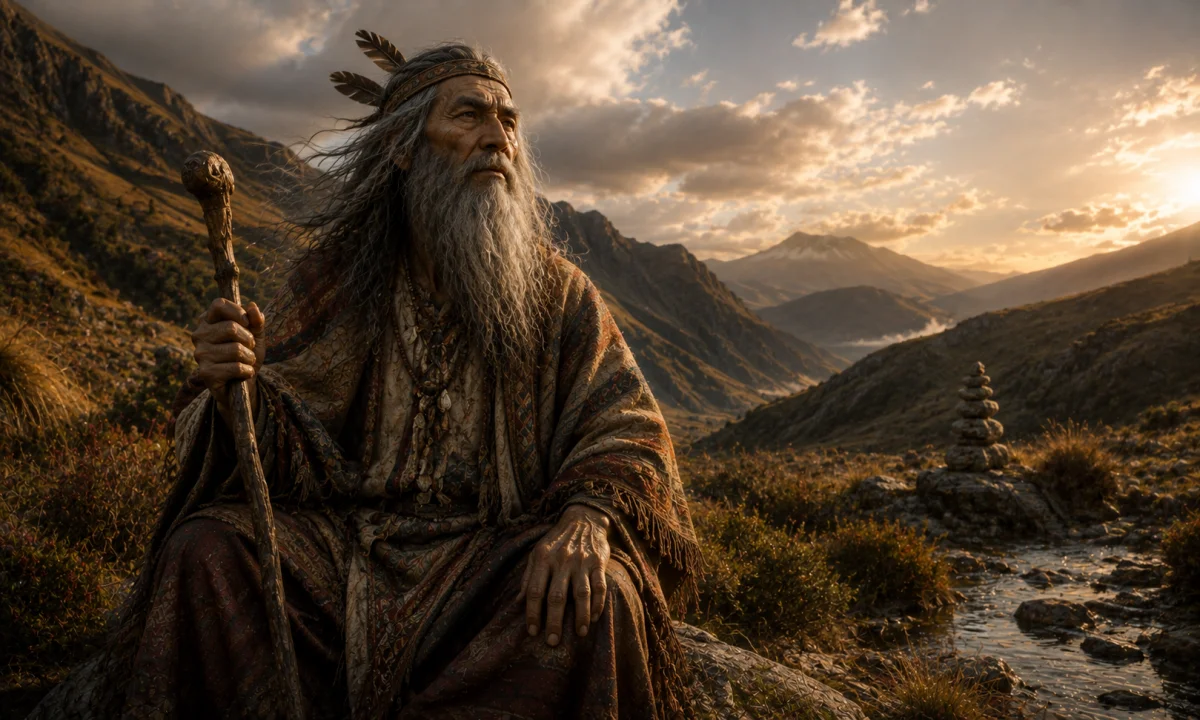
Guinechen is a name used in some Spanish-language accounts for Ngünechen, a major divine figure in Mapuche religious tradition. The Mapuche, also known as the Mapuche people, are Indigenous inhabitants of south-central Chile and parts of Argentina. Ngünechen is often described as a supreme being, creator, or governing lord associated with human life and the ordered world. The spelling Guinechen does not represent a separate South American deity; it is generally a Hispanic rendering of a Mapudungun name whose spelling varies considerably.
Name and identity
The name appears in several forms, including Ngünechen, Nguenechen, Günechen, Guinechen and Ngenechén. These variations reflect attempts to represent Mapudungun sounds using Spanish or different practical orthographies. The meaning is commonly explained as something like “the one who governs the people”, “lord of the people” or “owner of the people”, although translations are not identical in every source.
Ngünechen is not easily fitted into the category of a single human-shaped “god” in the manner of many figures in classical mythology. Mapuche religious thought can present the divine as relational, layered and multiple in manifestation. Accounts may describe Ngünechen as a supreme power, a creator, a father-and-mother presence, or a fourfold being. These descriptions should not automatically be treated as contradictory. They may express different aspects of a religious understanding in which unity and plurality exist together.
The form Guinechen is especially associated with older Spanish descriptions and popular reference works. Ngünechen is closer to forms used in contemporary Mapuche cultural and linguistic contexts, but spelling conventions differ even among modern writers. Since the surviving written record was largely produced by outsiders, no single spelling has universal authority.
Mapuche cultural and religious setting
Mapuche religion is rooted in relationships among human communities, ancestors, spiritual beings, animals, plants, the land and the forces of the wider cosmos. The natural world is not generally treated as spiritually empty. Particular places, waters, mountains and forests may have their own spiritual guardians or owners. Human well-being depends on maintaining respectful and balanced relationships rather than on belief alone.
Mapuche cosmological descriptions often distinguish several interconnected levels of existence. Wenu Mapu is commonly translated as the upper or elevated land, associated with benevolent spiritual powers and the realm above the human world. Nag Mapu is the ordinary or middle world in which people live. Minche Mapu is described in some accounts as a lower or hidden realm. These terms and explanations vary according to community, informant and scholar, and they should not be mistaken for a universally fixed map of the afterlife.
Within this religious environment, Ngünechen is frequently presented as a power of the highest order. Yet traditional practice has also involved communication with more immediate spiritual beings, ancestors and forces of place. A description of Ngünechen as the “supreme god” can therefore be useful as a rough comparison, but it may obscure the diversity and practical character of Mapuche spirituality.
Sources and the problem of interpretation
There is no ancient Mapuche scripture that provides a single official account of Ngünechen. Mapudungun was traditionally transmitted orally, through speech, ceremony, song, teaching and community memory. Written records were produced later, often by Catholic missionaries, colonial officials, ethnographers and other non-Mapuche observers. Their accounts are valuable, but they were shaped by the categories and assumptions of European religion.
Missionaries commonly compared Mapuche spiritual beings with figures from Christianity. Ngünechen was consequently identified in some texts with the Christian God, while other beings were interpreted as saints, devils, angels or lesser spirits. Such comparisons can preserve partial information, but they can also flatten distinctions within Mapuche thought. In particular, calling Ngünechen simply a “Mapuche God” may suggest a rigid, individualised deity where the tradition may instead emphasise a complex sacred order.
Modern descriptions draw on a mixture of oral traditions, linguistic analysis, historical documents and ethnographic work. Details can differ between communities in Chile and Argentina and between older and newer accounts. It is therefore more accurate to speak of recurring patterns of description than of one universally standard mythology.
The fourfold manifestation
One of the best-known descriptions of Ngünechen presents the divine power through four complementary persons or aspects. These are often named as an old man, an old woman, a young man and a young woman. In Mapudungun terminology, forms such as Fücha, Kushe, Weche and Ülcha are commonly associated with the older male, older female, younger male and younger female aspects, although spellings and explanations vary.
This fourfold structure is sometimes portrayed as a divine family or as four beings who together constitute Ngünechen. In other interpretations, the figures are symbolic aspects of one sacred reality. The older pair may be linked with experience, continuity and the ancestors, while the younger pair may express renewal, growth and future generations. These associations are interpretive rather than fixed attributes found in every account.
The four aspects also allow Ngünechen to encompass complementary qualities: masculine and feminine, age and youth, authority and renewal, continuity and change. This is one reason that the figure should not be described only as a male sky father. Some accounts use masculine grammatical or social language, while the wider representation includes female and generational dimensions.
Writers sometimes connect the fourfold form with the four directions, the four winds or the organisation of ceremonial space. Such connections may be meaningful in particular explanations of Mapuche cosmology, but they are not uniform across all sources. A fourfold image should not be turned into a rigid list of universal correspondences without identifying the tradition or interpretation in which those correspondences occur.
Functions and attributes
Ngünechen is commonly associated with creation, order, protection and the governance of human life. In descriptions that call Ngünechen the creator, the figure may be understood as the source of the world, people or the principles that make communal life possible. In other accounts, the emphasis falls less on a single act of creation and more on the continuing maintenance of balance and moral order.
Ngünechen may be invoked in prayer and ceremony for protection, health, fertility, good fortune and the well-being of the community. Religious specialists and participants may address the divine through formal speech, offerings, song and ritual action. The precise forms of worship are not identical everywhere, and the presence of Ngünechen in a ceremony does not mean that all Mapuche ritual is directed only to this one figure.
Mapuche religious life includes the work of the machi, often described in English as a ritual specialist or healer. A machi may communicate with spiritual forces, diagnose illness, conduct healing and lead important ceremonies. The machi’s role is not simply that of a priest serving a distant creator. It involves direct engagement with the spiritual condition of people and community, as well as with the powers of the land and the ancestors.
Ngünechen is also linked in many accounts with ethical conduct. Respect for elders, family, community and the living environment forms part of a wider moral order. Illness, misfortune or social conflict may be interpreted not merely as random events but as signs of disrupted relationships. This does not produce one simple doctrine of sin comparable to Christian theology; rather, it reflects a concern with reciprocity, respect and balance.
Relationships with other Mapuche spiritual beings
Ngünechen should be distinguished from the various ngen. The word ngen is commonly used in names for spiritual owners, guardians or governing beings associated with particular elements and places. Examples include beings connected with water, forests, hills or other aspects of the environment. A ngen-ko, for example, is often discussed as a guardian or owner of water. These beings are not simply alternate names for Ngünechen.
The ngen belong to a different level or category of spiritual relationship. They are associated with specific places and must be treated with respect if people are to use those places safely. Their presence reflects the idea that land and natural resources have spiritual agency and custodianship. Translating them merely as “nature spirits” can be convenient, but it does not convey the full cultural meaning of the relationship.
Another important term is püjü or am, depending on the subject and the spelling system being used. These words may refer to aspects of a person’s spirit or to the continuing presence of the dead, but their meanings are not identical in every account. Pillan is also a complex term associated in different contexts with powerful spirits, ancestors or beings connected with the forces of nature. None of these terms should be casually substituted for Ngünechen.
The figure of Wekufe is likewise distinct. Wekufe is often treated in non-Mapuche writing as a devil or evil spirit, but that translation is heavily influenced by Christian categories and does not capture every traditional usage. Ngünechen is not a Mapuche equivalent of the Christian God opposed by a single counterpart equivalent to Satan.
Stories and oral traditions
Mapuche narratives include accounts of origins, floods, the formation of the land, the actions of powerful beings and the relationship between humans and the spirit world. One widely known cycle concerns Treng Treng and Kai Kai, often described as opposing serpent-like beings associated with the land and the sea. In versions of the story, rising waters threaten humanity while the earth rises to offer refuge. The details and names vary, and the narrative is not a single fixed text.
It is tempting to describe every Mapuche origin narrative as a story about Ngünechen, but that would be misleading. Some modern summaries place Ngünechen at the beginning of creation or identify the being as the source of humanity. Other accounts focus on Treng Treng and Kai Kai, ancestral powers, or the ordering of the world without making Ngünechen the central character. The traditions should be kept distinct unless a particular community or source explicitly connects them.
Nor is there a standard cycle of adventures in which Guinechen acts like a mythological hero. Ngünechen’s importance generally comes from status, presence and relationship to the cosmic and human order rather than from a sequence of dramatic exploits. The lack of a canonical narrative is a feature of an oral religious tradition, not evidence that the figure is unimportant.
Gender, family and duality
Descriptions of Ngünechen often resist simple gender classification. Older sources may use masculine language because Spanish tends to assign grammatical gender and because missionaries interpreted the being through the model of a male creator. At the same time, the fourfold form includes both female and male aspects, as well as both old and young figures.
The divine family image may express the completeness of life across generations. It can also reflect the importance of complementarity in Mapuche thought, where social and cosmic order is not necessarily built around a single isolated authority. The four figures are sometimes represented as a married pair of elders and a married pair of younger beings; in other explanations, they are facets of Ngünechen rather than four independent personalities. Neither arrangement should be presented as the only traditional version.
Cultural significance today
Ngünechen remains relevant in discussions of Mapuche identity, spirituality, language revitalisation and cultural continuity. Contemporary Mapuche communities and writers may prefer Mapudungun forms such as Ngünechen rather than the older Spanish spelling Guinechen. The choice of name can signal attention to Indigenous pronunciation, self-representation and the limits of colonial descriptions.
Modern Mapuche religious life has also developed through contact with Christianity, state institutions and wider social change. Some people combine Christian practice with Mapuche ceremonies or interpret the two traditions in dialogue; others emphasise a more distinct Mapuche religious identity. There is no single contemporary position that represents every Mapuche community.
Outside Mapuche contexts, Guinechen occasionally appears in encyclopaedias of mythology, fantasy writing and generalized lists of “South American gods.” These treatments often reduce the figure to a male creator and omit the fourfold, relational and community-centred dimensions found in many traditional and scholarly descriptions. Modern fantasy adaptations may use the name freely, but invented powers, appearances or stories should not be presented as part of Mapuche tradition.
Distinguishing Guinechen from similar names
The spelling of Guinechen can create confusion with other terms beginning with ngen or with unrelated Indigenous names recorded in Spanish. Similar-looking words do not necessarily identify the same being. In particular, Ngünechen should not be confused with a local ngen, with Wekufe, with Pillan, or with the beings in the Treng Treng and Kai Kai cycle.
The safest description is that Guinechen is a variant Spanish spelling of Ngünechen, a major and variably described divine figure in Mapuche religious tradition. The figure is commonly connected with supreme authority, creation, protection and the ordering of human life, while many accounts also present Ngünechen through four complementary male, female, older and younger aspects. Because the evidence comes from diverse oral traditions and historically mediated records, details of identity, gender, cosmological position and mythic relationships should always be presented with appropriate caution.