WORLD
WORLD
Guecubu
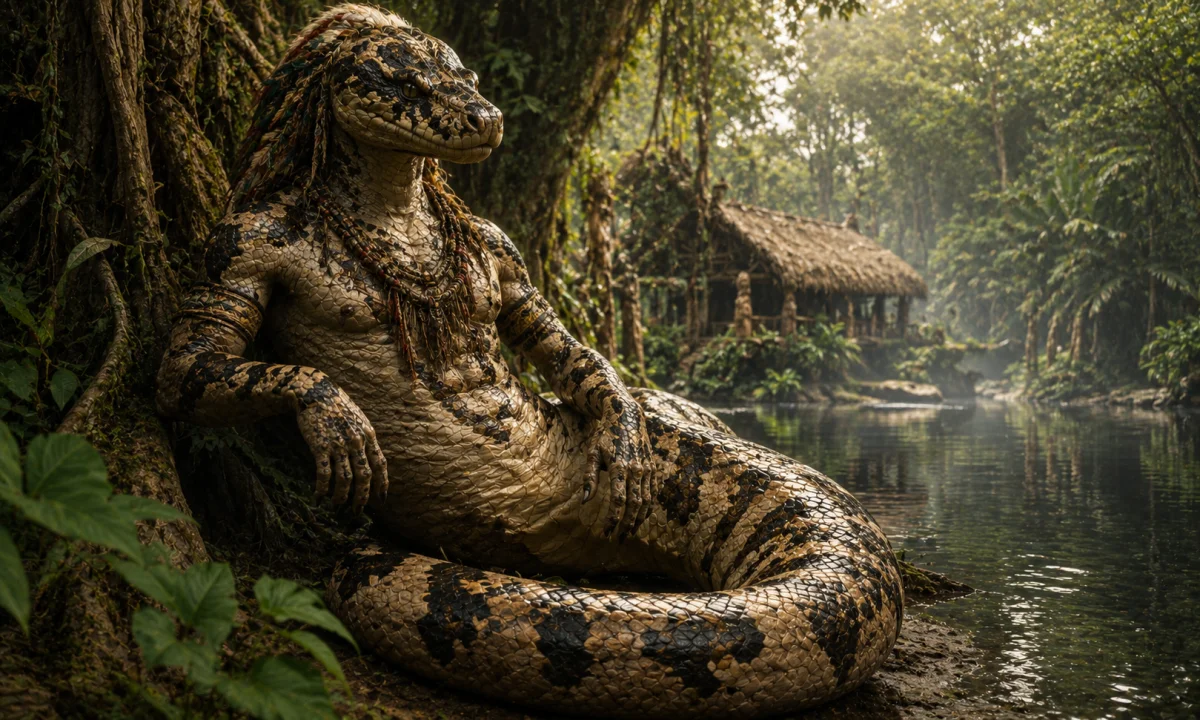
Guecubu is a name found in older European accounts of Mapuche religious tradition for a malevolent supernatural power or spirit. The term is associated with misfortune, illness, death and other forms of harm. It is often treated as the historical spelling of a Mapuche word related to wekufe or wekufü, although the relationship is not completely straightforward. In traditional Mapuche thought, the concept does not necessarily describe one individualized devil with a fixed biography. It can instead refer to harmful beings, forces or agencies that disturb the balance of the world.
Mapuche cultural setting
The Mapuche are an Indigenous people whose historical homeland lies principally in south-central Chile and the adjoining regions of Argentina. Their religious traditions have been transmitted through oral teaching, ritual practice, community memory and relationships with the land. They have never been a single, centrally organized religious institution with one universally fixed mythology. Beliefs and terminology may therefore differ between communities and regions.
Older accounts of Mapuche religion were written largely by missionaries, colonial officials, travellers and ethnographers. These observers often interpreted unfamiliar beings through European categories such as “devil,” “demon,” “evil spirit” or “idol.” Such translations can be useful as evidence that a concept was recorded, but they may conceal distinctions present in Mapuche languages and ritual thought. Guecubu should therefore not be assumed to be simply the Mapuche equivalent of the Christian Devil.
Mapuche religious ideas commonly emphasize relationships among human beings, spiritual powers, ancestors, animals, places and the wider natural world. Health and prosperity depend on maintaining proper balance and respectful conduct. Harm may arise when this balance is broken, when ritual obligations are neglected, or when hostile forces and practitioners intervene. Within this general framework, the beings or powers described as wekufe are associated with disruption and danger.
The name Guecubu and its identity
Guecubu is a colonial-era spelling. Other spellings encountered in older writings include forms such as Huecubu, Huecuve and Huecuvu. Historical spelling systems were inconsistent, and European writers attempted to represent Mapuche sounds with alphabets not designed for them. These variants do not always indicate different beings; they may reflect differences in transcription, pronunciation or the source language used by the recorder.
The name is frequently connected with wekufe, a term that is often translated as “evil spirit,” “malevolent being” or “harmful force.” In contemporary discussions, wekufe may be used in a broad or collective sense rather than as the proper name of one supernatural individual. Some older writers, however, presented Guecubu as if it were a single spirit or an organized principle of evil. That presentation may reflect European expectations about how supernatural beings should be classified.
It is consequently more accurate to describe Guecubu as a historical representation of Mapuche ideas about malevolent spiritual agency than to assign it a single, universally accepted identity. Depending on the source, the word may appear to denote an individual demon, a class of harmful beings, or a general power responsible for misfortune.
Role in traditional belief
Accounts associated with Guecubu describe a force connected with events that threaten human and communal well-being. These may include disease, sudden death, accidents, crop failure, conflict and other calamities. The concept belongs to a religious world in which misfortune is not always understood as random or purely physical. A serious illness, for example, may be interpreted through social, spiritual and ritual relationships as well as through its bodily symptoms.
This does not mean that every illness or accident was automatically attributed to one demon. Mapuche explanations of sickness have been varied, and they have changed through time and contact with other medical and religious systems. The word Guecubu is best understood as part of a wider vocabulary for danger, spiritual attack and disorder rather than as a universal explanation for every misfortune.
Malevolent forces could also be associated with hostile human action. Colonial descriptions often linked harmful supernatural activity with kalku, a person traditionally portrayed as using occult knowledge for destructive purposes. These accounts must be handled carefully: European observers sometimes turned complex disagreements about healing, ritual authority and social conduct into a simple opposition between “good” and “evil” magic. In Mapuche contexts, the boundaries between healing, power, ritual expertise and suspected sorcery could be socially contested.
Appearance and supernatural form
There is no single, reliable traditional portrait of Guecubu comparable to the standardized images of many figures in classical or medieval European mythology. Descriptions vary because the term was recorded in different places and periods, and because it may refer to more than one type of being.
In discussions of wekufe, malevolent beings may be associated with animals, monstrous forms, invisible presences or unusual manifestations in the landscape. Some accounts emphasize their capacity to change shape or to appear through signs of illness and disturbance. These motifs should not automatically be assigned to one fixed creature called Guecubu. They belong to a broader field of Mapuche ideas about spiritual danger.
European illustrations and later encyclopaedia entries sometimes gave Guecubu a body resembling a conventional horned devil or a generic demon. Such images are not evidence for an ancient, standardized Mapuche appearance. They reflect the visual language of Christian demonology and modern fantasy more than securely documented Mapuche tradition.
Guecubu, balance and disorder
The significance of Guecubu is clearer when considered alongside Mapuche ideas of order and reciprocity. Human life is connected to the land, community, ancestors and spiritual beings. Ritual acts help sustain these relationships, while disrespect, wrongdoing or spiritual aggression may produce imbalance. Malevolent forces represent or cause the dangerous side of that imbalance.
This framework is not necessarily a simple moral dualism in which the universe is divided into two equal armies, one entirely good and the other entirely evil. Mapuche spiritual traditions contain many kinds of beings with different powers and responsibilities. A being connected with a particular place, animal or natural phenomenon may be protective in one relationship and dangerous in another. The category of wekufe is more useful for identifying harmful or disruptive activity than for describing a complete cosmic opposite to every benevolent power.
The concept also has a social dimension. Misfortune can raise questions about relationships within the community, obligations to the spiritual world and the conduct of individuals. A diagnosis of supernatural harm is therefore not merely a statement about an invisible creature. It may involve ideas about responsibility, conflict, ritual neglect and the need to restore equilibrium.
Healing and ritual responses
Traditional Mapuche healing is strongly associated with the machi, a ritual specialist who may diagnose illness, communicate with spiritual powers and perform ceremonies intended to restore health and balance. The machi’s work is not adequately described as “magic” in the narrow European sense. It belongs to a religious and therapeutic system in which the body, spirit, family, community and environment are interconnected.
When a harmful spiritual influence was suspected, ritual treatment could involve prayer, ceremonial performance, medicinal plants, music, symbolic actions and the support of relatives and the wider community. The exact form of treatment depended on the local tradition and the perceived cause of the illness. It would be misleading to claim that there was one standard ceremony for driving out Guecubu, since the surviving record does not establish a single uniform ritual.
These practices also show why the term “demon” can be inadequate. In Christian demonology, a demon is commonly imagined as an enemy of God and a tempter of human beings. In Mapuche contexts, concern with wekufe is more closely tied to illness, spiritual attack, broken balance and the conditions that allow harm to enter human life.
Colonial interpretations
Missionaries encountered Mapuche religious concepts while attempting to convert communities to Christianity. They often organized local spiritual beings according to familiar Christian categories. A harmful power could be labelled a devil, while a ritual specialist might be described as a sorcerer. This vocabulary made foreign beliefs intelligible to European readers, but it also encouraged the idea that Mapuche religion possessed a single anti-god or ruler of evil.
The name Guecubu consequently appears in a tradition of writing shaped by translation and religious controversy. A missionary account may emphasize sin, demonic deception or opposition to Christian teaching. A later ethnographic account may treat the same term as the name of a supernatural species. Neither approach should automatically be taken as a complete description of Mapuche belief.
Historical evidence is also uneven. Much of the early material was recorded by outsiders rather than by Mapuche authors writing in their own language. Oral traditions continued independently of those publications, and Mapuche communities have preserved, adapted and reinterpreted religious knowledge under the pressures of colonialism, state expansion, Christian missionization and social change. The absence of a detail from an old book does not prove that the detail was unknown, just as the presence of a detail in a missionary text does not prove that it had the same meaning for Mapuche people.
Distinguishing Guecubu from related terms
- Wekufe or wekufü: A Mapuche term commonly associated with harmful beings or forces. It is often the closest traditional concept used to explain the historical descriptions of Guecubu, but it need not denote one individual spirit.
- Kalku: A person associated in many accounts with destructive sorcery or harmful occult practice. A kalku is not the same thing as Guecubu, although colonial writers may connect the two.
- Machi: A Mapuche ritual specialist, frequently associated with healing, diagnosis and communication with spiritual powers. A machi should not be confused with a sorcerer simply because both appear in accounts of supernatural illness.
- Ngen: A name used for various guardian or owner-like spiritual beings connected with places, natural features and living things. Ngen are not interchangeable with wekufe and should not be classified as uniformly malevolent.
- Pillan: A complex category of powerful spirits in Mapuche religious traditions, often associated with ancestors, natural forces or high spiritual power. Pillan and Guecubu belong to different and sometimes oversimplified categories in older European accounts.
These distinctions matter because early sources frequently translated several different Mapuche concepts with the same words: “devil,” “spirit,” “god,” “demon” or “sorcerer.” A list of mythological creatures can make the tradition appear more rigid than the evidence supports.
Stories and the absence of a fixed mythology
Guecubu is not known for a single canonical myth with a stable beginning, plot and ending. Unlike figures whose stories are preserved in a large cycle of written epics, the material connected with the name consists mainly of descriptions of religious belief, accounts of illness and sorcery, and references to harmful spiritual forces. Individual communities may preserve narratives involving dangerous beings, but those narratives should not automatically be presented as one universal story of Guecubu.
Some modern summaries portray Guecubu as a supreme lord of darkness who commands lesser demons or wages a cosmic war against the forces of good. Such details may be products of later synthesis, Christian analogy, occult writing or fantasy literature. They are not securely established features of the traditional Mapuche concept. Nor is there reliable evidence for a single genealogical family, throne, physical body or set of adventures belonging to Guecubu across Mapuche communities.
Cultural significance
Guecubu remains valuable as a term for examining how Indigenous religious concepts were translated and reshaped in colonial writing. It demonstrates the danger of treating a foreign-language label as if it were automatically the name of a mythological character with the same structure as a demon in European folklore.
The broader idea represented by wekufe expresses a concern central to many Mapuche religious explanations: the need to understand and repair disturbances in the relationships that sustain life. Harm is not only a supernatural spectacle. It can involve sickness, fear, social tension, damaged ties to the land and a failure of ritual or communal balance.
For that reason, Guecubu is best approached with both historical and cultural caution. The name has a recognizable place in older accounts of South American Indigenous religion, but its exact meaning depends on the source, spelling and interpretive framework. It should not be turned into a standardized monster while the living diversity of Mapuche traditions is ignored.