WORLD
WORLD
Gaap

Gaap is a demon described in early modern European demonological literature, most notably in the Pseudomonarchia Daemonum and the Ars Goetia, the first section of the Lesser Key of Solomon. These works present him as a powerful spirit with the titles of president and prince, associated with the control of knowledge, emotion, perception and movement. Gaap belongs to a Christian occult tradition that classified demons according to their supposed ranks, offices and legions; he is not securely identifiable with a deity or spirit from an older pre-Christian religion.
Origins in European demonology
Gaap is known primarily through texts produced within the learned demonology of early modern Europe. The oldest important source is Johann Weyer’s Pseudomonarchia Daemonum, a catalogue of demons included in his De praestigiis daemonum, first published in 1563. Weyer wrote from a Christian theological and medical perspective, treating accounts of demons as part of a broader discussion of diabolic deception, superstition and human vulnerability.
Gaap also appears in the Ars Goetia, a later magical work transmitted in manuscripts associated with the Lesser Key of Solomon. The Lesser Key is generally connected with seventeenth-century manuscript traditions, although its material draws on earlier magical and demonological writings. The Ars Goetia arranges seventy-two spirits into a hierarchy of kings, dukes, princes, marquises, presidents and other ranks. Gaap is listed as the thirty-third spirit in that sequence.
These sources do not present Gaap as a figure from a single continuous ancient mythology. Instead, they belong to a tradition that combined biblical ideas about demons with medieval discussions of spirits, magical manuals, astrology, folklore and inherited lists of infernal names. The classification is therefore literary and theological rather than evidence of an organized historical religion devoted to Gaap.
Name and identity
The name appears in variant forms. Gaap is the spelling most familiar from modern editions of the Ars Goetia, while Goap and Tap occur in related textual traditions or discussions of the name. The relationship between every variant is not fully certain. Some may reflect scribal transmission, copying errors or differences between languages and manuscripts rather than separate mythological beings.
In the sources, Gaap is treated as one identifiable spirit, but his exact status varies slightly between descriptions. He is called a great president and a mighty prince. The term “president” is a technical rank within the demonological hierarchy, not a political office in the modern sense. Such titles were used to impose an administrative structure on the spirit world, often giving each demon a defined number of subordinate legions and a particular set of powers.
The Ars Goetia states that Gaap governs sixty-six legions of spirits. This number is part of the literary system used by the text and should not be confused with historical evidence for an actual supernatural army. The work also places him among spirits associated with the order of the Potentates, a reference to one of the angelic orders in Christian celestial hierarchy. This detail reflects the widespread demonological idea that demons were fallen or corrupted angels who retained traces of their former ranks.
Appearance and manner of manifestation
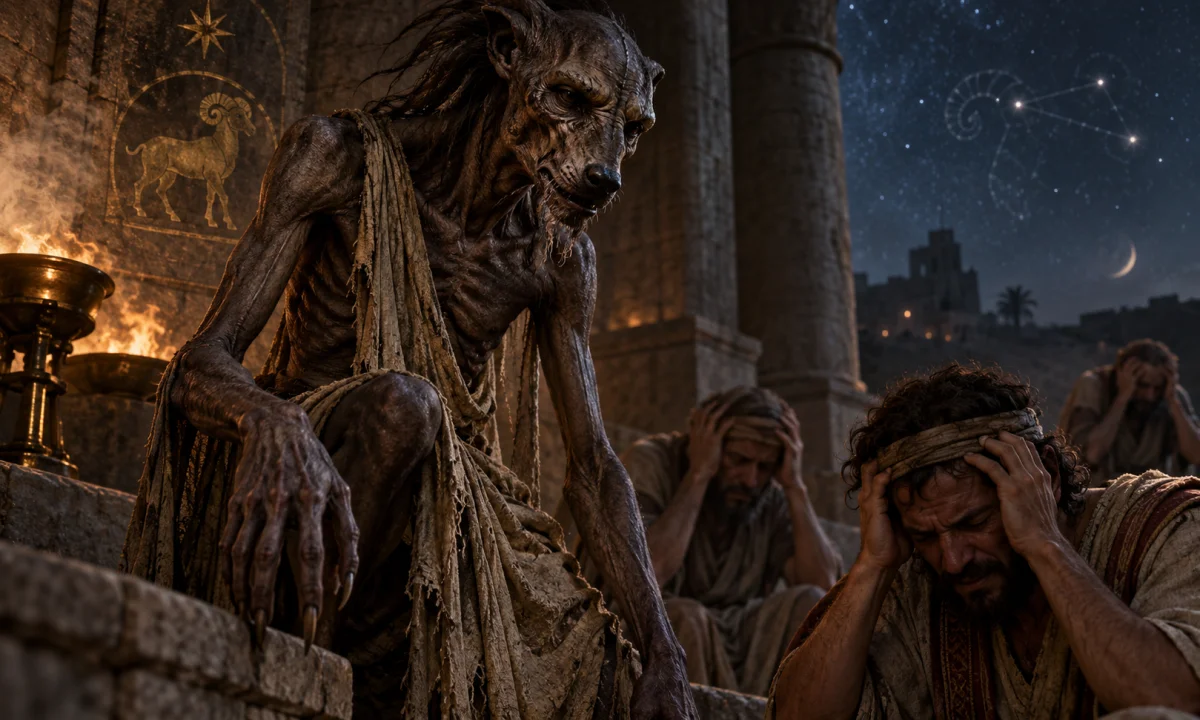
Gaap is described as appearing in human form. The account connects his appearance with the position of the Sun in certain southern signs of the zodiac. The wording differs between versions and is not always precise enough to establish a single astrological rule. The astrological setting is nevertheless significant: early modern magical literature often treated celestial timing as relevant to the appearance and effectiveness of spirits.
Unlike some demons in the same catalogues, Gaap is not consistently given a highly distinctive animal body, monstrous hybrid form or elaborate physical emblem. His human appearance places emphasis on his intelligence, authority and ability to act as a teacher or intermediary. In the demonological imagination, a spirit that appears in a respectable or human guise could be especially deceptive, since its danger was linked not only to violence but also to persuasion and false knowledge.
Some modern illustrations portray Gaap as a horned or heavily armed demon, but these visual features are not securely established by the main textual descriptions. They belong largely to later artistic conventions, general occult imagery or individual interpretations. There is no single universally authoritative traditional appearance for Gaap comparable to the standardized modern images of certain famous demons.
Powers and offices
Gaap’s attributed powers are unusually broad. The sources associate him with the following abilities:
- causing insensibility, dullness or a failure of understanding;
- teaching philosophy and the liberal sciences;
- producing love or hatred between people;
- transporting people or objects swiftly from one place or kingdom to another;
- providing information about past, present or future matters in some versions of the tradition;
- commanding a large number of subordinate spirits.
At first glance, the ability to teach philosophy seems inconsistent with Gaap’s role as a demon. Within Christian demonology, however, intellectual instruction was not automatically considered virtuous. A demon could possess knowledge, imitate wisdom or provide useful information while still being understood as a corrupting and dangerous being. The ability to teach could therefore function as a temptation, encouraging a person to seek forbidden knowledge or to trust a deceptive supernatural authority.
His association with insensibility and ignorance gives the figure a particularly ambivalent character. Gaap is not merely described as an agent of physical destruction. He affects mental awareness, judgment and emotional response. The terms used in translations may include dullness, stupidity, ignorance or insensibility, but these should be understood in their historical context rather than as precise modern psychological diagnoses.
The power to create love or hatred belongs to a wider pattern in magical and demonological writing. Spirits were frequently assigned authority over human passions, attraction, hostility and social bonds. Such powers could be interpreted as literal supernatural manipulation, but they also reflect a cultural fear that emotions could be externally influenced through enchantment, seduction or deception.
Gaap’s alleged ability to carry things rapidly from one kingdom to another is another example of a spirit performing a practical magical service. In the hierarchical system of the Ars Goetia, demons were often described as messengers, transporters, teachers or agents who could overcome ordinary limitations of distance. The claim does not establish a specific ancient travel myth about Gaap; it is part of the operational description given in a ritual manual.
Gaap in the Ars Goetia
In the Ars Goetia, Gaap occupies the thirty-third position. He is introduced as a great president and mighty prince and is said to appear in human form under a particular astrological condition. The text emphasizes his ability to make people insensible or ignorant, teach philosophy and the liberal sciences, cause love or hatred, and move things rapidly between kingdoms. It also records his rule over sixty-six legions.
The entry follows the standard format of the work. Each spirit is assigned a name, number, rank, appearance, abilities, number of legions and a sigil used in the ritual system. Gaap’s seal is therefore part of the manuscript’s magical technology, not an ancient symbol independently attested in classical, biblical or pre-Christian archaeology.
The Ars Goetia also describes the spirit in relation to celestial and infernal hierarchy. The reference to the Potentates reflects a recurring idea in demonological writing: demons may be fallen members of an originally angelic order, preserving organizational titles after their rebellion or expulsion. This framework comes from Christian angelology and demonology rather than from a distinct mythology belonging to Gaap himself.
Gaap in the Pseudomonarchia Daemonum
Weyer’s Pseudomonarchia Daemonum provides an earlier and closely related description. Its account associates Gaap with a human appearance, a southern astrological setting, the production of insensibility, instruction in philosophy and the liberal sciences, emotional influence and rapid transportation. It also gives him authority over sixty-six legions.
The two descriptions are close enough to show that the Ars Goetia inherited or adapted material from an earlier demonological catalogue. They are not identical in every wording or detail, however. Differences between editions, translations and manuscript witnesses mean that a statement found in one modern version should not automatically be treated as a universal feature of Gaap in every source.
Weyer’s work is especially important for understanding the cultural setting. It was not a pagan mythological narrative or a collection of folktales told independently by village communities. It was a learned Christian text concerned with demons, magic, fraud, superstition and the ways in which people might be deceived. Gaap’s identity is consequently shaped by clerical and occult classification rather than by a long cycle of popular legends.
Symbolism and interpretation
Gaap can be interpreted as a figure representing the dangers of misdirected knowledge. He teaches philosophy but also causes ignorance; he can provide information while undermining judgment; and he influences love and hatred, emotions that can distort a person’s understanding of events. These contrasts fit a common theme in Christian demonology: harmful spirits may offer real benefits or impressive knowledge while leading people toward dependence, error or moral danger.
His control over awareness is also important. Insensibility can mean more than unconsciousness. In historical translations, it may suggest numbness, lack of perception, mental dullness or an inability to respond appropriately. Gaap therefore belongs to a class of spirits whose imagined power lies in interfering with a person’s perception of reality.
The figure also demonstrates how demonological writers adapted the structure of heaven for the description of hell. Titles such as prince, president and Potentate imply hierarchy, bureaucracy and expertise. This organization helped writers present the demonic world as a distorted mirror of the celestial order. Demons had ranks, responsibilities and subordinate forces, but their knowledge and authority were represented as corrupted or illicit.
Distinguishing Gaap from similar names and figures
Gaap should not automatically be identified with every spirit whose name resembles it. The variant Tap appears in connection with related catalogues, but the exact relationship between Tap and Gaap depends on the textual tradition being examined. A difference in spelling may reflect transmission rather than a separate being, yet it is safer to acknowledge the variation than to treat all forms as unquestionably identical.
Gaap is also distinct from figures such as Gusion, Vapula and Buer, even though all appear in demonological catalogues and may share powers involving knowledge, instruction or divination. Gusion is described as a duke who gives answers concerning past, present and future; Vapula is associated with crafts, philosophy and sciences; and Buer is linked with philosophy, logic, healing and the virtues of herbs. Similar abilities reflect the conventions of the catalogue, not evidence that these names refer to one composite demon.
There is no reliable historical basis for equating Gaap with a named demon from ancient Mesopotamia, Egypt, Greece or Rome simply because a similar-sounding word can be found in another language. Nor is Gaap the same figure as a generic devil, Satan, a biblical fallen angel or a jinn from Islamic tradition. Later occult writers may make comparisons among these categories, but such comparisons are interpretations rather than established origins.
Later occult and popular reception
Gaap continued to circulate through editions of demonological and ceremonial-magical literature, particularly after the Ars Goetia became widely available in print. Modern occult practitioners sometimes treat the Goetic spirits as independent entities, psychological symbols, or names within a ritual system. These approaches differ considerably from one another and should not be projected backward onto Weyer’s sixteenth-century context.
In contemporary popular culture, Gaap is much less prominent than demons such as Lucifer, Asmodeus or Beelzebub. When he appears in fiction, games, role-playing materials or modern occult art, writers may expand his powers, change his appearance or reinterpret him as a ruler of knowledge, travel or emotional manipulation. Such portrayals are creative adaptations rather than part of the surviving early modern descriptions.
The historically identifiable Gaap is therefore the spirit of European demonological catalogues: a human-form president and prince, connected with sixty-six legions, intellectual instruction, emotional influence, mental dullness and supernatural transportation. His significance lies less in a large body of independent myths than in the way early modern writers organized ideas about forbidden knowledge, spiritual hierarchy and the deceptive powers attributed to demons.