WORLD
WORLD
Buer

Buer is a demon of European grimoire tradition, best known from the Ars Goetia, the first part of the Lesser Key of Solomon. In that text, Buer is described as a powerful president among infernal spirits, associated with the zodiacal sign Sagittarius and credited with teaching philosophy, logic and healing. Buer belongs to the learned tradition of Christian demonology rather than to a clearly documented ancient religion, and the surviving descriptions come from early modern magical texts rather than from an independent mythology or popular cult.
Origins in European demonology
Buer’s principal setting is the corpus of European grimoires that catalogued spirits, their ranks, names, appearances and supposed powers. These books were written and copied within a Christian intellectual environment in which magic was often understood as an attempt to communicate with demons. The spirits were placed into hierarchies resembling royal, military or bureaucratic systems, with titles such as king, duke, marquis, earl, president and prince.
The earliest important source connected with Buer is Johann Weyer’s Pseudomonarchia Daemonum, a catalogue of demons associated with his work on alleged witchcraft and demonic deception. Weyer’s material was published in the sixteenth century. Buer also appears in the Ars Goetia, which survives in manuscript traditions of the Lesser Key of Solomon from the seventeenth century and later. The Ars Goetia reorganises and expands material found in earlier demonological catalogues, although the exact relationships among manuscripts and printed editions are complicated.
These texts should not be treated as straightforward records of an ancient pantheon. They are products of Christian demonological and magical writing, drawing on biblical interpretation, medieval lore, astrological language, classical learning and earlier lists of spirits. There is no reliable evidence that Buer was worshipped as a major deity or venerated in a distinct ancient religious tradition before appearing in these texts.
Name and identity
Buer is the standard English spelling in modern editions of the Ars Goetia. The name is also found in related early modern demonological material, but its etymology is uncertain. No generally accepted ancient-language origin securely explains the name, and proposed connections should be regarded as speculative unless supported by specific textual evidence.
Buer should not automatically be identified with every figure whose name resembles it. In particular, Buer is distinct from Bune, another spirit listed in the Ars Goetia, and from Bael, the first spirit in that same catalogue. Similar spellings in translations, manuscript copies or modern occult publications do not by themselves establish that two names refer to the same being.
The Ars Goetia numbers Buer as the tenth spirit in its sequence and calls him a Great President. “President” is a rank within the grimoire’s infernal hierarchy; it does not mean a political office in the modern sense. The text also assigns Buer authority over a stated number of subordinate spirits, as it does for many other entries. Such numbers belong to the catalogue’s system of classification and are not independent evidence for a historical religious belief.
Appearance and association with Sagittarius
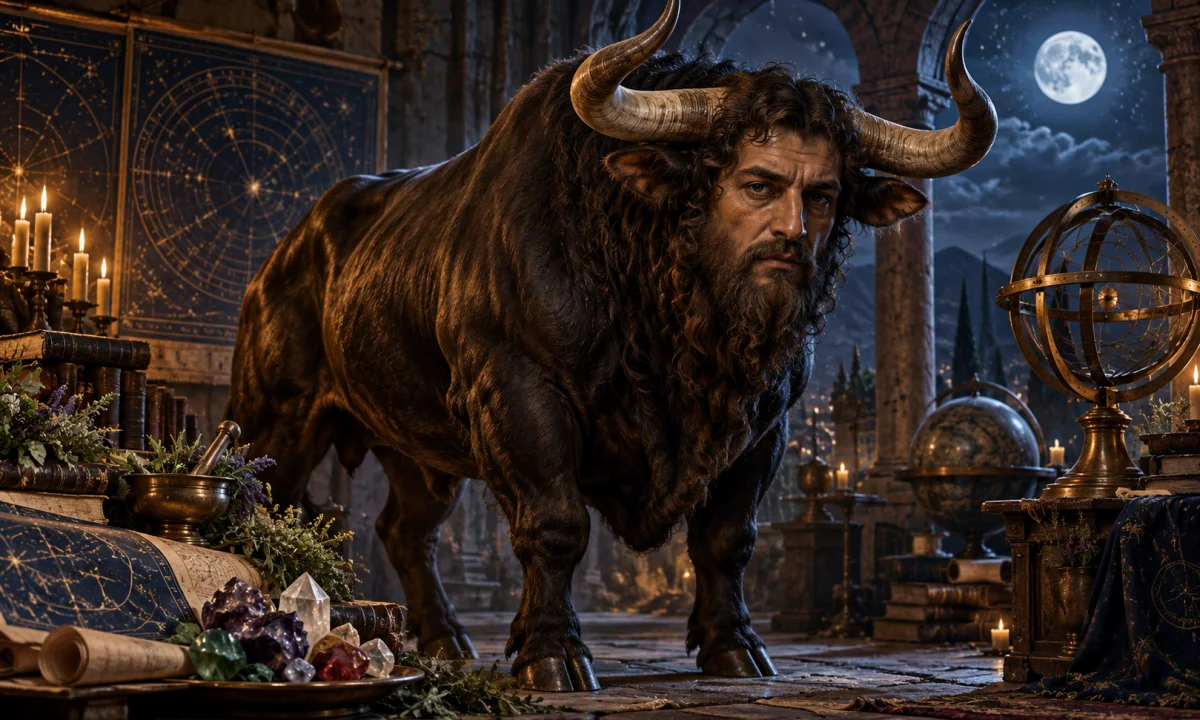
The Ars Goetia says that Buer first appears in the form or sign of Sagittarius and then assumes a human form. The wording has produced different interpretations. Sagittarius is the ninth sign of the zodiac and is conventionally represented as an archer, often a centaur. The text does not provide enough detail to establish that Buer must be imagined as a classical centaur, however. It describes a relationship to the sign rather than offering a complete naturalistic portrait.
This brief description is important because many modern images of Buer are far more elaborate than the original grimoire account. A widely circulated nineteenth-century illustration presents Buer as a lion-headed creature surrounded by several animal-like legs, giving the impression of a wheel or rotating body. This image is associated with later demonological publishing, especially the illustrated editions of Collin de Plancy’s Dictionnaire Infernal, rather than with the basic wording of the Ars Goetia.
As a result, two different visual traditions are often blended together. The early grimoire description emphasises Sagittarius and a subsequent human form. Later occult and popular art emphasises the unusual lion-headed, many-legged figure. The latter has become Buer’s most recognisable modern appearance, but it should be identified as a later iconographic development rather than assumed to be an exact portrait preserved unchanged from medieval or ancient times.
Attributed powers and functions
Buer’s abilities reflect the concerns of learned magic and early modern natural philosophy. The Ars Goetia presents him as a teacher of moral philosophy, natural philosophy and logic. These subjects were part of the intellectual curriculum of the period. Moral philosophy dealt with conduct and virtue, natural philosophy with the workings of the natural world, and logic with reasoning and argument.
This association gives Buer a somewhat different profile from demons described chiefly as tempters, warriors or providers of wealth. His catalogue entry presents him as a source of knowledge and instruction. The classification is still framed within a demonological system: the learning is obtained through the invocation of an infernal spirit, not through an institution recognised by ordinary Christian theology.
Buer is also associated with healing. The grimoire attributes to him the ability to heal human infirmities and, in some versions or translations, connects him with knowledge of herbs and plants. These claims belong to the magical literature of the period and should not be confused with evidence of medical practice or clinical effectiveness. They do, however, reflect the way occult catalogues often combined spiritual authority with practical concerns such as illness, medicine and botanical knowledge.
The text further says that Buer can provide good familiars. In early modern magical language, a familiar could mean a spirit serving or assisting a practitioner. The term is related to broader European ideas about spirit helpers and alleged witchcraft companions, although its exact meaning varies between authors and contexts. Buer’s supposed ability to grant such an assistant reinforces his role as a spirit who supplies knowledge and useful supernatural services.
Some versions also associate Buer with friendship or the reconciliation of relationships. The wording differs among editions, and it is safer to treat this as part of the catalogue’s wider promises of assistance than as a single universally fixed attribute. Like many entries in the Ars Goetia, Buer is presented through a list of practical effects rather than through a developed narrative biography.
Ritual context in the grimoires
Buer’s entry is part of a larger ritual system involving the naming, constraining and commanding of spirits. The Ars Goetia includes prayers, divine names, circles, seals and instructions for summoning. In that setting, the operator is not normally portrayed as worshipping Buer as a god. The ritual language places the spirit beneath the authority of God and the sacred names used by the magician.
This distinction matters when describing Buer as a “demon.” In the grimoire context, the word reflects a Christian cosmology in which spirits opposed to divine order are classified as demonic. Buer’s title, powers and apparent willingness to teach do not make him a benevolent deity in the ancient sense. The text treats him as an infernal being who may be compelled or controlled through ritual knowledge, despite the useful services attributed to him.
The catalogue also does not supply a continuous myth about Buer’s birth, family, enemies or exploits. Unlike figures from epic, scripture or oral legend, Buer is known primarily through a compact entry in a magical handbook. His identity is therefore defined by rank, appearance, ritual function and claimed powers rather than by a cycle of stories.
Interpretation and cultural significance
Buer’s unusual combination of infernal status, scholarly instruction and healing reflects the mixed character of early modern occult literature. The grimoires did not separate knowledge into the same sharply divided categories used today. Philosophy, astrology, medicine, theology and ritual magic could appear within a single intellectual world, even though religious authorities often condemned magical practices.
His association with Sagittarius may also illustrate the use of astrology as an organising language. Zodiacal signs offered a familiar symbolic structure for describing spirits, times, directions or ritual correspondences. The connection does not prove that Buer originated as a forgotten form of a Sagittarius deity. It is more securely understood as part of the grimoire tradition’s effort to classify supernatural beings through established celestial and astrological symbols.
The healing role attributed to Buer has attracted particular attention in later occult writing. Some modern interpretations portray him as a spirit of medicine, herbalism, natural knowledge or intellectual discipline. These interpretations build on the early descriptions, but they may give Buer a more coherent personality than the original texts provide. The sources present several functions in a catalogue format; they do not explain Buer’s motives, ethics or personal philosophy in detail.
Buer and similar figures
Buer is sometimes confused with the centaur-like figures of Greek mythology because of the reference to Sagittarius. The comparison is visual and symbolic rather than genealogical. Sagittarius in the zodiac is a sign used by the demonological text, while Greek centaurs belong to a separate mythological tradition with its own stories, names and religious context. Buer is not a Greek centaur, and there is no secure evidence that he derives directly from one particular centaur figure.
He is also distinct from the biblical word Beelzebub, from the demon Bael, and from Bune or Buna in grimoire catalogues. These names can appear near one another in modern lists of demons, but proximity in a catalogue does not establish a common origin. Nor should Buer be equated with every lion-headed or many-legged spirit found in art. His later image borrows visual ideas that may resemble other monstrous beings, but resemblance is not proof of identity.
Later reception and popular culture
Buer’s later reputation has been shaped strongly by printed demonologies and occult revival literature. The nineteenth-century illustrated image of a lion-headed, many-legged spirit made him especially memorable, and modern encyclopaedias of demons often repeat or expand that appearance. Such works helped transform a short grimoire entry into a visually distinctive character.
In contemporary popular culture, Buer may appear in role-playing games, novels, comics, films, music and digital games. These versions commonly reinterpret him as a monster, a boss character, a healer, a sage or a supernatural ally. They may retain the lion-like head, multiple legs, Sagittarius symbolism or healing powers, but these are creative adaptations rather than evidence about the historical grimoire tradition.
The historically identifiable Buer remains the ranked spirit of early modern demonological catalogues: a Great President linked with Sagittarius, philosophical and logical instruction, healing and familiars. Beyond those descriptions, claims about his personality, origins or independent mythology are uncertain and should be kept separate from later artistic and fictional developments.