WORLD
WORLD
Epunamun
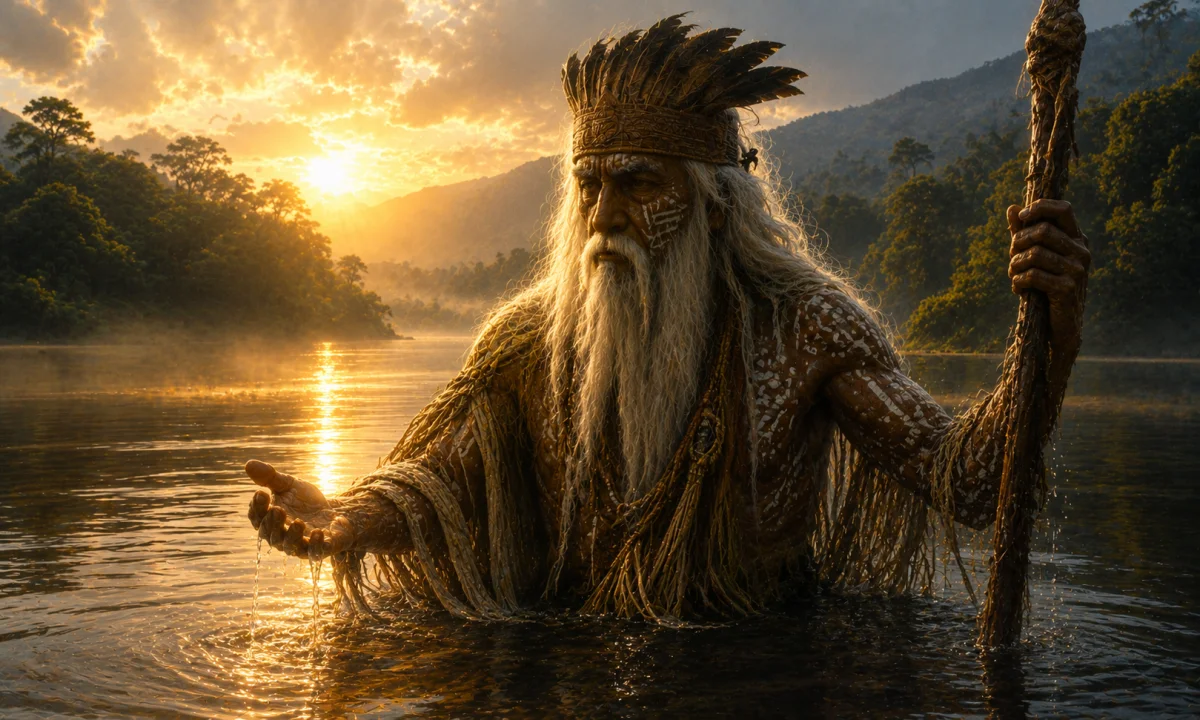
Epunamun is a figure associated with Mapuche religious tradition in south-central South America, especially the cultural region known as Wallmapu, extending across parts of present-day Chile and Argentina. He is commonly described in older written accounts as a being connected with war, courage and martial power. However, the surviving evidence is limited, and modern descriptions often present a much more fixed character than the historical record supports.
Origins and cultural setting
The Mapuche are an Indigenous people whose historical homeland lies principally in south-central Chile and adjacent areas of Argentina. Their religious traditions developed within a wider cultural world shaped by relationships among human communities, ancestors, natural forces, spirits and powerful beings. Mapuche religious life has never depended on a single universally fixed mythology comparable to a written pantheon. Knowledge was transmitted mainly through oral tradition, ritual practice, family teaching and the authority of religious specialists.
Mapuche communities have also used different regional terms, traditions and systems of pronunciation. The name Mapuche is generally translated as “people of the land,” while Wallmapu refers broadly to the traditional Mapuche territory. Older European writers often used the term “Araucanian,” derived from the name Arauco, but Mapuche is the preferred designation in contemporary usage.
Most information about Epunamun comes indirectly from colonial and early ethnographic descriptions. European missionaries, soldiers and chroniclers attempted to fit Mapuche religious beings into categories familiar from Christianity and classical European culture. As a result, a powerful spirit might be called a “god,” “demon,” “idol” or “deity,” even though these labels do not necessarily correspond to Mapuche understandings.
The written record is therefore valuable but incomplete. It preserves names and observations made during periods of war, missionisation and colonial expansion, yet it rarely records Mapuche religious ideas in their own conceptual framework. Oral traditions also change across time and region. Claims that Epunamun had one universally accepted appearance, genealogy or mythology should consequently be treated with caution.
The name Epunamun
The spelling Epunamun reflects the way early Spanish-language sources recorded a Mapuche name. Other spellings may occur, particularly when the word is adapted to different systems for writing Mapudungun. The name is often analysed in relation to Mapudungun elements that may be associated with “two” and “foot” or “leg.” This has led to translations such as “two-footed” or “one with two feet.”
That interpretation is frequently repeated, but the exact meaning and grammatical structure of the name should not be treated as completely settled without examining the original linguistic context. Colonial transcriptions often altered Indigenous words, and later writers sometimes repeated earlier explanations without independently verifying them. The name’s apparent reference to two feet may be significant, but it does not by itself prove that Epunamun was physically depicted as a two-legged monster or as a being with multiple limbs.
Nor should Epunamun automatically be treated as a direct equivalent of a European war god such as Mars or Ares. The label “god of war” is a convenient summary of his reported association, not evidence that Mapuche religion organised divine powers according to the same categories as ancient Mediterranean religion.
Identity and classification
In many summaries, Epunamun is called a Mapuche god of war. Older accounts and later reference works connect him with combat, martial courage and the fortunes of warriors. Some descriptions imply that warriors appealed to him before battle or regarded him as a source of strength. The available evidence, however, does not establish a single, detailed cult of Epunamun shared by all Mapuche communities.
It is more accurate to describe him as a powerful Mapuche-associated being or martial figure whose identity was recorded by colonial observers in terms of warfare. Whether he should be classified as a god, spirit, ancestral power or another type of supernatural being depends partly on the source and partly on how Mapuche categories are interpreted.
This uncertainty is especially important because Mapuche religious concepts do not map neatly onto the distinction between “god” and “spirit.” The word püllü, for example, can be discussed in connection with spiritual beings or forces, but translating every such being as a “spirit” may also be misleading. Terms such as ngen, referring broadly to owners, guardians or powerful beings associated with places and natural features, likewise have meanings that cannot be reduced to one English category.
Epunamun and warfare
Epunamun’s principal reported association is with warfare and the qualities needed by fighters. In this context, he may be understood as representing force, fearlessness, victory and the dangerous uncertainty of battle. The figure belongs to a cultural history in which military organisation and resistance were profoundly important, particularly during the long conflicts between Mapuche communities and the Spanish colonial state.
It would be misleading, however, to assume that references to Epunamun arose only from the later wars with Spain. European records may have encountered an older martial figure, but the surviving documents do not provide enough evidence to reconstruct his history with confidence. Colonial descriptions often focused on war because warfare was central to the observers’ own experience of Mapuche society. Their emphasis may therefore have made Epunamun appear more exclusively military than he was in Mapuche religious life.
There is no securely documented cycle of famous myths about Epunamun comparable to the extensive story traditions surrounding some better-known mythological figures. Accounts may mention his name or function without preserving a narrative of his origin, family, actions or final fate. Later retellings frequently expand these brief references into elaborate stories, but such additions should not be presented as ancient Mapuche tradition unless their provenance is clear.
Appearance and attributes
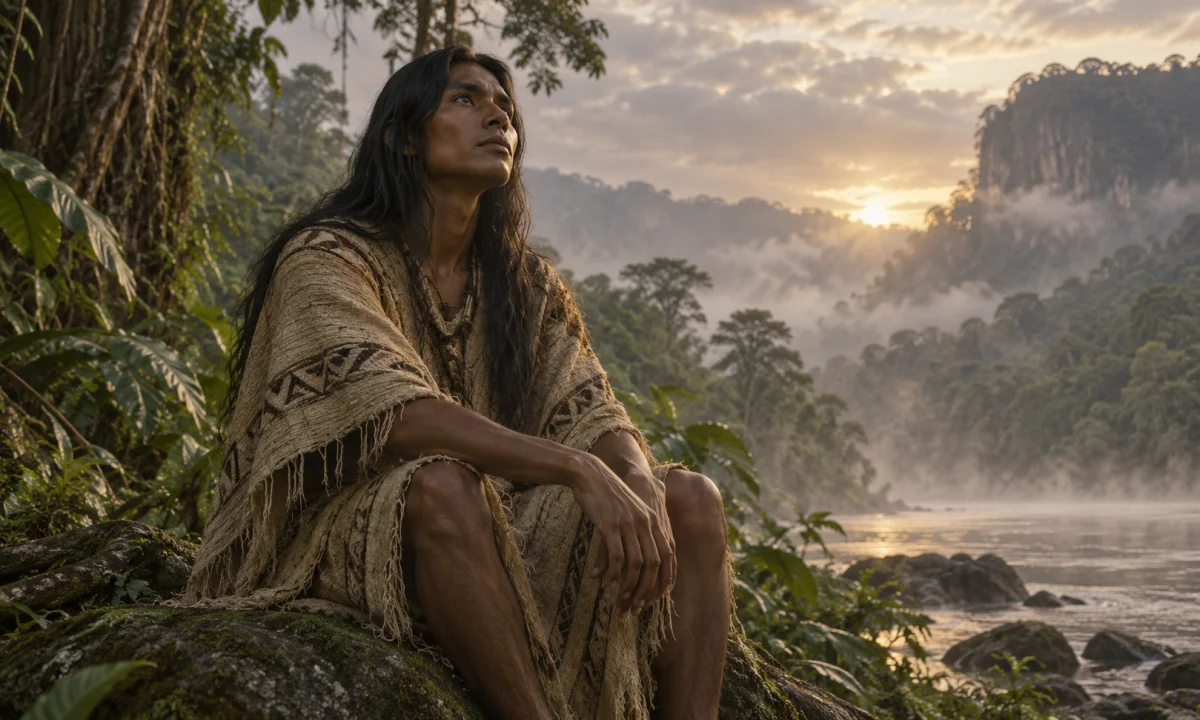
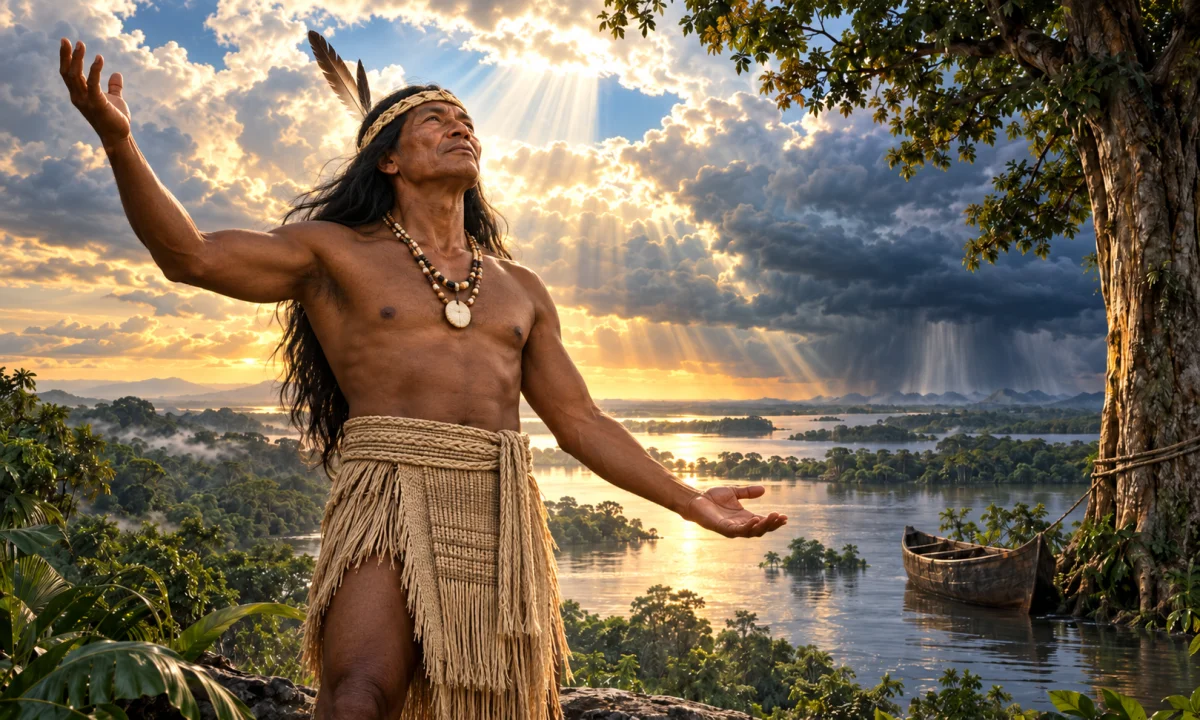
Popular descriptions sometimes portray Epunamun as a gigantic warrior, a being with two heads, or a figure possessing several arms, weapons or legs. These images are widespread in modern online summaries and fantasy-oriented treatments, but they are not consistently supported by the early evidence. The name’s possible connection with “two feet” may have encouraged visual speculation, while the association with war has invited the addition of armour, clubs and swords.
No single traditional appearance can be securely established. The historical sources do not provide a reliable canonical portrait comparable to an iconographic image from a literate temple tradition. It is therefore safer to discuss Epunamun through his reported function than through a fixed physical design.
Descriptions of weapons also require caution. A warrior figure may naturally be imagined with weapons, but there is insufficient evidence to claim that Epunamun possessed one particular sacred sword, spear or club. Similarly, statements that he had a specific number of arms, eyes or faces belong to uncertain or modernised representation rather than to a well-attested, universally recognised Mapuche image.
Place within Mapuche religious thought
Mapuche religious life includes a complex relationship between the visible and invisible worlds. Ceremonies such as the ngillatun involve communal prayer, offerings and the renewal of relationships among people, spiritual powers and the land. The machi, a traditional religious specialist and healer, plays an important role in communication, healing and ritual knowledge. These institutions provide a more useful context for understanding Mapuche religion than the idea of a neatly arranged pantheon.
Some important Mapuche religious beings are associated with creation, order, nature, ancestors or particular places. Ngenechen is often presented in outside sources as a supreme deity, although interpretations of the name, identity and gendered aspects vary. Ngemapun may be associated with the earth or the land in some accounts. Pillan can refer to powerful spiritual beings, often connected with ancestors, mountains, volcanoes, storms or other forces, although usage varies. Wekufe is commonly used for harmful or disruptive supernatural forces, but it is not simply a Mapuche equivalent of the Christian Devil.
Epunamun should not be placed into these categories without qualification. In particular, calling him a “war god” does not mean that he necessarily occupied a permanent rank in a divine hierarchy. His significance may instead have depended on a particular tradition, historical account or regional understanding of martial power.
Relationships and variants
Reliable evidence for Epunamun’s family relationships is scarce. Some modern descriptions connect him with other Mapuche supernatural beings or describe him as a subordinate or companion of a greater deity. These relationships are not consistently documented and should not be treated as established features of Mapuche mythology.
There is also no secure basis for claiming that Epunamun was universally opposed to a particular named enemy. Some retellings create battles between Epunamun and figures associated with peace, nature or rival peoples, but these narratives often reflect modern myth-making rather than a clearly preserved traditional story.
Variation is to be expected. Mapuche tradition has been maintained by communities living in different regions and under changing political conditions. A name recorded by a seventeenth-century chronicler may not carry exactly the same meaning as a similar name remembered in a later community. It is also possible that colonial writers grouped distinct beings together or misunderstood a title, ritual expression or local name as the name of a separate deity.
Distinguishing Epunamun from similar figures
Epunamun is sometimes confused with Pillan, but the two should not be casually merged. Pillan is a broad and variable term connected in different accounts with powerful beings, ancestral forces and dramatic natural phenomena. Epunamun, by contrast, is specifically associated in the written record with warfare and martial strength.
He should also be distinguished from Wekufe. Wekufe is often translated in older works as “devil” or “evil spirit,” but this translation reflects Christian interpretation and does not capture the full range of the term. Epunamun’s connection with battle does not make him a demonic figure, nor is there firm evidence that he was regarded as an embodiment of evil.
Epunamun is likewise not the same as a machi. A machi is a human religious specialist, commonly associated with healing, ritual knowledge and communication with spiritual powers. The machi may work within a religious world that includes martial or dangerous forces, but Epunamun is not a title for a machi or a type of healer.
Historical interpretation
The image of Epunamun as a distinct “god of war” was shaped heavily by European habits of classification. Chroniclers often searched for Indigenous equivalents of the gods they knew from the Bible or classical literature. A being invoked in connection with fighting could therefore be compared with a war deity, even if Mapuche religious practice did not treat that being as a member of an ordered pantheon.
Colonial circumstances also influenced what was recorded. Spanish observers encountered Mapuche communities during violent struggles over territory, labour, sovereignty and religion. They had practical reasons to ask about warfare and supernatural protection, while many other aspects of ritual life were ignored or misunderstood. A short description of a martial power may consequently preserve only one part of a broader tradition.
The name’s uncertain etymology offers another warning. An appealing translation can become the basis for an entire imagined mythology. If “two-footed” is interpreted as “two-bodied,” and that interpretation is then combined with the idea of a warrior, later writers may produce a many-limbed battle monster that has no firm historical foundation. Linguistic uncertainty should remain visible rather than being concealed behind a confident illustration.
Cultural significance
Epunamun is significant not because a complete body of myths survives under his name, but because he demonstrates the difficulties involved in reconstructing Indigenous religious traditions from colonial records. His reported association with war points toward the spiritual dimensions of courage, communal defence and conflict in Mapuche history. At the same time, the uncertainty surrounding his classification reminds readers that Mapuche religious concepts cannot be fully translated into a European pantheon.
For the Mapuche, warfare was not merely an abstract contest between supernatural beings. It involved territory, kinship, political authority, community obligations and relationships with the land. A martial figure such as Epunamun should therefore be approached within that social and spiritual setting rather than reduced to a fantasy character defined only by violence.
Modern representations
In modern popular culture, Epunamun occasionally appears in encyclopaedias of monsters, fantasy games, illustrations and online lists of South American gods. These treatments often give him a dramatic body, detailed weapons and a fully developed personality. Such portrayals can introduce the name to new audiences, but they should be identified as creative adaptations or speculative reconstructions.
No single modern image has authority across Mapuche communities, and a fantasy depiction should not be mistaken for a traditional religious icon. The most responsible representations preserve the distinction between what the historical record actually supports—an association with Mapuche warfare and martial power—and later additions concerning appearance, genealogy, powers and narrative adventures.