WORLD

Dziva
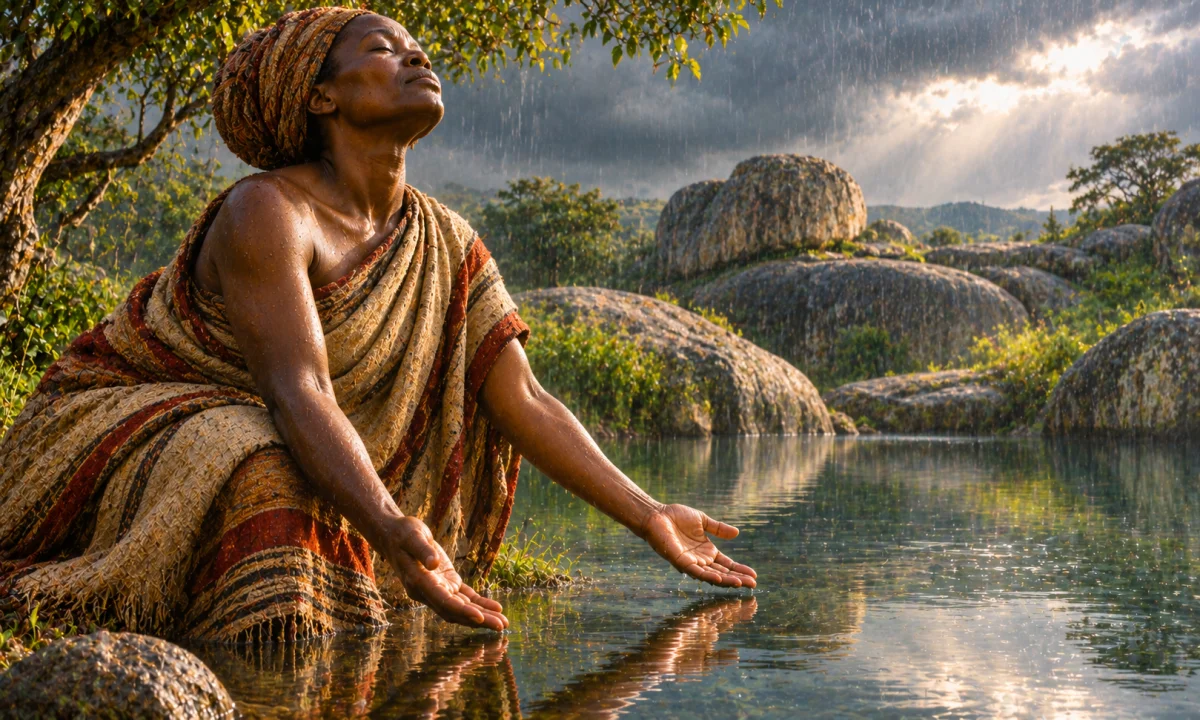
Dziva is a name associated in some accounts with Shona religious tradition in southern Africa, especially with water, fertility and primordial creation. The identification is not uniform: some modern summaries present Dziva as a goddess or mother of living things, while other discussions treat the name as a symbolic or descriptive term connected with a pool, lake or water source rather than as the name of one universally defined deity. Surviving information is limited and comes largely through oral traditions, local interpretations and later written descriptions.
Cultural setting
The Shona are a group of related peoples whose languages and communities are concentrated mainly in Zimbabwe, with related populations in parts of Mozambique and neighbouring areas. “Shona” is a broad cultural and linguistic designation rather than the name of a single ancient kingdom or a completely uniform religious system. Beliefs and ritual practices have varied between communities, regions and historical periods.
Traditional Shona religion recognises a high creator or supreme power commonly called Mwari. Mwari is associated in many accounts with creation, the ordering of the world and the granting of rain, fertility and well-being. Religious life also includes ancestral spirits, territorial or local spiritual powers, diviners and beings connected with particular natural places. Water sources, mountains, caves and unusual landscapes may possess religious significance without belonging to one standardised pantheon.
Within that setting, Dziva is best approached cautiously. The name is sometimes used for a female supernatural figure linked to the origins of life or to water. It does not, however, have a single securely documented mythology comparable to the better-known and more extensively discussed figures associated with Shona religion.
Name and identity
In Shona, dziva is associated with a pool or body of water. Spellings and interpretations may vary when oral names are recorded in English or in other languages. Forms such as Dziwa may appear in secondary material, although a variant spelling does not automatically indicate a separate being. The ordinary meaning of the word is important because the figure’s supernatural interpretation may arise from the religious importance of water itself.
Some accounts describe Dziva as a primordial female being, a mother figure or a goddess associated with the beginning of human and animal life. Other accounts give the name less of a personal identity and more of a symbolic meaning: Dziva represents a life-giving pool, the waters from which life emerges, or the generative power of the earth. These interpretations should not be treated as interchangeable without qualification.
There is no universally accepted ancient Shona scripture that provides a fixed biography for Dziva. Shona religious knowledge was transmitted primarily through oral performance, ritual practice, family traditions, praise poetry and instruction by knowledgeable elders and ritual specialists. Oral traditions can preserve very old themes while also changing in wording, emphasis and narrative detail. As a result, one community’s account may not establish a belief held by all Shona-speaking communities.
Water, fertility and creation
The strongest recurring association attached to Dziva is water. In an agricultural environment, water is directly connected with survival, crops, livestock, childbirth and the renewal of the community. Rain is especially significant in southern African religious thought, and the power to bring or withhold rain has often been connected with the supreme deity, ancestors and other spiritual forces.
A pool or spring can carry several meanings at once. It may be a practical source of drinking water, a boundary between the human and spirit worlds, a place associated with ancestral presence, or a location where unusual events are believed to occur. A name such as Dziva can therefore signify more than a natural feature. It may evoke the hidden source of life and the mysterious depths beneath the visible world.
When Dziva is interpreted as a mother or creator figure, her water association supports themes of fertility, birth and renewal. Water can be imagined as the medium from which living beings arise or as the substance that sustains them after creation. Such symbolism does not necessarily mean that Dziva replaces Mwari as the supreme creator. In some interpretations, she is a personification of a created power, a complementary female principle or a local expression of the life-giving forces governed by the creator.
These interpretations remain uncertain because the surviving descriptions do not provide a consistent sequence of creation events. It is therefore safer to speak of Dziva as a water-associated and possibly primordial figure in some Shona traditions than to assign her a definitive role in a single pan-Shona creation myth.
Attributes and religious role
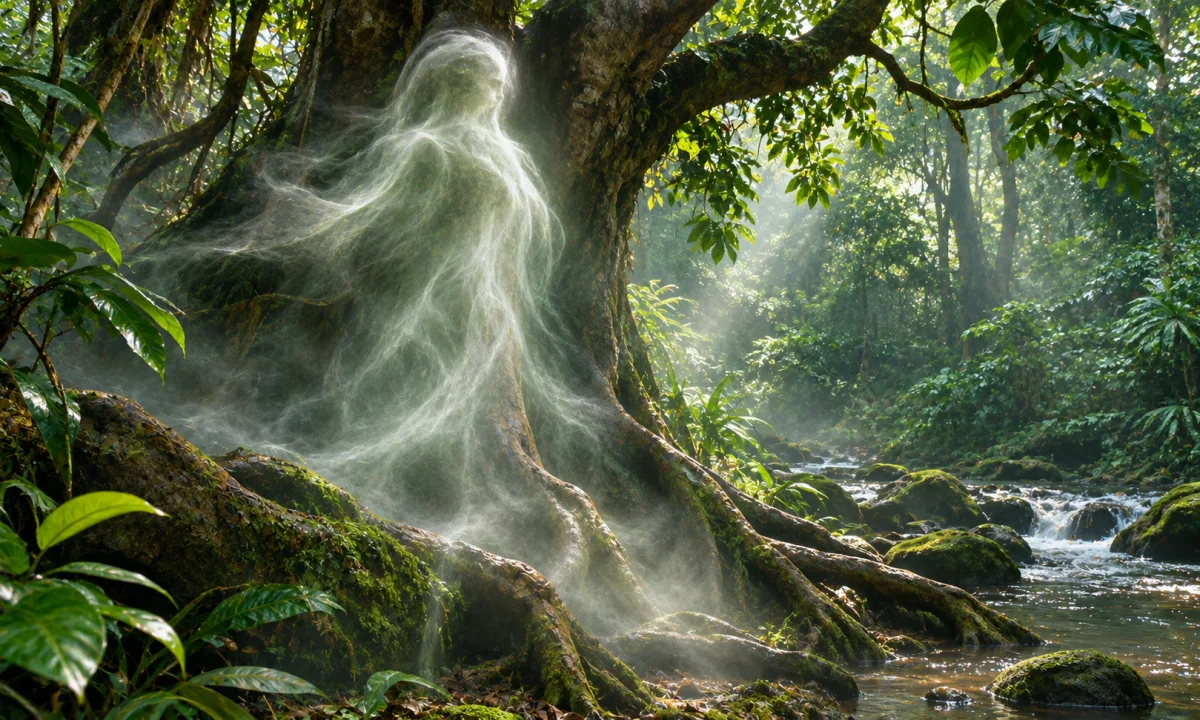
Descriptions of Dziva’s appearance are scarce. Unlike figures represented in detailed artistic or literary traditions, she does not have a stable, widely attested visual form. Modern illustrations may depict her as a woman rising from water, a spirit beside a pool or a goddess surrounded by aquatic imagery, but these images should be recognised as artistic interpretations rather than established traditional descriptions.
The attributes most often connected with the name are:
- Water: especially a pool, spring or other body of still or life-giving water.
- Fertility: the power of birth, growth, reproduction and agricultural abundance.
- Primordial motherhood: in accounts that treat Dziva as an ancestral or generative female presence.
- Renewal: the restoration of life through rain, water and the seasonal cycle.
- Hidden spiritual power: the idea that a natural water source may conceal or reveal contact with the spirit world.
These attributes describe patterns of interpretation rather than a fixed list of powers found in every tradition. There is no secure basis for assigning Dziva a standard set of weapons, sacred animals, marital relationships or ritual titles. Claims that she rules every river, commands all aquatic spirits or possesses a detailed genealogy should be treated carefully unless they are tied to a specific local tradition.
Stories and relationships
Accounts of Dziva are much less consistent than the myths surrounding Mwari or the historical-spiritual traditions associated with figures such as Nehanda and Chaminuka. In general references, Dziva may be placed among primordial beings connected with the beginning of life, but the available narratives do not form one agreed cycle of stories.
Some retellings make Dziva a female counterpart or companion of a male creator figure. Others imply that she is part of the created order rather than an equal to the supreme deity. Such differences may reflect local theology, translation choices or the tendency of later writers to arrange diverse spiritual beings into a hierarchy resembling the pantheons of classical mythology.
For the same reason, relationships sometimes attributed to Dziva should not be presented as universal. There is no generally established account that makes her the mother, wife or daughter of every major Shona spiritual figure. The identities of Mwari, ancestral spirits, local guardians and water beings belong to different levels of religious understanding in many Shona contexts, and a simple family tree can distort those distinctions.
Dziva and other water beings
Dziva should not automatically be equated with every spirit associated with water. The most important distinction is between the name Dziva and njuzu, a term used in Shona contexts for water spirits or mermaid-like beings. Njuzu traditions are diverse, but these spirits are often associated with rivers, pools and initiation into healing or divining knowledge. A njuzu may be described as an individual spirit encountered by a person, whereas Dziva, in interpretations that treat her as a deity, is a broader primordial or symbolic figure.
Nor should Dziva be merged with Nyaminyami, the famous dragon- or serpent-like being associated particularly with the Zambezi River and the Tonga people. Nyaminyami belongs to a different cultural tradition and has a distinct historical and regional context. Popular writing sometimes groups all African water beings together, but their communities, names and meanings are not interchangeable.
There is also a difference between a sacred water place and a water goddess. A pool called a dziva may be spiritually important without being understood as the body or dwelling place of a single named deity. Conversely, a story that personifies a pool may use the name symbolically rather than describe a separate goddess with an independent cult.
Religious and cultural significance
Dziva is significant as an example of how natural features can become central to religious imagination. Water is not merely an element in such traditions: it links the visible environment with health, food production, reproduction, weather and the presence of spirits. A body of water can consequently be treated with respect, caution or ritual attention.
The possible feminine dimension of Dziva also reflects a widespread symbolic association between water and gestation. Pools and springs are enclosed spaces from which life-giving water emerges, making them suitable images for the womb, the mother and the hidden origin of living things. This symbolism should not be used to claim that all African religions share one “water goddess” concept. It is better understood within the particular language, landscape and religious history of Shona-speaking communities.
Attention to Dziva also illustrates the limits of categories such as “goddess.” English-language descriptions often classify every supernatural figure as a god, goddess, spirit or monster. Shona religious concepts may not always fit those categories neatly. A figure may be understood simultaneously through a natural place, an ancestral presence, a spiritual power and a story about origins. The word “goddess” can be useful as a rough comparison, but it may impose a rigid individuality that is not present in every local interpretation.
Sources, variation and interpretation
Much of what is said about Dziva in English comes from compilations of African mythology, educational summaries and modern retellings rather than from a single canonical Shona text. Such works may simplify regional differences or turn a descriptive word into the name of a fully developed deity. They may also combine information from unrelated communities because both traditions involve water.
A careful account should therefore distinguish between traditional themes and later presentation. The traditional themes most plausibly associated with Dziva are water, fertility, life and possibly primordial motherhood. The more elaborate claims sometimes attached to her—such as a fixed divine genealogy, a universal temple cult or a detailed set of adventures—are not consistently documented across Shona traditions.
Modern readers may encounter Dziva in online lists of African gods and goddesses, fantasy writing or symbolic artwork. These presentations can keep a little-known name in circulation, but they frequently standardise an identity that was originally variable or locally rooted. A fictional portrayal may legitimately adapt Dziva as a water goddess, yet that portrayal should not be confused with evidence for a uniform historical belief.
Dziva in perspective
Dziva is most responsibly understood as a water-associated name and spiritual figure found in some interpretations of Shona mythology, with possible links to creation, fertility and the origins of life. Her identity is less securely fixed than popular summaries often suggest. The evidence does not justify treating her as a universally recognised member of a single Shona pantheon, nor does it support merging her with njuzu, Nyaminyami or other African water beings.
Her importance lies partly in the way the name brings together landscape and theology. A pool may be a source of physical life, a symbol of generation and a point of contact with unseen powers. Whether Dziva is understood as a goddess, a primordial mother, a personification of water or a local spiritual concept depends on the tradition and interpretation being followed.