WORLD

Cloacina
Cloacina was a Roman deity or divine epithet associated with the cleansing and maintenance of Rome’s drainage system. She is most often known as Venus Cloacina, “Venus of the Cloaca,” and was connected with the Cloaca Maxima, Rome’s principal sewer and one of the city’s major public works. Her identity is unusual because the surviving evidence does not present a complete myth or a clearly independent goddess. Instead, it shows a sacred figure at the meeting point of Roman religion, urban engineering, ritual purification, peace-making and the Roman interpretation of Venus.
Origins and Roman setting
The Latin word cloaca referred to a drain, sewer or covered channel for carrying away water and waste. In Rome, the name became especially associated with the Cloaca Maxima, traditionally described as one of the city’s oldest drainage works. Roman tradition connected its construction with the early kings, particularly the Tarquins, although the system developed over a long period and was repeatedly repaired and extended.
Drainage had practical importance in Rome. The low-lying areas around the Forum could become wet and unhealthy, and channels were needed to control water flowing from the surrounding hills. The Cloaca Maxima eventually carried water toward the Tiber. Roman religious thought did not separate such public infrastructure completely from sacred concerns. Roads, boundaries, bridges, gates, walls, rivers and sewers could all possess religious significance because they shaped the safety and order of the city.
Cloacina belonged to this urban religious environment. She was not a goddess whose worship is documented across the Roman world in the way that the worship of Jupiter, Juno, Mars or Venus was. Her evidence is concentrated in Rome, where the sewer and its associated shrine formed part of the civic landscape.
The name Cloacina
The name Cloacina is plainly connected with cloaca, but its precise linguistic and religious development is uncertain. Ancient Roman writers sometimes explained divine names through popular etymology, and the word could also be associated with ideas of cleansing or purification. Modern interpretations therefore differ over whether Cloacina began as an independent local deity, a personification of the sewer, an old purification goddess later identified with Venus, or an epithet attached to an existing goddess.
The form most commonly encountered is Venus Cloacina. This does not necessarily mean that Romans regarded Cloacina as simply identical with every aspect of the goddess Venus. Roman religion often incorporated local powers and older cults by placing them under the name or protection of a better-known deity. An epithet could preserve a distinctive local function while connecting it to a major divine personality.
The association with Venus is also open to interpretation. Venus could represent love, beauty, fertility and sexuality, but Roman Venus had broader civic and religious roles. She could be connected with generation, prosperity, protection and the renewal of social relationships. A purification cult placed under her name need not have been intended as a joke or contradiction. It may reflect the way Roman religion combined bodily, social and civic forms of renewal.
Ancient evidence
The main literary evidence for Cloacina comes from Roman and late antique authors who mention her as an example of an unusual Roman divinity. Pliny the Elder referred to a sacred image of Venus Cloacina in the Roman Forum area. Other writers used her name when discussing the Romans’ habit of assigning divine status to particular functions, places or objects.
These references are brief. No surviving ancient text gives a full account of Cloacina’s birth, personality, family relationships or adventures. There is no established body of hymns, epic stories or ritual instructions devoted to her. Claims about her powers must therefore be based on her name, location, artistic representations and the comments of later authors rather than on a complete mythology.
Archaeological remains of the ancient shrine are difficult to identify with certainty, but the sanctuary was associated with the Forum and the course of the Cloaca Maxima. A Roman coin issued in the first century BCE provides especially valuable evidence. It shows a small circular shrine or sacred enclosure with two female figures and identifies the place with Cloacina. The coin does not resolve all questions about the cult, because the figures are stylised and the image cannot reveal the complete ritual meaning of the shrine. It does, however, demonstrate that the cult had a recognised place in Roman public memory.
The shrine of Venus Cloacina
The shrine was known as the Sacrum Cloacinae, the sacred place of Cloacina. It stood near the Forum, close to the route of the Cloaca Maxima and near the Basilica Aemilia. Its position was significant. The Forum was the centre of Roman political, legal and commercial life, while the sewer represented the hidden infrastructure that made the public centre more habitable.
The sanctuary appears to have been relatively small and open or lightly enclosed rather than a large temple. The coin image shows a round structure raised above the ground, with divine figures inside it. The exact appearance of the shrine in daily use is unknown, and surviving evidence does not establish whether it contained a substantial building, an altar, statues or a combination of these elements at every period.
Because the shrine was connected with a working sewer, it illustrates an important feature of Roman religion: sacred places did not have to be remote from ordinary physical processes. Water, waste, disease, fertility and purification could all be religiously meaningful. The presence of a shrine beside a drain does not indicate that Romans considered the drain itself a god in a simple or literal sense. It shows that the management of potentially dangerous substances could be placed within a framework of ritual protection and civic responsibility.
Cloacina and purification
Cloacina is often described as a goddess of sewage, but that modern shorthand is incomplete. Her name and location certainly connect her with drainage and the removal of waste. Yet the ancient religious idea most often associated with her was probably cleansing in a wider sense.
Roman purification rituals, known collectively through ideas such as lustratio, could cleanse people, armies, animals, fields or communities. Purification did not necessarily mean removing physical dirt alone. It could restore proper relations between humans, gods and the community after violence, pollution or disorder. Cloacina’s connection with a sewer may therefore have carried a symbolic meaning: harmful or impure material was removed, and civic life could continue in an ordered state.
Some ancient explanations linked Cloacina with the cleansing of the city or with the purification of places after conflict. These explanations are not preserved in a single consistent myth, and the surviving sources do not allow certainty about the original ritual. It is safer to say that Cloacina was associated with the practical and symbolic removal of impurity than to assign her a detailed purification ceremony for which no secure evidence survives.
The Roman and Sabine peace tradition
Ancient writers connected the location of Venus Cloacina with the legendary reconciliation between the Romans and the Sabines. In the traditional story, conflict followed the seizure of the Sabine women by the early Romans. The women eventually intervened between their Roman husbands and Sabine relatives, helping bring the fighting to an end and producing a political union between the two peoples.
Later accounts associated the place of this reconciliation with the shrine of Cloacina. Some versions suggest that the Romans and Sabines purified themselves or performed an act of cleansing after making peace. The exact details vary, and it is not clear whether this tradition preserves an old local story or a later explanation for the shrine’s location and name.
The connection is nevertheless revealing. Cloacina could stand for more than the physical removal of waste. She could also be understood through the ideas of reconciliation, restoration and the clearing away of conflict. The association with Venus strengthened this interpretation, since Venus could be connected with attraction, union and the re-establishment of social bonds.
This tradition should not be treated as a securely historical account of the Roman–Sabine settlement. The early history of Rome contains many foundation legends that express Roman ideas about citizenship, marriage, conflict and political integration. The Cloacina story belongs to that legendary and religious framework rather than providing independent evidence for the events described.
Appearance and symbols
Cloacina has no securely established standard appearance. The coin associated with her shrine depicts two female figures, but their identities and attributes are not completely certain. They may represent Venus and Cloacina, two aspects of a single cult, or paired divine forms whose precise significance has been lost.
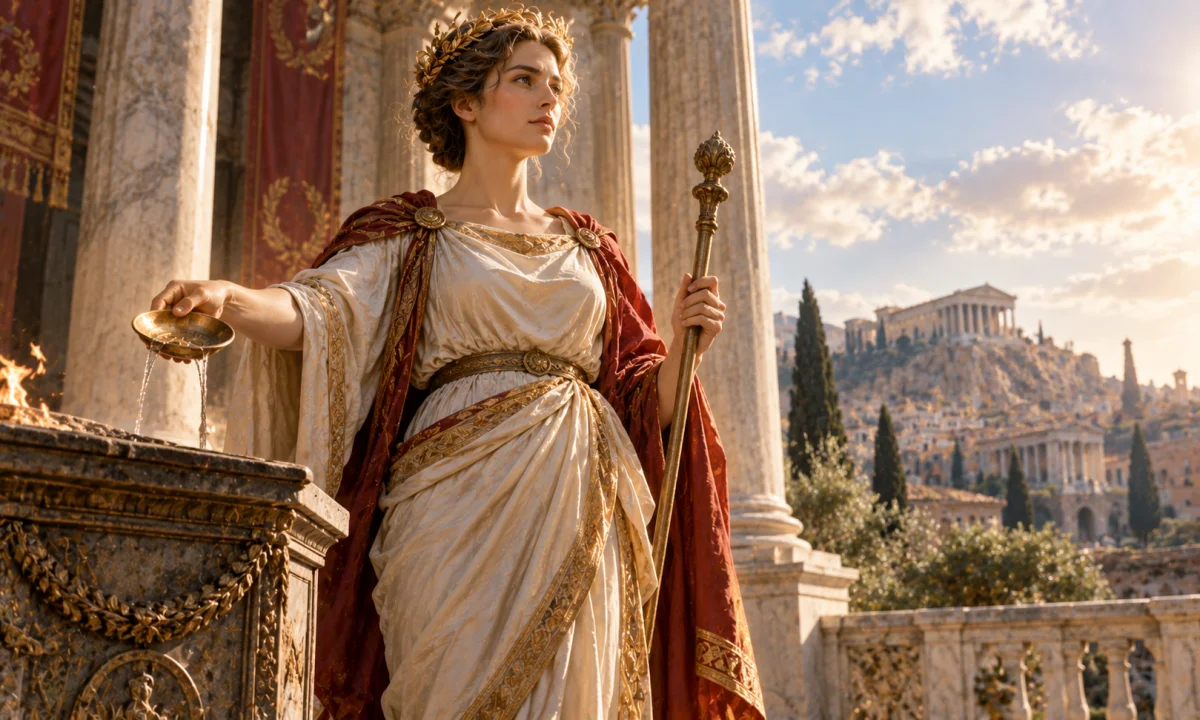
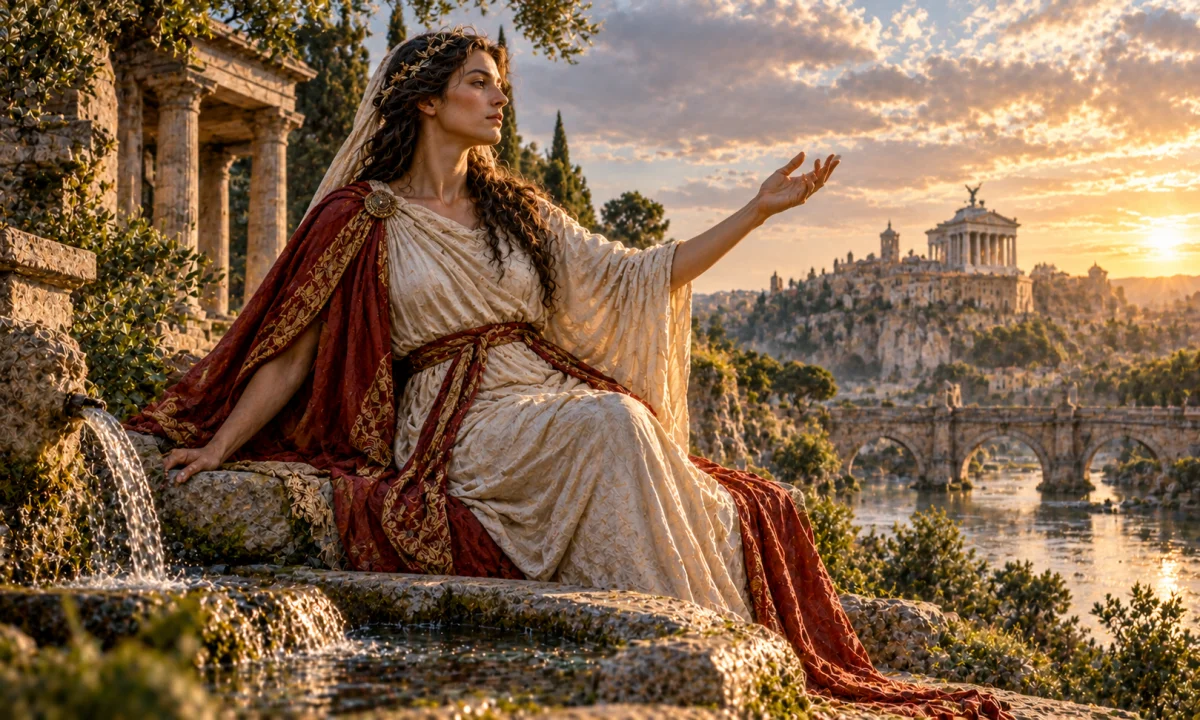
There is no reliable ancient description of Cloacina wearing a particular garment, carrying a fixed weapon or possessing a distinctive animal companion. Images sometimes presented in modern discussions as definitive portraits of the goddess are usually reconstructions based on the coin or on general Roman artistic conventions.
The most secure symbols associated with her are therefore the sewer, flowing water, cleansing and the sacred urban landscape. These symbols should be understood within Roman cultural assumptions. Water could be life-giving and dangerous; drainage could protect the city while also carrying away material considered polluted. A deity connected with such a system occupied a boundary between public health, ritual purity and the management of the city’s physical environment.
Was Cloacina a separate goddess?
The classification of Cloacina remains disputed. The name may have belonged originally to a local Roman power later identified with Venus. Alternatively, Venus may have received the epithet because a cult of purification was attached to a place beside the Cloaca Maxima. Another possibility is that Cloacina was primarily a personification or sacred title rather than an independent goddess with a separate mythology.
Roman religion frequently tolerated overlapping identities. A local deity could be interpreted through a Greek or Roman equivalent, a place spirit could receive a temple and ritual, and a divine epithet could become important without producing a large cult community. For this reason, asking whether Cloacina was “really” a goddess or “only” an epithet imposes a modern distinction that may not match ancient practice.
The phrase Venus Cloacina should also not be confused with a separate goddess called Venus who merely happened to share a name. It indicates a particular Roman cult expression of Venus, shaped by its location and function. The evidence supports the existence of this cult expression, but it does not justify inventing a fully independent pantheon figure with stories that are not preserved.
Meaning in Roman religious culture
Cloacina reveals how Roman religion could sacralise infrastructure. The Romans built roads, drains, bridges and public buildings on a large scale, but they did not regard engineering as entirely outside religion. Structures that affected the health, movement and security of the community could be placed under divine protection.
Her cult also illustrates the Roman interest in boundaries. A sewer moved between the city and the river, between inhabited space and the outside world, and between useful water and polluted material. Cloacina belonged to a threshold where order had to be maintained. In religious terms, such boundaries could be vulnerable and in need of ritual attention.
The goddess’s association with Venus adds another layer. Venus was not limited to romantic love, and Cloacina should not be reduced to an amusing pairing of love and sewage. The connection may have expressed purification, harmony, fertility or the restoration of social order. It may also reflect the Roman tendency to place a specialised local cult under the identity of a widely recognised goddess.
Distinguishing Cloacina from similar figures
Cloacina should not be confused with Venus Cloacina as though the two names referred to unrelated beings. Venus Cloacina is the usual expanded form of her name and indicates the cult’s connection with Venus.
She is also distinct from other Roman figures associated with waste, earth or fertility. Sterculinus, for example, is a name used in later discussions of Roman agricultural and fertilising powers, but it is not another name for Cloacina. Likewise, the goddess Dea Mefitis was associated with harmful or sulphurous vapours and poisonous exhalations, especially in particular Italian localities. Mefitis and Cloacina may both be discussed in relation to unpleasant environmental conditions, but they belong to different cult contexts.
Cloacina is not the Roman equivalent of a well-documented Greek goddess of the underworld, death or excrement. Nor is she a demon or monster. Her role belongs to civic religion and sacred sanitation, not to an underworld genealogy or a tradition of monstrous beings.
Later reception
Later writers often mentioned Cloacina because she seemed to challenge modern expectations about what counted as a proper deity. Her name became an example of the Roman practice of assigning divine significance to remarkably specific functions. This has sometimes encouraged humorous or sensational descriptions of her as merely a “sewer goddess.” Such descriptions point to one real aspect of the evidence but overlook her connections with purification, public order, peace and Venus.
In modern popular culture, Cloacina occasionally appears in encyclopaedias of obscure deities, historical fantasy, humorous treatments of mythology and discussions of ancient sanitation. These appearances are usually modern reinterpretations rather than continuations of a living Roman cult. There is no substantial surviving tradition that gives her a developed personality, a fixed appearance or a standard set of adventures.
The most historically responsible understanding of Cloacina is therefore modest but significant: she was a Roman sacred figure, usually identified with Venus, whose cult was tied to the Cloaca Maxima and to ideas of cleansing and civic order. Her importance lies less in a large collection of myths than in what her shrine shows about Roman religion—the ability to find divine meaning in the systems that sustained the city.