WORLD

Cozaana
Cozaana is a figure associated with Zapotec religious tradition, although the name, identity and role are not described consistently in surviving accounts. The form Cozana is also common, and some modern summaries present Cozaana as a creator deity, an ancestral power or a lord of animals. These descriptions should be treated cautiously. “Zapotec mythology” does not refer to a single standardized body of stories: Zapotec-speaking communities have long maintained distinct regional traditions, and much of the written information about pre-colonial religion was recorded by outsiders after Spanish colonization.
The Zapotec cultural setting
The Zapotec peoples have lived primarily in Oaxaca, in southern Mexico, for many centuries. Major historical regions include the Valley of Oaxaca, the central valleys, the Sierra Norte, the Isthmus of Tehuantepec and the southern highlands. Zapotec communities continue to speak related but distinct languages and to preserve different religious customs. For that reason, a deity known by one name in one area may not have exactly the same status, stories or ritual importance elsewhere.
Zapotec civilization developed one of Mesoamerica’s earliest complex urban traditions. Monte Albán, founded in the late first millennium BCE, became a major political and ceremonial centre, and later Zapotec societies flourished at places such as Mitla. Archaeological remains demonstrate elaborate funerary practices, temple architecture, calendrical knowledge and interaction with neighbouring peoples. They do not, however, provide a complete catalogue of named gods. Identifying an individual from a later written name with a particular ancient image is often uncertain.
Zapotec religious life connected the natural world, the community, the dead and the maintenance of cosmic order. Rain, lightning, maize, fertility, caves, mountains, ancestors and the cycles of the sun all had religious significance. These concerns were not necessarily represented by a fixed set of human-like gods with sharply separated functions. A sacred power could be understood through a place, an animal, an ancestral presence, a natural force or a ritual relationship.
The name Cozaana and the problem of spelling
The spelling Cozaana is not the only form used for this figure. Cozana is especially frequent in English-language descriptions, while other transcriptions may appear in discussions of Zapotec traditions. Such variation reflects several difficulties: early colonial writers represented Indigenous words with Spanish orthography; Zapotec languages are not identical; and modern authors have sometimes copied or simplified older spellings without explaining their origin.
The doubled vowel in “Cozaana” may therefore be a transcriptional or editorial feature rather than evidence of a separate deity. At the same time, similar-looking names should not automatically be treated as variants. Without a clearly documented regional tradition, it is safest to say that Cozaana and Cozana are related forms in modern discussions, while recognizing that the exact linguistic history of the name is not securely established.
The meaning of the name is also uncertain. Popular references sometimes assign a precise translation, but a definitive interpretation cannot be assumed merely from the spelling. Zapotec languages have their own grammatical structures and sound systems, and a word recorded by a colonial author may not be recoverable with confidence in a modern language. Claims that the name simply means “creator,” “animal lord” or another English title require evidence from a specific linguistic and cultural context.
Identity and classification
Cozaana is often classified as a creator figure or as a power connected with the origin of living beings. In some modern accounts, Cozaana is paired with Huichaana, a female figure, and the pair are described as primordial parents or creators. Other summaries associate Cozaana more specifically with animals or with the ancestors of humankind. These descriptions may preserve fragments of different regional interpretations, but they should not be combined into one certain biography.
There is no universally accepted Zapotec equivalent of a single, all-powerful creator god named Cozaana. Nor is there sufficient evidence to say that every Zapotec community worshipped this figure. The title “creator deity” can be misleading if it suggests a theology uniform across all Zapotec-speaking peoples. In Indigenous religious systems, creation may be described through several episodes, generations of sacred beings, transformations of humans and animals, or the ordering of an already existing world.
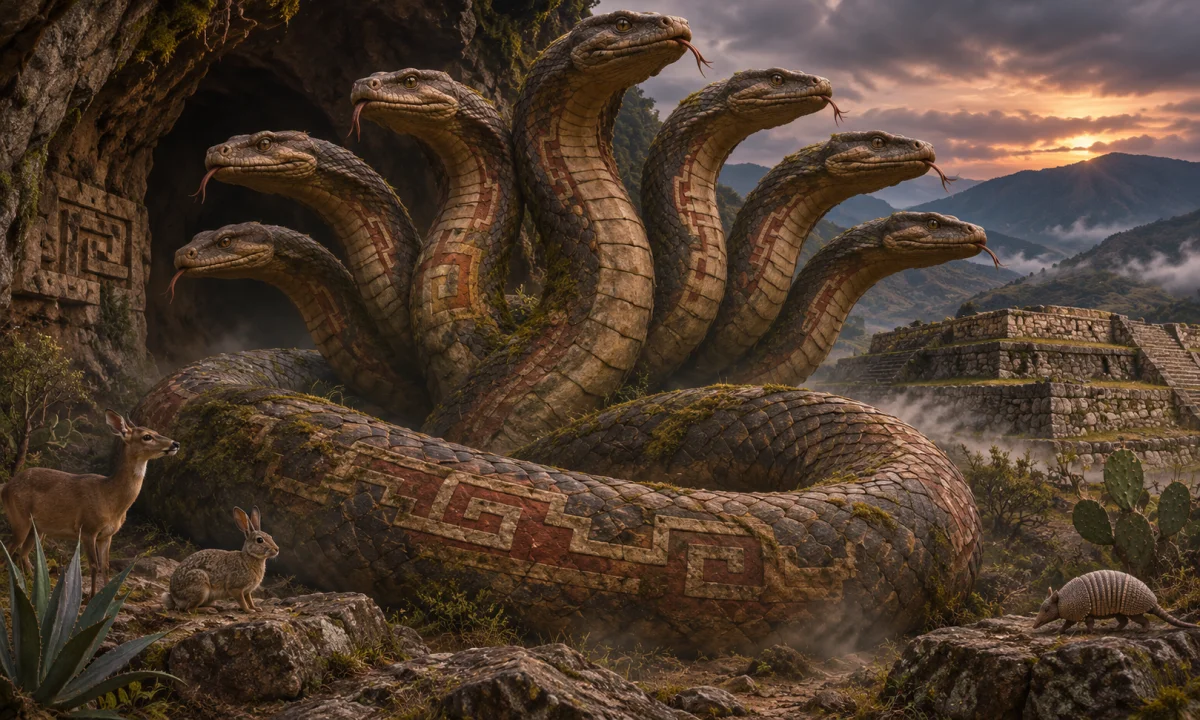
Some writers place Cozaana among the powers responsible for animals and natural life. This interpretation fits broader Mesoamerican patterns in which animals were not merely resources but beings with agency, sacred associations and relationships to human communities. Yet a “god of animals” is a modern shorthand, not necessarily a literal translation of an ancient Zapotec title. It may refer to a creator, guardian, progenitor or sacred owner rather than to a deity with exclusive control over every animal species.
Possible relationship with Huichaana
Huichaana is frequently mentioned alongside Cozaana in modern accounts of Zapotec mythology. The pair are sometimes presented as complementary powers associated with the creation of life, animals or humanity. This pairing resembles a common interpretive pattern in which male and female principles together generate the living world.
Details about Huichaana and Cozaana vary considerably, however. Some descriptions call them divine parents; others treat them as ancestral or natural powers. The surviving record does not provide a single widely attested narrative comparable to a fully preserved epic. It is therefore more accurate to describe the pair as a reported association than to state confidently that they always functioned as husband and wife, or that they possessed a fixed set of children and descendants.
It is also important not to assume that the presence of a male and female pairing implies a simple division of power between them. Zapotec concepts of complementarity could involve community, fertility, landscape, ritual exchange and the relationship between different kinds of life. The meaning of the pair would have depended on the community and the tradition in which their names were used.
Attributes and symbolic associations
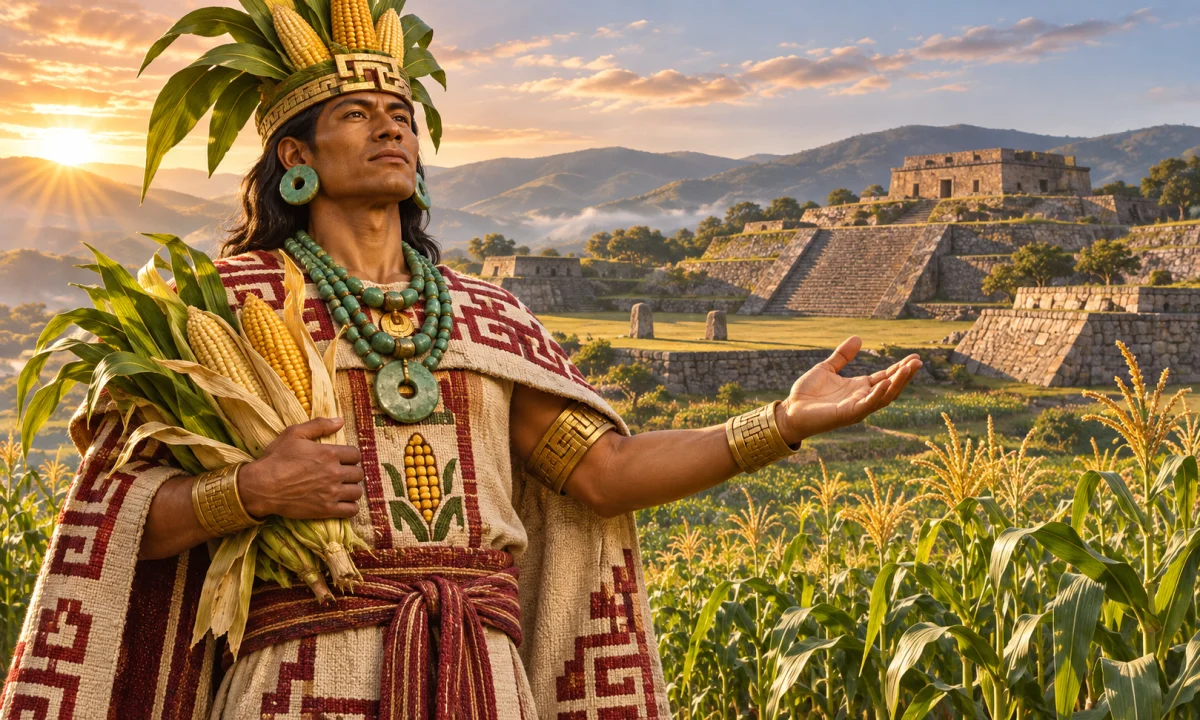
Because descriptions of Cozaana are limited and inconsistent, no securely established physical appearance can be assigned to the figure. There is no reliable basis for claiming that Cozaana had a particular animal head, costume, weapon, colour scheme or headdress. Images from Zapotec archaeological sites should not be labelled as Cozaana simply because they show an animal, a supernatural being or a figure connected with fertility.
If the association with animals is accepted as a cautious interpretive possibility, Cozaana may be understood symbolically through the relationship between humans and the non-human world. Such a relationship could include several ideas:
- animals as beings whose origins belong to the sacred ordering of the world;
- animals as companions, ancestors or transformed forms of humans;
- the dependence of human communities on hunting, herding, agriculture and the wider environment;
- the need to show respect toward powerful beings connected with forests, mountains, caves and water; and
- the continuing presence of the sacred in ordinary forms of life.
These are themes found in Indigenous Mesoamerican religious traditions more broadly, not a list of powers that can be attributed exclusively to Cozaana. They help explain why a creator or ancestral figure might be associated with animals without being reducible to a simple “animal god.”
Creation, ancestry and transformation
When Cozaana is described as a creator, the word may refer to the formation of living beings rather than to creation from absolute nothingness. Mesoamerican origin traditions often portray the world as emerging through transformation, naming, ordering, sacrifice, emergence from a sacred place or the actions of successive generations of beings. A figure involved in creation might establish relationships between humans, animals, plants and the landscape rather than merely manufacture the physical universe.
The term “ancestor” is equally important in interpreting accounts of Cozaana. In Zapotec societies, the dead were not necessarily imagined as entirely separated from the living. Burial practices, tombs and offerings show that relationships with ancestors had social and religious significance. The dead could remain part of the community’s history and protection. If Cozaana was understood as an ancestral power, the name may have expressed origin, continuity and collective identity as much as a supernatural genealogy.
Some popular descriptions say that Cozaana created all animals and that Huichaana created fish or other forms of life. These precise divisions are not consistently supported across references. They may result from regional traditions, modern retellings or attempts to organize fragmentary information into a neat system. They should not be presented as universal Zapotec doctrine.
Evidence from the past
Knowledge of pre-colonial Zapotec religion comes from several kinds of evidence: archaeological architecture, tombs, carved monuments, ceramics, traces of ritual activity, colonial reports and Indigenous traditions that continued after the conquest. Each type of evidence has limitations.
Archaeology can reveal that particular animals, ancestors, rain powers or fertility symbols were important, but it rarely preserves the name of the being represented. Colonial documents may record names and rituals, yet their authors often interpreted Zapotec beliefs through Christian categories or selected information according to their own concerns. Later oral traditions can preserve valuable cultural memory, but they may also reflect centuries of change, regional difference and interaction with Christianity.
For Cozaana, the central difficulty is that the name is not supported by a large, clearly preserved cycle of ancient narratives. There is no secure textual record that establishes a complete genealogy, a canonical creation story or a standard iconography. Consequently, statements about Cozaana should distinguish between what is repeatedly reported in modern descriptions and what is directly demonstrated by historical evidence.
The absence of extensive documentation does not mean that the figure was unimportant. It means that the surviving record is uneven. Many religious concepts were transmitted through ritual practice, oral teaching and local knowledge rather than through a written mythology designed to preserve every story. A brief or obscure record may represent the surviving trace of a once-richer tradition.
Distinction from other Zapotec sacred figures
Cozaana should not automatically be identified with better-documented Zapotec or Mesoamerican deities. In particular, Cozaana is distinct in name and reported function from Cocijo, the major Zapotec rain and lightning deity. Cocijo is associated with storms, rain and agricultural fertility, and archaeological images linked to that complex are often recognizable through distinctive features. Cozaana should not be treated as another name for Cocijo merely because both may be connected indirectly with life and fertility.
Cozaana is also distinct from Pitao Cozobi, a Zapotec maize deity whose name is associated with agricultural abundance. Nor should the figure be merged with Coqui Bezelao, a deity associated in colonial and later descriptions with the realm of the dead, or with Xonaxi Quecuya, who appears in some accounts as a female death-related figure. The exact interpretation of these beings also varies, but their names belong to different bodies of tradition.
Confusion can arise because Zapotec deities may share themes such as fertility, ancestors, nature and death. Religious roles were not always isolated into modern categories, and a single sacred complex could involve several connected powers. Similar themes, however, do not prove that separate names refer to the same being.
Interpretation and cultural significance
Cozaana is most usefully approached as a figure whose significance lies in the connection between origins, living creatures and cultural continuity. Whether understood as a creator, an ancestral force or a power related to animals, the figure points toward a worldview in which human life is embedded in a larger sacred community. The boundary between nature and culture, or between the living and the dead, may be less absolute than it is in many modern Western classifications.
The uncertainty surrounding Cozaana is itself part of the historical context. A short entry in a modern mythology list can make a regional or poorly documented figure appear as though it belonged to a fully standardized pantheon. In reality, Zapotec religious traditions have changed over time and differ from one community to another. Christian influence, colonial administration, migration, language change and the preservation of local ceremonies have all shaped how sacred beings are remembered and described.
Modern readers should therefore avoid treating Cozaana as a fictional character with a single official profile. The name is better understood through careful comparison of regional evidence and through respect for living Zapotec communities, whose religious and cultural identities cannot be reduced to pre-colonial mythology alone. Where the evidence does not establish a detail, leaving it uncertain is more accurate than supplying an attractive but unsupported story.
Cozaana in modern retellings
Cozaana appears mainly in modern compilations of Mesoamerican or Zapotec mythology rather than in widely distributed popular culture. Retellings often turn the figure into a clearly defined “god of animals” or “creator of humanity,” sometimes adding a fixed appearance, powers and family relationships. Such presentations may be useful as simplified introductions, but they frequently conceal the differences between regional tradition, colonial description and modern reconstruction.
No single modern portrayal should be treated as authoritative for all Zapotec peoples. A responsible account keeps the traditional associations—origins, animals, ancestry and sacred life—separate from later attempts to create a complete character profile. The name remains important precisely because it opens a view into a partially documented and regionally diverse religious world rather than supplying a simple, universally agreed mythological biography.