WORLD

Coqueelaa
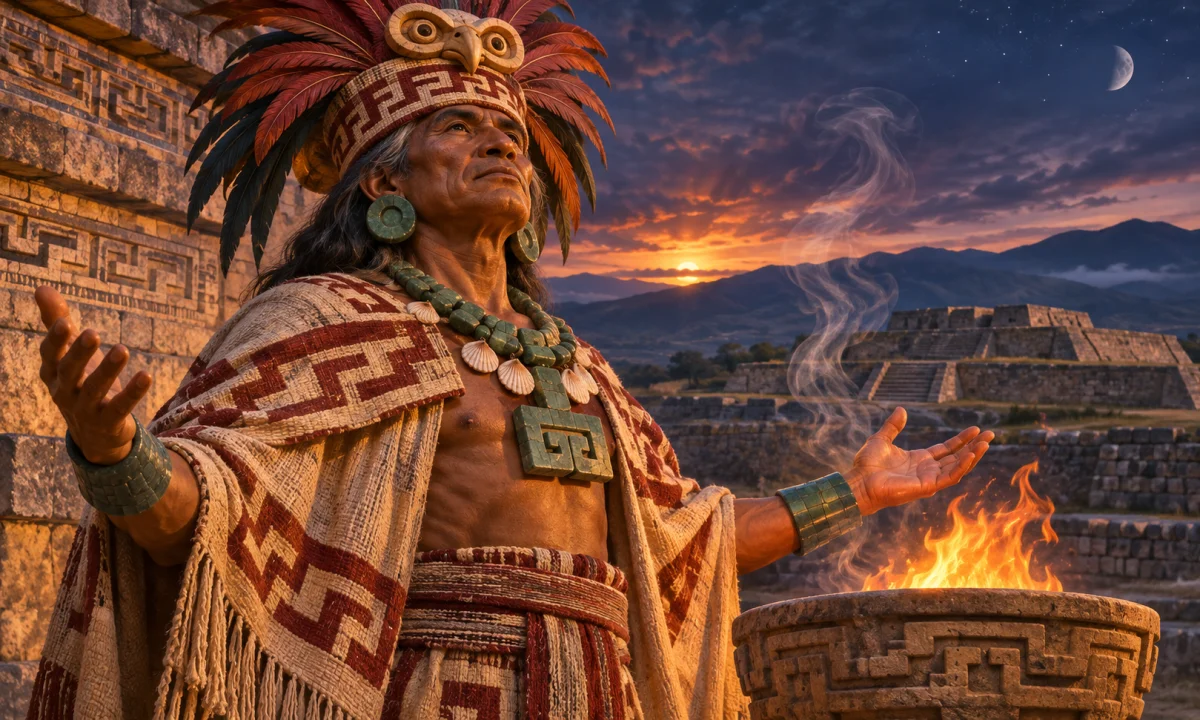
Coqueelaa is a name associated in some modern accounts with Zapotec mythology and, most often, with earthquakes or powerful movements of the earth. The identification is uncertain, however. Unlike better-documented Zapotec figures such as Cocijo, the rain and lightning deity, or Coqui Bezelao, a lord associated with the dead, Coqueelaa does not have a clearly preserved body of myths, securely established iconography, or a consistent description across historical and scholarly sources.
Zapotec religious and cultural setting
The Zapotec peoples have lived for many centuries in what is now southern Mexico, especially in the Central Valleys, the Sierra regions, and the Isthmus of Tehuantepec in Oaxaca. Zapotec civilization developed major urban centres, including Monte Albán, and created distinctive traditions of architecture, writing, calendrical practice, rulership, and ritual.
“Zapotec mythology” should not be understood as a single, unchanging system shared identically by every Zapotec community. Zapotec languages form a large and diverse language family, and religious traditions have changed over time. Beliefs known from the ancient cities of Oaxaca cannot automatically be treated as identical to those recorded in colonial villages or practised by contemporary communities.
Knowledge of Zapotec religion comes from several different kinds of evidence. Archaeological remains include temples, tombs, carved monuments, painted ceramics, offerings, and representations of supernatural beings. Spanish colonial observers and Indigenous authors recorded some names, rituals, calendrical concepts, and religious practices after the conquest. Later ethnographers and contemporary communities provide evidence for continuing traditions, although these sources also reflect local variation and historical change.
There is no surviving Zapotec sacred book that presents a complete pantheon and a continuous set of myths in the way that some readers may expect from the word “mythology.” Names were also written inconsistently in colonial documents. Spanish writers attempted to represent sounds from Zapotec languages with an alphabet not designed for them, and different Zapotec languages could use similar-looking words in different ways.
The name Coqueelaa
The spelling Coqueelaa is not sufficiently stable to establish a single, universally accepted interpretation. Related or alternative spellings may appear in modern lists of Zapotec deities, but similarity of spelling does not by itself prove that the names refer to the same being. Zapotec orthographies have changed, and a word recorded in one community or period may not have the same meaning in another.
The first element of some Zapotec divine names is sometimes connected with a title or word for a lord, ruler, or important person. Such apparent elements must be treated cautiously. A name may preserve a title, a personal designation, a place-name, or a phrase whose original meaning is now unclear. It is not safe to translate the whole name simply by assigning a fixed meaning to each syllable.
Modern reference works commonly classify Coqueelaa as a deity of earthquakes. That classification may reflect a genuine regional tradition, a reconstruction from fragmentary material, or the repetition of an early modern interpretation. The available evidence does not establish a detailed and universally recognized biography for the figure. It is therefore more accurate to describe Coqueelaa as a poorly documented or disputed Zapotec earth-power figure than to present a long, definite myth as historical fact.
Association with earthquakes
When Coqueelaa is identified as an earthquake deity, the association places the figure within a wider Mesoamerican pattern of understanding the landscape as active, powerful, and spiritually significant. Mountains, caves, springs, rocks, storms, and the ground itself could be treated as places or forces with which human beings had to maintain a respectful relationship.
Earthquakes would have been especially powerful religious events in Oaxaca, a region shaped by active geological processes. A tremor could damage buildings, disturb tombs, alter springs, and threaten crops or settlements. A supernatural explanation did not necessarily exclude practical observation. In many traditional societies, natural events were understood simultaneously through physical experience, social responsibility, ritual obligation, and sacred agency.
Even so, there is no secure evidence for a standard ancient Zapotec story in which Coqueelaa repeatedly shakes the earth, carries a distinctive weapon, lives beneath a particular mountain, or receives a prescribed offering. Those details are sometimes supplied in popular retellings, but they should not be treated as established features of the tradition unless they can be connected to a specific local account or historical record.
It is also uncertain whether the earthquake attribution describes a deity in the narrow sense, a title for a supernatural power, a regional spirit, or a modern categorisation imposed on an obscure name. Zapotec religious terminology did not necessarily divide sacred beings into fixed “gods” in the same way that modern encyclopaedic lists do.
Attributes and representation
No widely accepted ancient image of Coqueelaa has been identified. This is an important distinction because Mesoamerican art contains many powerful figures associated by modern researchers with rain, fertility, rulership, death, ancestors, mountains, and the earth. An image of a supernatural being cannot be assigned to Coqueelaa merely because the figure appears frightening, emerges from the ground, or is surrounded by natural imagery.
The absence of a known image does not demonstrate that Coqueelaa was unimportant. Many religious names and local sacred beings left no identifiable artistic record. Some may have been invoked in spoken prayers or community rituals without being represented in monumental art. Conversely, a name that appears in a modern list may not correspond to a major deity of ancient Zapotec state religion.
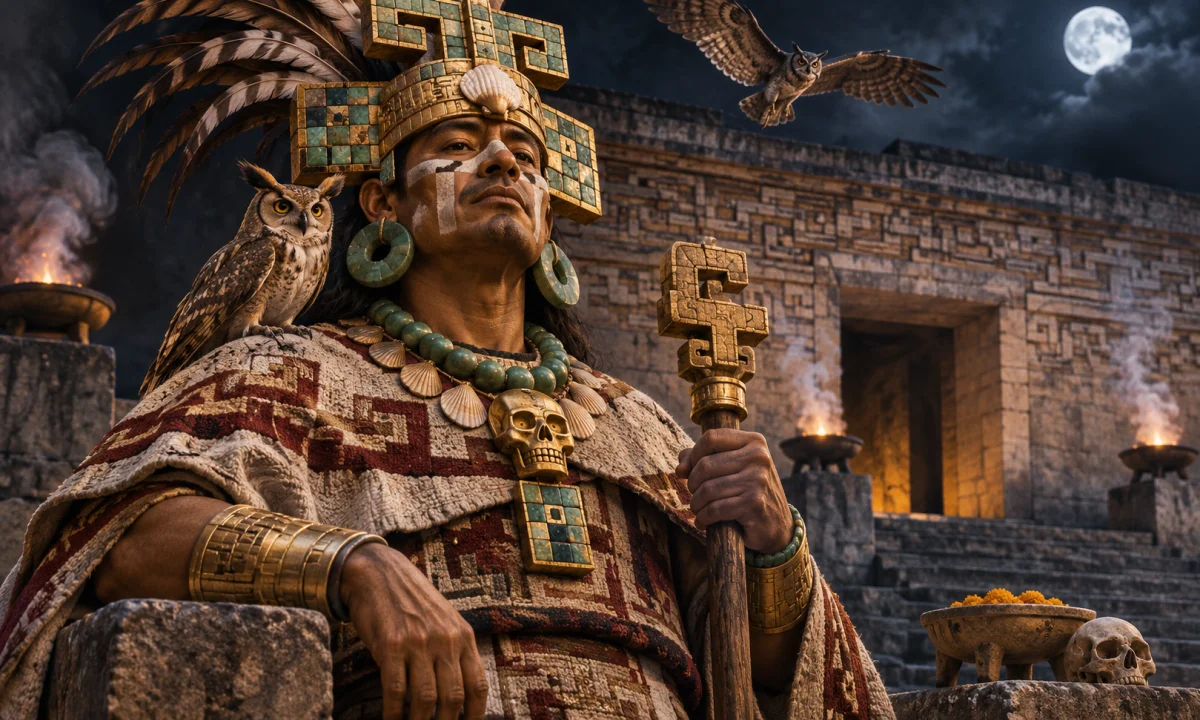
Popular descriptions sometimes give Coqueelaa a threatening appearance, an underground dwelling, or control over mountains and caves. These motifs are compatible with broader Mesoamerican ideas about the earth, but compatibility is not proof. They should be understood as interpretive additions or generalised imagery unless tied to a documented Zapotec tradition.
Relationships to better-documented Zapotec figures
Cocijo
Cocijo is one of the best-known Zapotec supernatural figures. He is associated with rain, lightning, storms, agricultural fertility, and the life-giving powers of water. Archaeological representations linked with Cocijo often show a distinctive supernatural face with prominent features, including a broad or mask-like mouth and elements interpreted as fangs or cloud and rain symbolism.
Because storms can produce thunder, lightning, flooding, and changes in the ground, modern summaries sometimes blur the distinctions between Cocijo and figures associated with earthquakes. There is no reason to treat Coqueelaa as another name for Cocijo simply because both might be connected with dangerous natural forces. They should remain separate unless a particular source explicitly equates them.
Coqui Bezelao
Coqui Bezelao is commonly described as a Zapotec lord of the dead or ruler of the underworld. His name is also spelled in different ways, and the details attached to him vary. Colonial descriptions of Zapotec death rituals and later interpretations connect him with funerary practices, ancestors, and the realm of the dead.
The earth can be symbolically connected with burial and the underworld, so Coqueelaa is occasionally confused with Coqui Bezelao in simplified accounts. The names and functions should not be merged. A figure associated with earthquakes is not automatically a death god, and a lord of the dead is not automatically an earth deity.
Pitao and other divine names
Zapotec religious vocabulary includes the term Pitao, which appears in names for powerful sacred beings. Pitao Cocijo is one well-known example, while other names are associated with maize, fertility, or particular ritual concerns. Colonial descriptions may use terms such as “god,” “devil,” or “idol” in ways shaped by Christian assumptions. Such translations can conceal distinctions present in Zapotec religious thought.
Coqueelaa should not be added casually to a fixed pantheon alongside every name found in a colonial vocabulary or a modern mythology catalogue. A recorded name may refer to a deity, a local spirit, a ritual epithet, or a misunderstood term. Careful interpretation requires attention to the language, place, date, and context of the record.
Stories and ritual tradition
No single, widely attested narrative cycle about Coqueelaa is known. There is no securely established creation story, contest with another deity, family relationship, or cycle of heroic episodes that can be presented as standard Zapotec tradition. This lack of narrative material is one reason the figure remains difficult to classify.
It is possible that beliefs connected with earthquakes were expressed through local prayers, explanations of particular disasters, or rituals directed toward the landscape rather than through a formal myth. Traditional religious knowledge is not always preserved in stories intended for outsiders. It may be embedded in the timing of ceremonies, the treatment of sacred places, rules concerning offerings, or the words used by ritual specialists.
Historical disruption also affected the survival of such material. Indigenous religious practices were condemned or reinterpreted during the colonial period, while written records were usually produced selectively by outsiders. Later conversion, migration, language shift, and the loss of local records further complicated the transmission of names and meanings. These circumstances make silence in the surviving sources difficult to interpret: it may indicate that a figure was minor, local, renamed, misunderstood, or simply not recorded.
Interpretation and cultural significance
Coqueelaa is most useful for understanding the limits of modern categories as well as the possibility of a Zapotec connection with seismic power. A list of “gods” can make a complex religious world appear orderly and uniform, even when the historical evidence is fragmentary. In reality, sacred powers may have overlapped, changed names, or belonged primarily to a particular community.
If the earthquake association reflects an authentic local tradition, Coqueelaa may represent the recognition that the earth was not passive matter but a force capable of movement, danger, and renewal. Such an interpretation fits broader Zapotec attention to mountains, caves, water, fertility, ancestors, and the relationship between human settlements and the landscape. It does not, however, justify assigning the figure every earth-related attribute found in other Mesoamerican traditions.
The name also illustrates why cultural context matters. Mesoamerican religions are often presented through neat comparisons: rain gods, death gods, sun gods, and earth gods. These comparisons can help readers begin, but they can also erase local distinctions. A Zapotec supernatural being should be interpreted through Zapotec languages, communities, historical periods, and forms of evidence rather than through assumptions drawn from Aztec or Maya mythology.
Modern reception
Coqueelaa appears mainly in modern summaries of Zapotec mythology, online deity lists, and general discussions of Mesoamerican religion. These sources often present the earthquake identification with more certainty than the surviving evidence allows. They may also provide an appearance, personality, dwelling place, or set of rituals without indicating whether those details come from a historical record, a local tradition, a scholarly reconstruction, or creative elaboration.
For that reason, descriptions of Coqueelaa in popular culture should be separated from ancient or traditional evidence. A novel, game, illustration, or internet catalogue may use the name as a creative figure connected with earthquakes, caves, or the underworld. Such uses can introduce the name to a wider audience, but they do not establish a traditional myth or prove that all Zapotec communities recognise the figure in the same way.
The most responsible description remains a limited one: Coqueelaa is a disputed or weakly documented name in accounts of Zapotec mythology, commonly associated in modern sources with earthquakes. The identification should be kept distinct from Cocijo, Coqui Bezelao, and other Zapotec sacred figures, and any more detailed portrayal should be identified as regional, interpretive, or modern rather than presented as universally attested tradition.