WORLD
WORLD
Cerviel
Cerviel is a little-known angelic name found in later esoteric and occult lists. It is most often associated with strength, courage, or fortitude, but the evidence for this identity is limited and inconsistent. Cerviel does not appear as a clearly defined angel in the Bible, the Qur’an, or the principal bodies of Christian and Jewish scriptural tradition. Nor is there a widely recognized religious cult, feast, canonical prayer, or independent mythology devoted to Cerviel.
The name belongs chiefly to the history of angelological catalogues: lists that assign names, offices, virtues, planetary connections, or ritual functions to angels. Such lists were produced and copied in different periods, especially within Western esotericism. Because many modern books repeat names without identifying their earliest source, it is difficult to determine when the name Cerviel first became associated with the role of strength or how consistently that association was understood.
Origins and cultural setting
Ideas about named angels developed within several overlapping religious and intellectual traditions. The Hebrew Bible contains relatively few personal angelic names. Michael and Gabriel are the best-known examples, while Raphael is prominent in the Book of Tobit, a text accepted as scriptural in some Christian churches but not in the Jewish biblical canon or most Protestant Bibles. Other angelic names entered religious imagination through apocalyptic writings, mystical speculation, liturgy, magical manuals, and later devotional or literary works.
In Jewish and Christian thought, angels may serve as messengers, guardians, attendants of God, interpreters of visions, or agents of divine judgment. Later angelologies attempted to organize these beings into ranks and offices. Some systems classified angels by choirs, such as seraphim, cherubim, thrones, dominions, virtues, powers, principalities, archangels, and angels. Other systems connected individual names with planets, hours, days, directions, virtues, or human needs.
Cerviel belongs more plausibly to this later cataloguing tradition than to the central scriptural traditions of Judaism or Christianity. The name is encountered in modern collections of angelic names and occult reference works, where it is commonly given a relationship to strength. Those references should not automatically be treated as evidence of an ancient belief. A name appearing in an angel dictionary may reflect a relatively recent compilation, a transcription, or the repetition of information from an earlier modern source.
The name and its identity
The spelling Cerviel is not supported by a universally accepted etymology. Its form may resemble names found in Western angelological catalogues, but resemblance alone does not establish a Hebrew, Aramaic, Greek, Latin, or other ancient origin. The apparent connection between “Cerviel” and Latin cervus, meaning “deer” or “stag,” is sometimes tempting to modern readers, yet there is no secure traditional evidence that Cerviel means “deer-like,” “of the stag,” or anything similar.
Likewise, the ending -iel resembles the common angelic name ending derived from the Hebrew divine element El, “God.” Many angelic names use this ending, including Gabriel, Michael, Raphael, and Uriel. However, the presence of -iel does not by itself prove that a name is ancient Hebrew or that its meaning can be reconstructed with confidence. In the case of Cerviel, the complete linguistic analysis remains uncertain.
The most cautious description is therefore that Cerviel is a minor or obscure angelic figure in later esoteric tradition, usually assigned the symbolic quality of strength. Different lists may provide different classifications, and some may give no details beyond the name. There is no single authoritative account that establishes Cerviel’s rank, gender, appearance, origin, or precise duties.
Association with strength
When Cerviel is mentioned, the attribute most often connected with the name is strength. This may be interpreted in several ways:
- Physical strength: the capacity to endure hardship, labour, illness, or danger.
- Moral strength: the ability to remain faithful to a principle under pressure.
- Spiritual fortitude: perseverance in prayer, religious discipline, or a struggle against temptation.
- Courage: the resolve to confront fear, uncertainty, or injustice.
- Inner resilience: the ability to recover from loss and continue through adversity.
These interpretations are symbolic expansions of Cerviel’s usual catalogue description rather than elements of a preserved narrative. No widely attested ancient story describes Cerviel granting strength to a named hero, defeating a particular demon, or appearing to a historical prophet. The association should consequently be treated as an attributed virtue, not as a detailed mythology.
In broader angelic symbolism, strength is often connected with divine protection and steadfastness. Biblical and later Christian traditions frequently portray God as the ultimate source of strength, while angels act as messengers or instruments of divine power. A figure associated with strength would therefore not necessarily represent independent force. In a religious reading, Cerviel could be understood as a symbolic reminder that courage and endurance are received through divine help rather than originating solely in human will.
Classification and rank
No stable classification of Cerviel is universally recognized. Some modern occult lists may place obscure angels within one of the traditional angelic orders, but those assignments are not consistent across all systems. The name should not automatically be called an archangel, principality, power, or virtue unless a particular source explicitly makes that classification.
This distinction matters because the word “angel” can refer to different kinds of material. In scripture, it may describe a messenger or heavenly servant in a narrative. In medieval theology, angels may be discussed as members of an ordered spiritual hierarchy. In magical handbooks, an angelic name may function as part of a ritual catalogue. In modern spirituality, the same name may be presented as a guide associated with an emotional quality. These uses are related but not identical.
Cerviel has no broadly established place alongside major named angels such as Michael, Gabriel, Raphael, or Uriel. Those figures possess substantial scriptural, liturgical, theological, and artistic histories. Cerviel’s attestation is far more limited, and treating the name as equivalent to one of the major archangels would exaggerate the strength of the evidence.
Appearance and symbols
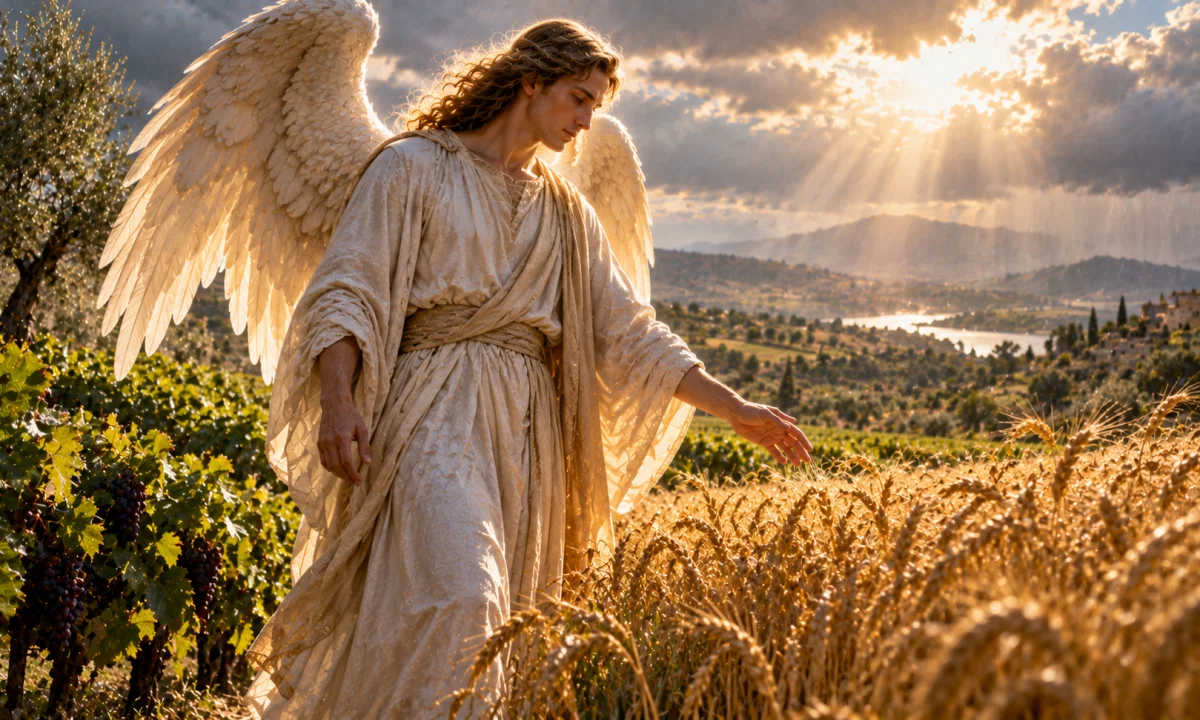
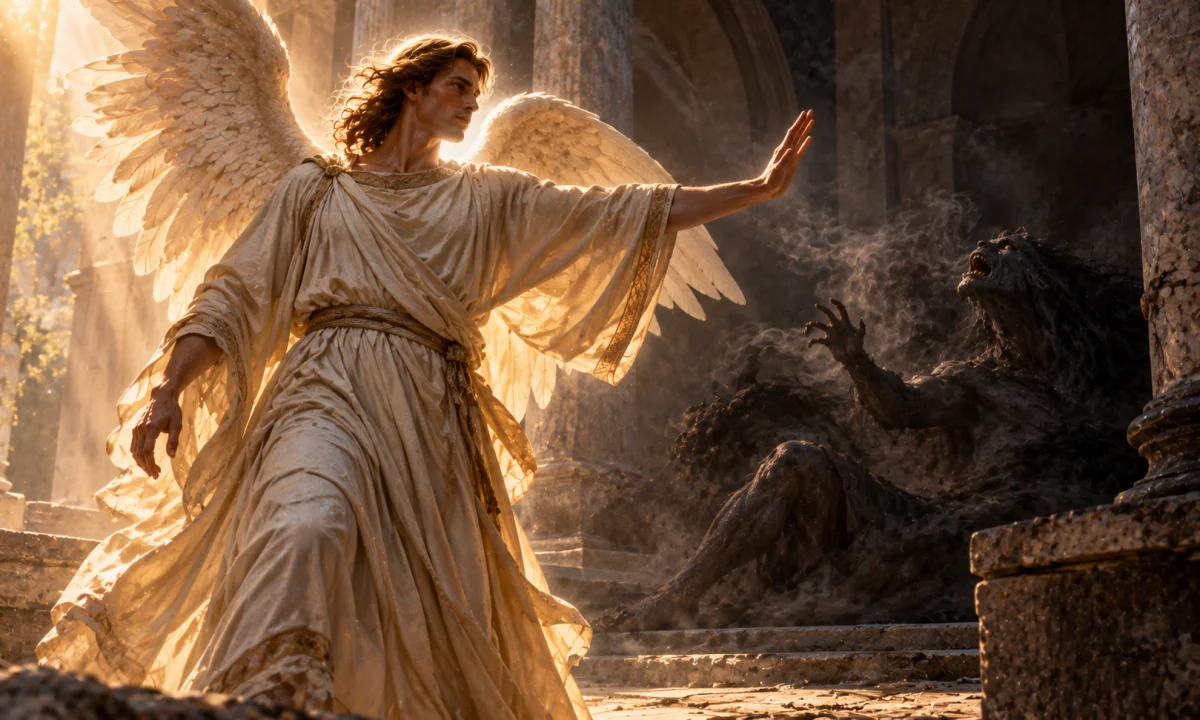
There is no standard traditional appearance for Cerviel. No widely recognized iconographic programme, medieval feast, manuscript illustration, or canonical description determines whether the figure should be shown with wings, armour, a sword, a shield, a staff, or any other object. Such features may appear in modern artwork, but they are creative interpretations rather than inherited attributes.
Artists who wish to visualize the name may naturally use symbols of fortitude: a standing figure, a fortified gate, a mountain, a pillar, a shield, or a flame that remains alight in a storm. Armour and weapons may suggest protection and courage, although they can also imply warfare. A calmer representation might use a staff, a stone, or an upright tree to express endurance rather than combat.
These images should be distinguished from historical iconography. Michael, for example, has a long-established artistic association with the defeat of evil, often represented through a sword, spear, dragon, or defeated demon. Cerviel has no comparably stable visual tradition. Assigning Michael’s imagery to Cerviel simply because both might be linked with strength would blur two very different histories.
Stories and relationships
No major narrative cycle about Cerviel survives in the commonly known scriptural, apocryphal, or medieval religious literature. There is no securely established account of Cerviel’s creation, heavenly office, rebellion, earthly appearance, or relationship with another named angel. Claims that Cerviel serves under a particular archangel or governs a specific region, day, planet, or hour should be treated as source-dependent rather than universal facts.
This lack of narrative does not make the name meaningless, but it changes how it should be studied. Cerviel is better understood as a catalogued attribute-bearing name than as a character with a developed mythology. The important historical question is not “What adventures did Cerviel have?” but rather “How did later systems use this name, and why was strength assigned to it?” Unfortunately, the available references are often too brief or derivative to answer those questions with certainty.
Lists of angels can also preserve spelling errors, variant transliterations, or names copied from one another. A single unusual name may be transformed as it passes between Hebrew characters, Greek or Latin transliteration, manuscript handwriting, print editions, and modern English. Without a traceable chain of sources, it is unsafe to assume that every occurrence of Cerviel represents the same figure or that every spelling preserves the original form.
Religious significance and interpretation
For historical religious study, Cerviel illustrates the wide range of material included under the heading of angelology. Popular discussions sometimes present all angel names as if they had equal antiquity and authority. In reality, named angels come from different layers of tradition: scripture, apocrypha, mystical writings, liturgy, theological speculation, magical texts, literature, and modern reference books.
Cerviel is significant mainly as an example of how an angelic name can survive at the margins of established religious tradition. The assignment of strength reflects a common human desire to give personal form to qualities such as courage, endurance, and protection. Naming a spiritual virtue can make it easier to contemplate, invoke symbolically, or incorporate into prayer and meditation. That devotional use may be meaningful to an individual even when the historical origin of the name remains obscure.
At the same time, historical accuracy requires a clear distinction between personal spirituality and communal tradition. A contemporary practitioner may regard Cerviel as a protector or source of courage, but this does not demonstrate that the same belief was held in antiquity or by a major religious institution. There is no broadly recognized doctrine requiring belief in Cerviel, and the name has no uniform status across Judaism, Christianity, Islam, or other religious traditions.
Distinction from similar figures
Cerviel should not be confused with better-attested angels whose names or functions involve power, courage, or protection. Michael is a major biblical and post-biblical angelic figure associated in different traditions with heavenly warfare, protection, and the defeat of evil. Gabriel is principally known as a divine messenger in Jewish, Christian, and Islamic traditions. Raphael is associated especially with healing in the Book of Tobit and later traditions. None of these figures is simply another name for Cerviel.
Cerviel should also not be automatically identified with Kamael or Camael, a name found in some later angelological and mystical systems and variously associated with power, severity, or martial qualities. The spellings may look sufficiently different, but medieval and occult catalogues contain many unstable names, and superficial similarity is not proof of identity.
Nor should Cerviel be treated as a demon merely because obscure occult lists sometimes place angels and spirits in the same manuals. A ritual book may catalogue benevolent, ambivalent, and hostile beings together without implying that they belong to the same moral category. The name Cerviel is generally presented as angelic, with a positive association with strength, but the limited evidence does not support a detailed account of its nature.
Later reception
Cerviel has little presence in major religious art, canonical fiction, or widely known folklore. Its modern visibility comes mainly from internet lists, esoteric publications, angel-themed reference works, and personal spiritual practice. These settings often expand a brief entry into a fuller personality, assigning colours, stones, prayers, sigils, planetary correspondences, or visual designs. Such additions may be meaningful within a modern system, but they should be labelled as contemporary interpretations rather than ancient attributes.
Modern fantasy and popular culture occasionally draw on obscure angel names because they sound archaic and carry an impression of hidden lore. If Cerviel appears in a novel, game, film, or other creative work, that portrayal belongs to the work’s fictional setting unless it is explicitly presented as a historical belief. A winged warrior, guardian spirit, or supernatural adviser named Cerviel may be an effective fictional invention, but it should not be mistaken for evidence of a long-established Cerviel mythology.
The most reliable account of Cerviel remains a modest one: the name is associated in later and often poorly documented angelic catalogues with strength or fortitude, while its original language, age, rank, appearance, stories, and religious authority are uncertain. Its value lies less in a rich body of ancient legend than in showing how angelic names can move between religious speculation, occult classification, personal devotion, and modern imagination.