WORLD
WORLD
Camenae
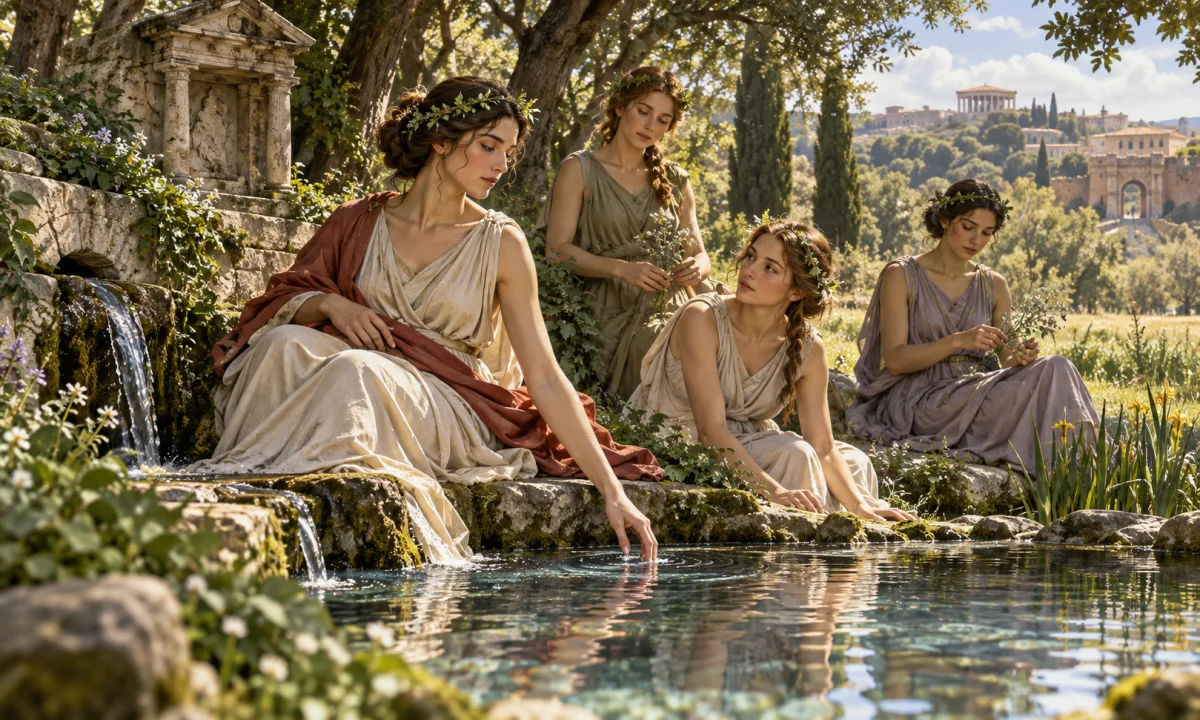
The Camenae were a group of Roman divine beings associated with springs, prophecy, inspired speech and song. In early Roman religious tradition they belonged to the sacred landscape around the Porta Capena, a gate on the southern side of Rome, where a spring and grove were linked with ritual activity. Later Roman poets often treated the Camenae as the Latin or Roman equivalent of the Greek Muses, but this literary identification did not erase their older local character.
Origins and religious setting
The Camenae appear to have originated as local Italian or Roman water divinities rather than as a simple Roman copy of a Greek group. Their earliest religious setting was probably a spring outside or near the Porta Capena, an important entrance into Rome on the road leading south. Springs, groves and other natural water sources frequently became sacred places in ancient Italy, especially when they were associated with healing, prophecy or unusual natural features.
Roman tradition connected the Camenae with a sacred grove and spring known as the fons Camenarum, the “spring of the Camenae.” The site was also associated with the Vestal Virgins, who are said to have drawn water there for ritual purposes. The spring therefore belonged not only to poetic imagination but also to Roman religious geography. Its importance reflects the Roman tendency to link divine power with specific places, public institutions and ritual duties.
The Camenae were not represented by a single universally fixed myth. Roman religion preserved many local and functional deities whose identities were less sharply defined than those of major Olympian or Capitoline gods. Their character could be understood through the places, practices and forms of inspiration connected with them rather than through a large cycle of stories.
The name and its meaning
The Latin word Camenae is plural. A singular form, Camena, appears in later literary usage, but the traditional religious name generally refers to a group. The word’s etymology is uncertain. Ancient and modern interpreters have associated it with Latin words connected with song, speech or poetic utterance, but the precise linguistic history remains debated.
Because of their connection with inspired song, the Camenae became closely associated with the Latin word carmen, meaning a song, poem, spell, formula or ritually powerful utterance. This relationship is culturally meaningful even where the exact etymology cannot be demonstrated with certainty. In Roman thought, poetry and religious speech could overlap: a correctly formed utterance might preserve tradition, praise a god, express prophecy or exert ritual force.
Their name is sometimes translated as “Muses,” especially in literary contexts. That translation is convenient but incomplete. It reflects a later comparison between Roman and Greek divine figures rather than proving that the Camenae were originally identical to the nine Greek Muses.
Identity and classification
The Camenae are usually described as water nymphs or spring goddesses, although the surviving evidence does not provide a single formal classification accepted across all periods. Their association with a spring places them within a broad Mediterranean and Italian pattern in which water sources could be inhabited or protected by female divine beings.
They also possessed prophetic and poetic qualities. The spring at which they were worshipped was linked with divine instruction, and Roman writers used the Camenae as figures who inspired poets. Their powers therefore extended beyond the physical protection of water. They represented access to hidden knowledge, eloquence and the ability to give meaningful form to speech.
In later Latin poetry, the Camenae could function as a Roman alternative to the Muses. A poet might invoke them at the beginning of a work or address them as guardians of song. This usage helped create a specifically Roman literary vocabulary, allowing poets to draw on Greek poetic conventions while presenting their inspiration as native to Latium and Rome.
The spring at the Porta Capena
The most important traditional location of the Camenae was their spring near the Porta Capena. The area lay outside the earliest sacred centre of Rome but became part of the city’s expanding religious landscape. Ancient writers remembered it as a grove-like place, suggesting a setting in which trees, water and ritual formed a connected sacred environment.
The spring was especially associated with the Vestal Virgins. According to Roman tradition, the Vestals used its water in religious service. Such a connection would have given the Camenae a place within the public cult of Rome, even if they did not possess a major state temple comparable to those of Jupiter, Juno or Minerva.
The use of spring water for ritual purposes also illustrates an important feature of Roman religion: purity was not merely an abstract moral condition but could be maintained through proper materials, spaces and procedures. A water source under divine protection was suitable for rites because its sanctity was tied to both the landscape and the powers believed to inhabit it.
Numa, Egeria and prophetic instruction
The Camenae are often discussed alongside Egeria, the nymph who was said to advise Rome’s legendary second king, Numa Pompilius. According to Roman tradition, Numa met Egeria in a sacred grove and received instruction concerning religious laws and ceremonies. The setting of this story was associated with the same general area as the spring of the Camenae.
It is important not to treat Egeria and the Camenae as automatically identical. Egeria is a distinct named figure with her own role in Roman legend. Some ancient and later interpretations connected her with the Camenae or placed her within the same sacred complex, but the evidence does not establish that she was simply one of the Camenae in every version of the tradition.
The relationship between them is nevertheless significant. Egeria’s role as a divine adviser resembles the Camenae’s association with inspiration, prophecy and authoritative speech. Both belong to a Roman imagination in which religious knowledge may come from a feminine nature spirit associated with water and a secluded sacred place. The Numa story also gives the Camenae’s environment a political and constitutional dimension: divine inspiration helps establish the rituals and institutions of Rome.
Camenae and the Greek Muses
From the middle and late Republic onward, Roman literature was deeply influenced by Greek culture. Roman writers adopted Greek genres, mythological comparisons and poetic conventions, and they frequently identified Roman gods with Greek counterparts. The Camenae were consequently compared with the Muses, the daughters of Zeus and Mnemosyne who presided over poetry, music, history and other arts.
The comparison was not entirely arbitrary. Both groups were female divine figures linked with song, inspiration and learned expression. Yet their traditional backgrounds differ. The Greek Muses were a clearly defined group of nine in classical mythology, each with an established name and artistic association in later tradition. The Camenae were a Roman group connected more strongly with a particular spring, grove and local cult.
Roman poets could use either name depending on the tone and cultural setting of a work. Calling upon the Camenae could emphasize Latin identity, Roman poetic tradition or the antiquity of Italian religious culture. Referring to the Muses could place a poem within the wider learned world of Greek and Roman literature. The two terms could overlap poetically without being historically interchangeable.
In works written in Latin, the Camenae sometimes serve as a distinctly Roman voice of poetic inspiration. They could be invoked in connection with epic, lyric poetry or the preservation of historical memory. Their presence allowed a poet to claim divine assistance while drawing attention to the language and cultural traditions of Rome itself.
Attributes and symbolic roles
The Camenae do not have a stable set of physical attributes comparable to the weapons of Mars or the owl of Minerva. Ancient evidence does not provide a consistently described costume, appearance or individual emblem for each member of the group. Their symbolism is instead concentrated in several connected ideas:
- Springs and fresh water: The sacred spring was the central physical focus of their worship and identity.
- Prophecy: They belonged to a tradition of divine communication through inspired or hidden knowledge.
- Song and poetry: Later literature made them patrons or sources of poetic expression.
- Ritual speech: Their association with the carmen suggests the power of formally shaped words, whether poetic, religious or magical.
- Female wisdom: Like Egeria in the Numa legend, they could represent knowledge transmitted through a sacred feminine presence.
These roles should not be separated too sharply. In ancient Rome, song, prophecy and ritual formula were not always understood as entirely different activities. A skilled utterance could preserve history, honour a deity or communicate divine will. The Camenae’s character lies partly in this overlap between artistic inspiration and religious power.
Stories and relationships
The Camenae have fewer independent myths than many better-known Roman deities. Their importance comes mainly from references to their sacred site and their later literary role. The association with Numa and Egeria is the most prominent narrative context, although it is primarily Egeria who acts as the named divine instructor in the story.
Some later accounts and interpretations brought the Camenae into contact with other prophetic or poetic female figures. These comparisons can include Carmenta, an ancient Roman goddess associated with prophecy, childbirth and the Carmentalia festival. Carmenta is not simply another name for the Camenae. Her cult, festival and traditional functions are distinct, even though prophecy and inspired speech create areas of overlap.
The similarity between the words Camenae and Carmenta, as well as their shared connection with prophetic utterance, has encouraged occasional conflation. Such identification should be treated cautiously. A resemblance in function or name does not demonstrate that two originally distinct Roman figures were the same deity.
The Camenae should also not be confused with every nymph associated with a Roman spring. Water spirits formed a broad category in Roman and Italian religious thought. A specific nymph might protect a spring, river or grove without belonging to the Camenae. Local traditions could overlap, but the surviving evidence does not justify merging all such beings into one group.
Literary development
As Roman literature developed, the Camenae moved from a local religious setting into the language of poetry. Latin authors could invoke them as sources of song or address them in ways that echoed Greek poetic practice. Their literary use is particularly important because it preserves a memory of an older Roman divine identity that might otherwise be known only through the place-name of the spring.
The poetic Camenae were not necessarily meant to describe a separate cult event each time they were mentioned. In many literary contexts, they function as a conventional invocation. Even so, the convention retained cultural meaning. It connected the act of writing with the sacred landscape of Rome and with an inherited tradition of divine speech.
Their literary transformation also demonstrates how Roman religion adapted under Greek influence. Roman writers did not merely discard local gods when they encountered Greek mythology. They often reinterpreted them, matched them with Greek figures or gave them new roles within Latin literary forms. The Camenae survived partly because they could occupy both positions: local spring divinities and Roman counterparts to the Muses.
Historical evidence and uncertainty
Knowledge of the Camenae comes mainly from literary testimony and references to Roman sacred places. The surviving evidence is not a complete description of their cult. It does not securely preserve the names of individual Camenae, a fixed number for the group, a detailed genealogy or a standard visual representation.
Ancient authors also wrote at different times and for different purposes. A historian might mention the spring in connection with Roman religious institutions, while a poet might use the Camenae as an elevated word for poetic inspiration. These contexts should not be treated as equally direct evidence for the earliest form of the cult.
The original significance of the group is therefore partly reconstructed. Their association with water and place is relatively clear, as is their later connection with poetry and prophecy. The exact development from local spring powers to literary “Muses” remains less certain. Interpretations that present them as fully equivalent to the Greek Muses from the beginning simplify the historical evidence.
Cultural significance
The Camenae express a particularly Roman understanding of how divine power could inhabit the environment and support civic religion. Their spring was not an abstract mythological location but part of the actual landscape through which Romans moved. The connection with the Vestals linked local nature worship to the maintenance of the state’s sacred obligations.
Their later identity as poetic inspirers added another layer. Rome’s literary culture was heavily indebted to Greece, yet Roman authors continued to seek a native source of authority. Invoking the Camenae made poetry part of Rome’s own sacred geography. It suggested that Latin song, history and religious memory had local divine guardians.
For modern readers, the Camenae are therefore best understood as figures at the meeting point of water worship, prophecy, ritual speech and literature. Their tradition is less a single narrative than a series of connected meanings: a holy spring near Rome, a group of female divine powers, a setting associated with Egeria and Numa, and a later poetic name for inspiration. Their resemblance to the Muses is genuine at the level of literary function, but their original Roman identity remains distinct.