WORLD
WORLD
Britannia
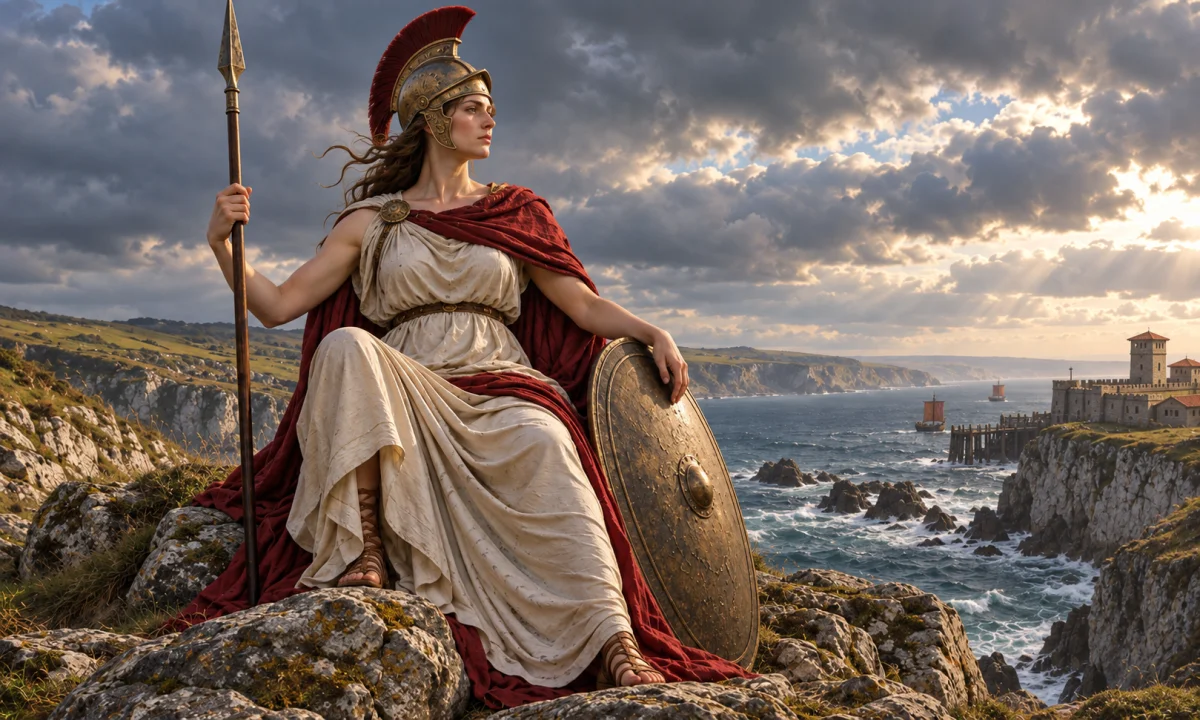
Britannia is the Roman personification of Britain and the province that Rome established in parts of the British Isles. She is usually represented as a helmeted woman seated beside a shield, holding a spear or military standard. Although Britannia belongs to the visual and political language of Roman imperial culture, she was not originally a Celtic goddess with a clearly documented cult. Her identity developed from the Roman habit of representing lands, peoples and provinces as human figures.
Britannia in Roman culture
The Latin word Britannia referred principally to Britain as a geographical region and Roman province. Roman writers used related forms of the name for the island, its inhabitants and, after the conquest, the territory governed by Rome. The name itself was not invented as the title of a goddess. Britannia became a female figure when artists and officials transformed the name of the land into a personified image.
Personification was common in Roman public art. Cities, rivers, provinces and military victories could appear as human or semi-human figures. These images made abstract political ideas visible: a province could be shown as loyal, conquered, prosperous or under imperial protection. Britannia therefore belongs to Roman mythology in a broad sense, but she is better classified as a personification of a land and its people than as a goddess with an independent mythology.
Her imagery arose during the period of Roman expansion into Britain. The first invasion under the emperor Claudius began in 43 CE, although Rome had maintained earlier contacts with southern Britain and Julius Caesar had led expeditions there in 55 and 54 BCE. Roman control was never complete. It extended over much of Britain but did not permanently include all of the island, and the northern frontier was marked by military boundaries such as Hadrian’s Wall.
Origins and surviving evidence
Knowledge of Britannia comes mainly from Roman coins, sculpture, reliefs and inscriptions rather than from myths told in continuous literary narratives. There is no surviving ancient story in which Britannia has a family, a divine birth, a series of adventures or a distinct priesthood comparable to those associated with major Roman gods.
Roman authors sometimes described Britain in personal or emotional terms, especially when discussing conquest and rebellion. Such writing could portray the province as a defeated or resistant woman, but literary personification should not automatically be treated as evidence for a formal religious figure. The clearest evidence for Britannia as an established visual type comes from imperial coinage.
Images associated with Britain became especially prominent during the reign of the emperor Hadrian in the early second century CE. Hadrian travelled through the provinces and presented himself as a ruler attentive to the security and administration of the empire. Coins connected with Britain showed a seated female figure labelled BRITANNIA. These issues likely commemorated the province and its place within the imperial system rather than celebrating a separate local religion.
Later coins of the Antonine period also used Britannia, including issues produced during renewed Roman military activity in northern Britain. On such coinage, the figure could communicate both the identity of the province and the emperor’s authority over it. A coin bearing Britannia did not necessarily mean that people worshipped her; Roman coins often used divine and allegorical figures to express political messages.
Name and identity
The origin of the name Britannia is not completely settled. It is related to the Roman and Greek names used for Britain and the Britons, but the deeper etymology is debated. Scholars have proposed connections with Celtic languages and with names recorded by ancient Mediterranean writers, yet the precise original meaning remains uncertain.
The word changed in meaning according to context. In a geographical setting, Britannia meant Britain. In an administrative setting, it could mean the Roman province. In art, the same name identified a female personification. These uses overlap but should not be treated as identical. The province, the island and the allegorical woman are related concepts, not three separate ancient goddesses.
Britannia is also sometimes described as a “Roman goddess of Britain.” This wording can be convenient, but it may suggest more evidence for worship than actually survives. No securely documented ancient cult of Britannia is known. The safest description is Roman provincial personification, with a symbolic role that could become religiously coloured when placed within a sacred or imperial monument.
Appearance and attributes
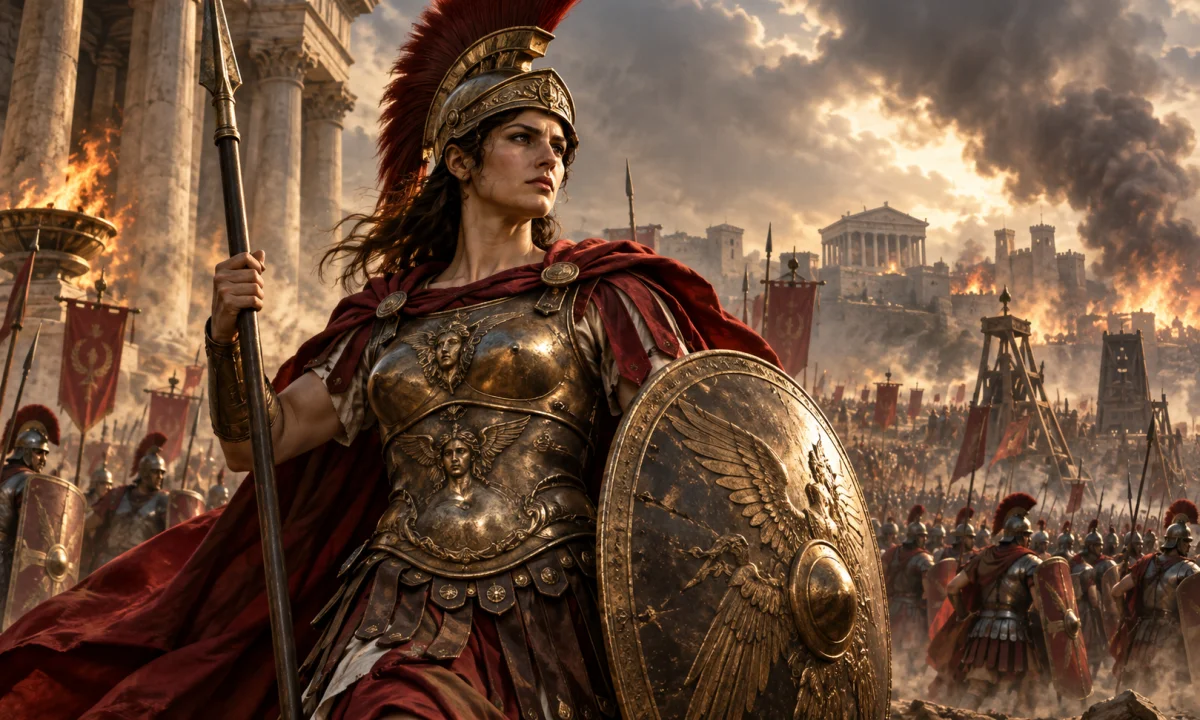
The best-known Roman Britannia is seated, often on a rock or low seat. She commonly wears a helmet and holds a spear, while a large shield rests beside her or supports her body. Her dress is generally that of a dignified female figure rather than a recognisably local costume. Some representations give her a military or defensive character; others emphasise the province as a settled and enduring part of the empire.
The helmet links her with warfare and military occupation. This does not mean that she was a war goddess in the same sense as Mars or Bellona. Rather, it reflects the fact that Britain was a frontier province whose relationship with Rome was strongly shaped by armies, forts and rebellions. The spear and shield similarly evoke defence, conquest and the guarded status of the province.
Her seated position can carry several meanings. It may suggest stability, territorial presence or the permanence of Roman rule. In other contexts, seated provincial figures represent lands brought under imperial authority. The exact emphasis depends on the monument, inscription and political circumstances. A single attribute should not be treated as a fixed explanation for every image.
Britannia is usually shown as a mature and dignified woman rather than as a youthful nymph. This visual character suited the Roman habit of giving provinces a monumental, civic appearance. She could stand for the land itself, its inhabitants, its military importance or the benefits of imperial administration. These meanings were not necessarily separate in Roman thought.
Some representations of conquered Britain used different imagery, including defeated or captive figures. Such figures should not automatically be identified as Britannia. A bound captive representing Britain, a generic barbarian woman and the formal seated figure labelled BRITANNIA may serve related political purposes while belonging to different artistic types.
Britannia and the Roman conquest
Britannia’s symbolic meaning cannot be separated from the history of Roman rule. The conquest was presented in imperial ideology as a victory bringing Britain into the ordered world of Rome. Coins and monuments could therefore portray the province as a possession of the emperor, a participant in imperial prosperity or a territory requiring continued military protection.
At the same time, Roman Britain was not a peaceful or culturally uniform region. Revolts occurred, most famously the uprising led by Boudica in 60 or 61 CE. Boudica is not Britannia, and the two figures should never be merged. Boudica was a historical queen of the Iceni who became the leader of a major revolt against Roman rule. Britannia was an allegorical representation created within Roman visual culture. Later artists sometimes connected them because both could symbolise Britain, but their historical identities are distinct.
Roman Britain contained many local religious traditions, including those associated with Celtic deities, local sacred places and hybrid Romano-British cults. Some native gods were identified with Roman deities through a process often called interpretatio Romana. There is no comparable evidence that Britannia was simply a renamed Celtic mother goddess or a pre-Roman island deity. Claims that she directly descends from a specific Celtic goddess are speculative unless supported by particular evidence.
Britannia and related figures
Britannia can be confused with several other female figures from ancient art. Roma personified the city and power of Rome. She often wore a helmet and carried military equipment, so her appearance can resemble Britannia. The difference is usually established by context, inscription and attributes: Roma represents Rome, while Britannia represents Britain.
Minerva may also appear helmeted and armed, but she is a goddess with a substantial Roman religious identity, associated with wisdom, crafts and warfare. A helmet alone does not identify Britannia. Likewise, Bellona is a Roman war goddess whose martial imagery overlaps with provincial personifications.
Britannia is distinct from Boudica, from legendary queens such as Guinevere, and from figures created in medieval British origin legends. She is also different from Albion, a name used in ancient and later traditions for Britain. Albion could be personified in later literature, but it is not simply another ancient name for the Roman figure Britannia.
Meaning within Roman imperial art
Britannia expressed the way the Roman Empire imagined its territories. Provinces were not merely places on a map; in official art they could be given bodies, clothing and emotional states. A province might appear prosperous, mourning, submissive, armed or protected. Such imagery helped audiences understand the empire as a collection of lands organised beneath one ruler.
The figure could therefore carry a tension between local identity and imperial control. On one level, Britannia marked Britain as a distinct land with its own name and symbolic presence. On another, the image appeared on Roman coins and monuments issued by imperial authorities. Her existence in art acknowledged Britain while placing it within Rome’s political order.
Her military attributes are particularly significant. Britain was a distant western province and a major frontier zone. The Roman army was essential to maintaining control, especially in Wales, northern England and the areas near the Scottish frontier. A helmeted Britannia could represent not only a conquered land but also a province whose security and status depended on imperial military power.
Interpretations should remain sensitive to the limits of the evidence. The same image might have been understood differently by an emperor, a Roman soldier, a provincial administrator and a local inhabitant. Coins communicate official messages, but they do not tell us exactly how every person in Britain responded to them. Nor do they prove that ordinary people worshipped the personification as a living goddess.
Medieval and early modern development
After the end of Roman rule in Britain, the ancient provincial personification did not continue as a clearly documented, uninterrupted cult. The name Britannia survived in Latin writing as a term for Britain, while memories of Roman Britain were transformed by Christian, medieval and legendary traditions. The female figure became more important again during the Renaissance and early modern periods, when European artists and political writers revived classical personifications.
In early modern Britain, Britannia gradually became a national symbol rather than an image of a Roman province. Her Roman-style helmet, shield and spear were retained because they evoked antiquity, military strength and civic authority. The trident and association with the sea became increasingly important in later representations, reflecting Britain’s maritime power and imperial ambitions. These additions belong chiefly to later political symbolism, not to the earliest Roman images.
Britannia appeared on English copper coinage during the reign of Charles II in the seventeenth century and remained a familiar presence on British coins for centuries. A popular story claims that the original design was based on Frances Teresa Stuart, a prominent woman at the court of Charles II. This identification is often repeated, but the evidence is not strong enough to treat it as certain. The design is better understood as part of a broader revival of classical allegory.
Modern significance
Modern Britannia is principally a national personification of Britain or the United Kingdom, not a figure of active Roman religion. She has appeared on coins, medals, political cartoons, public monuments and commercial imagery. Her shield, helmet, trident and union symbolism can express national strength, sovereignty, maritime power or imperial history, depending on the period and political context.
Her image has also attracted criticism because it is connected with the British Empire and with older ideas of military and political dominance. In some settings she represents national unity and resilience; in others, she evokes colonial rule, imperial self-confidence or changing arguments about British identity. These modern meanings should not be projected uncritically onto Roman Britannia.
Contemporary depictions may simplify or redesign her appearance, sometimes presenting her as a modern woman, a patriotic emblem or a figure of resistance. Such adaptations belong to modern visual culture. They draw on the ancient name and general form, but they are not evidence for beliefs held in Roman Britain.
Britannia’s historical importance lies precisely in the movement between these meanings. She began as a Roman way of giving a province a human form, acquired new associations through the revival of classical imagery, and eventually became one of the most recognisable symbols of Britain. Treating her as a personification rather than assuming a fully developed ancient goddess helps distinguish the surviving evidence from later national mythology.