WORLD
WORLD
Bellona
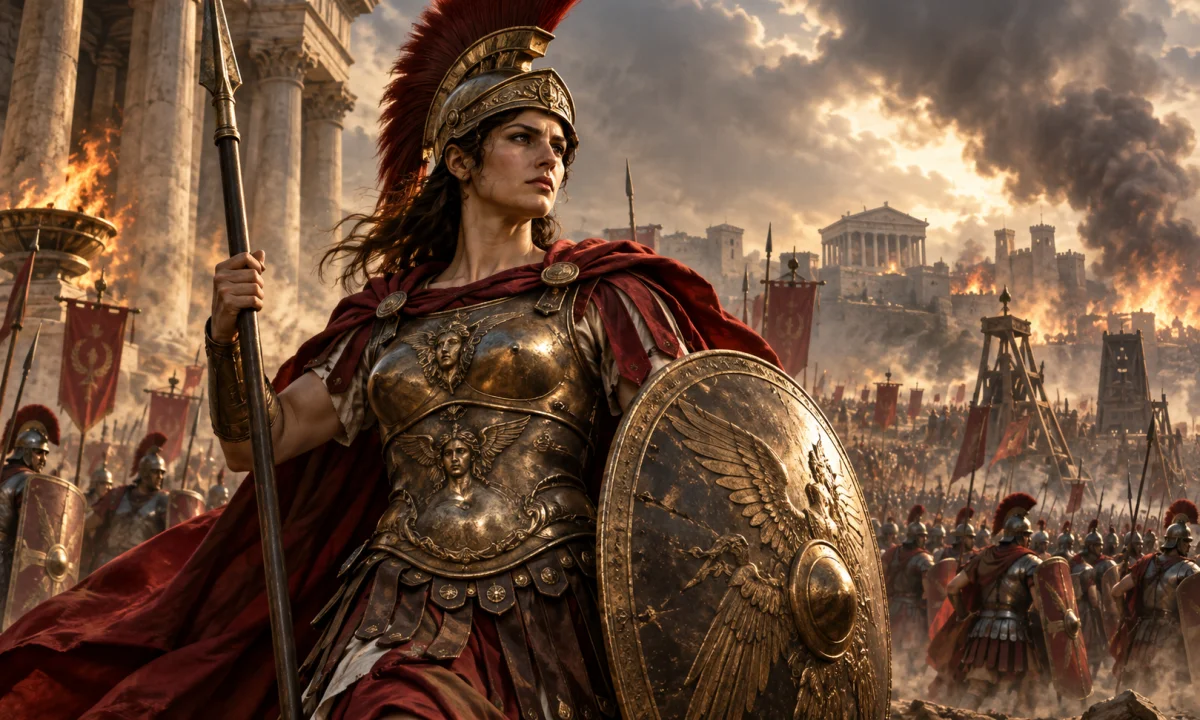
Bellona is a Roman goddess associated with war, military violence and the dangerous power of armed conflict. Her name is closely related to the Latin word bellum, meaning “war,” and she was sometimes represented as a helmeted woman carrying weapons. Unlike Mars, who developed into one of Rome’s principal gods and the divine father of the Roman people, Bellona remained a more specialised and sometimes unsettling figure. She represented war as an active, destructive force: the clash of armies, the fury of battle and the ritual authority of Rome’s military expansion.
Origins and religious setting
Bellona belongs to the native religious tradition of ancient Rome, although the precise origins of her cult are uncertain. Her name may have developed from an older Latin form related to duellum, an early word for war. Some scholars have proposed that she had Sabine or other central Italian connections, but there is no secure evidence establishing her as a clearly imported Sabine goddess. Ancient writers do not preserve a detailed foundation myth explaining her birth, family or arrival in Rome.
The main known centre of her Roman worship was the Temple of Bellona in the Campus Martius, outside Rome’s sacred boundary, the pomerium. According to the Roman historian Livy, the temple was vowed and dedicated by Appius Claudius Caecus in 296 BCE during the wars against the Samnites. Its location outside the pomerium was religiously and politically appropriate. The boundary separated the civic and religious heart of Rome from areas associated with military command, and Roman commanders holding military authority were not normally permitted to bring their armies across it.
The temple stood near the Circus Flaminius, in an area that became closely associated with public monuments and foreign affairs. A stone known as the Columna Bellica, or War Column, was located near the temple. Roman tradition connected this column with the formal declaration of war. In an older ritual, a designated Roman official threw a spear into the territory of an enemy. As Rome’s wars moved farther from Italy, this act was symbolically reproduced near the temple rather than performed on the actual frontier. The ritual did not mean that Bellona alone declared war; rather, her sanctuary formed part of a wider religious and constitutional setting in which Rome represented military action as a matter of public and sacred authority.
Name and identity
Bellona’s name is usually understood as a personification of war rather than the name of a goddess with a large independent mythology. Roman religion often treated abstract powers as divine beings, and Bellona could occupy both roles. She was a goddess who could be worshipped, invoked and represented in art, but she also embodied the violence and urgency of war itself.
Her identity overlapped with several other Roman concepts without being identical to them. Mars was the most important Roman god of war, but his significance extended beyond battle. He was connected with agriculture, civic identity, male vitality and the legendary ancestry of Rome through Romulus and Remus. Bellona was not simply a female version of Mars. Her emphasis was narrower and often more ferocious: the immediate experience of warfare and the destructive energy released by conflict.
Bellona was also distinct from Victoria, the goddess of victory. Victoria represented the successful outcome of a campaign, whereas Bellona represented war itself. Likewise, she should not be confused with Virtus, a personification of courage, military excellence and manly virtue, or with Pax, the goddess of peace. Roman monuments and literature could place these figures in the same symbolic world, but they expressed different stages or values within Roman ideas about war.
Appearance and attributes
Bellona was generally imagined as an armed woman. Artistic representations may show her wearing a helmet, cuirass or other military clothing, and carrying a spear, sword, shield or whip. She could also appear with a torch, a symbol of burning cities and the destructive spread of war. Some later artistic traditions gave her wings or a more dramatic, almost demonic appearance, but these features were not a fixed requirement of ancient Roman worship.
There was no single canonical appearance preserved in the way that later artists sometimes treated the attributes of Athena or Minerva. Literary descriptions, inscriptions, coins and sculptural images could emphasise different aspects of her character. A helmet and weapons identified her as a military power, while a torch or raised arm could suggest the violence and alarm of battle. In Roman visual language, an armed goddess did not necessarily represent a particular mythic episode; she could function as a symbolic image of the state’s power to wage war.
Bellona’s presence could therefore be both protective and threatening. Rome’s military success was a source of security and prestige, but war was also a force that brought death, fear and disorder. Her imagery preserved that tension. She was not simply a benevolent guardian of soldiers, nor merely an evil spirit of destruction. She embodied a power Rome considered necessary, glorious and dangerous at the same time.
The Temple of Bellona and public affairs
The Temple of Bellona had an important public role beyond private prayer. Because it stood outside the pomerium, the Roman Senate could meet there in circumstances connected with military command and foreign relations. Generals returning from campaigns could appear before the Senate there, and foreign envoys could be received in a setting appropriate to matters of war and diplomacy.
This use of the temple reveals an important feature of Roman religion: temples were not isolated places devoted only to personal devotion. They could also serve as political spaces, meeting places and settings for ceremonies that connected divine authority with the decisions of the Roman state. Bellona’s sanctuary provided a visible framework for discussing military actions, receiving victorious commanders and handling relations with peoples beyond Rome’s civic boundary.
The temple itself was eventually lost, and its exact remains are difficult to identify with certainty among the ancient structures of the Campus Martius. Literary and archaeological evidence nevertheless confirms that Bellona’s cult had a recognised place in Rome’s monumental landscape. Her sanctuary was not simply a shrine for a minor household deity; it was attached to the public rituals through which Rome defined and managed warfare.
Priests and the “day of blood”
Bellona was associated with a group of priests commonly called the Bellonarii. Later descriptions state that these priests performed a violent blood ritual on 24 March, a day known as the dies sanguinis, or “day of blood.” They were said to cut or wound themselves and offer their own blood to the goddess, sometimes using a sword or other sharp instrument.
The surviving accounts must be treated carefully. Much of the detailed information comes from later authors, including Christian writers who described Roman sacrifice in order to criticise non-Christian religious practices. Their reports may preserve genuine features of the cult, but they may also exaggerate, moralise or combine details from different traditions. The exact form, date and frequency of the ritual are therefore less certain than the broad association between Bellona and ritual bloodletting.
The reported practice would have made Bellona’s worship unusually intense in Roman religious life. Blood created a direct connection between the body of the worshipper and the violence represented by the goddess. It may have expressed devotion, ecstatic participation in divine power or a symbolic imitation of the wounds suffered in war. This does not mean that all Romans worshipped Bellona through self-injury, or that blood rituals defined her entire cult. The evidence points to a particular priestly observance rather than a universal practice among her worshippers.
Bellona in Roman literature
Bellona appears more often as a literary and poetic figure than as the subject of a substantial myth. Roman poets could summon her when describing battle, civil conflict or the destructive consequences of ambition. Her presence allowed warfare to be portrayed as a divine force moving through human history rather than merely as a sequence of political decisions.
In epic poetry, Bellona may stand beside armies, weapons or other warlike powers. Such appearances do not always describe a separate story involving the goddess. They are often examples of personification, in which an abstract force is presented as an armed divine being. A poet might invoke Bellona to intensify an image of bloodshed, to describe a city threatened by war or to suggest that a conflict has taken on a life of its own.
She could also be used in political symbolism. Roman authors sometimes presented civil war as especially unnatural and destructive, and Bellona’s name was well suited to descriptions of Romans fighting Romans. In this context, she could represent not only legitimate military expansion but also the loss of civic order caused by internal violence. The same goddess could therefore appear in language celebrating Roman arms and in language condemning the horrors of war.
Relationships and identifications
Ancient sources do not provide a consistent family relationship between Bellona and Mars. Later writers and artists sometimes treated her as his companion, wife, sister or attendant, but these relationships should not be presented as a fixed element of early Roman religion. Roman gods could be grouped together in different ways depending on the literary, political or artistic context.
Bellona was also identified by the Romans with Enyo, a Greek war goddess associated with destruction and the sack of cities. This was part of the broader Roman habit of comparing Roman deities with Greek ones. The identification does not prove that Bellona and Enyo began as the same goddess, nor does it mean that every Roman worshipper understood them as interchangeable. Greek and Roman religious traditions had already developed their own histories before later writers placed them in correspondence.
Another important distinction concerns the Anatolian goddess Ma. In the Roman imperial period, Ma was sometimes identified with Bellona, and forms of a combined or interpreted cult could be described as Ma-Bellona. Ma had her own origins and religious traditions, particularly in Cappadocia and other parts of Asia Minor. The equation with Bellona reflects cultural translation within the Roman Empire, not proof that the two goddesses were originally identical.
Religious and cultural significance
Bellona illustrates the Roman tendency to make war both a civic institution and a sacred reality. Roman military activity required laws, magistrates, public votes and political decisions, but it also involved vows, omens, sacrifices and rituals. Bellona belonged to this religious system, where the success of a campaign could be interpreted as evidence of divine favour and where the state’s violence required formal justification.
Her cult also exposes the uneasy relationship between Roman ideals and the reality of conquest. Roman culture often celebrated discipline, victory and the expansion of Roman order. At the same time, the rituals associated with Bellona acknowledged that war involved blood, fear and uncontrolled passion. Her priestly rites, armed imagery and connection with the War Column gave religious form to the dangerous side of military power.
Bellona should therefore not be reduced to a simple “goddess of battle.” She represented the broader phenomenon of war as something that could be invoked, managed, glorified and feared. Her importance lay partly in the lack of a large personal mythology: she functioned within rituals, political ceremonies, poetry and visual symbolism that allowed Romans to think about the meaning of war in different ways.
Bellona and similar figures
- Bellona and Mars: Bellona is a goddess of war and military violence, while Mars was a major Roman god connected with war, agriculture, civic identity and Roman ancestry. They could appear together but were not simply two forms of one deity.
- Bellona and Minerva: Minerva could be associated with strategic intelligence, crafts and organised warfare, especially in her Greek identification with Athena. Bellona was more closely linked with the fury and destruction of armed conflict.
- Bellona and Victoria: Victoria represented victory or successful triumph, whereas Bellona represented the war that produced, or sometimes failed to produce, that result.
- Bellona and Enyo: Enyo was a Greek war goddess whom Roman authors could equate with Bellona. The comparison is an ancient interpretive identification, not evidence that the two cults had identical origins.
- Bellona and Ma: Ma was an Anatolian goddess later associated with Bellona in some Roman imperial contexts. Their connection belongs to religious interpretation and cultural adaptation rather than to a single uninterrupted tradition.
Later reception
After the ancient Roman period, Bellona continued to appear in European art, literature and political imagery as an allegorical figure of war. Renaissance and later artists often depicted her as a dramatic armed woman, sometimes with a helmet, sword, spear, shield or torch. These images drew on ancient Roman models but also reflected later European ideas about war, empire and military glory. They should not automatically be taken as evidence for details of the original Roman cult.
In modern popular culture, Bellona is sometimes used as the name of a warrior character, a military faction, a fictional world or a generic female embodiment of battle. Such uses usually draw on the recognisable sound and symbolism of the Roman goddess rather than retelling a specific ancient myth. Modern portrayals may give her powers, relationships or personality traits that are not attested in Roman religion. The historical Bellona is best understood through her temple, public rituals, priesthood, literary appearances and association with the sacred and political institutions of Roman warfare.