WORLD

Briareus
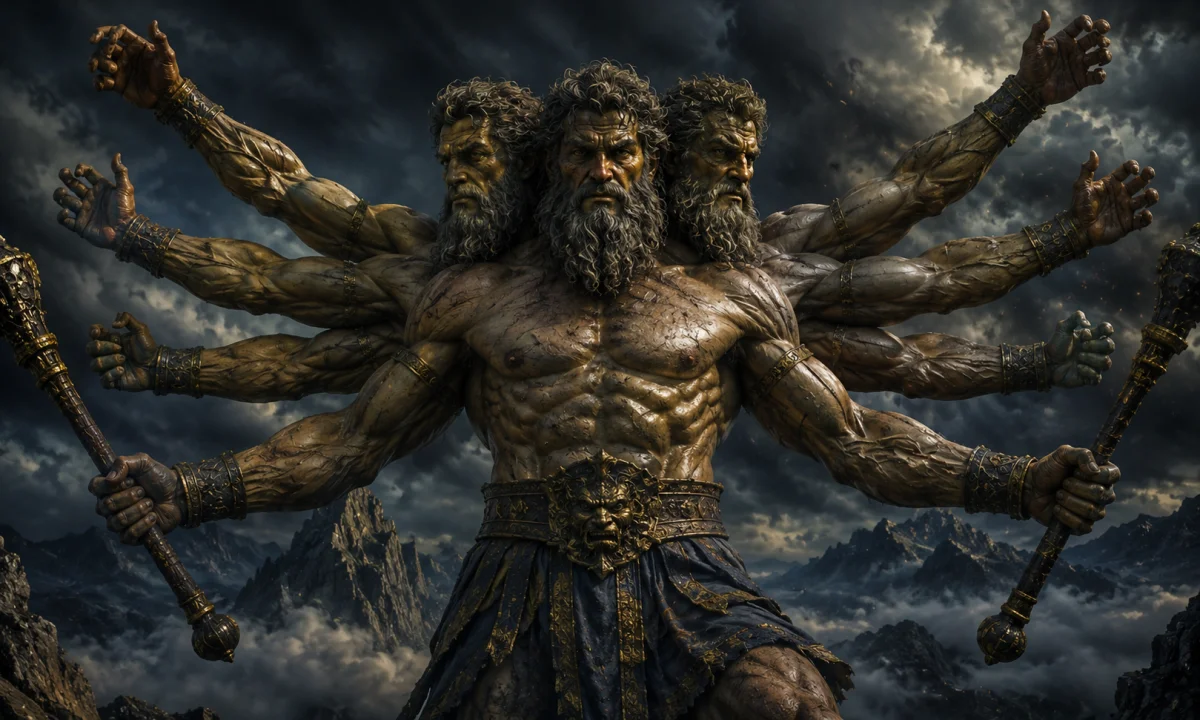
Briareus is a primordial being in Greek mythology, one of the three Hekatoncheires, or “Hundred-Handers.” He is described as possessing extraordinary strength, many arms and numerous heads, and he plays an important part in the divine war in which Zeus and the younger gods overthrow the Titans. In different ancient traditions, he is also known by the name Aegaeon, although the relationship between these names is not entirely uniform.
Origins in Greek mythology
Briareus belongs to the oldest generation of divine beings in Greek myth. According to Hesiod’s Theogony, he was born to Gaia, the Earth, and Ouranos, the Sky. His brothers were Cottus and Gyges. Together, the three were known as the Hekatoncheires, a name formed from Greek words meaning “hundred-handed.”
The Hekatoncheires were not ordinary giants or human-like monsters. They were ancient powers associated with overwhelming physical force and the dangerous, untamed energies of the early cosmos. Each had one hundred arms and fifty heads in Hesiod’s account. Their strange bodies marked them as beings outside the normal order of gods, heroes and mortals.
Ouranos feared the Hekatoncheires, as well as their brothers the Cyclopes, and confined them in the depths of the earth. In Hesiod’s story, Gaia suffered because her children were imprisoned within her. She eventually encouraged her son Cronus to rebel against Ouranos. Cronus overthrew his father, but the Hekatoncheires were not immediately restored to freedom. Their imprisonment remained a problem for the next generation of gods.
When Zeus later challenged Cronus and the Titans, he released Briareus, Cottus and Gyges from their confinement. Their aid was decisive in the Titanomachy, the great war between Zeus’s forces and the older Titan gods. The Hekatoncheires hurled enormous stones with their many arms, helping to defeat and imprison the Titans. In this tradition, Briareus is not merely a frightening creature: he is a powerful ally whose strength helps establish the rule of Zeus.
The Hekatoncheires
The three Hundred-Handers are generally named as:
- Briareus, who is also associated with the name Aegaeon;
- Cottus, whose name is connected in some interpretations with force or impact;
- Gyges, whose name and identity are not securely explained by surviving evidence.
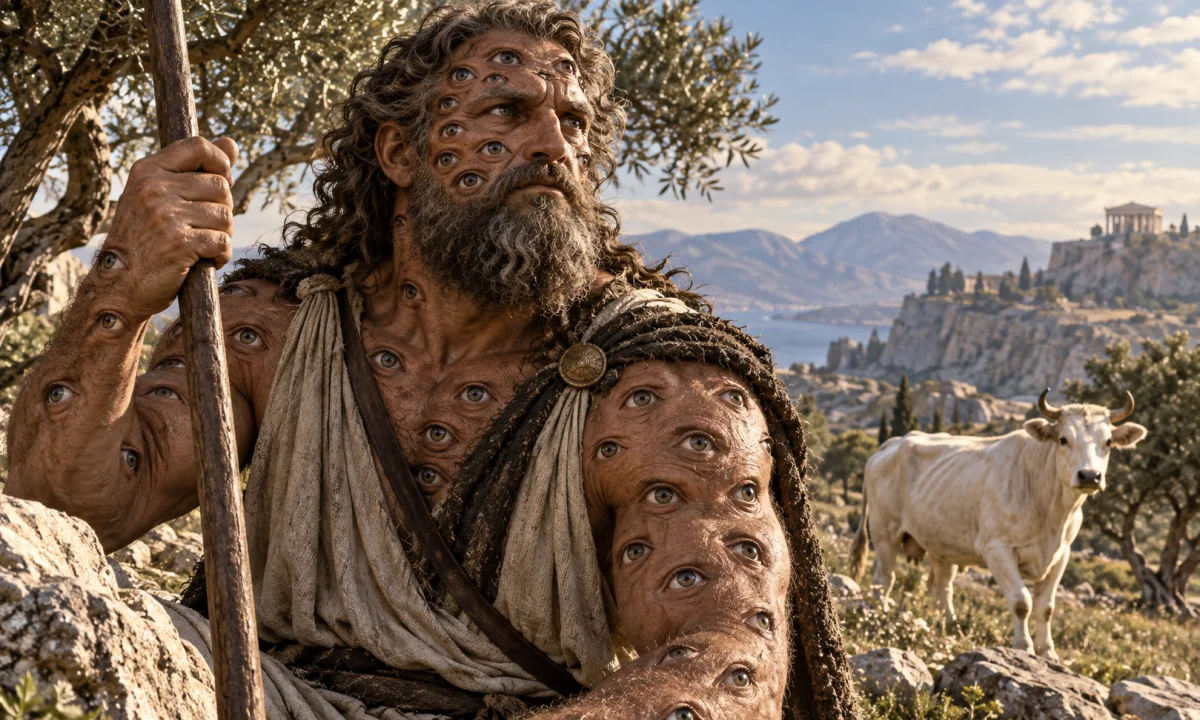
Their most distinctive features are their one hundred arms and fifty heads. Ancient Greek art does not preserve a single standard visual form for Briareus, and surviving artistic representations of the Hekatoncheires are comparatively rare. Consequently, modern images often rely on the literal meaning of the name and show him as a colossal figure with many arms, but the exact ancient appearance cannot be reconstructed with certainty.
The multiple arms are especially important to his role in the Titanomachy. They express the ability to attack on an almost unimaginable scale, allowing the Hekatoncheires to overwhelm the Titans with a rain of stones. Their many heads may suggest watchfulness, multiplicity or monstrous excess, although ancient texts do not provide a detailed symbolic explanation.
Briareus is sometimes called a giant in modern descriptions, but that classification can be misleading. Greek mythology contains several different groups of oversized or primordial beings. The Hekatoncheires are children of Gaia and Ouranos, but they are distinct from the Gigantes, who emerge in a different myth connected with the blood of Ouranos. They are also distinct from the Titans and from the Cyclopes, despite sharing an early place in the genealogy of the gods.
Briareus and Aegaeon
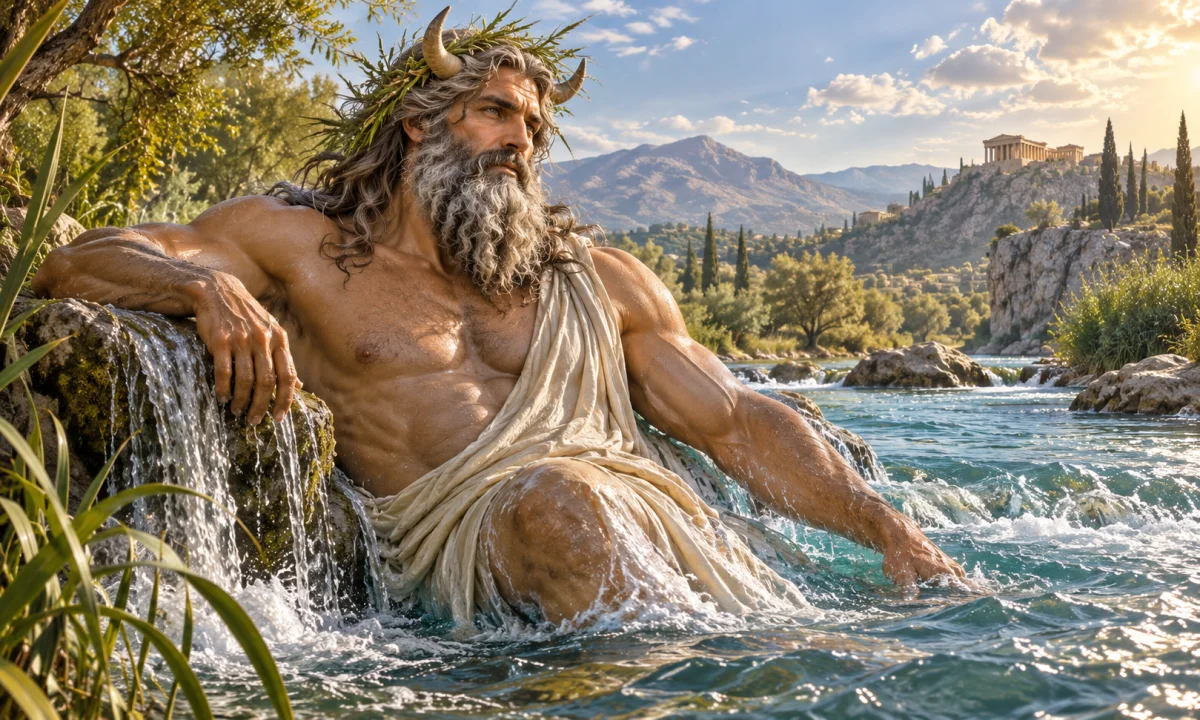
The name Aegaeon creates one of the most important questions surrounding Briareus. In the Iliad, the poet says that the gods call him Briareus, while mortals call him Aegaeon. This passage presents the two names as belonging to the same exceptionally powerful being. Aegaeon is described as stronger than his father, and his presence is enough to deter a group of gods who are considering binding Zeus.
Other ancient authors do not always handle the name in exactly the same way. Aegaeon can appear as an independent sea-associated figure or as a separate monstrous being, especially in later mythological and poetic traditions. Because the surviving sources vary, it is safest to say that Briareus and Aegaeon are frequently identified with one another, but not in every tradition.
The origin of the name Aegaeon is also uncertain. It has sometimes been connected with the Aegean Sea, with the Greek word for “goat,” or with other ancient names and local traditions. None of these explanations is universally accepted. The relationship between Aegaeon and maritime mythology may reflect later attempts to connect the figure with the sea, rather than a feature of the earliest account of Briareus.
Briareus in the divine war
Briareus’s most important mythological function is his participation in the war between the Olympian gods and the Titans. Zeus, his brothers and sisters, and their allies fought to replace Cronus and the older divine order. The conflict was not simply a battle between good and evil in the modern sense. It was a struggle over succession, sovereignty and the organization of the cosmos.
The Titans possessed great power and represented the older generation of divine rule. Zeus needed allies capable of matching them. The Cyclopes provided weapons, including the thunderbolt associated with Zeus, while the Hekatoncheires contributed overwhelming military force. Their hundred arms allowed them to throw huge stones in numbers no ordinary army could withstand.
Hesiod’s account places the Hekatoncheires at the decisive stage of the conflict. Once freed, they join the Olympian side and help force the Titans into defeat. After the war, the defeated Titans are imprisoned in Tartarus, and the Hekatoncheires become their guards. This reversal is significant: beings who were once imprisoned in the underworld now guard the ancient rulers who had been defeated and confined there.
Briareus’s role therefore moves through three stages: he is first a feared child imprisoned by the old ruler, then an indispensable ally of Zeus, and finally a guardian of the new cosmic order. His power is not eliminated or absorbed into Zeus’s authority. Instead, it is incorporated into the structure that Zeus establishes.
The story of Zeus and the rebellious gods
The Iliad gives Briareus a different but related role. At one point, Hera, Poseidon and Athena are said to have considered restraining Zeus. Thetis, who had a strong relationship with Zeus in the poem, summoned Briareus to Olympus. His appearance beside Zeus discouraged the other gods from carrying out their plan.
This episode does not focus on the Titanomachy or describe Briareus fighting with all his arms. Instead, it emphasizes his reputation. His presence alone is a warning that Zeus is protected by a power too formidable to challenge. The story also shows that the Olympians, although immortal, are not always presented as a perfectly harmonious family. They can quarrel, form alliances and contemplate rebellion against their own ruler.
The scene is one reason Briareus cannot be reduced to a simple monster. In the Iliad, he is a figure of authority and strategic importance. He is associated with Zeus’s security at a moment when the stability of Olympus is threatened from within.
Marriage and later status
In the Theogony, Briareus receives a place within the divine order after the Titans’ defeat. Zeus gives him Cymopoleia, a daughter of Poseidon, as a wife. Cymopoleia is associated with the violent movement of the sea, although the surviving material about her is very limited.
This marriage links Briareus to Poseidon and to maritime powers, but it should not be confused with the later tendency to treat Aegaeon as a sea monster or sea god. The ancient traditions are not fully consistent about his residence, powers and family connections. The marriage mainly demonstrates that Briareus has been accepted into the ruling divine structure rather than cast aside as a defeated or hostile force.
Some later writers and commentators connect Briareus or Aegaeon with particular coastal places, islands or stretches of sea. These associations belong to the broader Greek habit of giving myths a local setting. They do not necessarily represent a single, unified national tradition about the figure.
Name and meaning
The name Briareus is commonly connected with a Greek adjective meaning “strong,” “vigorous” or “mighty.” This interpretation fits his function, but the exact history of the name is not completely certain. Ancient mythological names can preserve very old words whose original meanings were already obscure to later Greek speakers.
The descriptive term Hekatoncheir is more transparent. It literally refers to a being with one hundred hands or arms. In the plural, Hekatoncheires identifies the three brothers as a group. English forms such as “Hecatoncheir,” “Hecatoncheires” and “Hundred-Hander” are all encountered in modern writing. “Briareus” is the most common English form of his personal name, while “Briareos” reflects a closer transliteration of the Greek.
The spelling Aegaeon is also rendered as Aegeon or Aegaeus in some contexts. These forms should be checked carefully because similar names can refer to different figures in different sources. The name Aegeus, for example, is associated with the human king of Athens and is not simply another name for Briareus.
Symbolism and interpretation
Briareus can be understood as an image of force that exists before the world has been fully ordered. His body is excessive: one hundred arms, fifty heads and strength beyond that of ordinary gods. Such a form expresses the frightening scale of the primordial universe, where divine beings are not yet shaped into the more familiar personalities of Olympian religion.
At the same time, the myth does not portray primordial power as permanently opposed to order. Zeus releases the Hekatoncheires and turns their strength against the Titans. Briareus thus represents a force that can be integrated into a new political and cosmic arrangement. His power becomes legitimate when it supports the victorious ruler.
His imprisonment also reflects a recurring pattern in Greek divine genealogy. Older rulers fear the children who may replace them, and attempts to suppress those children ultimately contribute to rebellion. Ouranos confines his offspring, Cronus later swallows his own children, and Zeus rises through a conflict between generations. Briareus belongs to this cycle of succession, even though he never seeks the throne himself.
Scholars have sometimes interpreted the Hekatoncheires as mythic expressions of earthquakes, storms, volcanic violence or the uncontrollable forces of nature. Such readings can be suggestive, but they are interpretations rather than explicit explanations supplied by the ancient poets. The texts chiefly emphasize their genealogy, imprisonment, physical enormity and military usefulness.
Distinction from similar figures
Briareus should be distinguished from several figures who are sometimes confused with him:
- The Cyclopes: The Cyclopes are also children of Gaia and Ouranos in Hesiod’s genealogy, but they are a separate group. They have one eye in the middle of the forehead and are associated with the making of Zeus’s thunderbolt and other divine weapons.
- The Titans: The Titans are the older generation of ruling gods led by Cronus. Briareus is their contemporary in the broad genealogical sense but is not a Titan.
- The Gigantes: The Giants are a distinct group born from Gaia in connection with Ouranos’s blood. Their later war against the Olympians, the Gigantomachy, is separate from the Titanomachy.
- Typhon: Typhon is another enormous enemy of Zeus, usually associated with Gaia and Tartarus. He is not a Hekatoncheir and does not share Briareus’s role as an ally and guardian of Zeus’s order.
- Aegaeon: In the Iliad, Aegaeon is another name for Briareus, but later traditions may treat Aegaeon as a separate sea-related being. The names should not be treated as interchangeable in every source.
Later reception
Ancient and later poets retained Briareus as a memorable symbol of colossal strength. Roman authors generally use forms related to Aegaeon or Briareus when referring to the hundred-handed being. His enormous number of arms made him particularly suitable for epic descriptions of supernatural warfare, even when later writers adapted the details for their own literary purposes.
In modern fantasy, games, comics and visual media, Briareus is often depicted as a many-armed giant or boss-like monster. These adaptations usually emphasize his appearance and combat abilities, sometimes combining him with other giants, Titans or sea creatures. Such portrayals draw on genuine features of Greek mythology but may merge traditions that ancient sources kept separate.
The traditional Briareus is more specific than a generic giant. He is one of the Hekatoncheires, a child of Gaia and Ouranos, an ally who helps Zeus defeat the Titans, and a guardian associated with the postwar order of Olympus. His alternate name Aegaeon is ancient and important, but its use varies across the surviving tradition.