WORLD
WORLD
Bonus-eventus
Bonus Eventus was a Roman divine personification of a successful or favourable outcome. His name literally means “good result” or “fortunate outcome”: bonus means “good”, while eventus means “outcome”, “issue” or “result”. He was associated especially with successful harvests, although the idea could extend to prosperity, public undertakings and other ventures that ended well.
Bonus Eventus is a relatively obscure figure in Roman religion. Unlike Jupiter, Mars, Venus or Ceres, he has no surviving cycle of myths, no clearly recorded priesthood of major importance and no established genealogy. Most knowledge of him comes from brief literary references, inscriptions, coins and works of Roman art. These sources suggest a god of practical success rather than a character in a traditional heroic narrative.
Origins and religious setting
Roman religion included many divine powers connected with particular places, activities, conditions and desired results. Some were major gods with temples and elaborate public cults; others were highly specialised powers whose names expressed a particular stage in an agricultural, domestic or civic process. Bonus Eventus belongs to this wider Roman habit of treating an important quality or outcome as a divine presence.
The Roman understanding of religion was strongly concerned with results. Farmers sought a productive harvest, generals required victory, families prayed for health and continuity, and public officials performed rituals for the safety and prosperity of the community. A favourable outcome could therefore be understood not merely as luck, but as something requiring divine support and correct religious attention.
Bonus Eventus appears to have been connected most clearly with agriculture. Roman writers sometimes mention him among the powers relevant to cultivated land and the success of crops. This agricultural association does not mean that he was simply another name for Ceres, the goddess of grain and agriculture. Ceres represented a much broader divine sphere, including grain, cultivation, fertility and the social importance of agriculture. Bonus Eventus represented the hoped-for successful result of an undertaking, particularly when that undertaking involved sowing, growing and harvesting.
The surviving evidence does not establish a single moment when his worship began. He may belong to the old Roman tendency to name specialised agricultural and practical powers, but the exact origins of the cult are unknown. Claims that he was an extremely ancient or universally important Roman god go beyond what the evidence securely demonstrates.
The name and identity of the god
Bonus Eventus is a masculine Latin name. The word eventus can refer to an outcome, issue or result, and does not necessarily imply a supernatural being in ordinary usage. In religious contexts, however, the phrase could be personified as a divine power responsible for bringing an undertaking to a good end.
The name also explains why Bonus Eventus does not have a distinctive mythology. He is not primarily defined by a dramatic origin story or a family relationship with other gods. His identity is functional: he is the favourable outcome itself, conceived as a power that could be honoured, invoked or represented.
Roman religious language contains several comparable personifications. Felicitas represented prosperity, good fortune and successful circumstances; Spes embodied hope; Victoria represented victory; and Abundantia was associated with plenty. These figures overlapped in meaning, but they were not interchangeable. Bonus Eventus focused on the successful issue of an action or enterprise, while Felicitas could describe a broader condition of prosperity or good fortune.
Modern descriptions sometimes call Bonus Eventus a “god of luck”. That wording is understandable but imprecise. Roman ideas of luck were expressed through several divine concepts, and Bonus Eventus was more specifically connected with a good result. The difference matters: he could be invoked in relation to the outcome of work, cultivation or an undertaking rather than being a general ruler of random chance.
Agriculture and successful work
Roman farming required long-term effort and remained vulnerable to drought, storms, pests, disease and political disruption. A successful harvest was therefore both an economic necessity and a religious concern. Ploughing, sowing and harvesting were accompanied by ritual observances, and numerous divine powers were associated with different aspects of agricultural life.
Within this setting, Bonus Eventus could represent the moment when effort produced the desired result. The farmer’s work did not guarantee a harvest; divine favour was still needed to bring the process to completion. His name may consequently have been used in prayers or religious language concerned with the prosperity of crops and the success of agricultural labour.
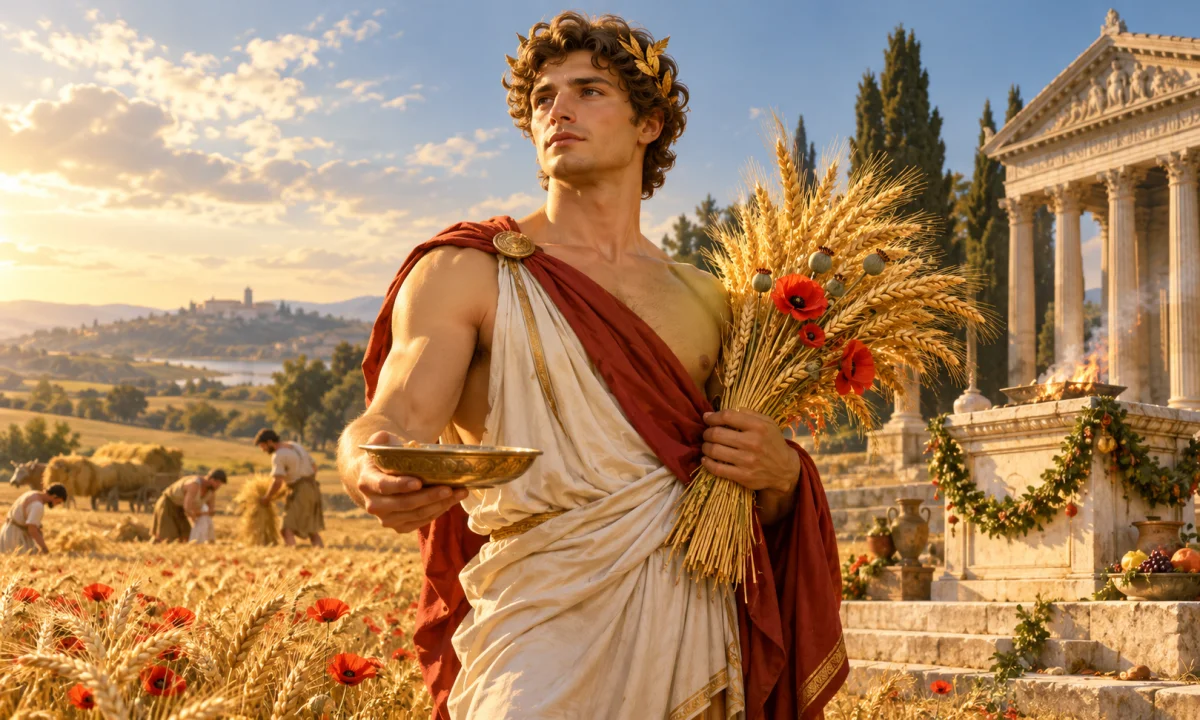
His agricultural identity is reflected in his artistic attributes. In surviving representations, he is commonly shown as a youthful male holding ears of grain. The grain makes the connection with harvest and productive land clear. It also distinguishes him from purely abstract representations of success by giving his good outcome a concrete, material form: food, wealth and the continuation of agricultural life.
Some images include a patera, a shallow ritual offering bowl. A patera indicates participation in sacrifice or libation and places the figure within the normal visual language of Roman worship. Other representations show a cornucopia, the horn of plenty associated with abundance and prosperity. These attributes are not present in every surviving image, and their variation reflects the broad meaning of favourable results.
Appearance in Roman art
Bonus Eventus is generally represented as a youthful, idealised male figure. He is often nude or partly nude, following conventions used in Greek and Roman art to express physical perfection, vitality and divine status. The nudity should not be treated as evidence that he was a fertility god in the same sense as Priapus or a god of sexual desire. It belongs primarily to the artistic vocabulary of the ideal male body.
His most recognisable attributes are ears of grain, a patera and, in some examples, a cornucopia. He may stand in a relaxed pose, sometimes beside an altar or another object connected with sacrifice. Because many Roman divine figures shared similar idealised bodies and prosperity symbols, identification depends heavily on accompanying inscriptions or on the combination of attributes.
Several works identified as Bonus Eventus are copies or adaptations of earlier Greek-style statues. Roman sculptors and patrons often used established artistic types to represent abstract or specialised deities. As a result, the visual form of Bonus Eventus does not necessarily reveal an ancient, independent mythology. It may instead show how Roman art adapted the language of the ideal youthful god to express success and abundance.
He also appears on Roman coinage, particularly in the imperial period. Coins could present a deity as a statement about the emperor’s hopes, achievements or relationship with the prosperity of the empire. A figure named Bonus Eventus on a coin might therefore communicate the expectation of successful rule, military or administrative achievement, agricultural plenty or general public welfare. The exact significance depends on the coin’s date, inscription and surrounding imagery.
Coin images should not automatically be interpreted as proof of a large popular cult. Roman emperors placed many deities and personifications on coins for political and symbolic reasons, even when their independent worship was limited. The appearance of Bonus Eventus on imperial coinage demonstrates that the idea was meaningful in official visual culture, but it does not by itself show that he had the same public importance as Jupiter or Victoria.
Literary and religious evidence
References to Bonus Eventus are brief and scattered. Roman agricultural writing and antiquarian discussion preserve evidence for a religious world in which the success of crops and labour could be assigned to named divine powers. Later Christian authors, when criticising traditional Roman religion, also mention specialised gods and personifications. Such authors are valuable witnesses to the names known in religious vocabulary, but their arguments were often designed to portray Roman polytheism as excessively divided or absurd. Their descriptions must therefore be read in context.
The evidence does not provide a complete ritual calendar for Bonus Eventus. There is no securely documented set of prayers, myths or festivals that can be reconstructed in detail. Nor is there a reliable basis for assigning him a particular temple cult throughout the Roman world. Some representations may have been intended for private settings, domestic decoration, gardens or elite collections rather than for a major public sanctuary.
This limited evidence is typical of many Roman divine figures. Survival in the written record depended on the interests of ancient authors, while survival in art depended on the preservation of statues, gems, coins and archaeological contexts. A deity could be recognised in Roman religious language without leaving enough evidence for modern historians to reconstruct a full cult.
Roles and symbolism
Bonus Eventus can be understood through several connected ideas:
- Successful completion: he represented an undertaking reaching a favourable result rather than failing or remaining unfinished.
- Agricultural prosperity: grain and harvest imagery connect him with the productive outcome of cultivation.
- Reward for labour: his symbolism reflects the Roman belief that human effort required favourable divine conditions to bear fruit.
- Material abundance: the cornucopia, where present, broadens his meaning from one successful result to prosperity and plenty.
- Ritual favour: the patera links his image with offerings made in the hope of securing or acknowledging divine assistance.
These meanings are related but not identical. Bonus Eventus was not simply “the harvest”, not merely “wealth” and not a personification of victory alone. His significance lies in the transition from effort or expectation to a good outcome.
Relationships and distinctions from other figures
Bonus Eventus and Felicitas
Bonus Eventus and Felicitas are particularly easy to confuse. Both can be connected with prosperity and good fortune, and both appear in Roman art and official language. Felicitas, however, often expressed a more comprehensive state of success, happiness or flourishing, especially in relation to the emperor and the Roman state. Bonus Eventus was narrower: the favourable result of an undertaking, with especially strong agricultural associations.
Bonus Eventus and Fortuna
Fortuna governed the instability of fortune, chance and changing circumstances. She could bring success, but she could also reverse it. Her wheel became a famous symbol of the unpredictability of human affairs. Bonus Eventus did not represent the whole unpredictable power of fate. His name emphasised the good outcome itself, while Fortuna encompassed both the uncertainty and the reversal of fortune.
Bonus Eventus and Ceres
Ceres was a major goddess with myths, public festivals and a central role in Roman ideas of grain and agriculture. Bonus Eventus was a more specialised power associated with the success of agricultural or other practical activity. Grain imagery can therefore appear in representations of both figures, but the two should not be merged.
Bonus Eventus and Abundantia
Abundantia personified abundance, especially the overflowing prosperity symbolised by the cornucopia. Bonus Eventus could be shown with the same object, but his central concept was the successful result that produces or permits prosperity. Abundantia expresses plentiful supply; Bonus Eventus expresses favourable outcome.
Bonus Eventus and Greek deities
There is no need to identify Bonus Eventus as a direct Roman equivalent of one specific Greek god. Greek religious figures such as Agathos Daimon, Tyche and Ploutos have overlapping associations with good fortune, prosperity or abundance, but their myths and cult traditions are different. Roman artists and writers could draw on Greek artistic conventions without turning Bonus Eventus into a Greek deity under another name.
Later reception
In later European art, the name Bonus Eventus continued to be used as an identification for ancient statues and copies of statues representing a youthful male with grain or prosperity attributes. Renaissance and neoclassical artists and collectors were interested in Roman personifications, particularly because they offered visual symbols for success, abundance and achievement.
His name has occasionally been revived in modern discussions of Roman mythology, classical art and ancient religion. He does not, however, have a major independent presence in modern popular culture. Contemporary references may treat him as a generic luck-bringer or use the Latin name as a decorative expression for success, but these uses should not be confused with evidence for ancient Roman beliefs.
Bonus Eventus is best understood as a modest but revealing example of Roman religious personification. His surviving image of a youthful figure with grain, a ritual bowl or a cornucopia expresses a distinctly Roman concern: the hope that work, cultivation and public enterprise would end well. The absence of a dramatic mythology is part of his character. He was important not because he acted in a famous story, but because Romans could name and honour the favourable outcome on which ordinary and public life depended.