WORLD
WORLD
Baruchiel

Baruchiel is an angelic name found chiefly in later Christian angelology, especially Eastern Orthodox and related devotional traditions. The name is also written Barachiel, Barakiel, Baraquel or Barchiel. He is commonly described as an archangel associated with divine blessing, benevolence and the bestowal of good gifts. Baruchiel is not a major figure in the Bible, and traditions about him are less uniform than those concerning Michael, Gabriel, Raphael or Uriel.
Origins and religious setting
Baruchiel belongs to a broad tradition of named angels that developed around biblical references to angels, Jewish and Christian ideas about heavenly beings, liturgical devotion, apocryphal writings and later theological or popular classifications. The Bible names only a small number of angels directly. As religious communities reflected on the many unnamed heavenly messengers mentioned in scripture, additional names emerged in apocryphal, mystical, liturgical and devotional contexts.
The precise origin of the name Baruchiel is uncertain. It does not appear as a clearly established individual in the standard Hebrew Bible or in the New Testament. Nor is Baruchiel one of the six-winged seraphim described by name in Isaiah, or one of the four living creatures in the visions of Ezekiel and Revelation. His identity belongs primarily to later angelic traditions rather than to a single foundational scriptural narrative.
In Eastern Christianity, especially in Byzantine and Slavic traditions, Barachiel is sometimes counted among the seven archangels. The number seven reflects several biblical and post-biblical ideas about heavenly attendants who stand before God. The names included in lists of seven vary considerably. Michael, Gabriel and Raphael are frequently present, while the remaining places may be occupied by Uriel, Selaphiel, Jegudiel, Barachiel, Jeremiel or other figures, depending on the tradition.
These lists should not be treated as a single universally accepted catalogue. The Eastern Orthodox Church honours the “bodiless powers” and commemorates the archangelic hosts, but local iconographic and devotional traditions do not always agree on the names, functions or rank of every archangel. Baruchiel’s place within this system is therefore traditional and devotional rather than a universally defined article of Christian doctrine.
The name Baruchiel
The name is generally interpreted as deriving from Hebrew elements connected with berakhah, meaning “blessing,” and El, meaning “God.” It is therefore commonly understood as “Blessing of God,” “God’s blessing” or “Blessed by God.” As with many angelic names ending in -el, the final element signals a relationship with the God of Israel.
The spelling varies because the name passed through different languages and systems of transliteration. Barachiel is a common English form, while Baruchiel more closely reflects a spelling associated with the idea of blessing. Barakiel and Baraquel also occur. These forms are often treated as variants of one angelic name, although historical sources do not always use names consistently.
The name should not be confused automatically with every occurrence of a similar form. Angelic names were copied, translated and adapted across Hebrew, Greek, Latin, Syriac, Arabic, Slavonic and later European traditions. A similar spelling may sometimes represent a different figure, a different transliteration or a modern reconstruction rather than a continuous ancient tradition.
Baruchiel as an angel of blessing
Baruchiel’s principal association is blessing. In devotional interpretation, he represents the gracious distribution of divine favour: prosperity understood in a broad sense, good fortune, spiritual encouragement, protection of the household and the recognition of gifts received from God. His role is not usually presented as that of an independent deity who controls luck. Instead, he serves as a heavenly messenger through whom blessing is symbolically expressed.
Some traditions connect Baruchiel with prayer for family life, marriage, children and domestic harmony. These associations arise naturally from the meaning of his name and from the idea that divine blessing extends to households and communities. They should be understood as devotional themes rather than as a detailed biography preserved in a canonical sacred text.
Baruchiel may also be invoked symbolically in connection with gratitude. A blessing is not only something requested; it is also something acknowledged. In this interpretation, the angel’s presence reminds worshippers that material well-being, companionship, health, fertility, peace and spiritual consolation may all be received as gifts rather than treated solely as personal achievements.
Unlike Michael, who is strongly associated with heavenly warfare, or Raphael, who is associated in Christian tradition with healing and the journey of Tobias, Baruchiel has no widely known narrative in which he performs a single dramatic act. His importance lies more in his symbolic function than in a developed cycle of stories.
Appearance and iconography
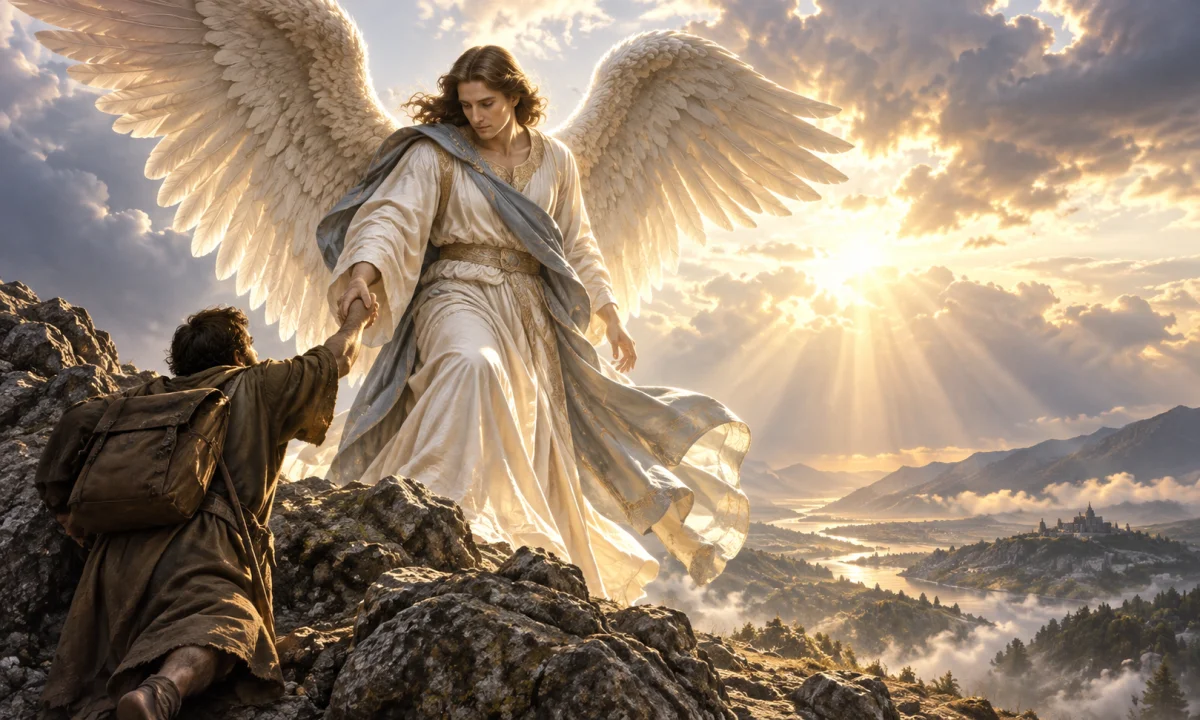
There is no universally fixed physical appearance for Baruchiel. Angels in Christian theology are spiritual beings rather than human bodies, and artistic representations use visible forms to communicate their roles. Artists may therefore depict Baruchiel as a winged figure in richly coloured robes, carrying a staff, scroll, cross or other emblem associated with angelic service.
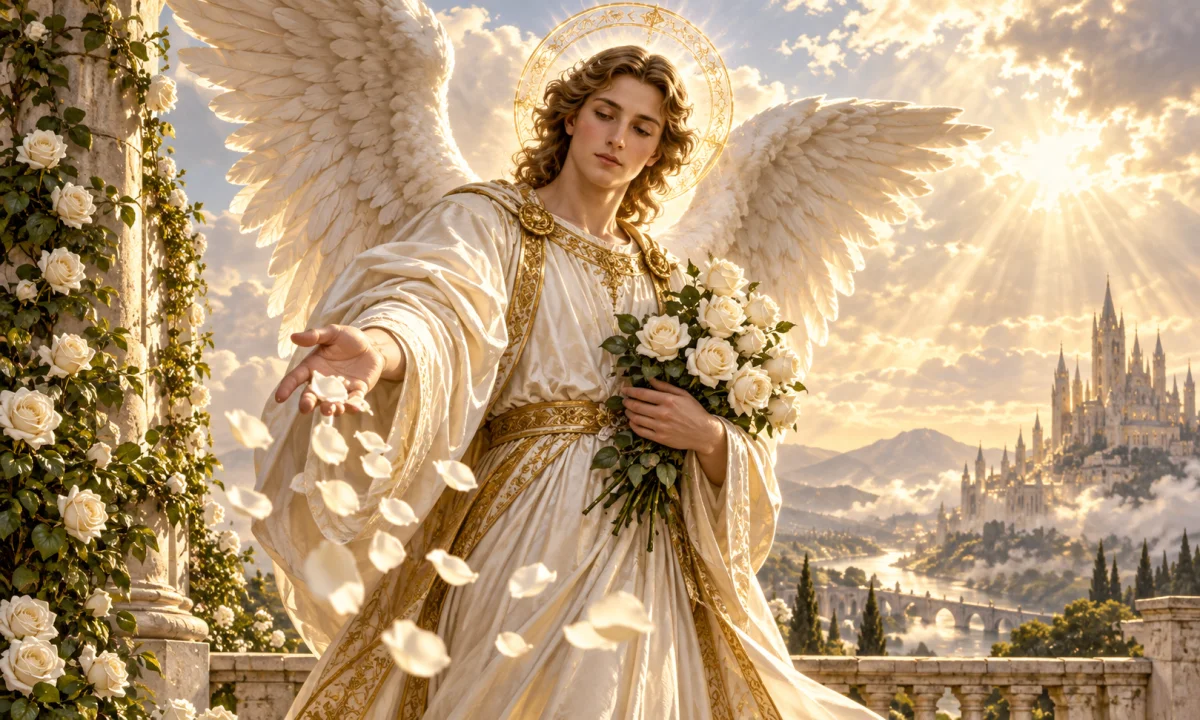
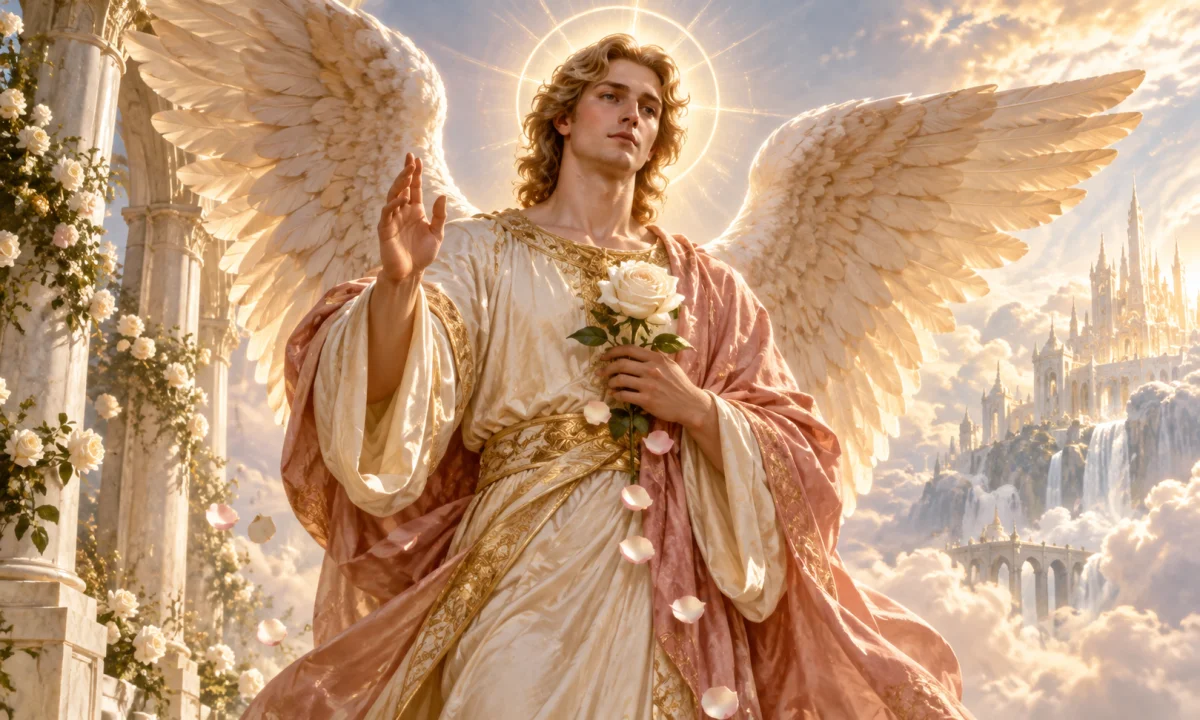
A recurring devotional image connects Baruchiel with roses, especially white roses. He may be shown holding roses, carrying a basket of flowers or wearing floral symbols on his garments. The flowers represent blessing, purity, beauty, generosity and the abundance of divine grace. In some versions, the roses are understood as gifts offered to faithful people or as signs of the blessings brought by the angel.
These floral attributes are not supported by a single universally recognized biblical passage about Baruchiel. They belong to later iconographic and devotional practice, and their use differs between communities and artists. An image of an angel with roses should not automatically be identified as Baruchiel, since flowers are also used for other angels, saints and general religious symbolism.
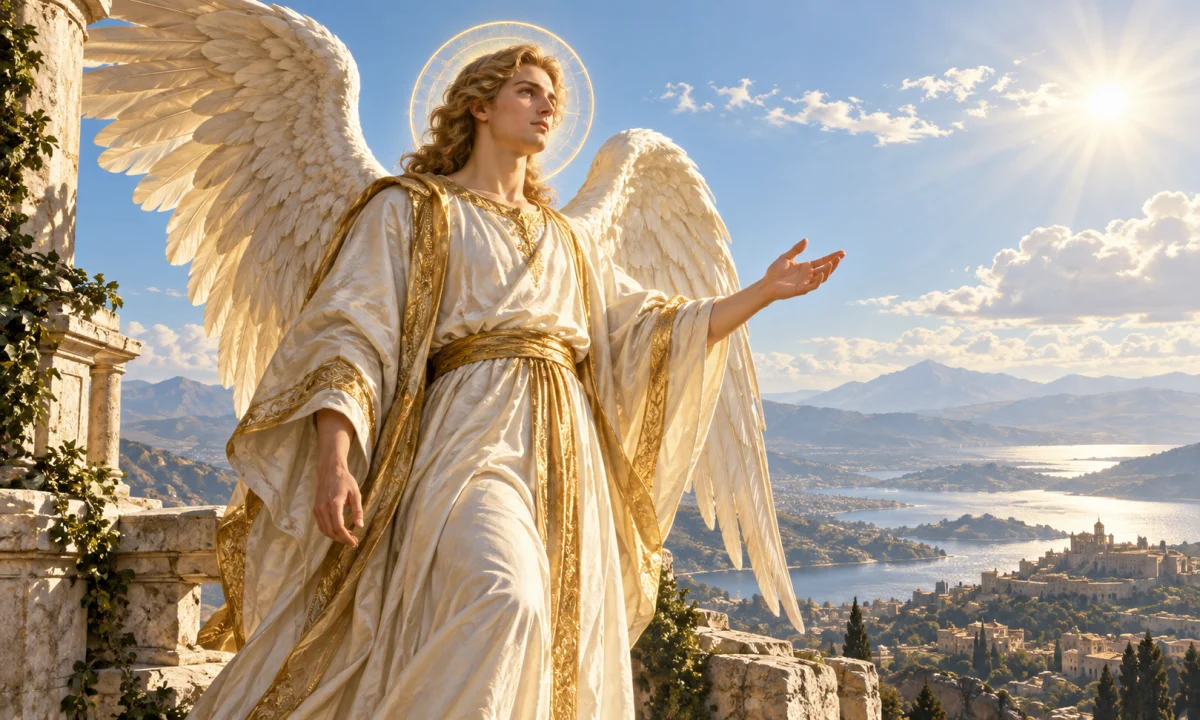
Some representations use the conventional visual language of an archangel: a youthful or majestic human form, wings, a halo and formal garments. Such features indicate the figure’s heavenly status, not a literal description preserved from an ancient eyewitness account. The same principle applies to colours, weapons and objects assigned to him in later artistic or esoteric systems.
Stories and relationships
Baruchiel does not possess a well-established narrative cycle comparable to the stories of Raphael in the Book of Tobit, Michael in the Book of Daniel and the Revelation of John, or Gabriel in the announcements surrounding the births of John the Baptist and Jesus. There is no widely accepted canonical account describing his origin, a particular mission on earth or a distinctive encounter with a prophet.
Later religious traditions may place him among the archangels who stand before God or among the heavenly powers responsible for carrying out divine purposes. In such contexts, his relationship with other archangels is usually one of shared service rather than rivalry or family connection. Claims that he is the “brother” or close personal companion of another named angel generally belong to later imaginative systems and should not be presented as an ancient theological fact.
Some devotional accounts describe Barachiel as the angel who brings blessings to people, homes or communities. These accounts are often short and symbolic rather than narrative. They express the meaning of the name and the function assigned to him, but they do not form a single consistent legend across all Christian traditions.
Place among the archangels
The word archangel itself has a narrower scriptural basis than many later lists suggest. Michael is explicitly called an archangel in the New Testament, while other named angels receive different descriptions. Over time, however, Christian writers and worshippers used “archangel” more broadly for exalted heavenly messengers.
Baruchiel’s classification reflects this later development. In some Eastern Orthodox contexts he appears among the seven archangels or as one of the archangels commemorated with the heavenly hosts. In other Christian communities, he is little known or not included in formal teaching. Western Catholic devotional culture generally gives greater prominence to Michael, Gabriel and Raphael, whose names and roles have stronger canonical or liturgical foundations.
The influential Christian writer Pseudo-Dionysius the Areopagite described a hierarchy of angels divided into nine orders, including seraphim, cherubim, thrones, dominions, virtues, powers, principalities, archangels and angels. This system became important in Christian theology, but it does not provide a personal profile for Baruchiel. His name cannot be assigned securely to one of these nine orders on the basis of that hierarchy alone.
Consequently, calling Baruchiel an archangel is best understood as a description used by particular traditions, not as proof that all Christian churches recognize him in exactly the same way. The title indicates an exalted messenger in devotional usage, while his precise rank remains dependent on the source and community.
Distinguishing Baruchiel from similar figures
The most important distinction concerns Barakel, also written Barakiel in some translations or variant spellings. In the First Book of Enoch, Barakel is listed among the Watchers, the angels who descend to earth and transgress their heavenly boundaries. That figure belongs to the Enochic account of rebellious angels. He should not automatically be identified with the later Christian Barachiel, whose name is associated with blessing.
The spelling overlap creates particular difficulty. Translators and later writers have sometimes used forms such as Barakiel, Barachiel and Barakel inconsistently. Similar-looking names may therefore conceal different traditions. The benevolent archangel of blessing and the Watcher associated with the Enochic story should be kept separate unless a specific source clearly equates them.
Baruchiel is also distinct from Barach or Barak, a human figure connected with the biblical story of Deborah and the battle against Sisera. The similarity of the initial consonants does not establish a relationship. Nor should Baruchiel be confused with Bartholomew, the apostle, or with unnamed guardian angels mentioned in general Christian teaching.
Jewish and Christian background
The linguistic shape of Baruchiel’s name reflects the wider religious environment in which many angelic names developed. Hebrew and Aramaic names ending in -el often express an attribute of God or a relationship with God. Examples include Michael, “Who is like God?”, Gabriel, “Strength of God,” and Raphael, “God heals.” Baruchiel fits this naming pattern through its association with blessing.
That linguistic connection does not by itself prove that Baruchiel was an ancient Israelite angel known in the biblical period. Angelic names could be formed, transmitted or reinterpreted at different times. A name may preserve an old religious vocabulary while the individual figure associated with it belongs to a much later layer of tradition.
Christian angelology also developed through the interpretation of scriptural passages about heavenly courts, divine messengers and celestial worship. Apocryphal literature, homilies, calendars, iconography and popular devotion expanded the number of named angels known to believers. Baruchiel illustrates this process: the meaning and devotional role are relatively clear, while the earliest historical evidence for a fully developed personal identity is much less secure.
Later esoteric classifications
Baruchiel appears in some later occult and esoteric angel lists, where individual angels are assigned to planets, zodiac signs, days, hours or particular magical functions. These systems were assembled from a variety of sources and often disagree with one another. One list may associate a name with a planetary power, while another gives it a different celestial office.
Such classifications should be distinguished from Eastern Orthodox devotion, biblical angelology and mainstream Christian doctrine. They are part of Western esotericism and ceremonial magic rather than evidence for an ancient, universally accepted office of Baruchiel. Modern reference works sometimes repeat these associations without explaining their late and variable character, which can make them appear more historically stable than they are.
Cultural significance
Baruchiel’s enduring appeal lies in the idea that blessing can be understood as a relationship between divine generosity and human gratitude. He provides a personal image for a religious theme that is otherwise abstract. Through him, blessings of the home, family, harvest, friendship, protection and spiritual hope can be represented in prayer and art.
At the same time, Baruchiel demonstrates why angelic traditions need to be read in context. A named angel may be important in one local or denominational tradition and almost unknown in another. An attribute such as roses may come from iconography rather than scripture, while a title such as archangel may reflect later devotional classification rather than a universally defined rank.
Baruchiel is therefore best understood as a later angelic figure associated with blessing, especially within Eastern Christian and related devotional traditions. His name, spellings and attributes vary, and his identity should not be merged with the similarly named Watcher Barakel or with figures from unrelated religious and esoteric systems.