WORLD
WORLD
Balthioul

Balthioul is an obscure angelic name found chiefly in modern and post-medieval compilations of esoteric angelology. Unlike Michael, Gabriel, Raphael, or other angels named in Jewish and Christian scripture, Balthioul has no widely recognized biblical narrative, established liturgical feast, or consistent role across major religious traditions. The name is therefore best treated cautiously: it belongs to the broad history of angelic and occult naming, but its origin, meaning, classification, and supposed powers are uncertain.
Origins and religious setting
Angelic traditions developed over many centuries through the interaction of scripture, religious commentary, liturgy, visionary literature, magical practice, and folklore. Jewish and Christian writings name a relatively limited number of angels in their canonical texts, while later traditions preserve hundreds of additional names. Some of these names occur in respected religious or mystical writings; others appear in manuscripts of ritual magic, lists of planetary spirits, private revelations, or modern reference works.
Balthioul belongs to the less securely documented part of this wider tradition. There is no generally accepted ancient scripture that introduces an angel named Balthioul, and the name is not associated with a single universally recognized story. References to it tend to be brief, inconsistent, or repeated from one esoteric list to another without a clear account of the original manuscript or religious community that first used it.
This lack of firm documentation is important. A name can circulate widely in occult books or online catalogues without having a long-standing place in Jewish liturgy, Christian theology, Islamic angelology, or the mythology of a particular historical culture. The presence of Balthioul in an angel list does not by itself establish an ancient cult, a scriptural identity, or a universally accepted celestial office.
The name Balthioul
The spelling Balthioul is not stable. Related forms may include Balthiol, Balthiuel, Balthiel, Balthial, or other spellings produced by the transliteration of Hebrew, Aramaic, Greek, Latin, or pseudo-Hebrew names. These forms should not automatically be assumed to represent the same being. In angelological literature, a difference of one or two letters can reflect a genuine separate name, a scribal error, a translator’s choice, or a later attempt to regularize an unfamiliar word.
The ending -el is common in angelic names and usually reflects the Hebrew divine element meaning “God” or “of God.” Balthioul does not, however, have a securely established etymology. Attempts to divide the name into meaningful Hebrew components are speculative unless supported by a clear early-language form and a reliable textual context. Similarity to better-known names such as Balthiel or Balthazar is not proof of a shared identity.
The name has sometimes been presented as though it possessed a definite translation or a precise theological meaning. Such claims should be regarded as uncertain when they are not accompanied by an identifiable historical text. Many names in later magical traditions were copied, adapted, or altered over time, and their original linguistic sense may have been lost.
Identity and classification
No single classification of Balthioul is accepted across angelic traditions. Some modern occult catalogues place obscure names within one of the traditional angelic choirs, such as the cherubim, thrones, or principalities. Other lists assign names to planetary spheres, days, hours, directions, elements, or specific magical functions. These systems are not interchangeable, and a classification given in one source may have no authority outside that source.
Balthioul is therefore not securely identifiable as an archangel, guardian angel, throne, principality, or member of any other particular order. Descriptions that assign the name a fixed rank should be understood as belonging to a specific esoteric system rather than to general Jewish or Christian doctrine.
Nor is there a well-established account of Balthioul as a personal guardian of an individual, nation, profession, or place. Some later angel lists attach protective, healing, or spiritual attributes to nearly every named angel, but these associations often reflect the organizing habits of the compiler rather than a continuous religious tradition.
Attributes and supposed functions
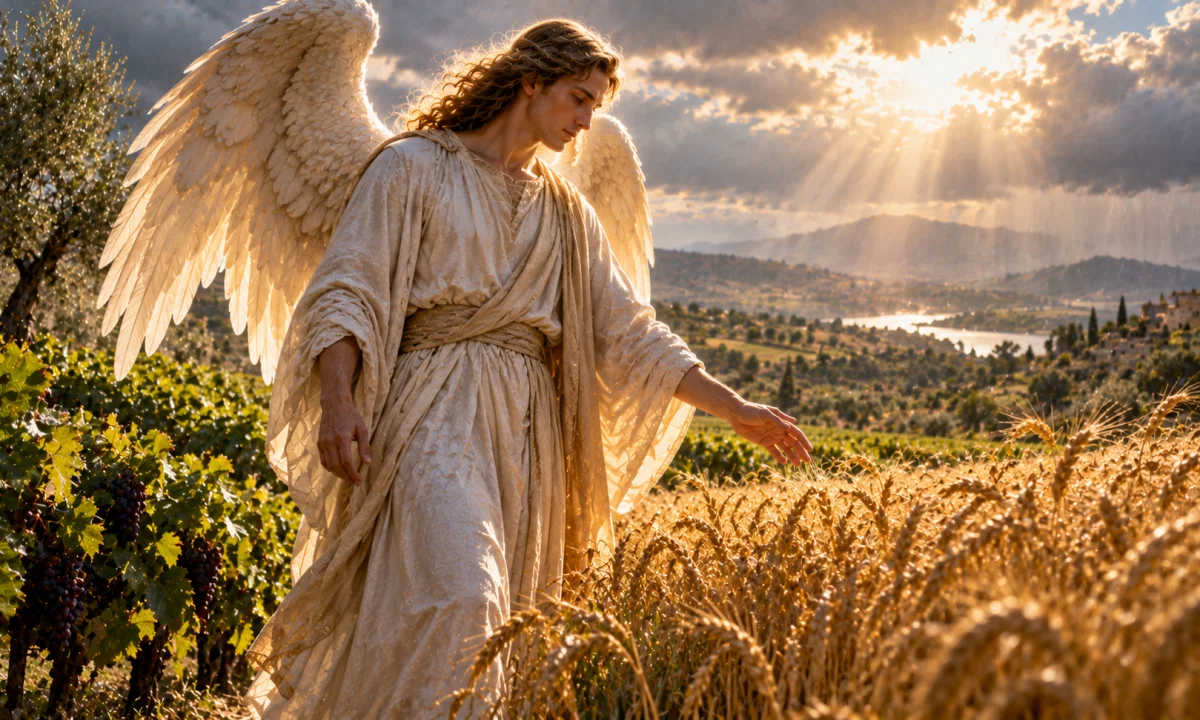
Reliable traditional material does not provide a consistent physical appearance for Balthioul. There is no standard iconography, canonical colour, characteristic animal, weapon, garment, or celestial emblem associated with the name. Artistic depictions that may appear in contemporary angel books or digital illustrations are usually imaginative interpretations rather than representations inherited from an established cult or artistic tradition.
The same uncertainty applies to powers and duties. Balthioul is sometimes described in general terms as a protective or benevolent angel, but such descriptions are too broad to establish a distinct identity. Other occult sources may connect obscure angels with knowledge, ritual protection, healing, dreams, purification, or communication with the divine. These functions should not be treated as features of Balthioul unless a particular historical source clearly assigns them.
In traditional angelology, an angel’s name and function are often connected with the theological structure of the work in which the name occurs. A name in a prayer may express divine protection; a name in a visionary text may serve a narrative purpose; a name in a magical manual may be part of a ritual hierarchy. Removing the name from that setting can create an appearance of certainty that the original material does not support.
Sources and transmission
The main difficulty in studying Balthioul is not a lack of general information about angels, but the lack of a secure textual trail for this particular name. Well-attested angels can be followed through identifiable scriptural passages, early Jewish writings, Christian liturgies, mystical treatises, or works of art. With Balthioul, references are often detached from their original context, and later summaries may repeat one another without preserving the earlier wording.
Names in esoteric angelology were frequently transmitted through handwritten lists. Copyists could misread letters, combine similar names, or adapt unfamiliar forms to the spelling conventions of another language. Printers and later occult authors sometimes expanded these lists, reorganized them according to planets or celestial spheres, and supplied meanings or functions that were not present in the earliest surviving material.
Modern databases create an additional problem. A single uncertain entry may be reproduced on many websites and in many popular books, giving the impression of broad independent evidence. Repetition is not the same as separate attestation. Unless a reference can be connected to an identifiable manuscript, printed work, liturgical tradition, or historical community, it is safer to describe the name as poorly documented rather than ancient, universal, or canonical.
Religious and esoteric significance
Even an uncertain angelic name can be useful for understanding the history of religious imagination. Angel lists reveal a recurring human interest in ordering the invisible world. They give names to forms of protection, knowledge, judgement, healing, revelation, and divine presence. In some settings, naming an angel was believed to make prayer more precise or to place a ritual within a structured heavenly hierarchy.
Balthioul’s obscurity also illustrates the difference between major religious traditions and later occult systems. Mainstream Jewish and Christian theology generally emphasizes the role of angels as messengers, servants, guardians, and ministers of God, while often warning against treating angels as independent deities. Ceremonial magic, by contrast, may arrange angelic names according to complex correspondences involving planets, times, directions, numbers, letters, and ritual offices.
These systems sometimes draw on Jewish, Christian, Islamic, classical, and late antique material at the same time. Their categories may resemble traditional theology while also introducing new combinations. A name such as Balthioul may consequently be meaningful within a particular occult framework without possessing a recognized place in the theology from which that framework borrowed its language.
Distinction from similar names
Balthioul should not be casually identified with Balthiel or Balthial. Those names may appear in related angelic or magical lists, but spelling similarity alone does not demonstrate that they are variants of one figure. A responsible account should preserve the distinction unless a source explicitly equates them.
The name should also be separated from Balthazar, one of the traditional names assigned to a Magus or wise man in later Christian tradition. Balthazar is a human figure in Christian legend and nativity tradition, not an angelic counterpart of Balthioul. The resemblance between the initial syllables is not evidence of a relationship.
Likewise, Balthioul is not the same as Barachiel, a better-known angel associated in some Christian traditions with blessing and divine favour. Nor should it be confused with Bath Kol, the “daughter of a voice” in Jewish tradition, which refers to a heavenly or divine voice rather than a named angel of the same type.
These distinctions matter because angelic names are often copied in variant spellings. Treating every similar form as one being can create a fictional biography assembled from unrelated texts.
Modern reception
Balthioul has little established presence in mainstream popular culture. It does not have the broad recognition of Lucifer, Michael, Azrael, or Gabriel, and it is not a central figure in a major modern religious movement or a widely known body of folklore. When the name appears today, it is more likely to be found in occult reference material, lists of angels, fantasy writing, role-playing settings, or online discussions of obscure celestial beings.
Modern authors may give Balthioul a definite appearance, personality, rank, weapon, domain, or mythology. Such portrayals can be creative and legitimate within fiction, but they should not be confused with documented religious tradition. In particular, a modern illustration or character profile does not establish an ancient origin for the name.
The most accurate description of Balthioul is therefore a restrained one: an obscure and variably spelled angelic name associated with later esoteric angelology, whose original source and precise identity remain uncertain. Claims about its rank, meaning, appearance, or special powers belong to particular interpretations unless stronger historical evidence is available.