WORLD
WORLD
Bacchus
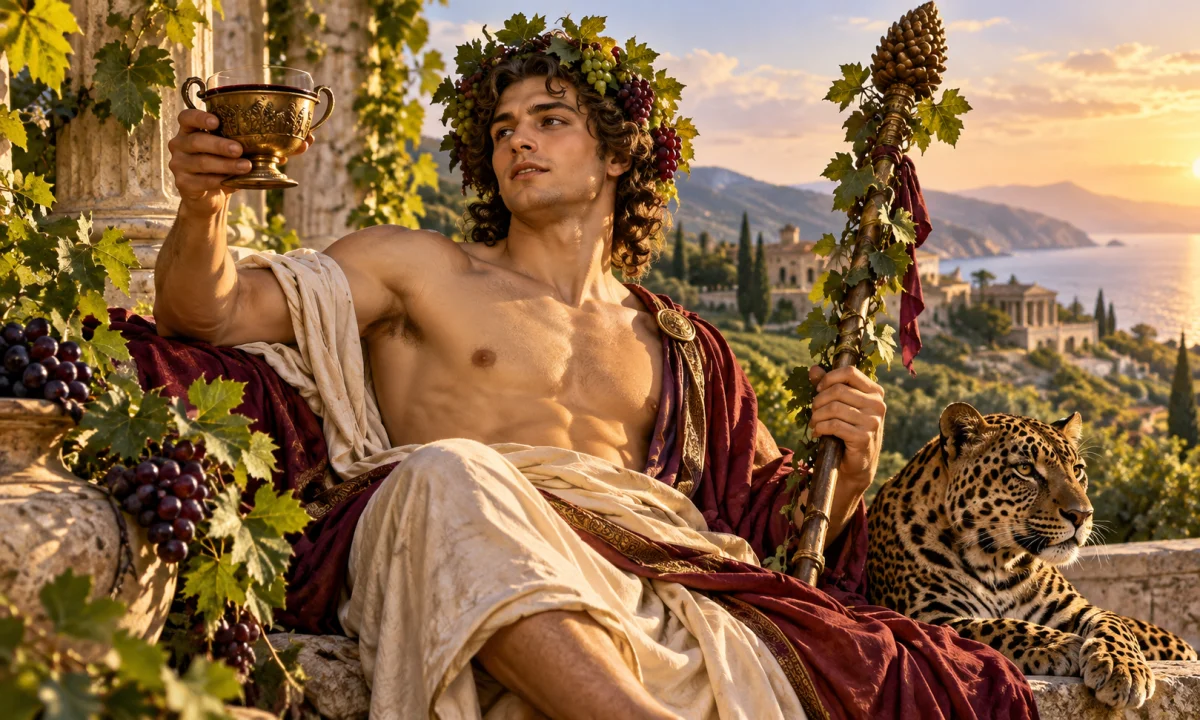
Bacchus is the Roman god associated with wine, ecstatic celebration, fertility, theatre and the loosening of ordinary social boundaries. He is closely identified with the Greek god Dionysus, and Roman writers often use the names Bacchus and Dionysus for the same divine figure. Yet Bacchus was not simply a Greek god copied unchanged into Roman religion. His Roman identity developed through the interaction of Greek myth, older Italian traditions and changing Roman attitudes toward public worship, pleasure and religious enthusiasm.
Name and identity
The name Bacchus comes from the Greek Bakkhos, a title or cult name associated with Dionysus. In Latin usage it became Bacchus and was especially connected with the god’s ecstatic and celebratory side. The name Dionysus remained common in Greek-influenced literature, while Bacchus became increasingly familiar in Roman poetry and later European art.
Bacchus also overlaps with Liber Pater, an ancient Roman god of wine, fertility and freedom. Liber was worshipped in Rome alongside Liber’s female counterpart Libera and the goddess Ceres. By the late Republic and imperial periods, Roman writers and worshippers frequently identified Liber with Dionysus or Bacchus. This identification was influential, but the two figures did not necessarily begin as identical. Liber belonged to an older Roman religious setting, whereas Bacchus entered Roman culture primarily through the reception of Greek Dionysian religion.
The names therefore reflect different layers of religious history. Dionysus is the principal Greek name, Bacchus is a Greek-derived Roman name, and Liber Pater is an older Roman figure who became closely assimilated to him. In ordinary Roman literature, these distinctions could be fluid rather than strictly maintained.
Origins and cultural setting
Dionysian worship developed in the Greek world, where the god was associated with the vine, wine, inspired performance and states of altered consciousness. Wine was not merely an alcoholic beverage in ancient Mediterranean societies. It had religious, social and economic importance, and its cultivation shaped landscapes, trade and seasonal labour. Bacchus represented both the benefits of the vine and the danger of excess.
Greek traditions presented Dionysus as a god whose worship could be joyful, frightening and socially disruptive. His festivals included processions, music, dancing, masks and theatrical performances. Some forms of worship emphasized communal celebration; others involved secret rites or initiatory experiences whose details were not publicly revealed. The term Dionysian is often used today for uninhibited passion, but ancient worship was not simply uncontrolled drinking. It involved formal festivals, ritual rules, sacred objects, myths and relationships with particular communities.
Roman engagement with Greek culture intensified during the Republic, especially as Rome expanded into the Greek-speaking Mediterranean. Greek myths, artistic forms and religious practices were translated into Roman settings. Bacchus became a prominent literary and artistic presence, but his cult also provoked political anxiety. Roman authorities were concerned not only with sexual or drunken behaviour, as later retellings sometimes suggest, but with unauthorized assemblies, secret oaths, competing loyalties and religious activity outside established civic supervision.
Evidence for Bacchus and Dionysus comes from many kinds of material: epic and lyric poetry, drama, inscriptions, vase paintings, sculpture, mosaics, coins and accounts of public festivals. These sources do not present one completely consistent mythology. A story told by Euripides, Ovid or a local cult community may emphasize different aspects of the god, and later Roman authors often reshaped Greek material for literary purposes.
Birth and divine family
The best-known myth makes Bacchus the son of Jupiter, the Roman equivalent of Zeus, and Semele, a mortal woman from Thebes. Juno, jealous of Jupiter’s relationship with Semele, is said to have approached her in disguise and persuaded her to ask Jupiter to appear in his full divine form. Jupiter had sworn to grant her request and could not withdraw his promise. His manifestation as a thunderous god killed Semele, who could not survive the sight.
Jupiter rescued the unborn child from Semele’s body and carried him until the time of birth. Roman and Greek retellings sometimes describe this as a second birth from Jupiter’s thigh, creating the famous image of Dionysus as twice-born. The myth explains the god’s unusual status as the child of a god and a mortal and presents him as a figure who passes through death, concealment and rebirth.
Different traditions give different accounts of his upbringing. Some say that Hermes carried the infant to the nymphs of Mount Nysa. Others make the god’s guardians the nymphs, the mountain-dwelling beings called the Hyades or, in some versions, Semele’s sister Ino and her husband Athamas. The location of Nysa was disputed in antiquity; several regions claimed a connection with the sacred mountain.
There was also an alternative tradition, particularly important in Orphic religion, in which Dionysus was the son of Zeus and Persephone. In this story, the infant Dionysus, sometimes called Zagreus, was attacked by the Titans. The surviving fragments and later reports of this myth vary considerably, and the relationship between Zagreus and the ordinary Dionysus tradition is complex. It should not be treated as a single universally accepted version of Bacchus’s birth.
Appearance and sacred symbols
Bacchus could be shown as a bearded mature god or as a youthful, nearly androgynous figure with long hair. This variation was meaningful. The bearded form connects him with older representations of Dionysus, while the youthful form became especially popular in classical and later art. His appearance could challenge conventional distinctions between masculine and feminine presentation, civilized and wild behaviour, and human and divine identity.
- The thyrsus: a staff wrapped in ivy or vine leaves and often topped with a pine cone. It was a ritual object and a sign of Dionysian authority.
- The vine and grape: symbols of wine, cultivation, abundance and transformation.
- Ivy: an evergreen plant associated with the god and with the wreaths worn by his followers.
- The drinking cup: often a kantharos, representing wine and the ritual sharing of the drink.
- The panther and other big cats: animals linked with the god’s wild power and his legendary eastern journeys.
- The bull and serpent: creatures that could express strength, fertility, danger and regenerative power.
- The mask: an emblem of theatre, changing identity and the boundary between performer and audience.
Bacchus was often accompanied by a divine or semi-divine retinue. The maenads, called Bacchae in Greek contexts, were ecstatic female followers who carried the thyrsus and participated in ritual dancing and processions. The satyrs were woodland beings associated with sexuality, music, drinking and comic disorder. Silenus, an older companion and tutor of Dionysus in Greek myth, was often represented as drunken, wise or both. These beings belong to the god’s mythic and artistic world, but they were not interchangeable with Bacchus himself.
Major myths
The god who must be recognized
A recurring pattern in Dionysian mythology is the refusal to acknowledge the god. In the Theban story told most famously by Euripides, King Pentheus rejects Dionysus and attempts to suppress his worship. The king’s mother, Agave, and other women of Thebes have joined the god’s ecstatic followers. Dionysus leads Pentheus into the mountains, where the women, overwhelmed by ritual frenzy, mistake him for a wild animal and tear him apart. Agave returns carrying what she believes is the head of a lion before realizing that she has killed her own son.
The story is not simply a celebration of drunkenness. It explores the consequences of denying a powerful divine force and the danger of allowing opposition to become persecution. It also presents religious ecstasy as frightening and morally ambiguous. The god grants liberation, but he can punish those who attempt to control or ridicule him.
Lycurgus and opposition to the god
In another Greek tradition, King Lycurgus of Thrace attacks Dionysus and his followers. The details differ between ancient authors. In some versions, Lycurgus drives away the god’s companions; in others, he harms or threatens the god himself. Dionysus responds with madness, punishment or the destruction of Lycurgus. The myth reinforces the theme that kings and communities ignore divine power at their peril.
The pirates and the transformation of the ship
A famous tale tells how pirates capture Dionysus, believing him to be a wealthy young man. When they try to bind him to the mast, ropes fail or fall away, vines grow across the ship and the air fills with divine signs. In many versions, the god transforms into a lion or causes a terrifying apparition, while dolphins appear as the pirates leap into the sea. The sailors become dolphins, except for the helmsman who recognized the god or opposed the kidnapping.
This story highlights the god’s ability to move between human and animal forms and to transform an ordinary voyage into a revelation of divine identity. It also explains, in mythic terms, the connection between Dionysus, the sea and dolphins.
Ariadne and the crown
Bacchus is frequently associated with Ariadne, the Cretan princess who helped Theseus escape from the Labyrinth. In many versions, Theseus abandons Ariadne on the island of Naxos, where Dionysus finds and marries her. Their relationship is not presented identically in every source, and some accounts of Ariadne’s fate differ. Nevertheless, the pairing became a major subject in Greek and Roman art.
Ariadne’s crown, or a jeweled diadem associated with her, was said to have been placed among the stars as the constellation Corona Borealis. The myth links Bacchus with abandonment transformed into divine marriage and with the elevation of a mortal woman into the heavens.
The journey to the underworld
Because Semele had died before seeing her son’s divine maturity, Bacchus was said in some traditions to descend to the underworld and bring her back. He then gave her the divine name Thyone. This episode emphasizes the god’s connections with death, rebirth and movement across boundaries that normally separate the living from the dead.
Roles, powers and religious meaning
Bacchus was the god of wine, but wine was only one part of his significance. He represented the cultivated vine, the seasonal cycle of growth, the release of emotion and the suspension of ordinary constraints. His festivals could temporarily invert social expectations: participants dressed in special clothing, performed music and dance, and entered a ritual environment in which normal identity was altered.
His relationship with madness was also complex. Ancient authors could portray divine madness as destructive, but they could also regard it as a form of inspiration. Bacchic enthusiasm might release grief, generate poetry or provide a sense of communion with the divine. This did not mean that ancient worshippers universally sought intoxication. Ritual experience varied widely, and respectable civic festivals could coexist with private or initiatory practices.
Bacchus was strongly connected with theatre. Greek dramatic festivals were held in honour of Dionysus, and Roman theatre inherited this association. Masks, impersonation and performance reflected the god’s interest in changing identities and crossing boundaries. Tragedy and comedy could both belong to his cultural sphere, even though Roman religious practice did not make every theatrical event a direct Bacchic ritual.
He also had associations with fertility, reproduction and the renewal of life. The vine dies back and returns, wine changes its drinkers’ perceptions, and the god’s myths repeatedly move between concealment and revelation, death and return, human and divine form. These patterns led ancient and modern interpreters to connect him with transformation, although not every ancient worshipper would have understood the god through a single symbolic system.
Bacchic worship in Rome
Roman religious life included festivals and associations devoted to Bacchus or Liber. One important festival was the Liberalia, celebrated on 17 March in honour of Liber, Libera and Ceres. It was connected with adult status and the assumption of the toga virilis by Roman boys, although the precise relationship between the festival and Bacchus varied according to period and interpretation.
The most famous Roman controversy surrounding Bacchus was the suppression of the Bacchanalia in 186 BCE. Livy describes secret nocturnal gatherings in Italy that, in the Roman Senate’s account, had become centres of disorder, conspiracy and sexual violence. Modern historians treat Livy’s narrative cautiously because it was written long after the events and reflects Roman political anxieties. The senatorial decree known as the Senatus consultum de Bacchanalibus restricted Bacchic associations and required official permission for certain forms of worship.
The action was not a simple ban on wine or on every honour paid to Bacchus. Nor does the surviving evidence prove that all Bacchic worship was inherently criminal. The measures targeted unauthorized organizations and their meetings, especially those that operated beyond the supervision of Roman magistrates. Some regulated worship continued, showing that the policy was one of control and restructuring rather than the complete eradication of the god’s cult.
Distinctions from similar figures
Bacchus should not be confused with Silvanus, a Roman woodland god, or with Faunus, a Roman pastoral deity often associated with prophecy and the countryside. Satyrs and fauns became visually similar in later art, but they were not the same beings in their earliest traditions. Bacchus is also distinct from Priapus, a fertility god represented with an exaggerated phallus, although both could appear in scenes of gardens, vineyards and rural abundance.
The figure called Sabazios was sometimes associated with Dionysus or Bacchus in ancient interpretations, but he had his own religious history and should not automatically be treated as another name for Bacchus. Similarly, the Orphic Zagreus is related to Dionysian theology in some traditions but is not simply a separate, universally recognized Roman form of Bacchus.
Later reception
Roman poets gave Bacchus an enduring place in literature. Virgil connected him with Italy’s vineyards and with the cultural power of wine, while Ovid retold many Dionysian myths in the Metamorphoses. Horace invoked the god in poetry and explored the relationship between wine, inspiration and artistic freedom. These literary portrayals are valuable evidence for Roman ideas, but they do not represent a single official theology.
During the Renaissance and later European art movements, Bacchus became a popular subject for paintings and sculptures. Artists often emphasized youth, beauty, vines, drunkenness and sensuality. In this setting, the god could serve as a symbol of pleasure, artistic inspiration or the tension between disciplined civilization and instinctive freedom. Such images draw on ancient motifs while reflecting the values and concerns of later societies.
The modern word bacchanalian usually means associated with heavy drinking or unrestrained revelry. That meaning preserves one aspect of Bacchus but narrows the ancient figure considerably. The traditional god also belonged to agriculture, theatre, ritual transformation, divine punishment, rebirth and the religious experience of crossing social and psychological boundaries.