WORLD
WORLD
Ayautheotl
Ayautheotl, more commonly written Ayauhtéotl, is a little-known deity associated with mist, fog, and atmospheric obscurity in Aztec or, more precisely, Nahua religious tradition. The name is also rendered as Ayauhteotl, without accents, and some references connect the figure with the name Ayauhcihuatl, meaning “Mist Woman.” Unlike major deities such as Tlaloc, Huitzilopochtli, or Quetzalcoatl, Ayauhtéotl is not the subject of a large, well-preserved body of mythology. Information about the deity is limited, and modern summaries sometimes assign attributes more confidently than the surviving evidence allows.
Name and identity
The name Ayauhtéotl is generally understood as a combination of the Nahuatl word ayauhtli, meaning mist or fog, and teotl, a word commonly translated as god or deity. The related form Ayauhcihuatl combines the same atmospheric term with cihuatl, “woman.” “Mist Deity” and “Mist Woman” are therefore useful approximate translations, although Nahuatl religious vocabulary does not always fit neatly into modern categories such as god, goddess, spirit, or personified natural force.
Spelling varies because most written records of Nahua religion were produced after the Spanish invasion, using Latin letters and different conventions for recording Nahuatl. The spelling Ayautheotl is widespread in English-language reference material, while Ayauhtéotl more closely indicates the pronunciation and structure of the Nahuatl name. The accent mark is a modern editorial aid rather than part of an original pre-Hispanic alphabetic spelling.
Ayauhtéotl is usually treated as a female or feminine-presenting deity in modern descriptions, especially when the alternative name Ayauhcihuatl is used. However, the surviving evidence does not provide a detailed and universally accepted biography. It is safer to describe Ayauhtéotl as a personified or divine presence of mist than to present her as a fully documented goddess with a fixed family tree and a single canonical mythology.
Cultural setting
Ayauhtéotl belongs to the religious world of central Mexico, where the Mexica and other Nahua-speaking peoples understood natural phenomena as active parts of a sacred cosmos. Rain, clouds, springs, mountains, wind, lightning, drought, fertility, disease, and seasonal change could all be connected with divine powers. Mist was not merely a visual effect. It concealed the landscape, altered perception, marked transitions between night and day, and suggested the presence of water and atmospheric forces.
The Mexica religious system did not consist of an isolated list of gods with sharply defined responsibilities. Deities could overlap, appear in different manifestations, share symbols, or be understood through relationships with larger divine complexes. A power associated with mist might therefore be discussed alongside rain gods, water goddesses, fertility deities, earth powers, or beings connected with night and liminality. This makes it difficult to determine whether every reference to Ayauhtéotl represents an independent goddess, a particular manifestation of another deity, or a poetic name for a related force.
The word “Aztec” is often used for the religious traditions of the Mexica imperial centre and their neighbours, but it can conceal important local and linguistic differences. Ayauhtéotl should consequently be placed within the wider Nahua religious environment rather than treated as a figure whose worship was necessarily identical throughout Mesoamerica. Evidence for a specific cult devoted to Ayauhtéotl is not comparable to the abundant evidence for major central Mexican deities.
Surviving evidence
Knowledge of Nahua religion comes from several kinds of evidence: colonial-period alphabetic texts in Nahuatl or Spanish, pictorial manuscripts, archaeological remains, indigenous testimony recorded under colonial conditions, and later interpretations by scholars and popular writers. These materials preserve valuable information, but they do not form a single undamaged account of pre-Hispanic belief.
Many sources were created after the conquest, often by Christian missionaries or in collaboration with Indigenous informants. Their descriptions may preserve pre-Hispanic concepts while also reflecting translation, editorial selection, Christian assumptions, or the disruption of older religious institutions. Pictorial manuscripts likewise require interpretation; identifying a painted figure as a particular deity can depend on costume, headdress, context, and comparison with other images.
In the case of Ayauhtéotl, the evidence is especially limited. The deity is known primarily through name-based identifications and brief descriptions in modern treatments of Nahua mythology. There is no widely accepted, extensive cycle of stories devoted to her. As a result, claims about a precise temple, a distinctive festival, a fixed genealogy, or a detailed set of rituals should be treated cautiously unless they are supported by specific historical evidence.
Mist, concealment, and transition
The symbolic importance of Ayauhtéotl arises from the qualities of mist itself. Fog makes familiar places difficult to recognise. It blurs boundaries between earth and sky and can hide approaching people, animals, or objects. In a religious imagination attentive to thresholds and transformations, mist could suggest uncertainty, concealment, and the temporary suspension of ordinary vision.
Mist is also connected with water. In the highland environment of central Mexico, early-morning vapour and cloud could signal moisture, rainfall, or the presence of springs and wetlands. This makes an association with the broader water and rain complex plausible, although it does not prove that Ayauhtéotl was simply another name for a major water deity. Atmospheric phenomena could have their own religious significance while remaining related to larger divine powers.
Some modern descriptions associate Ayauhtéotl with dawn and dusk, the times when atmospheric haze or low light can be especially noticeable. This association is symbolically appropriate because both dawn and dusk are periods of transition, but it is not supported by a large independent mythology comparable to the extensive traditions surrounding solar and lunar deities. It should therefore be presented as an interpretation or recurring modern attribution, not as an unquestionable ancient doctrine.
Associations with beauty, vanity, and reputation
Ayauhtéotl is sometimes described in modern reference works as being connected with vanity, fame, or the desire for recognition. These associations may derive from interpreting mist as something attractive yet insubstantial: it catches the eye, transforms the appearance of the world, and then disappears. They may also reflect attempts to connect Ayauhtéotl with other feminine powers concerned with beauty, sexuality, impurity, or social reputation.
Such links should not be overstated. The surviving evidence does not establish a detailed moral teaching in which Ayauhtéotl consistently rewards vanity or punishes pride. Nor is there a secure set of myths showing her as the patron of a particular profession or social group. “Vanity” and “fame” are best treated as interpretive themes found in modern accounts rather than as firmly documented domains equivalent to mist and fog.
Nahua religious thought often allowed apparently opposed qualities to exist together. Beauty could be compelling but dangerous; fertility could involve blood, decay, and renewal; water could sustain life but also bring flood or disease. If Ayauhtéotl was imagined through mist, her symbolism may likewise have included both attraction and uncertainty, visibility and concealment, promise and disappearance.
Relationship to other deities
Ayauhtéotl is sometimes connected with Tlaloc, the major rain and storm deity of central Mexico, because mist belongs to the same broad atmospheric and hydrological sphere. Tlaloc’s religious complex included rain, mountain water, lightning, agricultural fertility, and destructive storms. A connection between Ayauhtéotl and this complex is reasonable at the level of symbolism, but the available evidence does not establish a universally accepted parent-child relationship or consort relationship.
She may also be compared with water goddesses such as Chalchiuhtlicue, who was associated with water, rivers, lakes, springs, and fertility. Similarity of subject matter does not mean that the two figures were identical. Chalchiuhtlicue has a much more substantial body of evidence and a recognisable place in accounts of the creation ages and the destruction of a previous world by flood. No equivalent major creation narrative is securely attached to Ayauhtéotl.
Modern sources occasionally place Ayauhtéotl near Tlazolteotl, a complex deity associated with sexuality, bodily pollution, confession, and purification. This may reflect overlapping interpretations of feminine power, obscurity, desire, or moral ambiguity. It should not automatically be taken as proof that Ayauhtéotl was a sister, aspect, or subordinate of Tlazolteotl. The relationship varies between sources, and a firm genealogy cannot be assumed.
Nor should Ayauhtéotl be confused with every Nahua figure whose name contains a reference to water, cloud, darkness, or the sky. Shared natural imagery was common in Nahuatl religious vocabulary. A similar element in a name does not by itself demonstrate that two figures were the same deity.
Appearance and iconography
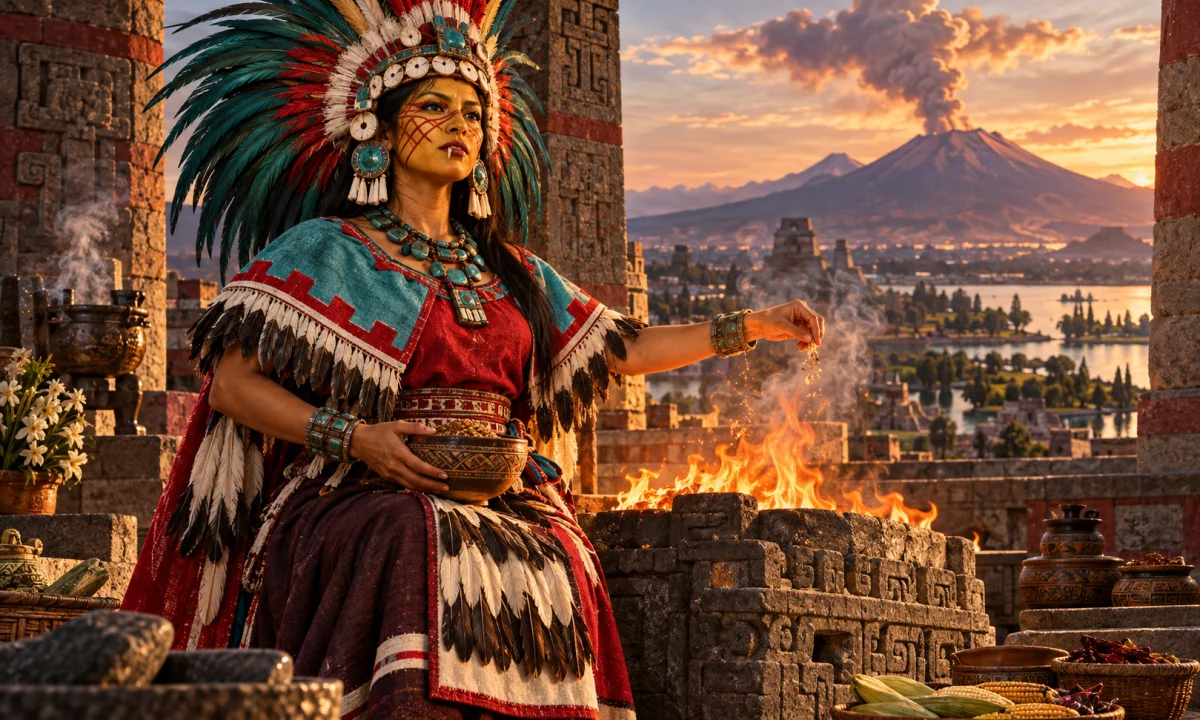
There is no universally agreed visual form for Ayauhtéotl. Some modern illustrations portray her as a young woman surrounded by pale vapour, clouds, or dawn light. These images communicate the meaning of the name, but they should not automatically be treated as reconstructions of an ancient standard. Artists and designers often combine features associated with several Nahua goddesses when depicting a poorly documented figure.
Identifying divine figures in Mesoamerican manuscripts is complex. Headdresses, facial paint, ornaments, body posture, weapons, and colours can carry meaning, but the same or similar features may occur in different contexts. A mist motif may indicate weather, water, a ritual setting, or a wider atmospheric power without naming Ayauhtéotl specifically. For this reason, an image labelled with her name in a modern publication may represent an interpretation rather than an uncontested ancient identification.
Vapour, cloud, pale haze, and obscured vision are appropriate symbolic representations of Ayauhtéotl. They are better understood as modern visual summaries of her attributed domain than as evidence of a securely documented costume or physical form. Claims that she always carried a particular object or wore a particular headdress require more evidence than is normally provided in popular accounts.
Mythological narratives and uncertainty
There is no famous surviving narrative in which Ayauhtéotl plays a central role comparable to Quetzalcoatl’s recovery of the bones of humanity, Huitzilopochtli’s birth and battle with Coyolxauhqui, or the stories surrounding Tlaloc and the rain. Her presence in modern lists of Aztec deities can create the impression that a full cycle of legends once existed in written form, but that conclusion is not justified by the available material.
Briefly documented deities may still have been meaningful in local ritual or oral tradition. The absence of a long recorded myth does not prove that no stories were told about Ayauhtéotl. It does mean that modern writers should distinguish between what is directly attested and what is inferred from the deity’s name, associations, or comparison with better-documented figures.
Accordingly, statements about Ayauhtéotl’s parents, siblings, lovers, enemies, temples, festivals, or specific supernatural deeds should be treated as variable unless supported by clear evidence. A cautious account preserves the deity’s association with mist while acknowledging that the rest of the profile remains fragmentary.
Cultural significance
Ayauhtéotl illustrates an important feature of Mesoamerican religion: the sacred significance of phenomena that modern descriptions might classify as minor or atmospheric. Mist can determine what people see, how they travel, how they interpret a landscape, and whether approaching rain appears hopeful or threatening. Personifying it gives religious language to uncertainty and to the shifting relationship between human beings and their environment.
The figure also demonstrates why Indigenous religious traditions should not be reduced to a rigid catalogue of neatly separated gods. Nahua deities could be understood through multiple forms, titles, manifestations, and overlapping powers. A minor or obscure name may preserve a local expression of a broader religious idea rather than represent a completely independent goddess in the modern sense.
For historians of religion, Ayauhtéotl is therefore significant not because she has a large surviving mythology, but because the figure reveals the limits of the evidence and the interpretive habits applied to it. Studying her requires attention to Nahuatl language, colonial transmission, pictorial interpretation, regional variation, and the difference between an ancient attestation and a modern reconstruction.
Later reception
Ayauhtéotl appears mainly in modern encyclopaedias, mythology websites, speculative reconstructions, and artistic treatments of lesser-known Aztec deities. Contemporary creators may expand her into a fully characterised goddess of fog, secrets, beauty, dreams, or twilight. Such portrayals can be imaginative responses to a sparse tradition, but they are not equivalent to evidence for a complete pre-Hispanic mythology.
When Ayauhtéotl is used in fantasy fiction, games, illustrations, or modern spiritual practices, those uses belong to contemporary reception. They should be distinguished from the limited historical record, particularly when new family relationships, powers, symbols, or stories are presented as though they were ancient facts. The most secure traditional association remains the deity’s connection with mist or fog, while many additional attributes remain uncertain, secondary, or interpretive.