WORLD
WORLD
Atrugiel
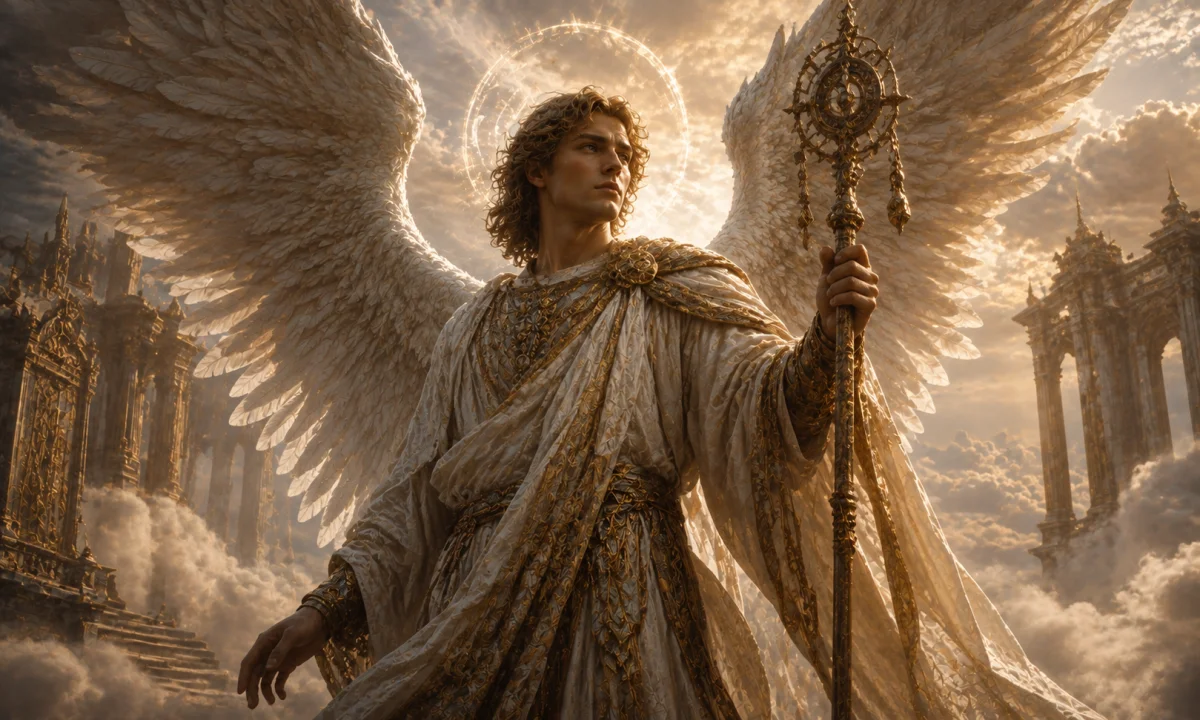
Atrugiel is an obscure angelic name whose identity and traditional setting are uncertain. It does not belong to the best-known groups of angels described in the Hebrew Bible, the New Testament, the Qur’an, or widely transmitted Jewish and Christian devotional traditions. Instead, the name appears mainly in later angelological and occult compilations, where spellings, classifications, and alleged functions are not consistent. Because the surviving evidence is limited, Atrugiel should not be treated as a clearly defined biblical or universally recognized angel.
Origins and textual setting
The name Atrugiel is difficult to trace to a single ancient text. Unlike names such as Michael, Gabriel, Raphael, or Uriel, it has no firmly established role in a major scriptural narrative. It is also absent from the central angelic figures of early Jewish apocalyptic writings, including the Book of Daniel, the Book of Tobit, and the principal sections of 1 Enoch. Nor is Atrugiel a standard figure in Christian liturgy or Islamic religious tradition.
Names of this kind often emerge from the extensive catalogues of angels associated with Jewish mystical writings, Renaissance ceremonial magic, astrological angelology, and later esoteric reference works. These traditions frequently preserve or adapt names from Hebrew, Aramaic, Greek, Latin, Arabic, and other languages. A name may be copied from one list to another without its original context, or it may be altered through transcription, translation, typesetting, or attempts to construct a meaningful sacred name.
That background is important in the case of Atrugiel. The name is sometimes presented online as though it belonged to a fixed hierarchy of ancient angels, but available references do not support a single, stable account of its origin. Claims that Atrugiel was a major biblical angel, a named archangel, or a prominent figure in early Jewish tradition are not substantiated by the principal religious texts.
The name and its identity
The meaning of Atrugiel is uncertain. Many angelic names ending in -el are interpreted as containing the divine name, since El is a Northwest Semitic word associated with God and appears in numerous Hebrew names. This element occurs in names such as Michael, Gabriel, Raphael, and Ariel. The presence of -el, however, does not by itself establish a name’s age, language, or religious authenticity.
The first part of Atrugiel has no generally accepted interpretation. It should not be confidently translated without a reliable ancient spelling and a documented linguistic context. Attempts to derive a complete meaning from the name are therefore speculative. Modern lists may assign meanings to obscure angel names by rearranging letters, connecting them with Hebrew roots, or associating them with symbolic ideas, but such explanations are not necessarily historical etymologies.
There is also no universally accepted spelling. The form Atrugiel is encountered in English-language esoteric material, but obscure names can appear with altered vowels, additional letters, or different transliterations. A spelling difference does not automatically indicate a separate angel; equally, similar-looking names should not be merged unless a source clearly identifies them as the same figure.
Classification in angelology
Atrugiel has no securely established rank in the traditional angelic hierarchies. In Christian theology, hierarchies such as the nine orders described by Pseudo-Dionysius the Areopagite classify angels as seraphim, cherubim, thrones, dominions, virtues, powers, principalities, archangels, and angels. Atrugiel is not a standard member of any of these orders.
Jewish angelology is less uniform than the later Christian hierarchy. Jewish texts describe angels as messengers, guardians, interpreters of visions, heavenly scribes, agents of divine judgment, and attendants at the divine throne. Some mystical works also name angels connected with the stars, planets, winds, days, hours, letters, or aspects of the heavenly temple. These catalogues can be highly elaborate, but they do not form one universally accepted system.
Where Atrugiel is placed in modern lists, the classification depends on the particular source. Some occult catalogues treat obscure names as members of a planetary, zodiacal, elemental, or calendrical system. Such assignments belong to the history of esoteric classification rather than to a consistent ancient tradition. Without a clear manuscript context, it is not possible to say that Atrugiel was traditionally the angel of a particular planet, hour, direction, virtue, or astrological sign.
Attributes and powers
No dependable ancient description gives Atrugiel a fixed appearance, emblem, weapon, colour, or set of powers. There is no well-established account of the angel appearing to a prophet, guiding a hero, defeating a demon, recording human deeds, or carrying a message from God. Stories of this kind should not be attributed to Atrugiel merely because they are common roles in angelic literature.
In religious traditions, an angel’s function is normally established by a text, liturgical use, commentary, vision, or sustained body of folklore. For example, Michael is repeatedly associated with protection and heavenly combat in Jewish and Christian sources; Gabriel is connected with divine announcements in several traditions; and Raphael is associated with healing and guidance in the Book of Tobit. Atrugiel lacks comparable narrative evidence.
Some modern occult references may attach a symbolic function to the name, but these attributions vary and are often repeated without explanation. A responsible description should therefore distinguish between documented tradition and modern cataloguing. It is more accurate to say that Atrugiel is an uncertain or poorly documented angelic name than to assign it a definite office simply to complete a hierarchy.
Relation to Jewish mystical and magical traditions
The uncertainty surrounding Atrugiel reflects the complicated history of angelic names in Jewish mysticism and ceremonial magic. Jewish writings from late antiquity and the medieval period contain many named heavenly beings. The Hekhalot literature, for example, describes visionary journeys through heavenly palaces guarded by angels. Other works, including sections of mystical and magical traditions associated with the names of God, preserve extensive angelic lists.
These texts were not all written at the same time, nor do they agree on every name or rank. A name appearing in a magical formula may have a different purpose from one appearing in a theological vision. Some names identify guardians, some are invoked in protective practices, and others form part of alphabetic, numerological, or cosmological arrangements. Later Christian and Renaissance occult authors copied, translated, reorganized, and sometimes expanded such material.
Atrugiel may belong to this broad history of transmitted angelic nomenclature, but the evidence does not establish a specific early Jewish text in which the figure plays a clearly defined role. It is therefore misleading to describe Atrugiel as an angel of “Jewish mythology” without qualification. The name is better understood as part of the wider history of angelic lists and esoteric reception, with its original context either obscure or lost.
Stories and relationships
Atrugiel has no widely recognized mythology. There are no firmly attested narratives describing a genealogy, a conflict with rebellious angels, a relationship with a named prophet, or a place in the heavenly court. In particular, Atrugiel should not be identified with one of the angels who appear in accounts of the Watchers, the fallen angels, or the judgment of the dead unless a specific source makes that connection.
Nor is there evidence that Atrugiel is another name for a better-known angel. Similar endings are common in angelic names, and the presence of -el does not imply identity. Confusing Atrugiel with Uriel, Ariel, Raguel, or other names can create relationships that are not present in the source material. The same caution applies to claims that Atrugiel is a variant of an angel whose name merely looks or sounds similar.
When modern websites provide a biography for Atrugiel, the details may reflect a process of synthesis: a name is taken from one list, a rank from another, and a symbolic attribute from a third. The resulting profile can appear complete while having no single historical source. Such composite descriptions are examples of modern esoteric interpretation rather than evidence for an ancient narrative.
Cultural significance
Although Atrugiel is not a major figure in established scripture or popular religious devotion, obscure angelic names have cultural importance in their own right. They show how traditions of sacred naming continued to develop beyond canonical texts. Medieval and early modern readers often believed that the universe was ordered through hidden correspondences among divine names, angels, planets, letters, numbers, times, and natural forces.
Lists of angels also reveal the tension between authority and invention. Some names were preserved from old manuscripts, while others were copied inaccurately or created according to perceived linguistic patterns. The existence of a name in a printed occult book does not prove that it was used in ancient worship. At the same time, a name need not be ancient to become meaningful within a later spiritual or magical community.
Atrugiel is therefore best approached as a marginal and uncertain figure in the history of angelic nomenclature. Its significance lies less in a known myth than in the way obscure names are transmitted, reinterpreted, and sometimes given new identities by later writers.
Atrugiel and modern popular culture
Atrugiel is not a prominent figure in mainstream novels, films, television, games, or comics. The name may appear in online occult databases, fantasy projects, role-playing material, or independently developed angelic systems, but these uses should be treated as modern adaptations unless they are explicitly based on a documented historical source.
Contemporary creators may assign Atrugiel a distinctive appearance, moral alignment, supernatural ability, or place in an angelic hierarchy. Such portrayals can be imaginative and culturally interesting, but they do not clarify the historical identity of the name. In particular, a fictional portrayal should not be used as evidence that Atrugiel was traditionally a warrior, healer, guardian, fallen angel, or ruler of a celestial sphere.
How to describe Atrugiel responsibly
- Atrugiel is an obscure angelic name with an uncertain origin and identity.
- It is not a standard biblical angel, archangel, or universally recognized figure in Jewish, Christian, or Islamic tradition.
- Its meaning, rank, appearance, powers, and symbolic associations are not securely established.
- Modern occult lists may provide attributes, but those claims vary and should be labelled as later or esoteric interpretations.
- Atrugiel should not be equated with similarly named angels without clear textual evidence.
The most accurate account of Atrugiel is consequently a cautious one. The name belongs to the broad and changing history of angelic classification, but the surviving evidence does not permit a confident biography or a fixed set of supernatural attributes. Any fuller profile should identify the particular later source on which it relies rather than presenting uncertain material as an ancient religious fact.