WORLD
WORLD
Arcas
Arcas is a legendary king and culture hero of Arcadia in Greek mythology. He is best known as the son of Zeus and Callisto, the young hunter who nearly killed his mother after she had been transformed into a bear, and the figure associated with the origins of the Arcadian people. Greek and Roman traditions also connect him with the constellations of the Great Bear, the Little Bear and, in some versions, Boötes.
Origins and cultural setting
Arcas belongs to the mythology of Arcadia, a mountainous region in the centre of the Peloponnese. In Greek imagination, Arcadia was an ancient, pastoral land whose people preserved old customs and maintained important cults of Zeus, Artemis and other deities. The region was not a single unified kingdom in historical times, but myth often presents it as an early realm ruled by ancestral kings.
The name Arcas is closely associated with Arcadia, and he functions principally as an eponymous ancestor: a legendary person whose name explains the name of a people or territory. His mythology therefore combines several functions. He is a member of the family of Zeus, a survivor of the violent myths surrounding his grandfather Lycaon, a founder or early king of Arcadia, and a figure in an astronomical explanation of the northern constellations.
There is no single canonical account of Arcas. His story survives in different forms in mythographical, poetic and geographical writings, including the Library attributed to Apollodorus, Ovid’s Metamorphoses, the astronomical traditions associated with Eratosthenes and Hyginus, and Pausanias’s description of Arcadian traditions. These accounts do not always agree about the details of his birth, Callisto’s transformation or his eventual identity in the stars.
Name and identity
In Greek, Arcas is written Arkás (Ἀρκάς), while the Latin form is Arcas. The name is connected with Arcadia, although its deeper etymology is uncertain. Ancient storytellers sometimes linked the tale to bears because Callisto becomes a bear and because Arcas is associated with bear constellations. That connection is mythological and symbolic rather than secure evidence that the personal name originally meant “bear.”
Arcas is not normally treated as a god. He is a heroic ancestor, king and culture-bringer, comparable to other Greek figures credited with establishing customs, skills or political communities. His importance comes from his relationship to Arcadian identity rather than from a large independent cult comparable to that of Zeus or Artemis.
Several genealogical traditions place him within an old royal line. His mother is usually Callisto, a companion of Artemis and the daughter of Lycaon. His father is Zeus, although some accounts obscure or alter the circumstances of their union. Through Callisto, Arcas is therefore the grandson of Lycaon, the notorious Arcadian ruler whose story is linked to human sacrifice and transformation into a wolf.
Callisto and the birth of Arcas
Callisto is generally described as a hunting companion of Artemis. She was expected to maintain the goddess’s ideal of chastity, at least in the versions that emphasize her membership in Artemis’s hunting band. Zeus desired her and approached her by deception. In Ovid’s account, he disguised himself as Diana, the Roman equivalent of Artemis, in order to come near her without causing alarm. Other Greek versions describe a similar deception, though the disguise and the exact circumstances vary.
Callisto became pregnant, and her condition was eventually discovered. The revelation was especially serious because it showed that she had broken the sexual restrictions associated with Artemis’s companions. In different traditions, Artemis or Hera is responsible for transforming Callisto into a bear. The change also serves to separate her from human society and to turn her into the wild creature with which her later constellation is associated.
Arcas was born before or around the time of Callisto’s transformation, depending on the version. Zeus protected the child, but the stories differ about who raised him. Some accounts place him in the care of a divine foster parent, while others move quickly from his birth to his later life as a hunter. These differences reflect the way mythographers combined separate local and literary traditions rather than preserving one continuous biography.
The name of Arcas’s mother also carries several layers of meaning. In Arcadian tradition, Callisto was connected with the wilderness, hunting and a bear-shaped form of the goddess or her attendant. Later Greek and Roman writers made her transformation central to the story, but local Arcadian traditions could preserve her as a royal ancestor as well as a tragic figure.
The story of Lycaon
Arcas’s family is connected with one of the most disturbing myths in Greek religion. Lycaon, king of Arcadia and father of Callisto in many genealogies, is said to have tested Zeus by serving him human flesh. The precise details differ: in some versions Lycaon sacrifices a child, while in others he kills or prepares one of his own sons. Zeus responds by overturning Lycaon’s house and transforming him into a wolf.
This myth is more than a story about a monstrous individual. It explores the boundaries between human beings, animals and gods, as well as the religious prohibition against violating the rules of hospitality and sacrifice. The name Lycaon is itself associated with the wolf, and the story may have been connected in later interpretation with the cult of Zeus Lykaios on Mount Lycaeus in Arcadia.
Arcas does not usually participate in Lycaon’s crime. Instead, he belongs to the next generation and represents the restoration or reorganization of Arcadian society after the violence surrounding his grandfather. Some accounts make the succession of Arcadian kings difficult to reconcile, with different figures placed in the kingdom at different stages. These inconsistencies should not be treated as a single historical royal chronology.
Arcas as hunter and tragic son
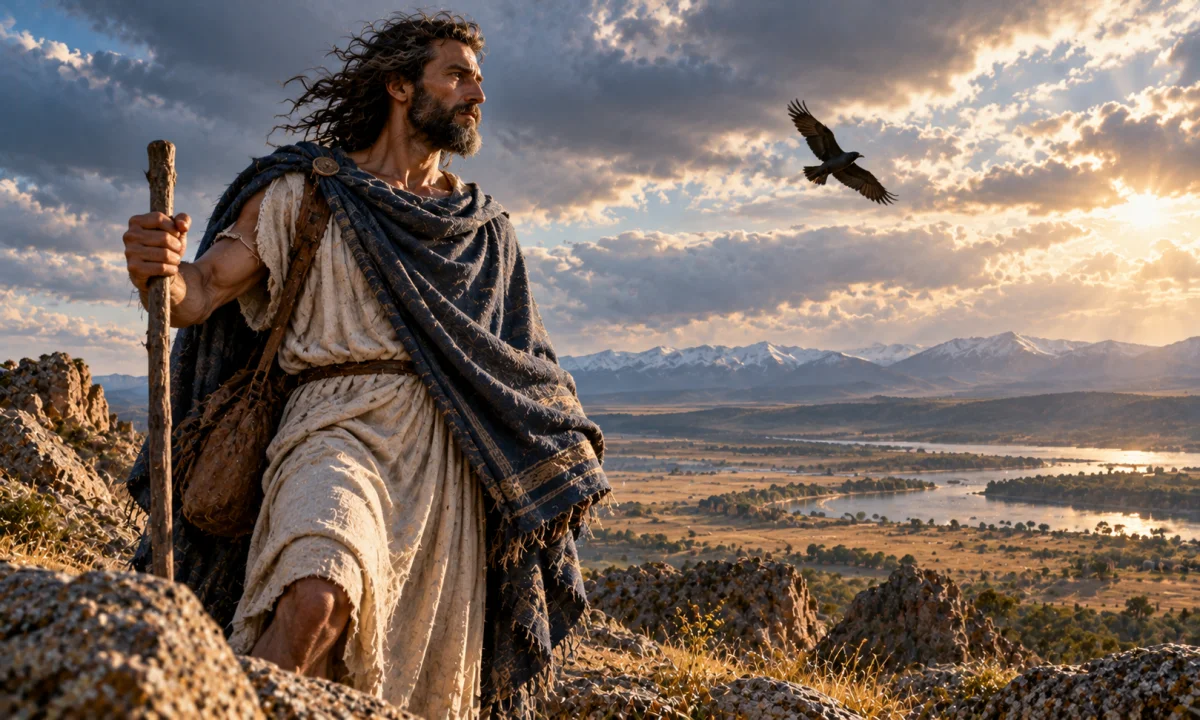
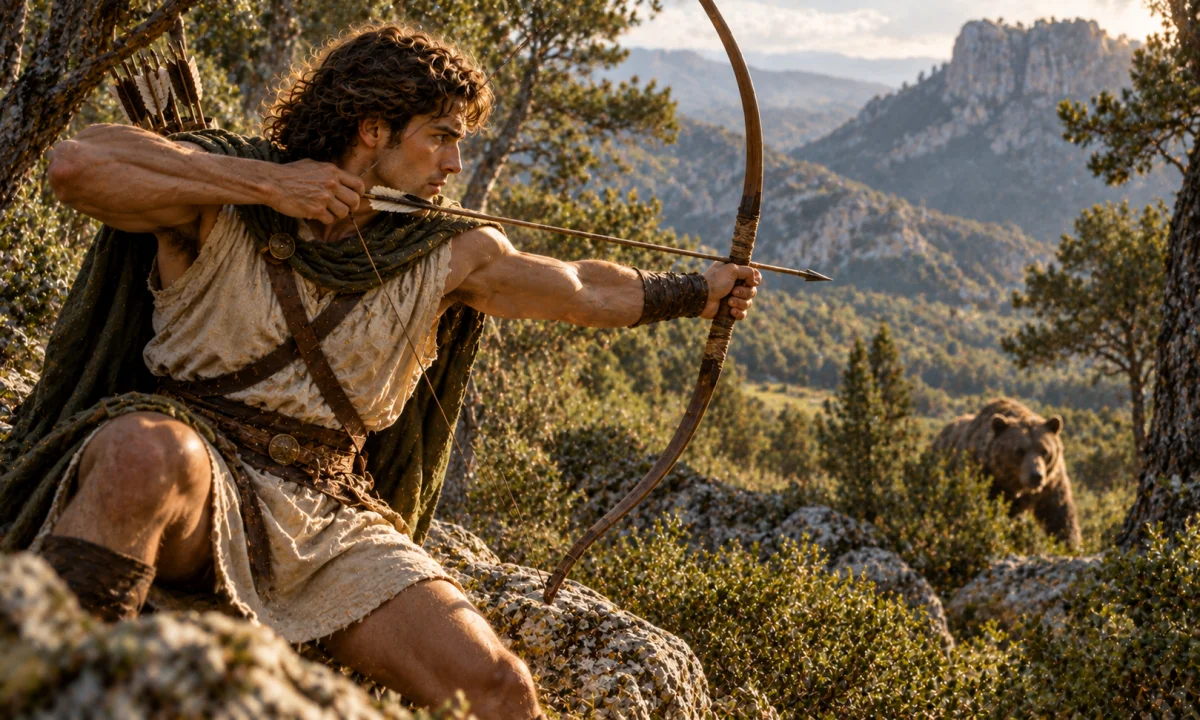
The best-known episode in the story of Arcas occurs after Callisto has become a bear. Arcas grows into a hunter and encounters the animal in the forest. He does not recognize his mother. Callisto, however, recognizes him and tries to approach her son. In some versions Arcas is about to kill her; in others, he enters a sacred enclosure or otherwise threatens to violate a boundary without knowing that the bear is human.
Zeus intervenes before the tragedy is completed. He places Callisto and Arcas among the stars, preserving them from death at each other’s hands. This is the basic explanation for the connection between the two figures and the bear constellations. The tale combines family recognition, divine rescue and the transformation of an earthly disaster into a permanent feature of the heavens.
Ovid’s version gives the episode particular emotional force. Callisto’s animal body prevents her from explaining who she is, while Arcas sees only a dangerous bear. The son’s ignorance makes the impending violence more tragic, since neither character is acting with full knowledge. Ovid also includes Juno’s anger toward Callisto and her complaint that the transformed mother and son have been granted an honourable place in the sky.
Arcas and the constellations
The celestial identities connected with Arcas vary considerably. Callisto is most often identified with Ursa Major, the Great Bear. Arcas may be identified with Ursa Minor, the Little Bear, especially in accounts that present him as a smaller or younger companion to his mother. In other traditions, Arcas becomes Boötes, the Bear-Watcher or Bear-Herder, a constellation located near the Great Bear.
These alternatives are not simply spelling differences. They represent competing attempts to explain a group of neighbouring constellations. The figure of Boötes was sometimes interpreted as a herdsman, ploughman or guardian, but Greek mythographers could also understand him as Arcas watching over his transformed mother. The title “Bear-Watcher” naturally encouraged this association.
Some accounts explain why the Great and Little Bears never set below the horizon. Hera, still hostile to Callisto, asks the sea gods or the cosmic powers not to allow the two constellations to descend into the waters. As a result, they circle perpetually around the north celestial pole. This is a mythic explanation of the circumpolar movement of the constellations, not an astronomical claim in the modern scientific sense.
The astronomical tradition also shows how Greek mythology could link family relationships to visible patterns in the sky. Callisto’s transformation into a bear, Arcas’s identity as hunter or guardian, and the unusual movement of the northern stars were woven into a single narrative. The story was especially influential because it offered a memorable account of why the constellations remained close together.
Arcas as king and culture hero
Arcas’s other major role is that of an early king of Arcadia. In local genealogical traditions, he succeeds earlier rulers and gives his name to the country, which was previously associated with the Pelasgians or with other ancestral figures. The exact order of these rulers varies. Some accounts place Arcas after Nyctimus, while others organize the royal succession differently.
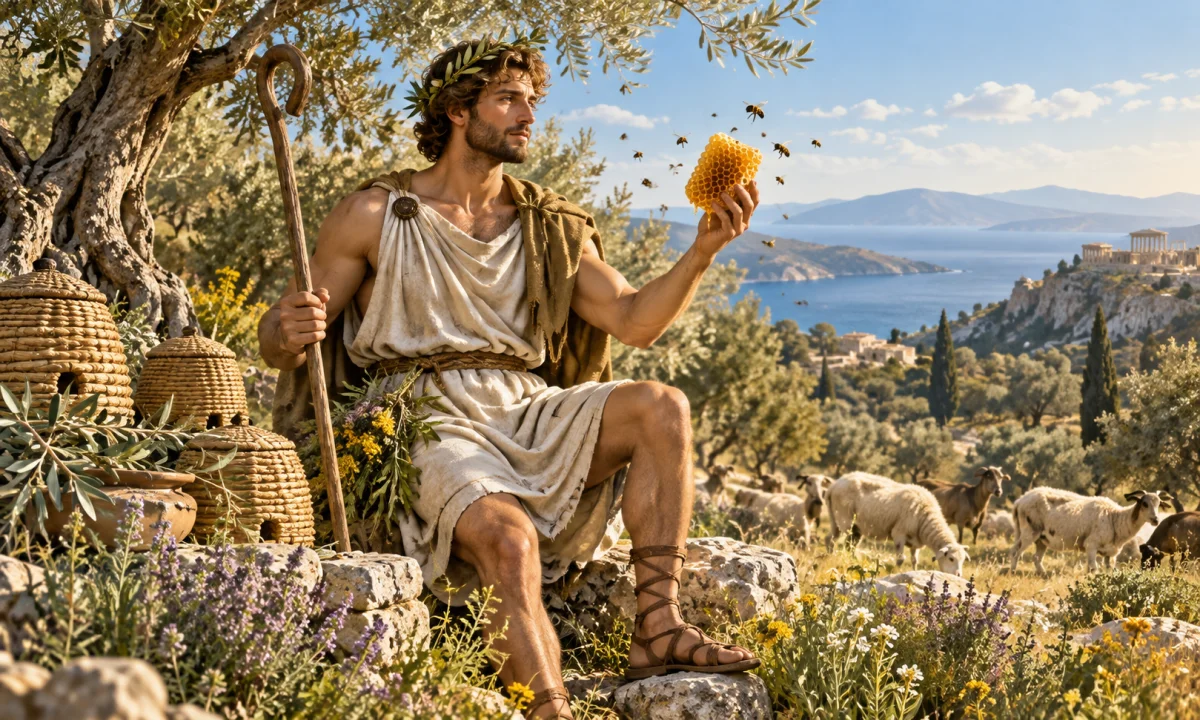
As king, Arcas is credited with making life more settled and civilized. Ancient writers associate him with the introduction or improvement of agriculture, the cultivation of grain and the preparation of bread. He is also sometimes connected with the weaving of wool and with the development of pastoral skills. These claims make him a typical Greek culture hero: a ruler who does not merely inherit a kingdom but gives its people practical knowledge.
Some traditions say that Arcas learned agriculture from Triptolemus, the Eleusinian culture hero associated with Demeter’s gift of grain. This connection places Arcadian farming within a wider Greek mythic network in which divine knowledge passes from the gods to exemplary human teachers. It should not be read as evidence for a historical individual who introduced farming to Arcadia.
Arcas is also portrayed as an accomplished hunter, which connects his royal and celestial identities. Hunting belongs to the wilderness of Arcadia, while agriculture represents settled life. His mythology therefore brings together two important images of the region: the rugged land of forests and mountains, and the organized community that produces food, customs and political order.
Descendants and the division of Arcadia
Traditions commonly give Arcas three sons: Azan, Apheidas and Elatus. After Arcas’s death, the kingdom is divided among them or associated with territories bearing their names. Azan is linked with Azania, Apheidas with Tegea, and Elatus with Mount Cyllene or other parts of Arcadia, although the territorial details vary between accounts.
This division explains why Arcadian mythology contains several local royal lines rather than one uninterrupted dynasty. Towns and districts could claim descent from different sons of Arcas, giving their communities a place within a shared ancestral story while preserving their separate identities. Through these descendants, Arcas becomes less an individual adventurer than the symbolic ancestor of a network of Arcadian peoples.
The genealogy also shows why ancient myth should not be approached as a fixed family tree. Greek communities often adapted genealogies to connect local founders with prestigious figures such as Zeus, Lycaon or Arcas. Contradictory relationships may reflect different regional traditions, poetic choices or attempts by later writers to combine independent stories.
Religious and cultural significance
Arcas’s mythology expresses several themes important in Greek thought. His family links divine power with human kingship, but the story also warns that divine desire and family violence can have devastating consequences. Callisto’s transformation places a human woman between the worlds of the household, the hunt and the heavens. Arcas then inherits both the danger of the wilderness and the responsibility of founding an ordered community.
His connection with Callisto may also reflect ancient interest in the relationship between Artemis, wild animals and female independence. The precise religious meaning of Callisto is uncertain, and she should not automatically be equated with Artemis. In some interpretations, however, her story preserves memories of a local Arcadian female figure associated with bears, hunting or the wilderness that was later incorporated into broader Greek mythology.
Arcas’s role as an ancestor was especially significant in Arcadian identity. By claiming descent from him, Arcadians could present themselves as an ancient people with a distinctive homeland and a continuous mythic past. His story helped explain the name of the region, the division of its territories, its royal families and its place in the sacred landscape of Greece.
Distinguishing Arcas from similar figures
Arcas should not be confused with Arcus, a Latin word meaning “bow” or “arch,” even though modern retellings may blur names when they pass between Greek and Roman traditions. He is also distinct from Arcas of Arcadia as a historical designation: no securely documented historical king corresponding to the mythic figure has been established.
Arcas is likewise not the same as Lycaon. Lycaon is his maternal grandfather in many genealogies and is the figure transformed into a wolf after offending Zeus. Nor is Arcas identical with Boötes in every tradition. Boötes is an independent constellation figure in some astronomical accounts, while other writers identify him with Arcas. The Great Bear, Little Bear and Boötes therefore belong to overlapping but not fully consistent mythological explanations.
Later reception
The story of Arcas and Callisto became particularly influential through Ovid’s Metamorphoses, which shaped later European readings of Greek and Roman mythology. Artists and poets were drawn to the image of the son confronting his transformed mother and to the final elevation of both figures into the sky. Renaissance and later art often emphasized the pathos of recognition, the danger of hunting and the power of divine transformation.
In modern retellings, Arcas is often reduced to the boy who becomes the Little Bear or the hunter who almost kills Callisto. Such versions may combine details from Ovid, ancient astronomical myth and later popular summaries. The older traditions are more varied: Arcas can be a constellation figure, an Arcadian king, a culture hero, or the ancestor of several regional dynasties, and no single version includes every one of these roles in the same way.
His most enduring legacy is therefore divided between the cultural memory of Arcadia and the stars associated with the Great Bear, Little Bear and Boötes. The myth preserves both a regional foundation story and an explanation of the northern sky, while its conflicting variants reveal how Greek communities and later writers continually reshaped inherited traditions.