WORLD
WORLD
Araqiel

Araqiel is a name associated primarily with the Watchers, a group of heavenly beings described in the apocalyptic tradition of 1 Enoch. In that work, Araqiel is listed among the angels who descended to earth and became involved with humanity. His particular teaching is connected with “the signs of the earth,” although the precise meaning of that phrase is uncertain. Araqiel is therefore best understood as a relatively obscure Enochic angel rather than as a universally recognised archangel in Jewish, Christian or Islamic tradition.
Origins in the Enochic tradition
The principal setting for Araqiel is the story of the Watchers in 1 Enoch, also known as the Book of Enoch. This is an ancient Jewish apocalyptic work that developed over several stages, probably between the third and first centuries BCE, although its individual sections have different dates and histories. The work expands upon the brief account of the “sons of God” in Genesis 6:1–4, presenting them as heavenly beings who descended to earth, took human women as partners and transmitted forbidden knowledge.
1 Enoch survives in a complete form in Ge'ez, the classical language of Ethiopia. Parts of the work are also preserved in Aramaic fragments found among the Dead Sea Scrolls, together with Greek material from later manuscript traditions. These surviving witnesses are important because the names of angels were copied and transliterated in different languages. As a result, the spelling and sometimes the form of Araqiel’s name vary considerably.
In the opening account of the Watchers, Araqiel appears in a list of the leaders who descended under the direction of Semjaza, their chief. The text does not present Araqiel as an independent deity or as an object of worship. He is one member of a larger group of heavenly beings whose actions contribute to the corruption of the human world and to the violence associated with the giants, or nephilim, born from the union between the Watchers and human women.
The name Araqiel and variant spellings
The name appears in several transliteration forms, including Araqiel, Arakiel, Araquiel and other less common spellings. These differences arise from the movement of the name between Aramaic, Greek, Ge'ez and modern scholarly languages. They do not necessarily indicate separate angels. In many contexts, Araqiel and Arakiel are simply alternative renderings of the same Enochic name.
The name is often interpreted as containing a divine element represented by -el, a common component in Hebrew and Aramaic angelic names. The first part is frequently connected with a word for earth or land. This has encouraged the translation “Earth of God” or similar forms. Such interpretations are plausible within the linguistic and theological environment of the Enochic writings, but the exact etymology is not completely secure. The name should not be treated as having one universally established translation.
Modern reference works sometimes standardise the name as “Arakiel,” while others prefer “Araqiel.” Neither spelling has an exclusive claim to authenticity in English. When discussing the figure, it is useful to recognise the variants rather than assuming that every form represents a different angel.
A Watcher among the fallen angels
Araqiel belongs to the tradition of the Watchers, usually called grigori in discussions of their Greek or later Christian reception. In 1 Enoch, the Watchers are heavenly beings who abandon their proper place. Their descent is not portrayed as a harmless visit to humanity. They enter into forbidden unions, reveal secret knowledge and help bring about a period of disorder and violence.
The Watchers are not identical to Satan or to a single ruler of demons. Their story is a distinct interpretation of the brief biblical passage in Genesis. Nor are they simply benevolent guardian angels. Some religious and literary traditions use the word “watcher” in a positive sense for heavenly guardians, but the Watchers of the opening sections of 1 Enoch are specifically associated with transgression and judgment.
Araqiel’s inclusion in the list of Watcher leaders places him within this morally negative narrative. The text does not provide a detailed biography for him, and it does not give him a central role comparable to Semjaza or Azazel. His significance comes chiefly from his place in the group and from the particular knowledge attributed to him.
The teaching of the signs of the earth
The clearest traditional association of Araqiel is found in a catalogue of the knowledge taught by the rebellious angels. Araqiel is said to have taught “the signs of the earth.” The wording is brief, and its interpretation is debated.
The phrase may refer to knowledge of terrestrial phenomena, omens, or signs observed in the natural world. In an ancient apocalyptic setting, “signs of the earth” could suggest the interpretation of earthquakes, unusual natural events, geographical features or other portents. It may also refer more broadly to forms of divination connected with the land and its movements. The text does not explain the expression in enough detail to identify a single technical discipline with certainty.
Later summaries sometimes describe Araqiel as the angel of earth, the ruler of earthly knowledge or the teacher of geomancy. These descriptions should be treated cautiously. The surviving Enochic passage connects him with signs of the earth, but it does not clearly establish a fully developed office as “angel of earth,” nor does it explicitly assign him the later occult practice of geomancy. Those expanded roles are interpretations or later associations rather than straightforward statements from 1 Enoch.
The catalogue of forbidden teachings gives the Watchers different areas of expertise. Azazel is associated with weapons, metalworking, cosmetics and related arts; other angels are connected with astronomy, meteorology, the courses of the sun and moon, or various forms of divination. In this context, Araqiel’s teaching belongs to a larger criticism of secret knowledge removed from its proper heavenly or moral order.
Role in the story of judgment
The central narrative of 1 Enoch does not follow Araqiel individually after naming him. Instead, the Watchers are treated collectively. Their actions lead to divine judgment, and the earth’s corruption becomes a reason for the coming flood. Noah is warned about the destruction, while the rebellious heavenly beings are denied restoration to their former state.
The Watchers are confined or restrained until the final judgment. Their offspring, the giants, are destroyed, but the spirits that proceed from the giants become associated with destructive spirits or demons in the interpretation developed within the work. Araqiel is part of the group condemned under this larger judgment, although the text does not describe a unique punishment designed specifically for him.
This lack of an individual narrative is significant. Many later lists of angels assign elaborate duties, personalities and appearances to figures who receive only a brief mention in ancient texts. In Araqiel’s case, the earliest surviving tradition provides a name, a place among the Watchers and an association with the signs of the earth. It does not provide a developed character portrait.
Appearance and powers
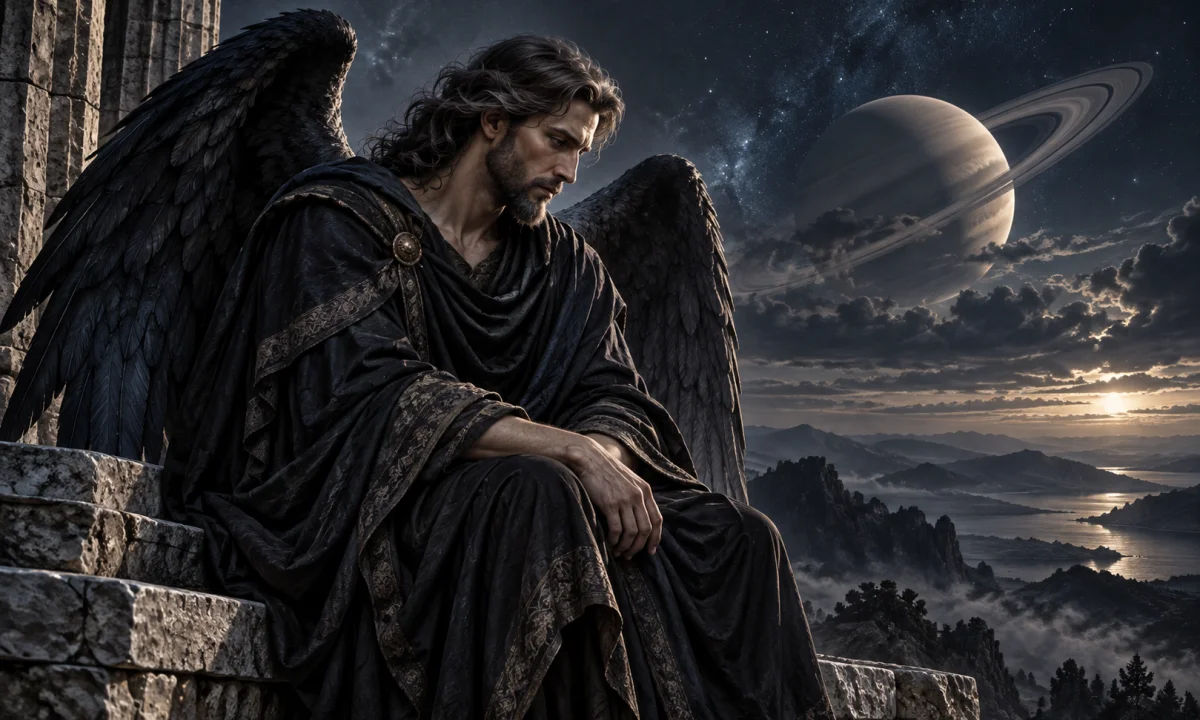
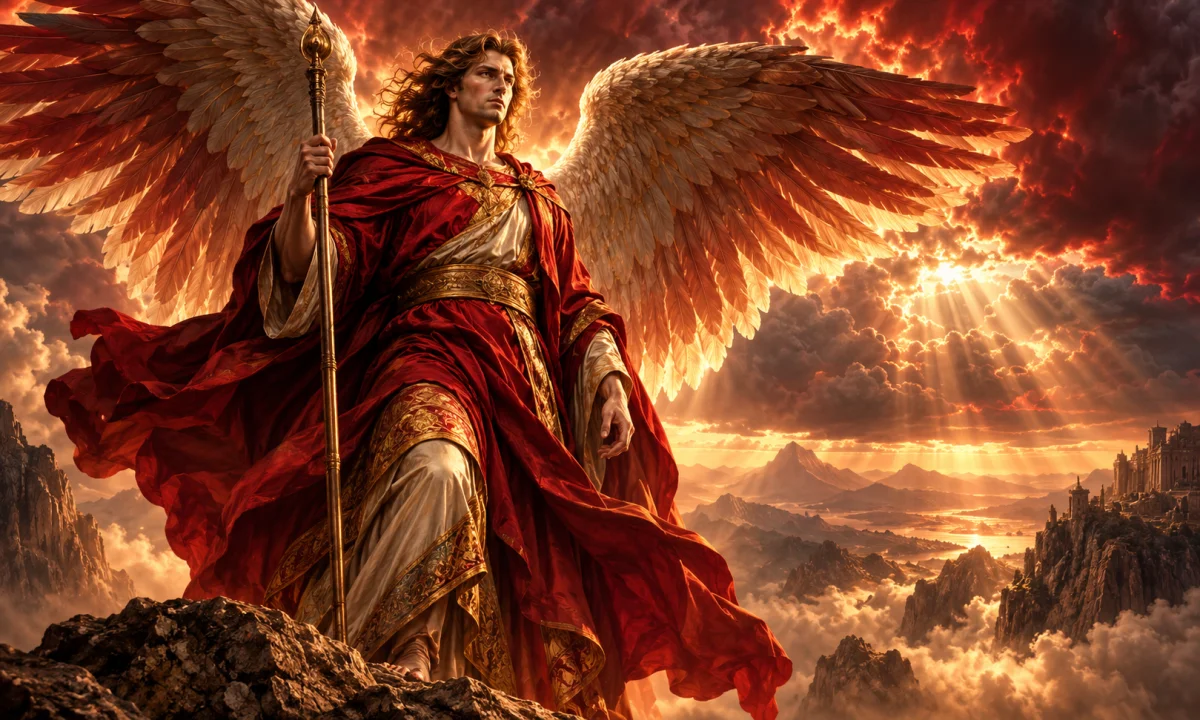
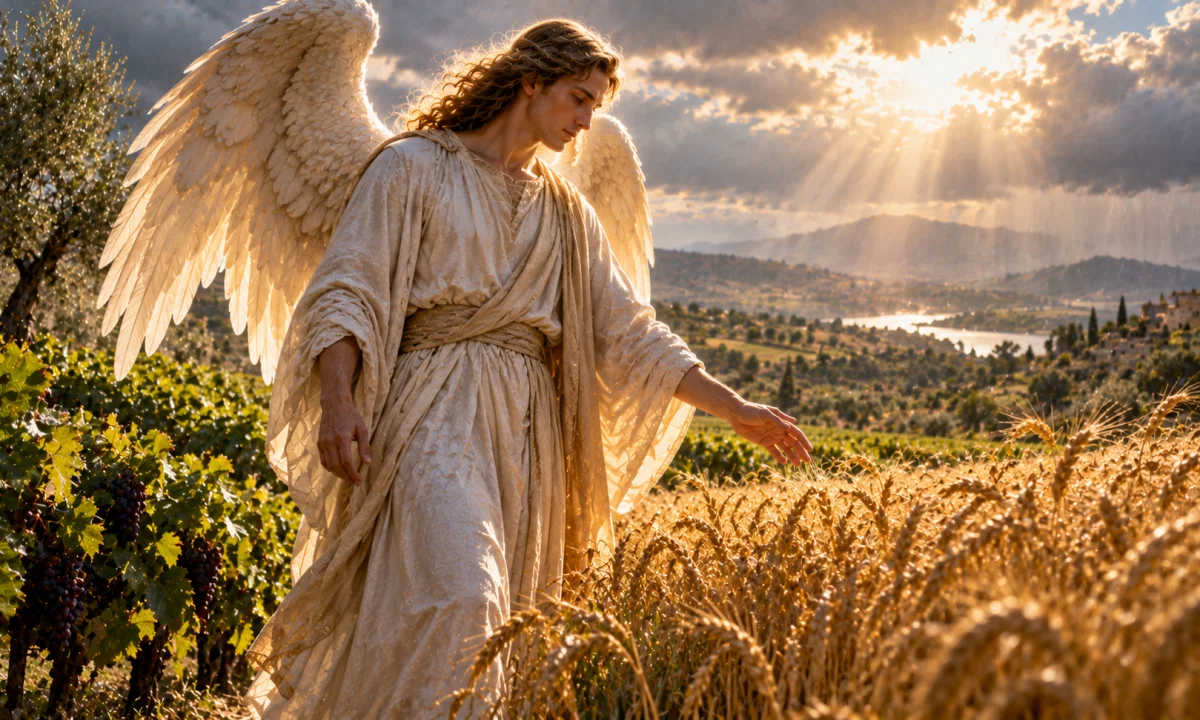
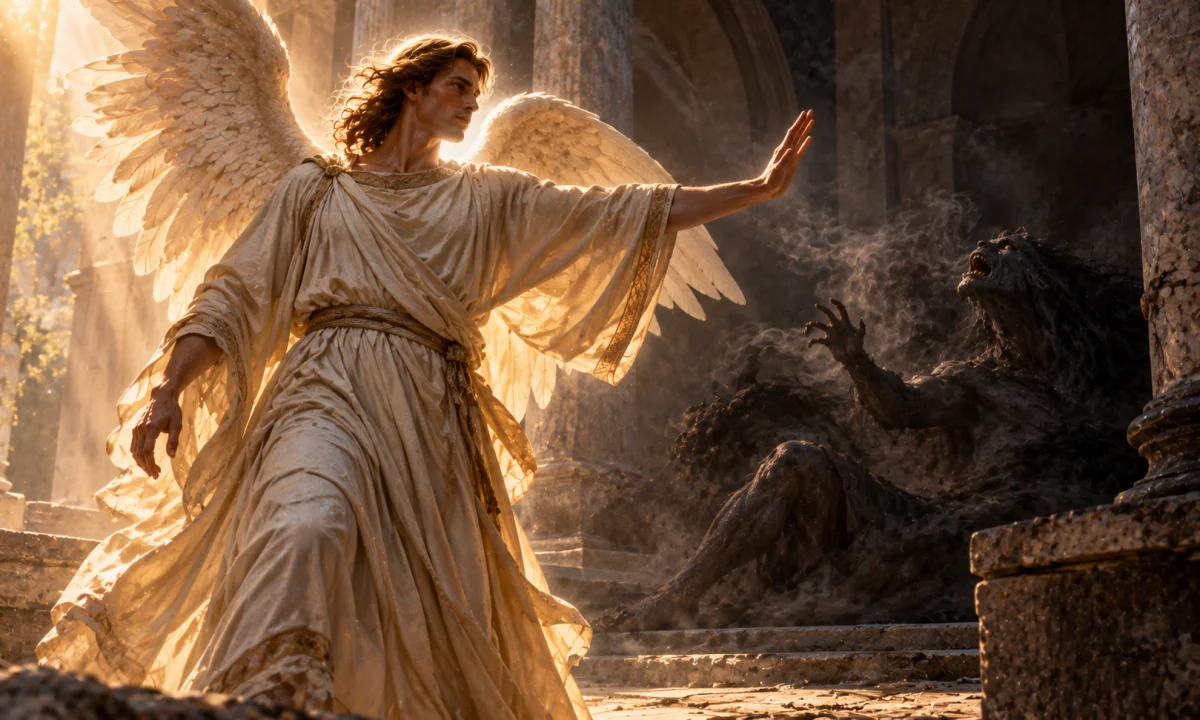
Ancient Enochic writings do not give Araqiel a standard physical appearance. There is no reliable early description of his face, wings, clothing, weapon or colour. Artistic representations that show him as a winged figure standing on the earth are modern attempts to visualise his name or role, not descriptions preserved by the Enochic text.
His “powers,” in the limited sense supported by the tradition, consist of supernatural knowledge concerning the signs of the earth. The text presents this knowledge as part of the forbidden instruction communicated by the Watchers. It does not say that Araqiel created the earth, governs all natural forces or protects humanity from earthquakes and other disasters.
Nor does the ancient account clearly classify him as an archangel. The word “archangel” is used in different ways across religious literature, and later angelologies often rank heavenly beings into elaborate orders. Araqiel’s appearance in a list of Watcher leaders does not automatically make him an archangel in the later hierarchical sense. He is more accurately described as a Watcher or fallen heavenly being in the Enochic tradition.
Relationship to other Watchers
Araqiel is named alongside figures such as Semjaza, Azazel, Baraqijal, Kokabel, Shamsiel and others. The exact form and order of these names can differ among manuscripts and translations. The list is not a complete account of every angel in Jewish tradition; it is a catalogue of the leaders connected with the Watchers’ descent.
Semjaza is generally presented as the leader who binds the Watchers to their collective oath. Azazel receives a particularly prominent role because he teaches destructive arts and is later singled out for punishment. Araqiel has a much smaller part. His association with terrestrial signs places him among the teachers of hidden knowledge, but the narrative does not make him a spokesman, commander or principal antagonist.
In some modern accounts, all of the Watchers are treated as if they possessed identical roles or as if each had a fully defined supernatural domain. The ancient material does not support that level of uniformity. The Watchers share a common transgression, but the catalogue assigns different kinds of instruction to different figures, and the surrounding text gives more attention to some names than to others.
Religious and cultural significance
Araqiel is important less as a widely venerated angel than as part of a major development in Jewish reflection on evil, forbidden knowledge and the origin of violence. The Watcher story addresses questions that Genesis leaves largely unexplained: Why did heavenly beings become involved with human society? How did extraordinary beings and destructive knowledge enter the world? Why is the human condition marked by violence before the flood?
Within 1 Enoch, the problem is not simply that humans acquire knowledge. The concern is that knowledge is transmitted through rebellion and used without the moral order expected by the divine realm. Araqiel’s teaching of earthly signs therefore participates in a wider theme: natural knowledge, divination and technical skill may become dangerous when separated from proper boundaries.
The Enochic account influenced later Jewish and Christian discussions of angels, demons and the interpretation of Genesis 6. 1 Enoch was especially preserved and valued in Ethiopian Christianity, where it remains part of the broader scriptural tradition. At the same time, Araqiel himself did not become a major object of liturgical devotion or a universally recognised figure in mainstream Christian angelology.
Jewish angelic traditions are diverse, and the Watchers do not occupy the same position in every Jewish text. Later rabbinic literature often approaches the interpretation of Genesis 6 differently, and the named Watchers of 1 Enoch are not consistently reproduced as a standard angelic hierarchy. Islamic tradition also contains accounts of angels, jinn and heavenly beings, but Araqiel is not a standard Qur'anic figure and should not be presented as an established Islamic angel without qualification.
Distinguishing Araqiel from similar names
Araqiel is sometimes confused with other angelic names because many traditions use the ending -el. He should not automatically be identified with Ariel, a name associated in different sources with a lion-like divine symbol, Jerusalem or an angelic being. Nor is he the same figure as Uriel, the prominent angel who appears in several Jewish and Christian apocalyptic traditions.
Araqiel is also distinct from Azrael, the name widely used in later Jewish, Christian and Islamic folklore for an angel of death. The similarity of sound is not evidence that the two names refer to the same being. Azrael belongs to a different body of traditions, while Araqiel’s earliest clear setting is the Watcher narrative of 1 Enoch.
Likewise, “Arakiel” should generally be treated as a spelling variant of Araqiel when it occurs in discussions of the Enochic Watcher. However, a name in a later occult catalogue may have been reassigned, altered or combined with material from another tradition. Each occurrence needs to be examined in its own textual context rather than assumed to preserve the ancient figure unchanged.
Later occult and popular representations
In modern esoteric writing, angel directories and fantasy-oriented material, Araqiel is sometimes recast as a neutral or benevolent spirit of the earth. He may be described as a guardian of nature, a teacher of earthly mysteries or a patron of divination. These portrayals draw on the phrase “signs of the earth,” but they reverse or soften the moral context of 1 Enoch, where the teaching belongs to a group condemned for rebellion.
Contemporary fiction and online angelology may also give Araqiel a distinctive appearance, rank, personality or set of powers. Such details can be useful as modern creative interpretations, but they are not part of a stable ancient biography. The traditional evidence remains comparatively narrow: Araqiel is a Watcher leader named in the Enochic tradition and associated with teaching the signs of the earth.