WORLD
WORLD
Antinous
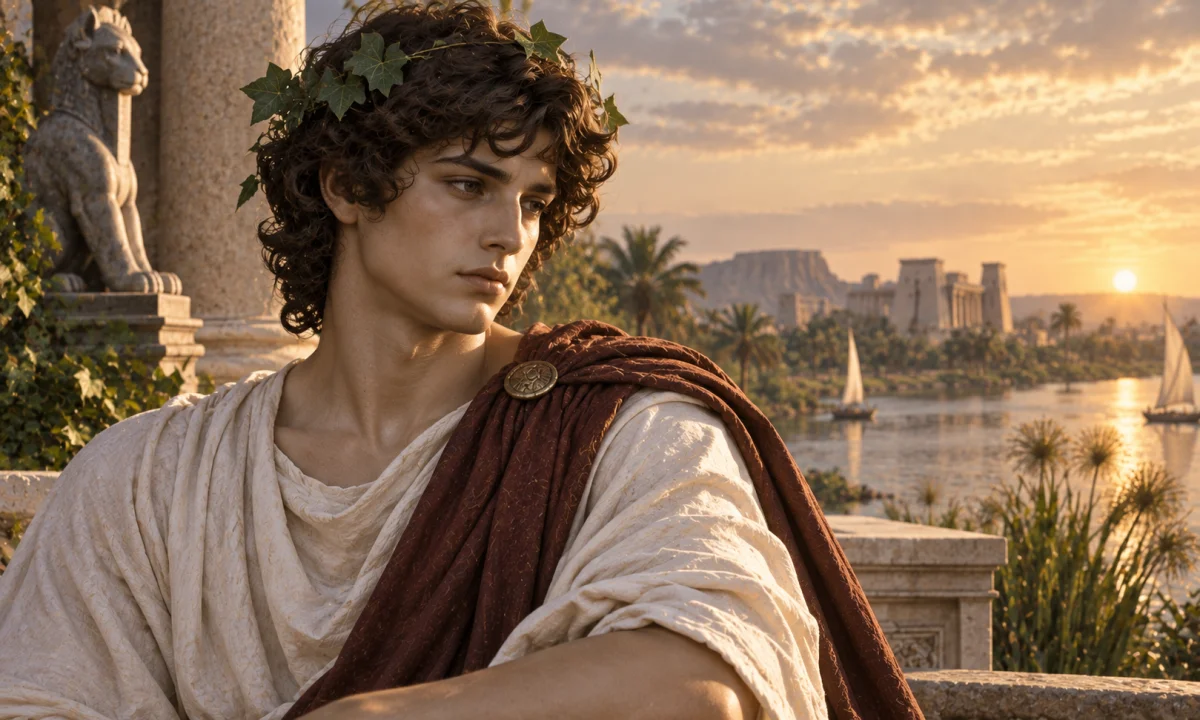
Antinous was a young man from Bithynia who became the beloved companion of the Roman emperor Hadrian and, after his death, the focus of a widespread religious cult. Unlike most figures classified under Roman mythology, Antinous did not originate as an ancient god or legendary hero. He was a historical person who was honoured as a divine or heroic being after dying in 130 CE. His cult combined Roman imperial religion, Greek traditions of hero worship, and Egyptian ideas about death and rebirth.
Historical identity and cultural setting
Antinous was born in Bithynium, a city in north-western Asia Minor later known as Claudiopolis. The region was culturally Greek-speaking but belonged to the Roman Empire. His exact birth date, family background and social status are not securely recorded. He was probably born around 110 CE, although the evidence does not permit a precise date.
Antinous entered the household of Hadrian at some point before 130 CE. The surviving evidence presents him as the emperor’s favourite and close companion. Ancient writers and later interpretations often describe their relationship as erotic, but the details of their private life are not known. Roman society recognised relationships between adult men and younger males within particular social and cultural conventions, yet the unequal status between an emperor and a young provincial Greek makes the relationship historically complex.
Hadrian ruled from 117 to 138 CE and travelled extensively through the empire. He was deeply interested in Greek language, literature, architecture and religious traditions. His association with Antinous therefore took place within a broader imperial fascination with Greek culture, while also involving the political and religious power of the Roman emperor.
Death in the Nile
Antinous died in Egypt in October 130 CE, while Hadrian and his entourage were travelling along the Nile. The basic fact of his death is well established, but its circumstances remain uncertain. The ancient sources do not provide a single fully reliable explanation.
Some accounts state that Antinous fell into the river and drowned. Others suggest that he deliberately sacrificed himself to preserve Hadrian’s life or prevent an ominous prophecy from being fulfilled. The later writer known as the author of the Historia Augusta reports competing explanations, including the possibility that Antinous gave his life for the emperor. Cassius Dio also records that Antinous died in the Nile and that Hadrian founded a city and established honours for him afterwards. These accounts were written after the events and reflect the growth of the cult rather than giving an eyewitness record.
Modern claims that Antinous was murdered, forced to die or deliberately sacrificed cannot be demonstrated with certainty. The suggestion of a ritual sacrifice may reflect ancient rumours, imperial propaganda, or an attempt to explain a sudden and politically significant death. Hadrian himself may have known what happened, but the surviving evidence does not allow the question to be settled.
Antinous’s death caused intense grief in Hadrian. The emperor ordered public honours, founded a new city in Egypt and promoted the worship of Antinous throughout the empire. A bright star or constellation was also associated with him. This rapid transformation from beloved companion into a divine figure was unusual in scale, though it had precedents in the ancient Mediterranean, where exceptional mortals could be honoured as heroes or gods after death.
The city of Antinoopolis
Hadrian founded Antinoopolis, also called Antinoë, near the place where Antinous was believed to have died. The city stood on the eastern bank of the Nile, opposite the older settlement of Hermopolis. It became a major centre of the new cult and was populated in part by Greek settlers, alongside the existing Egyptian population.
The foundation had both religious and political importance. Antinoopolis commemorated the dead favourite while also extending imperial influence in Egypt. Its institutions reflected Greek civic models, including athletic and cultural festivals. The city was granted privileges intended to attract inhabitants and support its development.
Antinoopolis was not simply a memorial monument. It became a functioning urban centre with temples, public buildings, cemeteries and religious officials. The city survived for centuries, although its importance changed over time. Archaeological remains and inscriptions from Antinoopolis provide some of the clearest evidence for the organisation of Antinous’s cult.
Name and classification
The Greek form of the name is Antinoos, while Antinous is the usual Latin and English form. The name is often translated as “opposed to thought” or interpreted through Greek word elements, but such explanations should not be treated as a certain description of his character. Ancient names did not necessarily function as personal labels with an intended mythological meaning.
Antinous is sometimes called a god, sometimes a hero, and sometimes a deified human. All three descriptions reflect parts of the evidence, but none should be used without qualification. In Greek religious language, he could receive honours similar to those given to gods and heroes. In Egypt, he was connected with Osiris, the divine figure associated with death, renewal and the afterlife. In the Roman imperial context, his worship was promoted by the emperor and supported through official institutions.
It is therefore more accurate to describe Antinous as a deified imperial favourite or a posthumously honoured hero-god than as an ancient deity with an independent mythology extending back before Hadrian’s reign. His religious identity developed after his death and varied according to local customs.
Appearance and artistic representation
Antinous is one of the most recognisable faces in ancient art. Sculptures usually portray him as a handsome young man with thick, wavy hair, a broad face, heavy eyelids and a calm or melancholy expression. Many images show him with an idealised, nearly nude body. His appearance is not a realistic portrait in the modern sense. It combines the features of an individual with the visual language of Greek heroic and divine sculpture.
The large number of surviving portraits reflects the scale of the cult rather than the existence of a single official image. Statues, busts, reliefs, gems and coins circulated in different regions. Although the portraits share recognisable characteristics, they are not identical. Some emphasise youthful beauty, while others present Antinous in a specifically divine or regional form.
Antinous may appear wearing attributes associated with several gods. He can be shown as a hunter, a Dionysiac figure, an Egyptian-style deity, or a youthful hero. These images do not necessarily indicate that he was identical to Dionysus, Hermes, Osiris or another god. They show that local worshippers interpreted him through familiar religious forms.
Some sculptures present him with the attributes of Osiris, especially in the Egyptian setting. Others connect him with Dionysus through wreaths, theatrical or ecstatic imagery, and the association between youthful beauty, death and renewed life. He was also sometimes linked with Hermes or the river god Nilus. These associations varied across time and place, and not every statue can be assigned a secure identity.
The cult of Antinous
After Antinous died, temples, priesthoods and festivals were established in his honour. Worship spread from Egypt to Greece, Asia Minor and parts of the Roman world. Inscriptions reveal priests dedicated to Antinous, while coins and medallions document the use of his image by cities and religious communities.
The cult had no single universal theology. In one place Antinous might be treated as a heroic youth; in another he might be identified with Osiris; elsewhere he could be honoured as a beautiful divine companion of the emperor. The Greek religious world allowed such overlapping identities. A god could be understood through several local manifestations without requiring a single authoritative doctrine.
In Egypt, the connection with Osiris was especially significant. Osiris was a dead and resurrected king whose story expressed fertility, continuity and hope for life beyond death. Antinous’s death in the Nile made this association particularly appropriate for the imperial cult. The composite name Osirantinous appears in some evidence, indicating that Antinous could be understood as an Osirian form or manifestation. This did not erase his identity as Hadrian’s companion; rather, it placed his story within an established Egyptian religious framework.
In the Greek-speaking cities of the empire, Antinous could receive athletic and cultural festivals. These celebrations resembled the honours given to heroes and the contests associated with major sanctuaries. The festivals also supported civic identity, connected local communities with the imperial household and displayed loyalty to Hadrian.
Antinous was not necessarily worshipped everywhere with the same enthusiasm. The surviving material is concentrated in places where the cult was officially sponsored or where its monuments survived. The absence of evidence from a particular region does not prove that no one there knew of him, but it is also unsafe to assume that his worship was equally important throughout the empire.
Stars, omens and celestial honour
Ancient accounts state that a star appeared after Antinous’s death and was interpreted as his soul. Hadrian associated the star with the new cult, and ancient astronomers identified a constellation called Antinous in the region of the sky near Aquila. It was represented in some traditions as a young figure or as a figure connected with the eagle.
Antinous was not one of the traditional constellations of Greek mythology in the same way as Orion or Perseus. His constellation was a product of the Roman imperial period and reflected the emperor’s decision to place the dead favourite among the stars. Later European astronomers continued to mark Antinous as a separate constellation for a time, but modern official constellation boundaries no longer recognise it as an independent constellation. Its stars are generally treated as part of Aquila.
Relationship with Hadrian
The bond between Antinous and Hadrian is central to the surviving tradition. Hadrian’s grief appears to have been genuine, but the religious and political response to that grief also served imperial purposes. By founding Antinoopolis, supporting temples and sponsoring festivals, Hadrian transformed a private loss into a public institution.
Ancient evidence does not preserve Antinous’s own voice, writings or independent political role. Most information about him comes from monuments created after his death or from accounts shaped by Hadrianic policy. As a result, Antinous is known largely through the way the emperor and later communities represented him. His silence in the historical record is important: the surviving image tells us much about imperial power, idealised youth and ancient religion, but less about Antinous’s personal character.
The cult also reflects the complicated status of beloved youths in Greek and Roman societies. Antinous’s beauty was repeatedly celebrated, yet his identity was subordinated to his relationship with a powerful older man and to the emperor’s religious programme. Modern readers should avoid assuming that ancient categories of sexuality, affection and social status correspond directly to contemporary ones.
Distinction from the Homeric Antinous
Antinous should not be confused with Antinous, the suitor of Penelope in Homer’s Odyssey. The Homeric Antinous is the most aggressive and arrogant of the suitors competing for Penelope’s hand while Odysseus is absent. He is the first of the suitors to be killed when Odysseus returns, shot by Odysseus with a bow.
The two figures share a name but belong to different traditions and periods. The Homeric character is a fictional figure in archaic Greek epic, while Hadrian’s Antinous was a historical Bithynian youth who lived in the second century CE. The Homeric Antinous has no established connection with the later imperial cult.
Later reception and modern significance
Antinous remained visible through his sculptures, coins and inscriptions, even after the official structures of his cult declined. His portraits became especially important to the study of ancient art because they survive in unusually large numbers and provide a coherent example of Roman-era idealised portraiture. Archaeological discoveries in Rome, Greece and Egypt have continued to expand knowledge of his worship.
From the Renaissance onward, artists and collectors admired images of Antinous as models of youthful beauty. His sculptures influenced neoclassical art and later European ideas about the male body. Modern writers and artists have also treated him as a symbol of same-sex love, beauty, mourning or the tension between individual identity and imperial power. These interpretations can be meaningful, but they are modern readings of an ancient figure rather than direct statements preserved by Antinous himself.
Contemporary representations sometimes portray Antinous as a tragic romantic hero, a victim of imperial control or a religious figure of rebirth. Such portrayals draw on genuine features of the ancient evidence—his relationship with Hadrian, his unexplained death, his posthumous worship and his association with Osiris—but often fill the historical gaps with imaginative detail. The ancient record supports the existence of a powerful cult and a deeply idealised image; it does not provide a complete biography or definitive explanation of his death.
Antinous’s importance lies precisely in the combination of history, religion and representation. He was a real young man whose death became an imperial religious event, a Greek-style hero cult and an Egyptian-inflected promise of renewal. His surviving image preserves not only the memory of Hadrian’s favourite but also the ways Roman society could transform personal grief into public ritual, political symbolism and divine honour.