WORLD
WORLD
Aurora
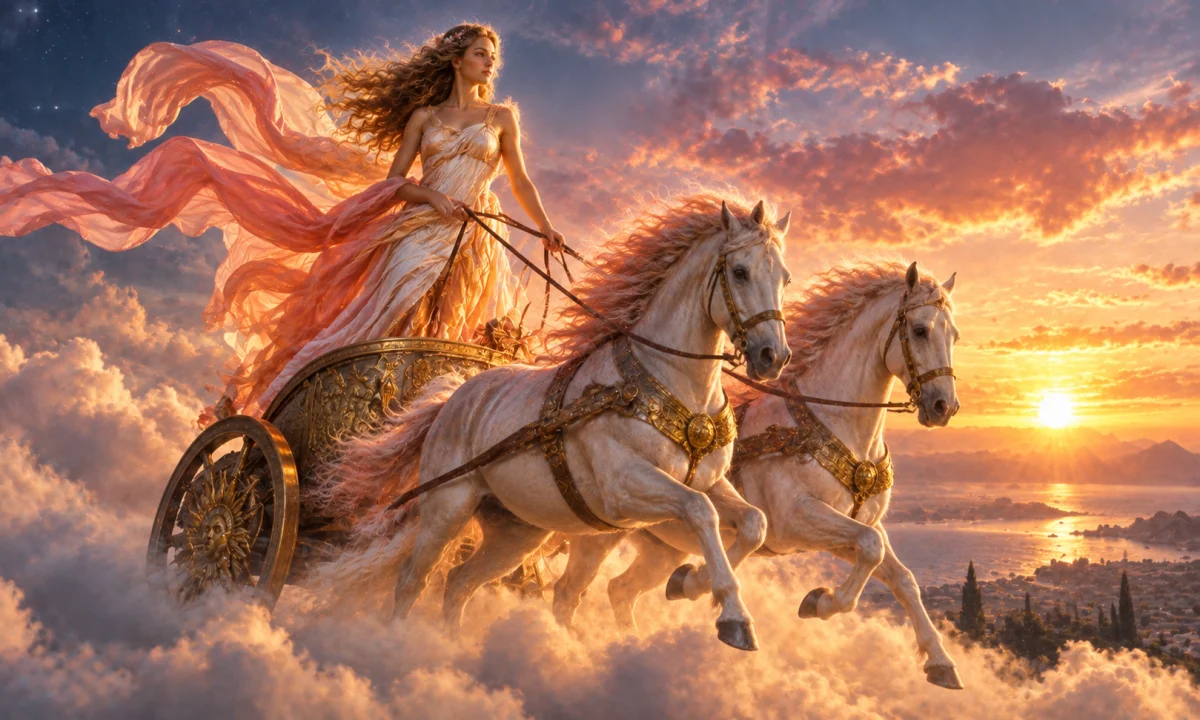
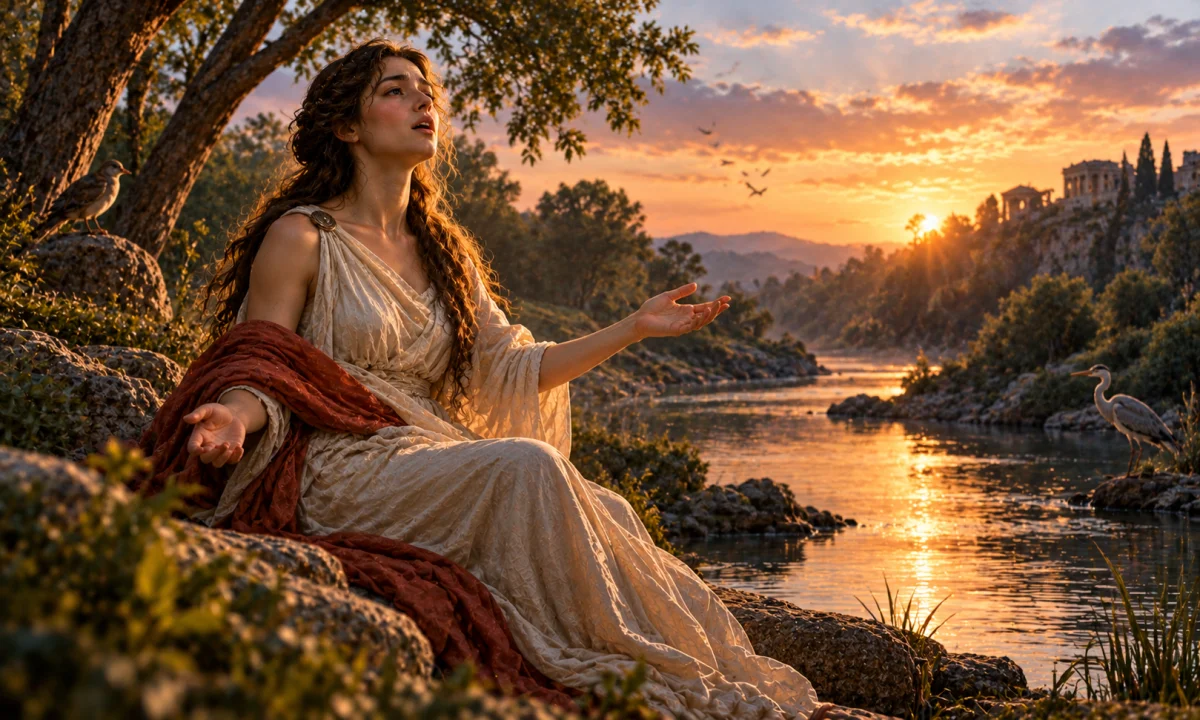
Aurora is the Roman goddess and poetic personification of the dawn. Each morning she brings light to the eastern horizon, opening the way for the sun and marking the transition between night and day. Her name is also the ordinary Latin word for “dawn,” so Roman writers could use aurora either for the natural phenomenon or for the divine figure imagined as causing it.
Origins and cultural setting
Aurora belongs to the Roman religious and literary understanding of the sky, time and daily renewal. She was not usually treated as one of Rome’s most prominent state deities, such as Jupiter, Juno, Mars or Venus. Instead, she appears especially often in poetry, where natural events are represented as divine actions. The rising dawn could therefore be described as a goddess leaving her chamber, opening the gates of heaven, spreading rosy light or driving a chariot across the sky.
Roman religion did not possess a single authoritative mythology that fixed every god’s family, appearance and story. Traditions developed through ritual practice, older Italian beliefs, Greek influence and the work of individual poets. As a result, Aurora’s identity is relatively consistent in her central function—she is the dawn—but her genealogy and relationships vary according to the source.
The most familiar Roman accounts come from poets including Virgil and Ovid. Their works draw heavily on Greek myth while adapting Greek figures and stories for Latin audiences. Aurora is the Roman counterpart of the Greek goddess Eos. The two figures share the same sphere of influence and many of the same myths, although the details in Roman literature are not always identical to those found in Greek sources.
The name Aurora and the dawn tradition
The Latin name Aurora is connected with words for dawn in several Indo-European languages. The Greek name Eos, the Vedic Sanskrit Ushas and other related terms are commonly discussed by scholars as expressions of an ancient inherited dawn tradition. This comparison concerns language and broad religious patterns; it does not prove that every story associated with Aurora existed unchanged in a prehistoric religion.
Dawn deities are often portrayed as young, beautiful and radiant because dawn itself appears as a moment of colour and transformation. In Roman poetry, Aurora may be described with rosy, golden or saffron imagery. These colours reflect conventional poetic language rather than a fixed official costume. The goddess is the visible personification of the first light, not simply a sun goddess under another name.
Aurora is therefore distinct from Sol, the Roman sun god. Sol governs or embodies the sun and its journey across the sky, while Aurora precedes the sun and announces its arrival. Roman poets sometimes place the two figures within the same celestial family or sequence, but their functions remain different. Aurora is the opening of the day; Sol is the sun’s presence and movement through it.
Appearance and attributes
Descriptions of Aurora are mainly poetic rather than archaeological. She is commonly imagined as a luminous woman with bright or rosy clothing, moving rapidly through the sky. She may travel in a chariot, although this image is not represented with the same consistency in every Roman text. Her role is often conveyed through motion: she rises, opens gates, spreads light, scatters darkness and awakens the world.
Roman poets also connect her with dew, birdsong, sleep’s ending and the beginning of human activity. These associations arise naturally from the experience of dawn, but they should not be mistaken for evidence of a fixed set of religious powers. Aurora was not, in every context, a goddess of all beginnings or a universal protector of travellers. Her principal domain was the daily arrival of light.
Her beauty is important in myth, particularly in stories inherited from Eos. Dawn is attractive but also fleeting: it appears, transforms the landscape and quickly gives way to the full day. This temporary quality helps explain why dawn goddesses in Greek and Roman poetry are sometimes portrayed as passionate, restless or involved in love affairs.
Aurora in Roman literature
There is no surviving Roman sacred narrative devoted exclusively to Aurora. Instead, she appears in many descriptions of morning and in retellings of myths connected with her Greek counterpart. A Roman poet may invoke Aurora simply to establish the time of day, while another may treat her as an active goddess with desires and relationships.
Virgil frequently uses dawn imagery in the Aeneid. The arrival of morning can signal the start of a journey, a battle, a meeting or a change in the emotional atmosphere of a scene. Such passages demonstrate how Roman poetry personified the natural world, but they do not necessarily describe a separate cult story or ritual performed for Aurora.
Ovid gives Aurora a more recognisable mythological personality in the Metamorphoses and other works. His treatment is often playful, literary and shaped by earlier Greek traditions. Ovid’s gods can behave like characters in an intricate story, but his version should not be treated as a complete statement of Roman religious belief. The relationship between poetic mythology and public worship was flexible and sometimes indirect.
Stories associated with Aurora
Aurora and Tithonus
The best-known story associated with the dawn goddess is the tale of Tithonus. In its oldest well-known forms, Tithonus is a mortal loved by Eos, the Greek dawn goddess. She asks Zeus to grant him immortality, but fails to request eternal youth. Tithonus therefore continues to age without dying.
This myth expresses a sharp contrast between the recurring renewal of dawn and the irreversible ageing of human beings. Aurora returns every morning, while Tithonus is trapped in a body that grows weaker. Some later versions describe him becoming a tiny, incessantly chirping creature, usually identified as a cicada. The details vary, and the transformation is not equally prominent in all versions.
Roman poets inherited the story and used it as a powerful example of a badly framed wish. The myth also provides a connection between Aurora and the eastern edge of the known world, since Tithonus is often associated with lands beyond the Aegean and with royal or heroic traditions linked to Troy. The story belongs originally to the Greek mythic sphere, even when Roman authors retell it using the name Aurora.
Aurora and Memnon
Aurora is also associated with Memnon, the heroic king of Ethiopia who fights for Troy and is killed by Achilles in traditions surrounding the Trojan War. In Greek myth, Eos is Memnon’s mother. After his death, she mourns him and asks Zeus to grant him special honour or a form of immortality.
Roman writers preserve and adapt this relationship. Aurora’s grief for Memnon gives the dawn a maternal and emotional dimension: the light of morning can be imagined as the goddess’s continuing response to the death of her son. Later artistic and literary traditions sometimes connect her tears with morning dew, although this is a poetic interpretation rather than a universal feature of Roman religion.
The Memnon story also became connected with the so-called Memnon statues in Egypt, monumental images that Greek and Roman visitors associated with the legendary king. Their sounds at sunrise were interpreted in antiquity as a greeting to Aurora or Eos. That interpretation belonged to ancient travel lore and religious imagination; it does not establish that the monuments were originally made as statues of the dawn goddess or of the Homeric hero.
Aurora and Cephalus
Another story links Aurora with Cephalus, a Greek hero married to Procris. In the tradition retold by Ovid, Aurora desires Cephalus and carries him away or attempts to win his affection. Cephalus remains devoted to Procris, and the episode becomes part of a larger tragedy involving jealousy, suspicion and accidental death.
This narrative is not a uniquely Roman creation. It belongs to a wider Greek mythic tradition that Roman poets reshaped. In Ovid’s version, Aurora’s role highlights the dangerous power of desire and the instability of human relationships. She is not simply a benevolent bringer of morning; like many divine figures in classical mythology, she can become involved in conflicts caused by love, pride and deception.
Family relationships and changing genealogies
Aurora’s family relationships are not fixed across Roman sources. Because Roman poets identified her with Eos, they could also transfer Greek genealogies to her. In Greek tradition, Eos is commonly the daughter of the Titans Hyperion and Theia and the sister of Helios, the sun, and Selene, the moon. Roman authors may use equivalent family arrangements, but they do not always present them as a formal, universally accepted theology.
Her children and lovers likewise vary. Tithonus and Memnon are the most important relationships associated with her. The winds, stars or other celestial beings may be connected with the dawn goddess in Greek genealogical systems, but these links should not automatically be treated as standard Roman beliefs. Classical poets frequently rearranged divine family trees to suit a poem’s theme, genealogy or rhetorical purpose.
For this reason, descriptions of Aurora should distinguish between her stable identity as dawn and the less stable myths attached to her. Her daily function is broadly consistent. Her ancestry, offspring and romantic relationships depend more strongly on the literary tradition being followed.
Aurora and Roman religious practice
Aurora’s presence in Roman literature does not by itself demonstrate a major public cult. Surviving evidence gives her less prominence as an independently organized deity than figures such as Juno, Minerva, Venus or Vesta. Romans could refer to the dawn as a divine power without maintaining a large body of rituals or temples dedicated specifically to Aurora.
She should also be distinguished from Mater Matuta, an important Italian and Roman goddess honoured at the Matralia festival. Mater Matuta is sometimes described in modern summaries as a dawn goddess because her name and functions have associations with morning, beginnings and the first light. However, she is not simply another name for Aurora. Her cult had its own ritual setting, social meanings and mythology, particularly involving mothers, children and protection.
The association between dawn and renewal made Aurora a useful figure in Roman religious language. Morning could represent a fresh beginning after darkness, the proper start of work or travel, and the restoration of order after night. Yet there is no need to assign her every symbolic meaning attached to dawn in later interpretation. The surviving evidence supports a central role as a celestial personification, while more elaborate claims require caution.
Symbolism and interpretation
Aurora embodies the boundary between two conditions. She is neither night nor full day, but the transition that connects them. This makes her an image of change, awakening and expectation. The dawn does not merely illuminate the world; it reveals what was hidden during darkness and prepares the way for action.
Her recurring appearance also creates a contrast between cosmic repetition and mortal limitation. The goddess returns endlessly, while humans age, suffer and die. The story of Tithonus makes this contrast explicit, and the mourning of Memnon gives it a personal and emotional form.
At the same time, Aurora’s beauty can be unsettling. In myths involving Tithonus and Cephalus, the dawn goddess’s desire disrupts mortal lives. Classical mythology often treats divine attraction as powerful rather than harmless. A goddess associated with renewal may still bring loss, separation or irreversible change.
In Roman poetry, Aurora can also mark narrative rhythm. Her arrival closes a night of grief, follows a night of passion or announces a coming battle. Because she appears at the beginning of each day, poets use her to move characters from reflection into action. She is both a mythological figure and a literary device rooted in a familiar natural event.
Distinguishing Aurora from similar figures
- Eos: The Greek dawn goddess and Aurora’s principal counterpart. Greek myths about Tithonus, Memnon and Cephalus may appear in Roman form with the name Aurora.
- Sol: The Roman sun god. Sol represents the sun itself and its course, whereas Aurora announces the sun’s coming.
- Luna: The Roman moon goddess, associated with night and the moon rather than the first light of morning.
- Mater Matuta: An Italian and Roman goddess with associations that can overlap with dawn and renewal, but a distinct cult and identity from Aurora.
- Aurora borealis: The modern scientific name for the northern lights. It uses the Latin name because of the lights’ appearance, not because the phenomenon is a surviving act of the Roman goddess.
Later reception
The name Aurora continued to be used in European poetry, painting and music as a symbol of morning, beauty and renewal. Artists often borrowed the Roman or Greco-Roman image of a radiant woman emerging at dawn, even when their work was more allegorical than religious. In these settings, Aurora may represent hope, rebirth or the arrival of a new age rather than a deity worshipped according to ancient Roman practice.
Modern popular culture also uses Aurora as a personal name and as a general symbol of light. Characters named Aurora do not necessarily represent the Roman goddess. The princess in modern adaptations of Sleeping Beauty, for example, is a fictional character whose name reflects the wider cultural appeal of “Aurora,” not a retelling of the goddess’s myths. The ancient figure remains specifically the personified dawn: radiant, recurring and poised between the darkness of night and the full light of day.