WORLD
WORLD
Ananke
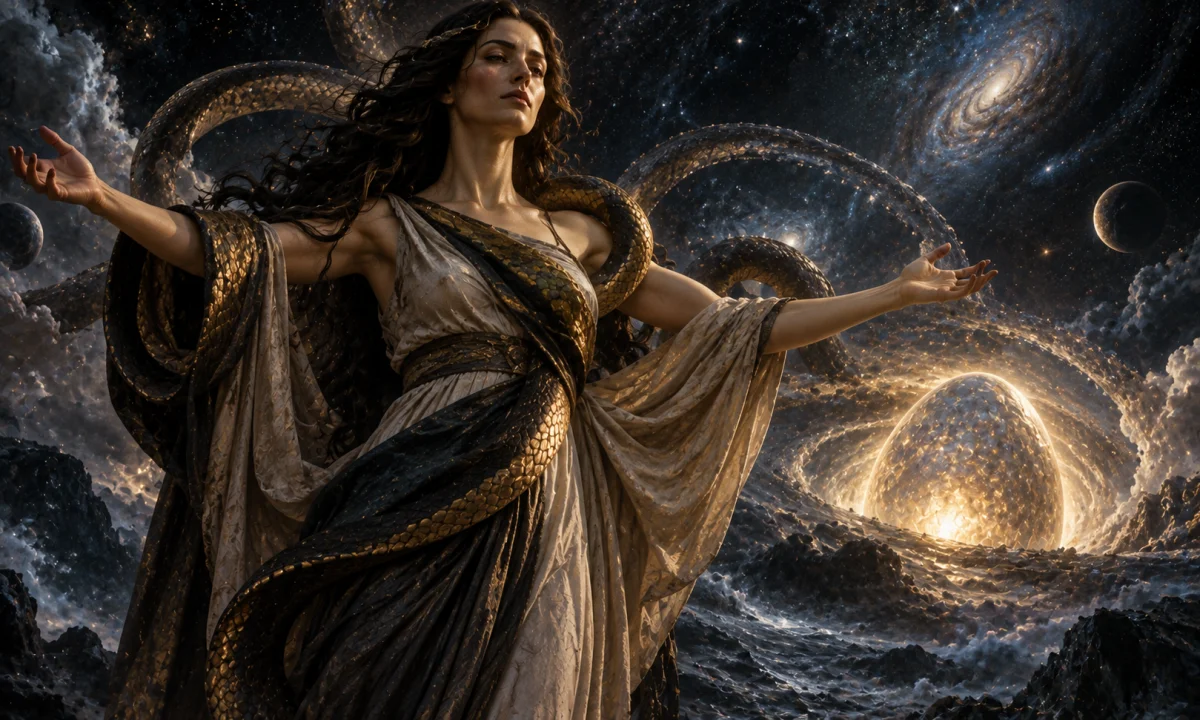
Ananke is the Greek personification of necessity, compulsion and the forces that cannot be avoided. Her name, written Ἀνάγκη in Greek and often transliterated as Anankē, can refer either to an abstract condition—something that must happen—or to a powerful cosmic being. She is especially important in Platonic philosophy and Orphic cosmology, although the surviving traditions do not present one single, universally agreed account of her identity.
Meaning and cultural setting
The Greek noun anankē means “necessity,” “constraint,” “compulsion” or “what must be.” It could describe a practical need, political coercion, divine compulsion or an unavoidable law of existence. Greek writers did not always use the word as the name of a goddess. In many passages, anankē remains an ordinary abstract noun or a philosophical concept.
When necessity is personified, however, it becomes a power greater than individual choice. Ananke represents the limits within which gods, humans and the cosmos must operate. She is not primarily a goddess of a particular natural phenomenon, city or human activity. Instead, she expresses the inescapable conditions that make events occur as they do.
This idea belongs to a wider feature of Greek religious and philosophical thought. Abstract forces such as Justice, Strife, Persuasion, Victory and Fate could be described in personal or divine terms without always having a consistent mythology or an established cult. Such figures occupied a space between theology, poetry and philosophical speculation.
Origins and surviving traditions
Ananke does not appear as a central character in the surviving poems of Homer or in Hesiod’s Theogony. Her importance comes chiefly from later philosophical and cosmological traditions, particularly Plato and texts associated with Orphism. These sources were composed or compiled over different periods and do not agree on every detail.
The earliest important literary appearance of personified Necessity is found in Plato’s Republic. At the end of the dialogue, Plato presents the Myth of Er, a vision of the structure of the cosmos and the fate of souls after death. At its centre stands the spindle of Necessity, the great cosmic mechanism that orders the heavenly spheres.
Plato’s presentation is philosophical rather than a straightforward account of popular cult. Ananke is described as a vast cosmic power, and the three Fates—Lachesis, Clotho and Atropos—are her daughters. They sit with her and sing as the celestial order turns. The myth uses familiar divine imagery to explore the relationship between cosmic order, destiny and moral responsibility.
Ananke also appears in Orphic cosmological traditions. These traditions were attributed to the mythical singer Orpheus and circulated in several forms from antiquity into late antiquity. They were never a single, uniform scripture with one universally accepted theology. In some Orphic accounts, Ananke is associated with Chronos, or Time, at the beginning of the cosmos. Together they may be imagined as primordial forces surrounding or shaping the cosmic egg from which the first divine being emerges.
Details vary considerably among Orphic sources. Some accounts describe Ananke and Chronos as serpentine or serpent-like cosmic powers; others focus more on their conceptual roles than on a stable physical appearance. The cosmic egg, the emergence of Phanes and the relationships among Time, Necessity and other primordial beings are not preserved in one complete ancient narrative. Statements about their genealogy therefore need to be treated as descriptions of particular Orphic variants, not as universal Greek mythology.
Identity and classification
Ananke can be classified in several different ways, depending on the source:
- As an abstract personification of necessity and compulsion.
- As a cosmic power involved in the ordering or origin of the universe.
- As a mother of the Fates in Platonic and some Orphic contexts.
- As a figure associated with Time, especially in Orphic cosmology.
- As a divine force that limits the freedom of gods, humans and the natural world.
These classifications should not be collapsed into one fixed biography. Greek mythology often preserved overlapping traditions rather than a single official genealogy. Ananke may be treated as a goddess in one text, a metaphysical principle in another and a poetic personification in a third.
Her name is feminine in Greek, as are many names for abstract qualities, but grammatical gender alone does not establish a distinct cult or a consistent anthropomorphic identity. Nor does every philosophical use of “necessity” imply belief in a goddess named Ananke.
Ananke in Plato’s Myth of Er
Plato’s Myth of Er provides the most influential ancient image of Ananke. After death, souls are judged and eventually come to a place where they must choose their next lives. Before them is the cosmic spindle of Necessity. Its whorl and nested circles represent the ordered movements of the heavens.
Ananke is not presented as a character who casually interferes in human affairs. She embodies the structure within which the universe operates. The Fates sit beside her, each governing a different aspect of temporal or destinational order. Lachesis is associated with what has already been allotted, Clotho with the present turning of the cosmic order and Atropos with what cannot be altered. These associations are connected with the meaning of their names and their traditional functions, although Plato’s account gives them a distinctive philosophical setting.
In the myth, souls choose their lives, but their choices are made under conditions shaped by prior experience, knowledge and ignorance. Once a soul has chosen, the choice becomes part of its destiny. Ananke therefore does not simply mean that every action is mechanically predetermined. Plato uses her cosmic authority to frame a difficult question: how can necessity, fate and moral responsibility exist together?
The story places responsibility on the soul. The famous warning associated with the scene is that the blame belongs to the chooser rather than to a god. Even within a universe governed by Necessity, the quality of a soul’s choice matters. Ananke supplies the unavoidable structure, while moral understanding influences how beings act within it.
Ananke and Orphic cosmology
Orphic traditions provide a more primordial image of Ananke. In several reconstructions of Orphic cosmology, Chronos creates or generates the first cosmic conditions, including Aither, Chaos and a cosmic egg. Ananke is linked with Chronos as a power present at the beginning of the ordered universe.
Their pairing is meaningful. Time determines sequence and change, while Necessity represents the laws or constraints through which cosmic events unfold. When the two are imagined together, they suggest that the universe is not merely a collection of accidental events. It is governed by powerful principles that precede the familiar Olympian gods.
Some Orphic material describes primordial beings in nonhuman or serpentine forms. Modern summaries sometimes turn this imagery into a single, definite portrait of Ananke as a serpent goddess. That is too certain. The ancient evidence is fragmentary, sources differ, and the surviving accounts do not establish one standard appearance. Serpent imagery may express cosmic continuity, generative power or the circular movement of time, but it should not be treated as Ananke’s universally fixed attribute.
In Orphic theology, the birth of the cosmos may involve Phanes, a radiant first-born deity who emerges from the cosmic egg. The precise relationship between Phanes, Chronos, Ananke and other primordial figures changes from one account to another. Ananke’s role is best understood as part of a network of cosmic principles rather than as a character with one stable family tree.
Attributes and symbolism
Ananke has no widely standardized iconography comparable to Athena’s helmet and spear or Poseidon’s trident. Ancient descriptions focus more on her function than on her physical form. The most important symbol associated with her is the spindle in Plato’s Myth of Er. The spindle represents the ordered turning of the heavens and the cosmic necessity within which mortal lives unfold.
Other images associated with Ananke are mainly conceptual:
- Cosmic rotation: the turning of the celestial spheres and the regular order of the universe.
- Chains or bonds: the force that constrains beings and prevents events from escaping their conditions.
- The cosmic egg: in Orphic traditions, the enclosed potential from which the ordered cosmos emerges.
- Serpentine forms: in some Orphic reconstructions, imagery connected with primordial cosmic powers and cyclical movement.
- The Fates: especially in Plato, the daughters whose work expresses the operation of destiny through time.
Her power is not usually described as the ability to cast spells, command storms or defeat enemies in combat. It is more fundamental than those abilities. Ananke represents the fact that certain things cannot be otherwise. Gods may be powerful, but even divine action can be portrayed as limited by necessity, fate or the structure of the cosmos.
Relationship with the Moirai
The Moirai, or Fates, are not simply alternative names for Ananke. The three Moirai are usually named Lachesis, Clotho and Atropos, and they govern the allotment or course of individual destinies. Ananke is the larger principle of necessity itself.
In Plato’s Republic, the relationship is explicitly genealogical: Ananke is the mother of the three Fates. This relationship gives the Moirai a cosmic foundation. Their work is not an isolated form of fortune-telling; it is part of the necessary order of the universe.
Other traditions may connect Ananke with fate without presenting the same family relationship. The Greek concepts of moira, heimarmenē and anankē overlap, but they are not identical in every context. Moira concerns an allotted portion or destiny. Heimarmenē can refer to a chain of causation or predetermined fate, particularly in later philosophical writing. Anankē emphasizes compulsion and what must occur.
Distinctions from related figures
Ananke and the Moirai: Ananke is necessity as a cosmic condition; the Moirai are the three figures who allot and regulate destinies. Plato presents the Fates as Ananke’s daughters, but the two concepts remain distinct.
Ananke and Tyche: Tyche is associated with fortune, chance and the unpredictable outcomes of life. Ananke represents the opposite tendency: what cannot be escaped or altered. Greek and later writers could place fortune and necessity in tension, but they are not the same goddess.
Ananke and Nemesis: Nemesis is connected with retribution, especially the correction of excessive prosperity or arrogance. Ananke does not primarily punish hubris. Her force is impersonal and structural rather than judicial.
Ananke and Adrasteia: Adrasteia means “the inescapable” and can be connected with unavoidable retribution, fate or cosmic order in different traditions. Because both figures involve inevitability, they are sometimes compared, but they do not have identical identities or myths.
Ananke and Roman Necessitas: Roman writers personified necessity as Necessitas, a figure related to the Greek concept. Roman Necessitas is not automatically the same as a Greek cult goddess with an independent mythology. The relationship is one of cultural translation and conceptual correspondence, not proof that every Greek and Roman tradition matched exactly.
Religious and philosophical significance
Ananke’s importance lies in the way she connects religious imagination with philosophical reflection. Greek thinkers repeatedly asked whether the universe was governed by divine decisions, rational order, blind fate or an unavoidable chain of causes. Personified Necessity offered a way to speak about that problem in mythic language.
In Plato, Ananke helps express the order of the cosmos and the consequences of moral choice. In Orphic material, she belongs to the deepest layer of creation, before the familiar gods and the world of human experience. In more ordinary Greek usage, the word could simply describe a pressing need or an unavoidable demand. These are related meanings, but they should not be treated as evidence of a single, organized doctrine.
There is limited evidence for a widespread independent cult of Ananke. The Greek travel writer Pausanias, writing during the Roman imperial period, reported a sanctuary at Corinth associated with Necessity and Force, and stated that people did not customarily enter it. This notice suggests that personified Necessity could have a religious presence, but it does not reveal a large mythology, a universal ritual system or a standard image of the goddess.
Later reception
Ananke continued to interest philosophers, poets and writers who explored determinism, freedom and the limits of human knowledge. Her name is particularly useful in works that treat the universe as governed by impersonal laws rather than by the personal decisions of anthropomorphic gods.
Modern fantasy, science fiction and esoteric writing sometimes portray Ananke as a primordial goddess, an embodiment of fate or a cosmic force controlling events. These portrayals may draw on Plato, Orphic cosmology or the general meaning of the Greek word, but they are modern reinterpretations. They should not be mistaken for a single ancient myth in which Ananke possesses a fixed appearance, complete biography and universally accepted set of powers.
For ancient Greek thought, Ananke is most accurately understood as the power of the unavoidable: sometimes an abstract necessity, sometimes a primordial cosmic being and, in Plato’s most famous mythic image, the mother of the Fates and the keeper of the spindle around which the ordered universe turns.